How to resolve AdBlock issue?
Refresh this page
How to resolve AdBlock issue?
Refresh this page
Lake County News,California
  • Home
    • Registration Form
  • News
    • Education
    • Veterans
    • Community
      • Obituaries
      • Letters
      • Commentary
    • Police Logs
    • Business
    • Recreation
    • Health
    • Religion
    • Legals
    • Arts & Life
    • Regional
  • Calendar
  • Contact us
    • FAQs
    • Phones, E-Mail
    • Subscribe
  • Advertise Here
  • Login
How to resolve AdBlock issue?
Refresh this page

News

Estate Planning: The new petition to determine succession to a decedent’s primary residence

Details
Written by: DENNIS FORDHAM
Published: 14 December 2024
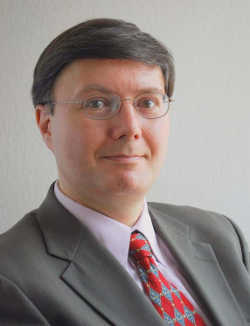
Dennis Fordham. Courtesy photo.

Under new legislation (AB 2016), for decedents dying after March 31, 2025, the successors in interest to the decedent’s primary residence, if it has an appraised date of death value under $750,000, may use a new special court petition to determine succession to a decedent's primary residence and so avoid a full-fledged probate administration.

Strangely, the decedent’s primary residence does not have to be the decedent’s residence at time of death and the key term “primary residence” is undefined.

However, this only applies if the remainder of the decedent’s estate — excluding any non-probate assets that pass automatically to death beneficiaries (e.g., joint tenancy and death beneficiary accounts) — does not exceed the probate threshold (presently $184,500 in total gross value).

When it applies, the successors in interest to the decedent’s estate can use this special petition to take title to the primary residence as co-owners, and would also use the separate affidavit procedure to take title to the decedent’s personal property and other items, including bank accounts (without death beneficiaries).

Presently, the existing petition to determine succession to real and personal property of a decedent with a small estate applies only if the total gross value of the decedent’s real and personal property (altogether) held in the decedent’s name individually does not exceed the current $184,500 threshold for a probate.

Again, the foregoing does not include assets held in a living trust, in joint tenancy, or a transfer on death assets (such as, “TOD” deeds) which each avoid probate.

Moreover, the current petition can include succession to both real and personal property and is not limited to the decedent’s “primary residence” and can include other non-primary real property.

However, as the value of most California real property well exceeds the $184,500 probate threshold the current petition has very limited application. It typically applies to vacant lots or lots associated with manufactured homes. The new petition replaces the old petition entirely.

Nevertheless, a probate is still required if the decedent’s other assets exceed the threshold for probate (presently $184,500) even if the decedent’s primary residence is under $750,000. This typically happens because the decedent also owns other real property (e.g., rentals) and/or financial assets (without pay on death or transfer on death beneficiaries).

When a probate applies, the special petition to determine succession to a decedent’s primary residence is not permissible, unless the court appointed personal representative consents to such a petition.

Also, now that the petition to determine succession to real property in a small estate is narrowly applicable only to the decedent’s primary residence alone, what happens if the decedent’s small estate also includes real property (e.g., an undeveloped lot)? The affidavit procedure for real property of small value only applies if the gross value of such real property is under $61,500.

The new laws abolish the existing petition to determine succession to real property in a small estate. Thus, when the current petition is replaced, probates may be required for small estates where the value of the decedent’s other real property (besides the primary residence) exceeds $61,500 even if such real property is part of a small estate. Clearly some follow up legislation is needed.

When there are multiple successors in interest to the decedent’s primary residence they will each have to sign as a petitioner, the same as now. If the petition is granted, the successors in interest will then co-own the primary residence. Thus, to sell the residence they will all have to agree. Otherwise, as co-owners they will want a tenants in common agreement that allocates the shared use and responsibilities associated with co-ownership.

The new law does not end the need for living trusts or transfer on death deeds. One advantage of using a living trust, or transfer on death deed, is that it does not require a court petition. Also, with a trust, one person (the trustee) is in control and the primary residence can be sold, distributed, or held in further trust as provided in the trust.

Also, a trust provides for contingency planning in the event of unforeseen circumstances. None of which is achieved by reliance on the new law.

The foregoing discussion is not legal advice. Anyone confronting such estate planning issues should consult with a qualified attorney.

Dennis A. Fordham, attorney, is a State Bar-Certified Specialist in estate planning, probate and trust law. His office is at 870 S. Main St., Lakeport, Calif. He can be reached at This email address is being protected from spambots. You need JavaScript enabled to view it. and 707-263-3235.

Space News: NASA’s crew capsule had heat shield issues during Artemis I − an aerospace expert on these critical spacecraft components

Details
Written by: Marcos Fernandez Tous, University of North Dakota
Published: 14 December 2024


Off the coast of Baja California in December 2022, sun sparkled over the rippling sea as waves sloshed around the USS Portland dock ship. Navy officials on the deck scrutinized the sky in search of a sign. The glow appeared suddenly.

A tiny spot at first, it gradually grew to a round circle falling at a great speed from the fringes of space. It was NASA’s Orion capsule, which would soon end the 25-day Artemis I mission around and beyond the Moon with a fiery splashdown into the ocean.

Orion’s reentry followed a sharply angled trajectory, during which the capsule fell at an incredible speed before deploying three red and white parachutes. As the mission finished its trip of over 270,000 miles (435,000 kilometers), it looked to those on the deck of the USS Portland like the capsule had made it home in a single piece.

As the recovery crew lifted Orion to the carrier’s deck, shock waves ruffled across the capsule’s surface. That’s when crew members started to spot big cracks on Orion’s lower surface, where the capsule’s exterior bonds to its heat shield.

The Orion spacecraft splashed down in December 2022, marking the end of the Artemis I mission.

But why wouldn’t a shield that has endured temperatures of about 5,000 degrees Fahrenheit (2,760 degrees Celsius) sustain damage? Seems only natural, right?

This mission, Artemis I, was uncrewed. But NASA’s ultimate objective is to send humans to the Moon in 2026. So, NASA needed to make sure that any damage to the capsule– even its heat shield, which is meant to take some damage – wouldn’t risk the lives of a future crew.

On Dec. 11, 2022 – the time of the Artemis I reentry – this shield took severe damage, which delayed the next two Artemis missions. While engineers are now working to prevent the same issues from happening again, the new launch date targets April 2026, and it is coming up fast.

As a professor of aerospace technology, I enjoy researching how objects interact with the atmosphere. Artemis I offers one particularly interesting case – and an argument for why having a functional heat shield is critical to a space exploration mission.

A conical spacecraft with the NASA worm logo in space, with Earth and the Moon shown in the background.
NASA’s Orion spacecraft had a view of both Earth and the Moon during the Artemis I mission. NASA via AP

Taking the heat

To understand what exactly happened to Orion, let’s rewind the story. As the capsule reentered Earth’s atmosphere, it started skimming its higher layers, which acts a bit like a trampoline and absorbs part of the approaching spacecraft’s kinetic energy. This maneuver was carefully designed to gradually decrease Orion’s velocity and reduce the heat stress on the inner layers of the shield.

After the first dive, Orion bounced back into space in a calculated maneuver, losing some of its energy before diving again. This second dive would take it to lower layers with denser air as it neared the ocean, decreasing its velocity even more.

While falling, the drag from the force of the air particles against the capsule helped reduced its velocity from about 27,000 miles per hour (43,000 kilometers per hour) down to about 20 mph (32 kph). But this slowdown came at a cost – the friction of the air was so great that temperatures on the bottom surface of the capsule facing the airflow reached 5,000 degrees Fahrenheit (2,760 degrees Celsius).

At these scorching temperatures, the air molecules started splitting and a hot blend of charged particles, called plasma, formed. This plasma radiated energy, which you could see as red and yellow inflamed air surrounding the front of the vehicle, wrapping around it backward in the shape of a candle.

No material on Earth can stand this hellish environment without being seriously damaged. So, the engineers behind these capsules designed a layer of material called a heat shield to be sacrificed through melting and evaporation, thus saving the compartment that would eventually house astronauts.

By protecting anyone who might one day be inside the capsule, the heat shield is a critical component.

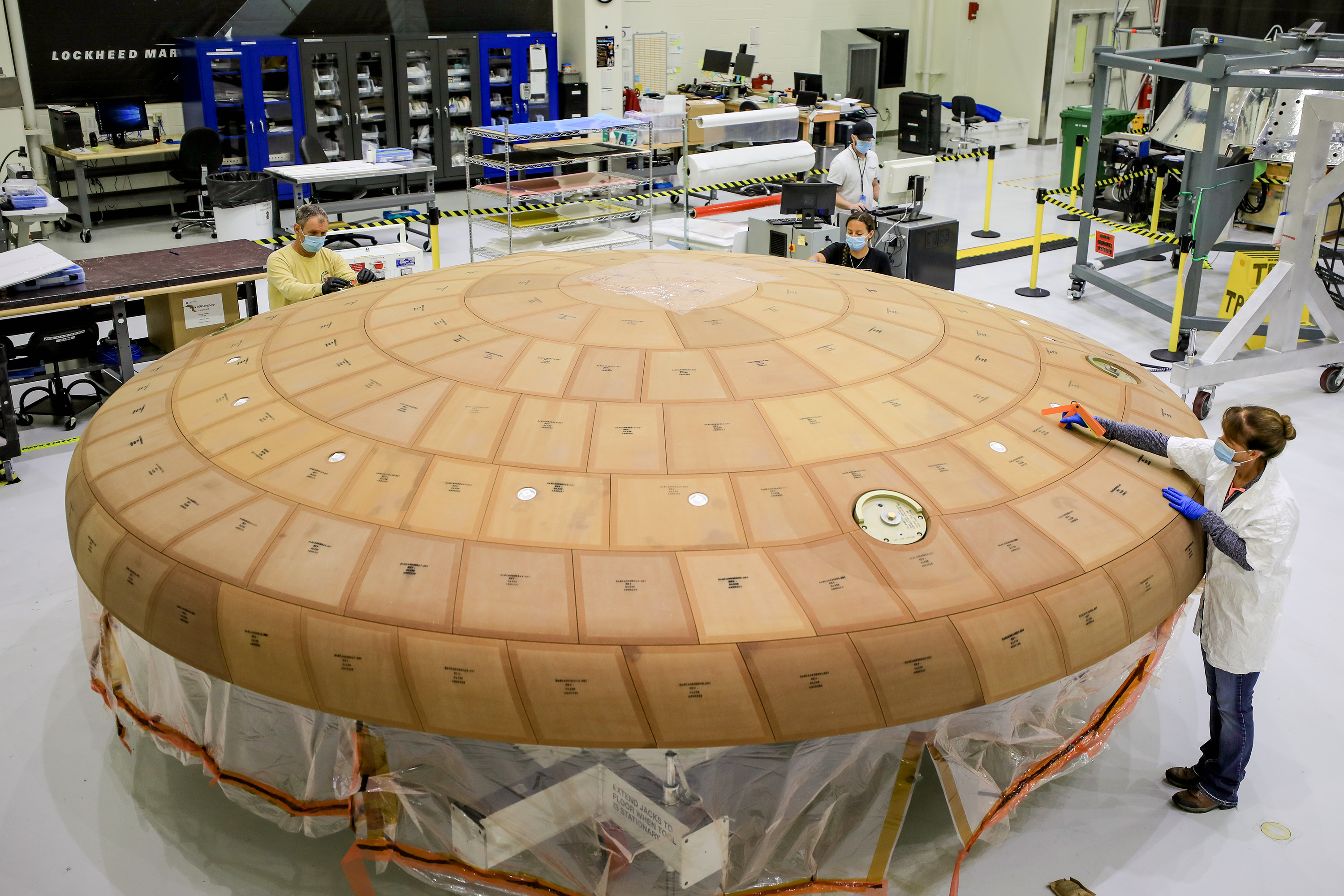
A large round shield covered in small tiles sitting in a laboratory.
The Orion heat shield is covered in tiles made of a material that will burn up when exposed to extreme heat. NASA/Isaac Watson

In the form of a shell, it is this shield that encapsulates the wide end of the spacecraft, facing the incoming airflow – the hottest part of the vehicle. It is made of a material that is designed to evaporate and absorb the energy produced by the friction of the air against the vehicle.

The case of Orion

But what really happened with Orion’s heat shield during that 2022 descent?

In the case of Orion, the heat shield material is a composite of a resin called Novolac – a relative to the Bakelite which some firearms are made of – absorbed in a honeycomb structure of fiberglass threads.

A molecule made up of atoms arranged in linked hexagons.
Novolac, the material that makes up Orion’s heat shield, is made up of atoms arranged in linked hexagons. Smokefoot/Wikimedia Commons, CC BY-SA

As the surface is exposed to the heat and airflow, the resin melts and recedes, exposing the fiberglass. The fiberglass reacts with the surrounding hot air, producing a black structure called char. This char then acts as a second heat barrier.

NASA used the same heat shield design for Orion as the Apollo capsule. But during the Apollo missions, the char structure didn’t break like it did on Orion.

After nearly two years spent analyzing samples of the charred material, NASA concluded that the Orion project team had overestimated the heat flow as the craft skimmed the atmosphere upon reentry.

As Orion approached the upper layers of the atmosphere, the shield started melting and produced gases that may have escaped through pores in the material. Then, when the capsule gained altitude again, the outer layers of the resin froze, trapping the heat from the first dive inside. This heat vaporized the resin.

When the capsule dipped into the atmosphere the second time, the gas expanded before finding a way out as it heated again – kind of like how a frozen lake thaws upward from the bottom – and its escape produced cracks in the capsule’s surface where the char structure got damaged. These were the cracks the recovery crew saw on the capsule after it splashed down.

In a Dec. 5, 2024, press conference, NASA officials announced that the Artemis II mission will be designed with a modified reentry trajectory to prevent heat from accumulating.

For Artemis III, which is planned to launch in 2027, NASA intends to use new manufacturing methods for the shield, making it more permeable. The outside of the capsule will still get very hot during reentry, and the heat shield will still evaporate. But these new methods will help keep the astronauts cozy in the capsule all the way through splashdown.

Chonglin Zhang, assistant professor of mechanical engineering at the University of North Dakota, assisted in researching this article.The Conversation

Marcos Fernandez Tous, Assistant Professor of Space Studies, University of North Dakota

This article is republished from The Conversation under a Creative Commons license. Read the original article.

Supervisors approve formation of new Lake County Hospital Improvement District

Details
Written by: Elizabeth Larson
Published: 13 December 2024
LAKE COUNTY, Calif. — The Board of Supervisors on Tuesday took action to approve the formation of the Lake County Hospital Improvement District, reported to be the first district of its kind in California.

The board voted 4-1, with Supervisor Michael Green voting no, to approve the district’s resolution of formation.

After the vote Board Chair Bruno Sabatier said it was “a first in the state of California,” adding, “Let’s see how this works out for the benefit of the community.”

Deputy County Administrative Officer Benjamin Rickelman’s written report to the board for the meeting explained that the district will be a “business-based assessment of general acute care hospitals in Lake County” — Adventist Health Clear Lake and Sutter Lakeside.

Rickelman said the hospitals petitioned the county to form the district by utilizing the Property and Business Improvement Law of 1994.

The district’s purpose is to utilize the assessment to increase the non-federal share of Medi-Cal reimbursement, which Rickelman said will then increase the federal share of Medi-Cal reimbursement at an anticipated 2:1 ratio.

Rickelman and hospital officials who presented to the board emphasized that the assessment will not be added to the cost of care for patients, but will be borne directly by the hospitals, who will assess themselves.

He said the assessment will be 6% of the hospitals’ net patient revenue, which is projected to raise $16.9 million on average per year for its initial five-year term, which will run from Jan. 1, 2025, to Dec. 31, 2029. It can then have 10-year renewals.

The district is similar in form and function to the Lake County Tourism Improvement District, which also had an initial five-year term and now is in a 10-year renewal period.

“The Hospitals plan to utilize the increase in federal Medi-Cal payment for an increase in services, which will also provide financial stability to the Hospitals. Medi-Cal reimbursement is generally lower than Medicare and private insurance. Approximately 53% of Lake County residents utilize Medi-Cal in some capacity,” Rickelman wrote.

Rickelman said the county would retain a 1% of the collected assessment to cover the district’s administration costs.

The district “will also submit an annual plan to the Board of Supervisors outlining how the increase in Medi-Cal reimbursement was utilized, a comparison of Medi-Cal charges from the Hospitals versus Sutter and Adventist hospitals systemswide, and volume of Medi-Cal services for inpatient and outpatient services,” Rickelman said.

“This is a four-step process and thankfully we are at the last step,” Rickelman told the board on Tuesday.

Those four steps included the initial resolution of intention, presented Sept. 10, at which point the board majority voted to advance it; a public meeting on Oct. 22; a public hearing on Nov. 5; and the Dec. 10 resolution of formation.

Rickelman said that, after the board approved the resolution of formation, the matter would go to the California Department of Public Health for consideration. It also will need to be reviewed by the Centers for Medicare & Medicaid Services.

Supervisor Jessica Pyska offered the resolution, with the board voting 4-1. The lone dissenter was Supervisor Michael Green, who said his no vote was to be consistent with prior votes on the issue.

The initial presentation

Hospital executives and the legal counsel for their efforts to form the district spoke to the board first on Sept. 10.

At that time, Sutter Lakeside Chief Administrative Officer Tim Stephens said forming the district was a joint action of the two hospitals, with the idea based on building sustainability in the challenging environment of rural health care.

He said they were looking at “how do we create the next 70 years of health care in the community,” Stephens said.

Chuck Kassis, Adventist Health Clear Lake’s administrator, said the two hospitals run at a deficit annually and so they need other revenue streams, which aren’t going to come from the government or a large source of commercial patients.

“We have to be creative in how we look at things and this is one way that we can do it without impacting the community,” said Kassis.

He said they will pursue dollars the state could access but doesn’t in the hopes of getting to a break even point.

Among the priorities the funding would be used for are seismic retrofits, which have to be completed by 2030, otherwise, the state could shut them down, Kassis said. In the case of Sutter Lakeside, which is in its third phase of the project, Stephens said the cost is expected to be $15 million.

In addition to seismic upgrades, both hospitals plan to work on projects such as upgrades for imaging services and community investments.

Stephens said when the hospitals are losing money and having to be supplemented by the parent company, they can’t make investments in the community.

In 2022, Sutter Lakeside lost $5.5 million in operations, said Stephens, noting that being able to sustain operations means the hospital can go into growth mode and do more for the community.

“We’re currently restricted on capital investments,” Stephens said.

Supervisor Green gave them an “A-plus for creativity” but opposed the plan because he didn’t believe the proposed district met the state guidelines. He also faulted the hospitals’ business model for lack of sustainability, and cited a lack of tangible assets and a plan for the district.

James Gjerset, a Texas-based health care attorney who appeared along with Kassis and Stephens, said that he had done many such programs across the United States, and some already are 25 years old, so he didn’t believe they would go away.

Critical access hospitals such as Adventist Health Clear Lake and Sutter Lakeside are operating “on shoestrings and mousetraps,” so the district will generate additional revenue to serve the community, Gjerset said.

Supervisor EJ Crandell, mentioning the tourism improvement district, said he saw the hospital district as similar. “I think it’s a good idea.”

“The impact to the patient will be zero. Just say that a lot,” said Supervisor Pyska, adding that with these expansions and investments, there will be a lot of benefits for patients.

Stephens noted during that conversation that the community benefit dollars Sutter spent across its system in 2023 was about $800 million.

“The amount of care that Sutter is providing that's not compensated for is enormous,” he said.

Kassis said their mission would not change, with or without the new district assessment. “These are dollars that are already there that we will be able to get back without a cost to the community.”

That’s compared to a bond — an alternative that Green had favored in his comments — in which something needs to be leveraged, Kassis said.

Pyska said she appreciated the collaboration between the hospitals. Stephens said the two hospitals have been discussing how to address other issues.

“It’s true and genuine for what we’re trying to do for the community,” Stephens said.

At that point, Kassis said he planned to return to the city of Clearlake to get its final resolution. Stephens also planned to seek a resolution from the city of Lakeport, although it’s not needed because it doesn’t have a hospital within its boundaries.

At that meeting, Green voted against the plan, which was why he chose to continue to vote against it this week.

Email Elizabeth Larson at This email address is being protected from spambots. You need JavaScript enabled to view it.. Follow her on Twitter, @ERLarson, and on Bluesky, @erlarson.bsky.social. Find Lake County News on the following platforms: Facebook, @LakeCoNews; X, @LakeCoNews; Threads, @lakeconews, and on Bluesky, @lakeconews.bsky.social.

Thompson announces bill to deliver tax relief to thousands of California wildfire victims signed

Details
Written by: LAKE COUNTY NEWS REPORTS
Published: 13 December 2024
On Thursday, Rep. Mike Thompson (D-CA-04) announced that President Biden has signed the bipartisan Federal Disaster Tax Relief Act (H.R. 5863) into law.

The bill includes Rep. Thompson’s legislation that exempts thousands of qualified wildfire victims in California from having to pay federal income tax on their settlement money or pay tax on attorney fees included in the settlement.

This relief applies retroactively to qualified victims.

“Federally declared wildfires in 2015, 2017, and 2018 devastated entire communities across my district and across the state of California. Entire towns were destroyed. Thousands of people lost homes, and dozens of people lost their lives,” said Thompson. “While the courts eventually created a path to compensation, victims were subjected to unfair taxes on their settlement money — money that is meant to help them rebuild their lives.

“In my time working on this issue, I have yet to encounter a single person on either side of the aisle who believes this is fair. Today marks the day we finish righting this wrong,” Thompson said.

“Thank you, President Biden, for signing my legislation into law. While no fire victim can ever be made truly whole, this law will provide needed and deserved relief to thousands in our community and across our country,” said Thompson.

Rep. Thompson serves as the Ranking Member of the Subcommittee on Tax for the Ways and Means Committee.

He introduced the original legislation with Rep. Doug LaMalfa (CA-01) in the House of Representatives to provide tax relief to PG&E fire victims in the 117th Congress and has worked with Senator Padilla and Rep. LaMalfa to advance the legislation.

Earlier this year, Rep. Thompson and Rep. Greg Steube (FL-17) led a bipartisan group of 218 Members of Congress to successfully advance a discharge petition which forced House Speaker Mike Johnson to bring the Federal Disaster Tax Relief Act to the House floor for a vote.

The historic advancement of Rep. Thompson and Rep. Steube’s petition marked only the third time a House discharge petition had succeeded in the 21st Century. H.R. 5863 passed the Senate earlier this month by unanimous consent.

The Federal Disaster Tax Relief Act excludes from taxpayer gross income, for income tax purposes, any amount received by an individual taxpayer as compensation for expenses or losses incurred due to a qualified wildfire disaster (a federally declared disaster declared after 2014 as a result of a forest or range fire).

It also excludes relief payments for losses resulting from the East Palestine, Ohio, train derailment on Feb. 3, 2023 and designates Hurricane Ian, among other federally declared disasters, as a qualified disaster for the purposes of determining the tax treatment of certain disaster-related personal casualty losses.

Thompson represents California’s Fourth Congressional District, which includes all or part of Lake, Napa, Solano, Sonoma and Yolo counties.
  1. Clearlake Animal Control: ‘Shayla’ and the dogs
  2. Why winter makes you more vulnerable to colds – a public health nurse explains the science behind the season
  3. Steady rain and wind in weekend and early week forecast
  • 450
  • 451
  • 452
  • 453
  • 454
  • 455
  • 456
  • 457
  • 458
  • 459
How to resolve AdBlock issue?
Refresh this page