How to resolve AdBlock issue?
Refresh this page
How to resolve AdBlock issue?
Refresh this page
Lake County News,California
  • Home
    • Registration Form
  • News
    • Education
    • Veterans
    • Community
      • Obituaries
      • Letters
      • Commentary
    • Police Logs
    • Business
    • Recreation
    • Health
    • Religion
    • Legals
    • Arts & Life
    • Regional
  • Calendar
  • Contact us
    • FAQs
    • Phones, E-Mail
    • Subscribe
  • Advertise Here
  • Login
How to resolve AdBlock issue?
Refresh this page

News

Technology is supposed to decrease teacher burnout – but we found it can sometimes make it worse

Details
Written by: David T. Marshall, Auburn University; Teanna Moore, University of Kansas, and Timothy Pressley, Christopher Newport University
Published: 10 January 2025


Asking teachers to adopt new tools without removing old requirements is a recipe for burnout. Drazen Zigic via Getty Images

When we set out to study pandemic-related changes in schools, we thought we’d find that learning management systems that rely on technology to improve teaching would make educators’ jobs easier. Instead, we found that teachers whose schools were using learning management systems had higher rates of burnout.

Our findings were based on a survey of 779 U.S. teachers conducted in May 2022, along with subsequent focus groups that took place in the fall of that year. Our study was peer-reviewed and published in April 2024.

During the COVID-19 pandemic, when schools across the country were under lockdown orders, schools adopted new technologies to facilitate remote learning during the crisis. These technologies included learning management systems, which are online platforms that help educators organize and keep track of their coursework.

We were puzzled to find that teachers who used a learning management system such as Canvas or Schoology reported higher levels of burnout. Ideally, these tools should have simplified their jobs. We also thought these systems would improve teachers’ ability to organize documents and assignments, mainly because they would house everything digitally, and thus, reduce the need to print documents or bring piles of student work home to grade.

But in the follow-up focus groups we conducted, the data told a different story. Instead of being used to replace old ways of completing tasks, the learning management systems were simply another thing on teachers’ plates.

A telling example was seen in lesson planning. Before the pandemic, teachers typically submitted hard copies of lesson plans to administrators. However, once school systems introduced learning management systems, some teachers were expected to not only continue submitting paper plans but to also upload digital versions to the learning management system using a completely different format.

Asking teachers to adopt new tools without removing old requirements is a recipe for burnout.

Teachers who taught early elementary grades had the most complaints about learning management systems because the systems did not align with where their students were at. A kindergarten teacher from Las Vegas shared, “Now granted my kids cannot really count to 10 when they first come in, but they have to learn a six digit student number” to access Canvas. “I definitely agree that … it does lead to burnout.”

In addition to technology-related concerns, teachers identified other factors such as administrative support, teacher autonomy and mental health as predictors of burnout.

Why it matters

Teacher burnout has been a persistent issue in education, and one that became especially pronounced during and after the COVID-19 pandemic.

If new technology is being adopted to help teachers do their jobs, then school leaders need to make sure it will not add extra work for them. If it adds to or increases teachers’ workloads, then adding technology increases the likelihood that a teacher will burn out. This likely compels more teachers to leave the field.

Schools that implement new technologies should make sure that they are streamlining the job of being a teacher by offsetting other tasks, and not simply adding more work to their load.

The broader lesson from this study is that teacher well-being should be a primary focus with the implementation of schoolwide changes.

What’s next

We believe our research is relevant for not only learning management systems but for other new technologies, including emerging artificial intelligence tools. We believe future research should identify schools and districts that effectively integrate new technologies and learn from their successes.

The Research Brief is a short take on interesting academic work.The Conversation

David T. Marshall, Associate Professor of Educational Research, Auburn University; Teanna Moore, Associate Researcher at Accessible Teaching, Learning and Assessment Systems, University of Kansas, and Timothy Pressley, Associate Professor of Psychology, Christopher Newport University

This article is republished from The Conversation under a Creative Commons license. Read the original article.
Dedication of ‘Water Baskets’ art project planned for Jan. 12

Details
Written by: LAKE COUNTY NEWS REPORTS
Published: 09 January 2025


This story has been updated.

MIDDLETOWN, Calif. — The public is invited to attend the “Water Baskets” project dedication and celebratory public reception on Sunday, Jan. 12, from 3:30 to 5 p.m.

It will be held at the Middletown Art Center, or MAC, 21456 State Highway 175 at the junction of Highway 29 in Middletown.

The event is free to the public and refreshments will be available.

Tribal and civic leaders as well the artists will be present. The public is also invited to weave a small chi or hitch from tule to contribute to the piece “Calling the Chi - Hitch” at the Reciprocity EcoArts Sculpture Walk.

Community members wishing to walk up to the Water Baskets on Rabbit Hill are encouraged to do so following opening remarks by Middletown Rancheria Tribal Chair Moke Simon, Lake County’s Assembly member Cecilia Aguiar-Curry, and other speakers.

The Water Baskets will be particularly spectacular at 4:30 or 5 p.m. following the reception, during the golden hour, sunset or dusk.

“The Water Basket project represents true collaboration between our Middletown Rancheria Tribal Nation, the Middletown Art Center, Callayomi County Water District and our local community,” said Tribal Chairman Moke Simon. “Water is life. And as the first people of this land we are honored to be a part of this historic project.”

The project honors the cultural legacy of the original stewards of this land, and the Indigenous flora and fauna of the Middletown area. It also reflects the unification, regeneration, and revitalization of the Middletown community as a whole, after the 2015 Valley Fire.

The selection process for the Water Basket designs was comprehensive and inclusive. It followed a call for proposals for 360° designs inspired by Pomo basketry design patterns. Pomo Baskets are renowned worldwide for excellence in aesthetics, craftsmanship, durability, and form and function. Several workshops, led by Pomo artists, were held to increase artists’ and the public’s awareness about the distinct design patterns and plant materials used in Pomo basketry and their relationship to this region’s ecology.

After careful consideration of over 20 designs, a jury of 14 diverse local stakeholders chose six designs to present to the public. Models were on view for voting for three full weeks at three locations. The designs now seen on Rabbit Hill are a reflection of the public’s choice.

“Tsúkli - To Shine Forth” by Trelasa Baratta, graces the larger tank.

“I come from the Chappo and Knight families of Middletown Rancheria,” Baratta said. “My design incorporates personal variations of common Pomo basketry patterns. It is dedicated to our ancestors, whose lives embodied Native survival and resilience, and a resolute commitment to preserving our culture.”

“Echoes of the Land,” which graces the smaller tank is by Lorraine Triana Rueda, a local artist originally from Colombia. “This mural tells a story of unity, respect, and shared harmony,” Lorraine shared. “It connects the community’s rich heritage with the natural beauty of the Middletown area’s land and wildlife, honoring the traditions, ancestral knowledge, and the people.”

The Water Basket project is funded in part by an award from the National Endowment for the Arts, with additional funding from the Middletown Rancheria, the Callayomi County Water District, MAC, Calpine at The Geysers and Lake County Tribal Health Consortium. The project was initiated and produced by MAC.

Middletown Art Center is a Lake County non-profit dedicated to engaging the public in art making, education and appreciation. Through exhibitions, performances, workshops, and community events, the Art Center provides a platform for diverse voices and perspectives, striving to create an inclusive and accessible space for all.

To learn more or to donate to support cultural and other arts programs at MAC please visit middletownartcenter.org or call 707-809-8118. The MAC is located at 21456 State Highway 175 in Middletown.

New 2024 population estimates show nation’s population grew by about 1% to 340.1 million since 2023

Details
Written by: Kristie Wilder
Published: 09 January 2025


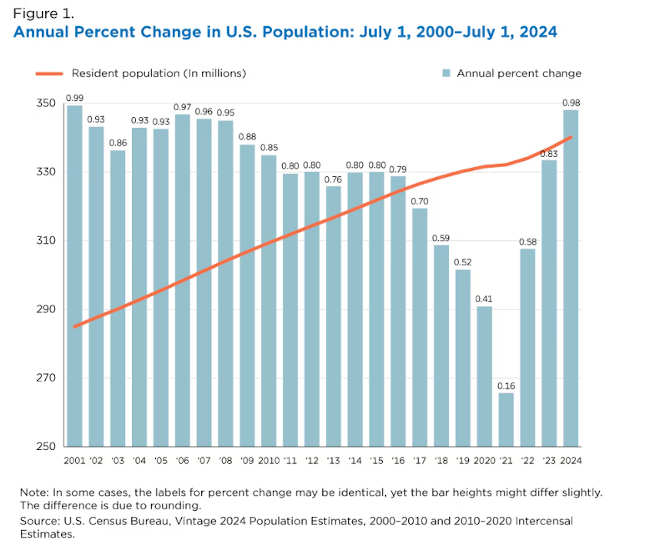
Following historically low growth at the height of the COVID-19 pandemic, the U.S. population grew substantially by almost 1% since 2023, outpacing average annual growth since 2000 and signaling a significant turnaround from the meager population gains at the start of this decade.

The U.S. Census Bureau released July 1, 2024, population estimates for the nation and states. The U.S. population reached 340.1 million, up 0.98% from 336.8 million on July 1, 2023 — the highest year-over-year increase since a jump of 0.99% between 2000 and 2001.

Population trends since 2000

Since 2000, the nation has grown by almost 58 million, with an average annual growth rate of approximately 0.8%. The most robust growth occurred between 2001 and 2008, fueled by changing migration trends and higher birth rates.

However, population trends have fluctuated over the past two decades, reflecting how major world and national events can influence population growth.

For instance, national security concerns immediately following 9/11 resulted in fewer migrants, slightly tempering population growth between 2001 and 2003.

Similarly, the financial crisis which started in 2008, dubbed “The Great Recession,” impacted both fertility and immigration in the United States. Between 2008 and 2009, births dipped by nearly 3% and net international migration fell almost 12%.

By the early 2010s, the pace of U.S. growth had begun to slow down. After a slight uptick in 2014-2015, population growth slowed again and 2016 ushered a new period of sluggish growth brought on by declining net international migration and falling birth rates (Figure 1).

That marked the start of a prolonged period of below-average growth.


COVID-19 pandemic and recovery

At the start of the 2020s, the COVID-19 pandemic slowed the nation’s population growth further.

A national emergency declaration resulted in travel restrictions, temporarily limiting entry. Also during this time, the number of deaths surged and births declined. This combination resulted in the United States experiencing the slowest period of growth on record in 2021 — as the population increased by just 0.16% — underscoring the pandemic’s effect on the population.

When the nation recovered from the pandemic, its population growth did as well, more than doubling from 2021 to 2022.

As travel restrictions started to ease and migration increased, the pace of growth quickened. A slight rise in births and decrease in the number of deaths supported the turnaround.

By 2024, after three consecutive years of population growth exceeding 0.5%, the United States seems to have recovered from pandemic-era lows.

What influences population change?

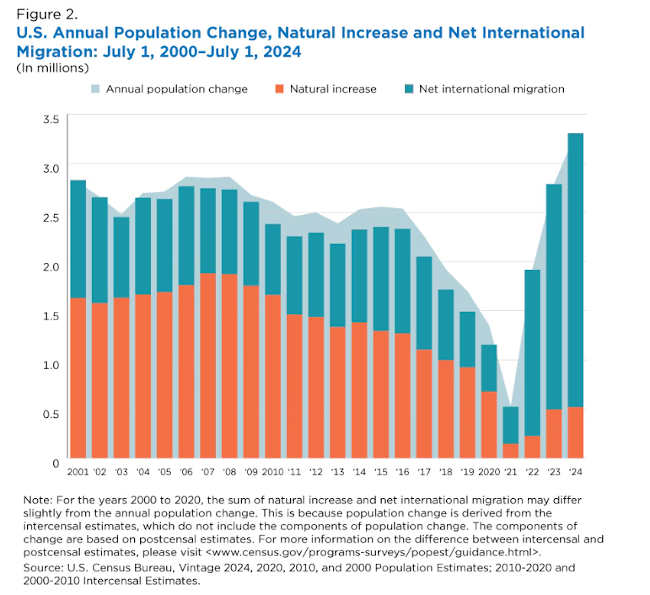
Natural increase (births minus deaths) and net international migration (immigration minus emigration) are the major influences on population growth, but their relative contributions to growth have changed over time (Figure 2).

Natural increase has historically been the cornerstone of U.S. population growth. Yet, in recent years, its contribution has dwindled due to fewer births and more deaths. The aging of the population is fueled by the large number of Baby Boomers born between 1946 and 1964 entering high mortality ages.

There was a brief uptick in births from 2021 to 2022, but rates returned to their downward trend in 2023.

In contrast, net international migration’s influence on population trends has increased over the last few years.

Since 2021, it accounted for the majority of the nation’s growth — departure from the last two decades, when natural increase was the main factor.

Kristie Wilder is a demographer in the U.S. Census Bureau’s Population Estimates Branch.
`

New study shows California’s educators ‘stretched thin’ due to financial pressures; four in 10 thinking of leaving the profession

Details
Written by: LAKE COUNTY NEWS REPORTS
Published: 09 January 2025
While 77 percent of California teachers find their jobs rewarding, four in 10 are thinking about leaving the profession due to a lack of resources at school and financial pressures at home, according to a new report released Wednesday by the California Teachers Association.

Conducted by GBAO Strategies, the “State of California's Public Schools” surveyed more than 2,000 transitional kindergarten to 12th grade public school educators across the state this school year, providing new insight about the increasing difficulty of recruiting and retaining California teachers.

“Too many educators are spread thin and can’t make ends meet,” CTA President David Goldberg said during a news conference held Tuesday. “For more than 46 years, schools have been operating in a deficit in large part due to the passage of Proposition 13. This created a shift away from investing in our schools and into profits for corporations.”

Goldberg highlighted some of the report’s findings:

• 84 percent of teachers surveyed cannot afford to live near their schools.
• 81 percent say their salaries are not keeping up with rising costs for groceries, childcare and other necessary expenses.
• 80 percent have concerns that they would not be able to cover an unexpected cost.
• 69 percent cite high, out-of-pocket costs for often inadequate health care benefits eating into their paychecks.

Carolina Gomez, a transitional kindergarten, or TK, teacher in San Diego and a single parent with five children, had a nearly impossible time finding affordable housing in one of California’ most expensive housing markets. At one point, she found it necessary to commute daily from across the border in Mexico to put a roof over her family's heads.

“I’m very grateful to have a union,” said Gomez, who participated in the CTA news conference. “My union helped me obtain affordable housing. I was fortunate. Across the state, many teachers are struggling to find a place — any place — for their families to live.”

Not only are educators struggling to find housing and pay rent, 91 percent of those who do rent say that they can’t afford to buy a home, according to the report.

Goldberg said the popular perception is that California public school teachers have generous health care benefits, but the reality is that some teachers pay as much as $1,500 per month in out-of-pocket costs.

Sacramento-area TK teacher Kristina Caswell said these exorbitant health care costs, in addition to rising housing and daycare expenses, have tightened her family budget to the point where she “thinks twice before paying for a prescription.” While she enjoys her job and loves her students and families, Caswell said the financial pressures are difficult to navigate.

Despite the financial impacts, Caswell routinely reaches into her own pocket to purchase supplies, food and other items for her classroom and students — and she’s not alone: 93 percent of educators surveyed reported routinely spending their own money to help and support their students.

The report also shows a number of alarming concerns educators have about California public schools:

• 84 percent of educators surveyed said inadequate resources for students provided by the state and school districts were a major concern, while the same number (84 percent) cited a lack of school funding.
• 68 percent specifically mentioned a lack of support for mental health issues. The report notes that California is failing at providing students with access to school counselors, with the state ranking 48th nationally for these crucial supports.
• 76 percent said overcrowded classes and a lack of staffing was a serious issue, with California ranking in the top 5 states with the largest average class sizes in the country.

“State of California's Public Schools” details the stark realities for new and veteran educators at both home and school that are causing dedicated teachers to consider leaving education.

The situation is even more dire for new educators, with one in three thinking about leaving and 92 percent citing financial reasons as the primary reason. This is compounding the ongoing teacher shortage crisis, which currently sees more than 10,000 teacher vacancies statewide.

Goldberg concluded the conference stating CTA's commitment to fighting for robust and stable revenue for public schools in the years to come: “California’s students, schools and communities deserve a more stable and robust funding system to support an equitable education system for all. This includes creative revenue-raising solutions that apply the great wealth of this state to our educational system.”
  1. Vitamin deficiency may be why you’re so tired – a nutritional neuroscientist explains how to kickstart your energy by getting essential nutrients in a well-rounded diet, along with more sleep and exercise
  2. New supervisors sworn in; board elects new chair and vice chair
  3. New District 1 supervisor opens applications for Lake County Planning Commission
  • 422
  • 423
  • 424
  • 425
  • 426
  • 427
  • 428
  • 429
  • 430
  • 431
How to resolve AdBlock issue?
Refresh this page
