How to resolve AdBlock issue?
Refresh this page
How to resolve AdBlock issue?
Refresh this page
Lake County News,California
  • Home
    • Registration Form
  • News
    • Education
    • Veterans
    • Community
      • Obituaries
      • Letters
      • Commentary
    • Police Logs
    • Business
    • Recreation
    • Health
    • Religion
    • Legals
    • Arts & Life
    • Regional
  • Calendar
  • Contact us
    • FAQs
    • Phones, E-Mail
    • Subscribe
  • Advertise Here
  • Login
How to resolve AdBlock issue?
Refresh this page

News

Supervisors to discuss letters to agencies regarding geographic name change procedures

Details
Written by: Elizabeth Larson
Published: 03 February 2025
LAKE COUNTY, Calif. — The Board of Supervisors is set to hold a discussion about sending letters to state and federal agencies regarding their policies for changing geographic names, which is a response to a request from community members for the board to reconsider its letter in support of changing the name of Kelseyville.

The‌ ‌board will meet beginning ‌at‌ ‌9‌ ‌a.m. Tuesday, Feb. 4, in the board chambers on the first floor of the Lake County Courthouse, 255 N. Forbes St., Lakeport.

The‌ ‌meeting‌ ‌can‌ ‌be‌ ‌watched‌ ‌live‌ ‌on‌ ‌Channel‌ ‌8, ‌online‌ ‌at‌ ‌https://countyoflake.legistar.com/Calendar.aspx‌‌ and‌ ‌on‌ ‌the‌ ‌county’s‌ ‌Facebook‌ ‌page. ‌ ‌Accompanying‌ ‌board‌ ‌documents, ‌the‌ ‌agenda‌ ‌and‌ ‌archived‌ ‌board‌ ‌meeting‌ ‌videos‌ ‌also‌ ‌are‌ ‌available‌ ‌at‌ ‌that‌ ‌link. ‌ ‌

To‌ ‌participate‌ ‌in‌ ‌real-time, ‌join‌ ‌the‌ ‌Zoom‌ ‌meeting‌ ‌by‌ ‌clicking‌ ‌this‌ ‌link‌. ‌ ‌

The‌ ‌meeting‌ ‌ID‌ ‌is‌ 865 3354 4962, ‌pass code 726865.‌ ‌The meeting also can be accessed via one tap mobile at +16694449171,,86533544962#,,,,*726865#. The meeting can also be accessed via phone at 669 900 6833.

At 1 p.m., the board will consider letters to the United States Board on Geographic Names’ Domestic Names Committee and the California Advisory Committee on Geographic Names, recommending changes to the Board on Geographic Names’ principles, policies and practices, in light of the Jan. 20 Presidential Executive Order, “Restoring Names That Honor American Greatness.”

District 5 Supervisor Jessica Pyska is presenting the items to the board.

Retired Supervisor Rob Brown asked the board last month to reconsider its letter to the Board of Geographic Names, approved in December, in support of Citizens for Healing’s application to change the name of Kelseyville to Konocti.

The supervisors took that action following the defeat of advisory Meaure U on the Nov. 5 ballot. Measure U asked if the town’s name should be changed, with 70.58% voting “no” and 29.42% voting “yes.”

After the agenda was released late last week, Brown said the agendized discussion wasn’t what he asked the board to do.

Rachel White, a leader of the Save Kelseyville group, also had asked the board to reconsider its letter in support of the name change, and she wrote to Pyska and new District 4 Supervisor Brad Rasmussen over the weekend to voice her concerns, noting that the Tuesday agenda item didn’t address her request.

“My position remains clear: this should be brought back to the Board of Supervisors for discussion and action to reverse the recommendation to support the name change. This is a new item with new information, including a newly confirmed Secretary of the Interior, Doug Burgum. I did not ask you to address Measure U, though nearly 18,000 votes against the name change are undeniable. Please do not deflect again,” White wrote.

She also submitted an eComment on the item on the board’s website. “I am deeply disappointed by this supplemental letter from the Board of Supervisors. What has been done to Kelseyville over the past year is nothing short of betrayal. The hurt caused by this endless cycle of inaction by our Supervisor cannot be overstated. Ambiguity in policy language is not an excuse—it never was—for the lack of leadership, the silence, and the refusal to make a clear stand for our community. The time for action was last year when you could have sent a definitive letter putting this matter to rest. Instead, we were left to fend for ourselves, our name questioned, and our town dragged through the mud.”

In other business, at 9:07 a.m. the board will present a proclamation honoring Phil Kirby for his years of service in education and at 9:30 a.m. will discuss midyear budget adjustments.

The full agenda follows.

CONSENT AGENDA

5.1: Adopt proclamation designating the month of February 2025 Black History Month and celebrating Martin Luther King Jr.'s birthday.

5.2: Adopt proclamation honoring Phil Kirby on 51 eventful years in education – 47 in Lake County.

5.3: Approve travel of over 1,500 miles for Lake County District 2 and District 5 supervisors to attend the NACo Annual Legislative Conference in Washington, D.C., from February 27, 2025, through March 5, 2025.

5.4: Adopt resolution approving amended Agreement No. 24-0132-016-SF with the State of California, Department of Food and Agriculture to provide reimbursement for the insect trapping program in the amount of $41,312 for FY 24-25.

5.5: Approve Board of Supervisors meeting minutes from Dec. 10, 2024, and Jan. 7, 2025.

5.6: (a) Waive the formal bidding process, pursuant to Lake County Code Section 2-38.4, Cooperative Purchases, and (b) authorize the IT director to issue a purchase order to Dell Marketing L.P. for Microsoft 365 G3 ‘Step up’ licenses in the amount of $18,537.75.

5.7: (A) Approve the FY 2024 Homeland Security application in the amount of $127,354, (B) authorize Sheriff Luke Bingham to sign the grant subaward face sheet, the authorized agent document, and the subrecipient grants management assessment form; (c) authorize County Administrative Officer Susan Parker to act as the authorized agent on behalf of the county to sign the standard assurances and initial each page and the FFATA Financial Disclosure document, and (D) authorize the chairperson of the Board of Supervisors to sign the certification of the governing body resolution

5.8: Approve agreement with GovEase Auction LLC for property tax sale auction services, with the associated costs of the auction paid by the winning bidder, and authorize the chair to sign

5.9: Addendum, approve Amendment One to the agreement with KNN Public Finance for municipal advisor services related to the Sheriff Facility Project financing for an increase of $112,500, and authorize the department head to sign.

TIMED ITEMS

6.2, 9:03 a.m.: Pet of the Week.

6.3, 9:05 a.m.: Presentation of proclamation designating the month of February 2025 Black History Month and celebrating Martin Luther King Jr.'s birthday

6.4, 9:07 a.m.: Presentation of proclamation honoring Phil Kirby on 51 eventful years in education – 47 in Lake County.

6.5, 9:30 a.m.: Consideration of (a) a resolution amending Resolution No. 2024-99 to amend the FY 2024-25 adopted budget by adjusting reserves, fund balance carryover, revenues, and appropriations; and (b) a resolution amending Resolution 2024-100 to amend the position allocations for FY 2024-25 to conform to the mid-year budget adjustments

6.6, 10 a.m.: Consideration and discussion of the Broadband Implementation Plan and update on broadband initiatives.

6.7, 11 a.m.: Hearing, consideration of request for post-abatement hearing on account and proposed assessment of summary abatement, 6439 Fifteenth Avenue, Lucerne, CA / APN#034-212-10

6.8, 1 p.m.: Consideration of letters to (a) the United States Board on Geographic Names’ Domestic Names Committee and (b) the California Advisory Committee on Geographic Names, recommending changes to the Board on Geographic Names’ Principles, Policies, and Practices, in light of the January 20, 2025, Presidential Executive Order, “Restoring Names That Honor American Greatness.”

UNTIMED ITEMS

7.2: (a) Consideration of a letter of support for the “Cumulative Health Impacts of Cascading Environmental Hazards on Rural Communities Project,” and (b) consideration of the Chief Climate Resiliency Officer and Tribal Liaison serving on the Community Advisory Board of the project.

7.3: Consideration of a letter of support for the Lake-Napa private, public, community-based organization, and tribal government collaborative forest health project.

7.4: Consideration of the following Advisory Board appointments: Big Valley Advisory Council, Emergency Medical Care Council, Fish and Wildlife Advisory Committee, Lake County Resource Conservation District, Middletown Area Town Hall and Middletown Cemetery District.

7.5: Consideration of (a) proposed reorganization and renaming of the Drought Workgroup; (b) establishment of an ad hoc committee; (c) transference of lead agency to the Community Development Department; and presentation of SB 552 compliance and project updates.

CLOSED SESSION

8.1: Public employee evaluation: Agricultural Commissioner Katherine VanDerWall.

8.2: Public employee evaluation: Special Districts Administrator Robin Borre.

8.3: Public employee evaluation: Water Resources Director Pawan Upadhyay.

8.4: Conference with legal counsel: Significant exposure to litigation pursuant to Gov. Code section 54956.9(d)(2), (e)(1) – One potential case.

Email Elizabeth Larson at This email address is being protected from spambots. You need JavaScript enabled to view it.. Follow her on Twitter, @ERLarson, and on Bluesky, @erlarson.bsky.social. Find Lake County News on the following platforms: Facebook, @LakeCoNews; X, @LakeCoNews; Threads, @lakeconews, and on Bluesky, @lakeconews.bsky.social.

Helping Paws: The newest puppies and dogs

Details
Written by: Elizabeth Larson
Published: 03 February 2025
LAKE COUNTY, Calif. — Lake County Animal Care and Control has more new dogs and puppies needing homes.

The dogs available for adoption this week include mixes of border collie, boxer, Doberman pinscher, German shepherd, husky, Labrador Retriever, pit bull terrier, pug, Shiba Inu and terrier.

Dogs that are adopted from Lake County Animal Care and Control are either neutered or spayed, microchipped and, if old enough, given a rabies shot and county license before being released to their new owner. License fees do not apply to residents of the cities of Lakeport or Clearlake.

Those dogs and the others shown on this page at the Lake County Animal Care and Control shelter have been cleared for adoption.

Call Lake County Animal Care and Control at 707-263-0278 or visit the shelter online for information on visiting or adopting.

The shelter is located at 4949 Helbush in Lakeport.

Email Elizabeth Larson at This email address is being protected from spambots. You need JavaScript enabled to view it.. Follow her on Twitter, @ERLarson, and on Bluesky, @erlarson.bsky.social. Find Lake County News on the following platforms: Facebook, @LakeCoNews; X, @LakeCoNews; Threads, @lakeconews, and on Bluesky, @lakeconews.bsky.social.

 
Delilah's preview photo
Delilah

Button's preview photo
Button

Salem's preview photo
Salem

Raven's preview photo
Raven

Spazz's preview photo
Spazz

Fuzzy Brains's preview photo
Fuzzy Brains

Missy's preview photo
Missy

Foster#9964's preview photo
Foster#9964

Kennel#28b(Pink Collar)'s preview photo
Kennel#28b(Pink Collar)

Foster#9966's preview photo
Foster#9966

Kennel#29d(Red Collar)'s preview photo
Kennel#29d(Red Collar)

Kennel#29e(Yellow Collar)'s preview photo
Kennel#29e(Yellow Collar)

Kennel#29f(Blue Collar)'s preview photo
Kennel#29f(Blue Collar)

Kennel#28g(Pink Collar)'s preview photo
Kennel#28g(Pink Collar)

Kennel#28h(Yellow Collar)'s preview photo
Kennel#28h(Yellow Collar)

Norma-Jean's preview photo
Norma-Jean

Arnold's preview photo
Arnold

Bingo's preview photo
Bingo

Asher's preview photo
Asher

Kennel#22's preview photo
Kennel#22

Tigra's preview photo
Tigra

Butterscotch's preview photo
Butterscotch

Sandy's preview photo
Sandy

Danny's preview photo
Danny

Lucy's preview photo
Lucy

Charlie's preview photo
Charlie

Frankie's preview photo
Frankie

Cleo's preview photo
Cleo


Kennel#5's preview photo
Kennel#5

Kennel#15a's preview photo
Kennel#15a

Kennel#15b's preview photo
Kennel#15b

Kennel#15c's preview photo
Kennel#15c

Kennel#31's preview photo
Kennel#31

Kennel#32's preview photo
Kennel#32

Kennel#15d's preview photo
Kennel#15d

Kennel#15e's preview photo
Kennel#15e

Kennel#24's preview photo
Kennel#24

Kennel#3's preview photo
Kennel#3

Kennel#6's preview photo
Kennel#6

Kennel#21's preview photo
Kennel#21

Kennel#10's preview photo
Kennel#10

Kennel#17a's preview photo
Kennel#17a

Kennel#17b's preview photo
Kennel#17b
Kennel#17c's preview photo
Kennel#17c

Kenny#17d's preview photo
Kenny#17d

Kennel#17e's preview photo
Kennel#17e
 

East Region Town Hall meets Feb. 5

Details
Written by: LAKE COUNTY NEWS REPORTS
Published: 03 February 2025
LAKE COUNTY, Calif. — The East Region Town Hall, or ERTH, will meet on Wednesday, Feb. 5.

The meeting will begin at 4 p.m. at the Moose Lodge, located at 15900 Moose Lodge Lane in Clearlake Oaks.

The meeting will be available via Zoom. The meeting ID is 813 6295 6146, pass code is 917658.

On the agenda are discussions about a Cal Recycle grant and illegal dumpsite cleanups, and the General Plan and Shoreline Area Plan update.

They also will get updates on the commercial cannabis report, Cannabis Ordinance Task Force and Spring Valley, and Supervisor EJ Crandell will give his monthly report.

ERTH’s next meeting will take place on March 5.

Members are Denise Loustalot, Angela Amaral, Holly Harris and Maria Kann.

For more information visit the group’s Facebook page.

Nonprofits that provide shelter for homeless people, disaster recovery help, and food for low-income Americans rely heavily on federal funding – they would be reeling if Trump froze that money

Details
Written by: Dyana Mason, University of Oregon and Mirae Kim, George Mason University
Published: 03 February 2025


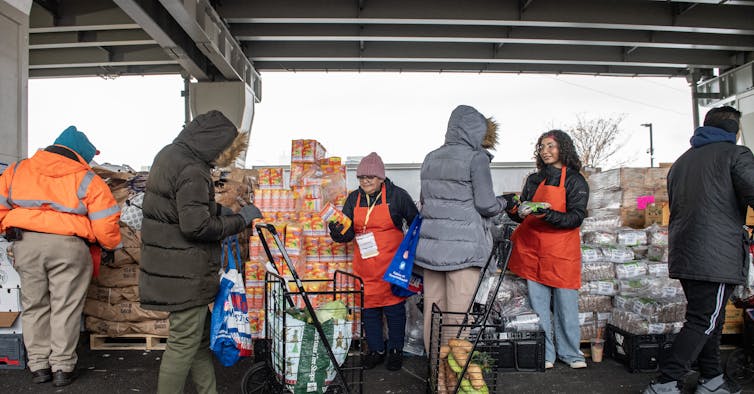
Food pantry staff members and volunteers hand out food in Chelsea, Mass., in November 2024. Joseph Prezioso/AFP via Getty Images

On Jan. 27, 2025, the Trump administration ordered a freeze on federal grants and contracts covering a wide array of aid programs to take effect at . This freeze was partially prevented when a judge responded to a lawsuit filed by the National Council of Nonprofits and other organizations. The flow of funds on grants that had already been awarded was at least temporarily protected by the judge’s action. The attorneys general of 22 states and the District of Columbia have also sued to block this funding freeze.

The Trump administration, which on Jan. 29 rescinded the memo ordering the funding suspension, has made clear that it may again seek to reduce or eliminate much of the money, totaling several hundred billion dollars, that funds many services that nonprofits provide, such as support for foster parents, after-school care and distributing food for free.

Dyana Mason and Mirae Kim, two scholars of nonprofits, explain the role that federal funding plays in the nonprofit sector.

How much do nonprofits rely on federal funding?

Nonprofits partner with the government to deliver social services, such as child care for low-income families, housing for people experiencing homelessness, and job training and placement. These partnerships can form with local or state governments, as well as with the federal government, with this collaboration mostly taking place through grants and contracts.

Government funding makes up about 33% of the revenue flowing into the nonprofit sector annually, according to the Urban Institute. The institute, a think tank, also found that nearly 40% of all nonprofits in the United States applied for federal grants in 2021, 2022 and 2023, and that about 10% applied for federal contracts. The share of government funding can be far larger for some kinds of social service nonprofits.

Many other nonprofits applied for local and state grants during that three-year period. Those grants, however, are often themselves funded by the federal government indirectly through grants it makes to state and local government agencies. Those agencies, in turn, then provide grants or maintain contracts with local nonprofits to provide services.

Although it’s hard to track with absolute precision due to those complex arrangements, government revenue is the second-largest source of income for nonprofits after the money these organizations and institutions earn through commercial activities.

Also called “fee-for-service,” this revenue includes the money nonprofit hospitals get when patients and insurers pay medical bills, nonprofit theaters receive when they sell tickets to performances, and nonprofit private schools obtain when parents pay tuition.

Some social service nonprofits charge fees too, typically on a sliding scale. That is, their clients with relatively higher incomes pay more, and those with extremely low incomes pay very little or nothing at all.

How could freezing federal funding affect nonprofits?

We have no doubt that a long freeze on federal grants and contracts would be devastating for nonprofits and the communities they serve.

For example, Meals on Wheels, a program that delivers hot meals to more than 2 million homebound people over 65 and helps them maintain social connections, gets 37% of its funding from the federal government.

Clackamas Women’s Services, a domestic and sexual violence organization based near Portland, Oregon, is one of the many local organizations that have expressed concern about what to expect. The group says it could lose half of its annual budget if federal funding were to be eliminated.

Without federal funding, organizations like these – many of which already have waitlists – would have to cut back on the services they provide.

Nonprofits are confused and concerned about the stability of federal funding, Scripps News reports.

What’s the role of nonprofits in the US safety net?

It’s very significant.

For the past several decades, attempts to scale back the size of the government have led to government agencies essentially hiring nonprofits to do much of their work.

Through contracts and grants, nonprofits then do such things as assist people who are recovering from fires, hurricanes and other disasters; provide services for veterans and active-duty members of the military; and help people with mental health conditions, including substance use problems, just to name a few.

This arrangement typically provides nonprofits with a reliable and predictable source of funds that they can use to serve their communities. But it can also leave them vulnerable to policy changes – especially when new administrations take over, as the second Trump administration’s actions illustrate.

Research we conducted about what happened to nonprofits during the COVID-19 pandemic showed that volatility in the economy has serious effects on the ability of nonprofits to do their work.

For example, social service nonprofits struggled in March and April 2020 due to falling revenue at a time of increasing demand. Many of these organizations had to scale back their services. In some cases, they canceled them.

We followed up with another survey in November and December 2020. By then, we found, 61% of the groups had received forgivable federal loans through the government’s Paycheck Protection Program.

Nearly half of the nonprofits told us that they had, in addition, received other forms of emergency funding from the federal government, including Economic Injury Disaster Loans and emergency food distributions.

This federal assistance made it possible for thousands of nonprofits to keep their staff employed and continue to provide important services as the economy recovered.

What happens when nonprofits lose federal funds?

It’s hard for social service organizations to replace federal funding.

Nonprofits can, of course, appeal to their donors to help bridge the gap. But donations from individuals, foundations, corporations and bequests only amount to no more than 15% of the funds flowing into the nonprofit sector.

The outcome of freezing, eliminating or scaling back federal funding for nonprofits would mean that those in need would get fewer services. We would also expect mass layoffs, which could harm the U.S. economy.

Nonprofits employ more than 12 million people in the United States. That’s more workers than big industries such as construction, transportation and finance employ. Should millions of them suddenly become unemployed, demand would grow further for social services from providers already unable to meet lower levels of demand due to funding cuts.

Has there ever been upheaval like this before?

Congress appropriates money to provide for the services that the public needs and demands. These moves have led to great fear and uncertainty among organizations that serve people in need in the United States and abroad.

Although it’s not unusual for funding priorities to change from one administration to the next, Donald Trump’s executive orders on international aid and nonprofit grants and contracts that underpin the U.S. safety net are unprecedented.The Conversation

Dyana Mason, Associate Professor of Planning, Public Policy and Management, University of Oregon and Mirae Kim, Associate Professor of Nonprofit Studies, George Mason University

This article is republished from The Conversation under a Creative Commons license. Read the original article.

  1. Police arrest Lakeport man for fatal Library Park shooting
  2. Lake County highway work among latest round of transportation projects approved by state
  3. Why Trump’s tariffs can’t solve America’s fentanyl crisis
  • 395
  • 396
  • 397
  • 398
  • 399
  • 400
  • 401
  • 402
  • 403
  • 404
How to resolve AdBlock issue?
Refresh this page