How to resolve AdBlock issue?
Refresh this page
How to resolve AdBlock issue?
Refresh this page
Lake County News,California
  • Home
    • Registration Form
  • News
    • Education
    • Veterans
    • Community
      • Obituaries
      • Letters
      • Commentary
    • Police Logs
    • Business
    • Recreation
    • Health
    • Religion
    • Legals
    • Arts & Life
    • Regional
  • Calendar
  • Contact us
    • FAQs
    • Phones, E-Mail
    • Subscribe
  • Advertise Here
  • Login
How to resolve AdBlock issue?
Refresh this page

News

The trade deficit isn’t an emergency – it’s a sign of America’s strength

Details
Written by: Tarek Alexander Hassan, Boston University
Published: 09 April 2025


When U.S. President Donald Trump imposed sweeping new tariffs on imported goods on April 2, 2025 – upending global trade and sending markets into a tailspin – he presented the move as a response to a crisis. In an executive order released the same day, the White House said the move was necessary to address “the national emergency posed by the large and persistent trade deficit.”

A trade deficit – when a country imports more than it exports – is often viewed as a problem. And yes, the U.S. trade deficit is both large and persistent. Yet, as an economist who has taught international finance at Boston University, the University of Chicago and Harvard, I maintain that far from a national emergency, this persistent deficit is actually a sign of America’s financial and technological dominance.

The trade deficit is the flip side of an investment magnet

A trade deficit sounds bad, but it is neither good nor bad.

It doesn’t mean the U.S. is losing money. It simply means foreigners are sending the U.S. more goods than the U.S. is sending them. America is getting more cheap goods, and in return it is giving foreigners financial assets: dollars issued by the Federal Reserve, bonds from the U.S. government and American corporations, and stocks in newly created firms.

That is, a trade deficit can only arise if foreigners invest more in the U.S. than Americans invest abroad. In other words, a country can only have a trade deficit if it also has an equally sized investment surplus. The U.S. is able to sustain a large trade deficit because so many foreigners are eager to invest here.

Why? One major reason is the safety of the U.S. dollar. Around the world, from large corporations to ordinary households, the dollar is used for saving, trading and settling debts. As the world economy grows, so does foreigners’ demand for dollars and dollar-denominated assets, from cash to Treasury bills and corporate bonds.

Because the dollar is so attractive, the Federal Reserve gets to mint extra cash for use abroad, and the U.S. government and American employers and families can borrow money at lower interest rates. Foreigners eagerly buy these U.S. financial assets, which enables Americans to consume and invest more than they ordinarily could. In return for our financial assets, we buy more German machines, Scotch whiskey, Chinese smartphones, Mexican steel and so on.

Blaming foreigners for the trade deficit, therefore, is like blaming the bank for charging a low interest rate. We have a trade deficit because foreigners willingly charge us low interest rates – and we choose to spend that credit.

US entrepreneurship attracts global capital – and fuels the deficit

Another reason for foreigners’ steady demand for U.S. assets is American technological dominance: When aspiring entrepreneurs from around the world start new companies, they often decide to do so in Silicon Valley. Foreigners want to buy stocks and bonds in these new companies, again adding to the U.S. investment surplus.

This strong demand for U.S. assets also explains why Trump’s last trade war in 2018 did little to close the trade deficit: Tariffs, by themselves, do nothing to reduce foreigners’ demand for U.S. dollars, stocks and bonds. If the investment surplus doesn’t change, the trade deficit cannot change. Instead, the U.S. dollar just appreciates, so that imports get cheaper, undoing the effect of the tariff on the size of the trade deficit. This is basic economics: You can’t have an investment surplus and a trade surplus at the same time, which is why it’s silly to call for both.

It’s worth noting that no other country in the world enjoys a similarly sized investment surplus. If a normal country with a normal currency tries to print more money or issues more debt, its currency depreciates until its investment account – and its trade balance – goes back to something close to zero. America’s financial and technological dominance allows it to escape this dynamic.

That doesn’t mean all tariffs are bad or all trade is automatically good. But it does mean that the U.S. trade deficit, poorly named though it is, does not signify failure. It is, instead, the consequence – and the privilege – of outsized American global influence.

The president’s frenzied attacks on the nation’s trade deficit show he’s misreading a sign of American economic strength as a weakness. If the president really wants to eliminate the trade deficit, his best option is to rein in the federal budget deficit, which would naturally reduce capital inflows by raising domestic savings.

Rather than reviving U.S. manufacturing, Trump’s extreme tariffs and erratic foreign policy are likely to instead scare off foreign investors altogether and undercut the dollar’s global role. That would indeed shrink the trade deficit – but only by eroding the very pillars of the country’s economic dominance, at a steep cost to American firms and families.The Conversation

Tarek Alexander Hassan, Professor of Economics, Boston University

This article is republished from The Conversation under a Creative Commons license. Read the original article.
Lake County supervisors approve letter supporting school and road funding after federal budget exclusion

Details
Written by: LINGZI CHEN
Published: 08 April 2025
LAKE COUNTY, Calif. — Last week, the Lake County Board of Supervisors unanimously approved sending a letter to Congressman Mike Thompson supporting a bipartisan bill to reauthorize essential federal funding for rural schools and infrastructure — funding omitted from the budget passed by Congress in March.

The Secure Rural Schools program helps fund public services like schools and roads in counties with large tracts of federal land. Last year, it brought more than $33 million to rural communities across California.

However, it expired in June and was not reauthorized, as CalMatters has reported. Although it was passed unanimously in the Senate in the fall, it was not included in the temporary budget passed in December and the congressional budget passed in March.

“We will stop receiving funding as of April of this year,” said Lake County Officer of Education Director Brock Falkenberg during the Board of Supervisors meeting last Tuesday.

Without renewal, schools may face layoffs and program cuts, while infrastructure projects risk stalling.

“The Secure Rural Schools Program has been instrumental in providing stable funding for our schools and infrastructure,” the supervisors’ letter to Thompson said.

“Rural roads that ensure access to schools, ingress and egress in the event of wildfire emergencies, and promote rural economic opportunity are maintained using this crucial funding source. Any reduction in either education or roads funding would be detrimental to Lake County; public safety, long-term economic vibrancy, and access to critical services will all be affected,” the letter said.

Now, over 50 congressmembers across states and partylines, including Thompson, have cosponsored the Secure Rural Schools Reauthorization Act 2025, seeking renewal of this critical funding.

“I know we're speaking to the choir with our congressman, but appreciate what he's doing and anything we can do to back him up and let him know that we can help his voice become louder,” District 2 Supervisor Bruno Sabatier said before the board voted unanimously in favor of sending the letter.

Rural California — including Lake County — is taking the hit

The Secure Rural Schools funding is distributed based on the acreage of federal forest land in each eligible county. For example, the counties with largest federal land include Siskiyou which received $4.3 million in the past year; Trinity, $3.5 million; and Plumas, $3.4 million.

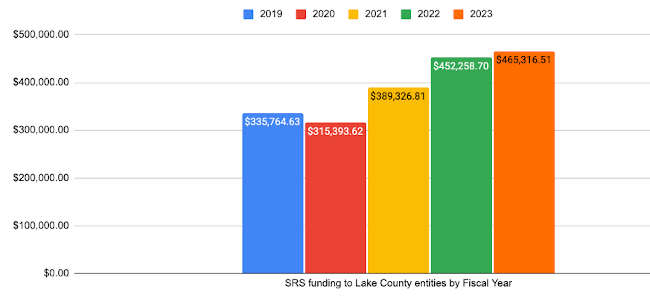
Lake County, with 258,602 acres of the Mendocino National Forest, received $465,316.51.

Affected rural communities in California have been raising concerns over the loss of the funding — and Lake County is no exception.

“Our county is not being hit as hard as other counties in Northern California that have bigger areas, larger tracks of forest lands, but it is significant,” said District 5 Supervisor Jessica Pyska. “It’s significant enough for us to really have concerns and see the impact to our schools.”

The funding is usually split into half between the county and the schools, said Falkenberg, who went on to explain the impact of the funding cuts on Lake County schools.

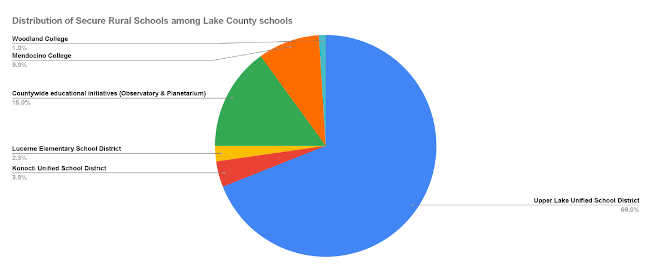
“If we were not to receive this funding, ultimately we would have to answer the question of how do we continue to fund the observatory, the planetarium, and the funds that are passed through to the school districts, which would equal about two and a half full time equivalent teaching positions,” he said, adding that the Upper Lake Unified School District will take the hardest hit as it has the largest acreage of federal land.

Falkenberg said the schools received roughly $200,000 to $250,000 each year over the last few years. “The bulk of that money goes to the Upper Lake Unified School District,” he later told Lake County News. “So for them, it's significant. It might not be huge, but it's significant.”


On the county’s road projects, the Secure Rural Schools funding “would be used for school area signage and for pavement markings and speed studies,” said Chief Deputy County Administrative Officer Matthew Rothstein at the meeting, drawing from notes given by Public Works Director Glen March who was absent.

The project is meant to mitigate concerns over traffic patterns around schools and to “encourage people to slow down in the areas of our schools,” Rothsten said.

“The infrastructure piece from the county is to make our schools safer. So that's why I thought it was urgent to bring this to us,” Supervisor Pyska said. “This funding cut directly impacts us in Lake County.”

“This is a bipartisan issue,” said Sabatier, recalling a recent meeting with Modoc County officials at Washington D.C.

“I sat down in the White House with Modoc County, who is very red, very conservative and they were very concerned about their losses as well,” said Sabatier. “So I think this goes across the board, that people are not wanting to see this go away.”

“Federal funding is absolutely critical for our local schools in Lake County. This funding ensures Lake County teachers and students have the resources they need to succeed and helps fund repairs for our local roads,” Thompson said in response to Lake County News’ request for comment.

“Any cuts to the Secure Rural Schools program, or to any other federal education funding, would hurt our kids. I will continue to work to renew this program and to protect all of the federal programs Lake County residents rely on every day,” he added.

The history of Secure Rural Schools funding in Lake County

For more than a century, the federal government has been subsidizing counties with large federal forest land.

Since 1908, the Forest Service Act has been enacted to set a portion — 25% of the revenue generated from activities like timber production and special permit use — to the local governments as compensation for not collecting tax on the federal land.

After the agency’s revenue declined for decades, in 2000, Congress passed the Secure Rural Schools and Community Self Determination Act to “help stabilize the funds available to rural counties,” according to the Forest Service under the U.S. Department of Agriculture.

During the board meeting, Falkenberg explained that the timber sale declined because the Endangered Species Act had started to “limit or make it much more difficult to harvest timber on national forest land.”

The Secure Rural Schools Act, then, was established as “a temporary, short term funding model,” while Congress tried to reconcile the tension between the two acts, Falkenberg said. “They have never been able to come to a consensus on how to manage that.”

With the new source of funding, counties could choose one of the two funding channels: either through the 1908 Act that pays 25% of timber revenues, or through Secure Rural Schools.

“The local county can elect to receive the greater of the two,” Falkenberg explained over a phone call with Lake County News.

Congress periodically allows counties to choose between the two payment types, with the last selection in 2013 and the choice locked.

In an approved 2012 resolution provided by Rothstein, Lake County opted for Secure Rural Schools.

“So for the last 25 years, counties and schools have continued to receive the secure rural schools funding in lieu of the 25% payment passed through with the exception of 2015/16—there was not a reauthorization,” Falkenberg said during the meeting. “So that particular year … we went from roughly half a million dollars to $14,000.”

The Secure Rural School funding allocates dollars under three titles: Title I for roads and schools, Title II for projects on federal lands and TITLE III for county projects. While Title II funds are retained by Forest Service, Title I and II go to local entities.

The chart below shows the total funding distributed to Lake County entities in the past five years under Title I and III.

“Distribution for the payments is off by a year,” explained Lauren Ott of Congressman Thompson’s office. So the Fiscal Year 2023 figures reflect money distributed in Fiscal Year 2024, she added.


Falkenberg is concerned that Lake County will receive even less than 2015/16 if Secure Rural Schools does not get reauthorized.

“If we revert back to the 25% funding rule, we're going to see that number drop to, I don't know, less than 10% or less than $10,000,” he told Lake County News.

Email staff reporter Lingzi Chen at This email address is being protected from spambots. You need JavaScript enabled to view it.. 


Authorities identify remains of missing woman; reward offered for information about case

Details
Written by: LAKE COUNTY NEWS REPORTS
Published: 08 April 2025
Remains found in May of 2024 near Nice, California, have been identified as belonging to Ellen Adams, 62, of Napa, California. Image courtesy of the Lake County Sheriff’s Office.

LAKE COUNTY, Calif. — The Lake County Sheriff’s Office said it has positively identified the woman whose remains were found in May in Rodman Slough, as detectives continue to investigate the circumstances behind her death and her family offer a reward for more information.

The remains belong to 62-year-old Ellen Adams of Napa, according to sheriff’s office spokesperson Lauren Berlinn.

Berlinn said Major Crimes Unit detectives are still actively investigating the circumstances surrounding Adams’ death.

On Friday, May 24, 2024, around 6 p.m., Adams was seen at the Robinson Rancheria Casino.
Berlinn said surveillance footage later captured Adams leaving the casino in her white Kia Rio sedan with a male subject on the following day at around 1 a.m.

Detectives have already identified and interviewed that individual seen with Adams. At this time, detectives do not believe that individual to be connected to Adams’ death, Berlinn said.

After leaving the casino, Adams and the male subject drove to the Rodman Slough, which Berlinn said was confirmed by speaking with additional witnesses who spoke with Adams.

On May 27, 2024, Adams was located deceased in the Rodman Slough, and on Sunday, June 2, 2024, Adams’ vehicle was discovered abandoned near Pyle Road in Nice, Berlinn said.

Berlinn said the Major Crimes Unit continues to actively investigate this case and is working closely with Adams’ family.

Ellen Adams Kia Rio. Image courtesy of the Lake County Sheriff’s Office.


Detectives have reviewed surveillance footage from nearby businesses, utilized license plate readers, collaborated with crime scene investigators, and worked with allied law enforcement agencies.

Berlinn said detectives have also interviewed several witnesses who may have seen Ellen between May 24 and May 27, 2024.

Detectives were able to track Adams’ movements through the afternoon of Saturday, May 25, 2024. However, the Lake County Sheriff’s Office is asking anyone who had contact with Adams or who saw her during the time period of May 24 to May 27, 2024, to come forward.

Adams’ family is offering a reward to anyone who provides information that helps solve her case.

Those with information can call the Major Crimes Unit tip line at 707-262-4088 or Sgt. Jeff Mora at 707-262-4224.

City of Lakeport employees apprehend suspect in vehicle theft

Details
Written by: LAKE COUNTY NEWS REPORTS
Published: 08 April 2025
A 2018 Kubota UTV stolen from the city of Lakeport, California. Photo courtesy of the Lakeport Police Department.

LAKEPORT, Calif. — City of Lakeport employees apprehended a Northshore man on Monday morning after he took a city-owned vehicle.

Daniel Louis Miller, 33, a transient from Nice was arrested in the case, the Lakeport Police Department reported.

Lakeport Police’s report said its officers responded to multiple 911 calls reporting a physical altercation involving a city employee and Miller.

Miller was taken into custody for vehicle theft and violation of parole after the city employee told officers that he had witnessed Miller steal a 2018 Kubota UTV and attached hydraulic dump trailer belonging to the city of Lakeport Parks Department.

The equipment was being used for trash removal at Xabatin Community Park when it was taken, authorities said.

The city employee pursued Miller and was able to physically detain the uncooperative Miller near the intersection of 9th and North Forbes streets after the attached trailer tipped onto its side.

Officers arrived shortly thereafter and took Miller into custody without incident.

Miller was booked and is being held without bail for the parole violation.
  1. California sues Trump administration after funding for critical library services threatened
  2. Acting governor proclaims California Library Week
  3. Board of Supervisors to discuss federal cuts on food bank funding, consider million-dollar road project agreements
  • 327
  • 328
  • 329
  • 330
  • 331
  • 332
  • 333
  • 334
  • 335
  • 336
How to resolve AdBlock issue?
Refresh this page