How to resolve AdBlock issue?
Refresh this page
How to resolve AdBlock issue?
Refresh this page
Lake County News,California
  • Home
    • Registration Form
  • News
    • Education
    • Veterans
    • Community
      • Obituaries
      • Letters
      • Commentary
    • Police Logs
    • Business
    • Recreation
    • Health
    • Religion
    • Legals
    • Arts & Life
    • Regional
  • Calendar
  • Contact us
    • FAQs
    • Phones, E-Mail
    • Subscribe
  • Advertise Here
  • Login
How to resolve AdBlock issue?
Refresh this page

News

Senate Leader McGuire announces agreement reached for pro tem designee, transition to occur in 2026

Details
Written by: LAKE COUNTY NEWS REPORTS
Published: 10 June 2025

On Monday, Senate President pro Tempore Mike McGuire (D-North Coast) announced that the Senate Democratic Caucus convened and determined that Sen. Monique Limón (D-Santa Barbara) will be the Pro Tem Designee, with a transition to be held early in 2026.

“Serving as the Leader of the State Senate is the honor of a lifetime,” Senate Leader Mike McGuire said Monday. “And today, the Senate unanimously elected Senator Limón as the Pro Tem Designee. Sen. Limón always puts people first, she’s a bridge builder and never stops fighting for progress. We are going to be well served under her leadership and the Golden State will be stronger thanks to Sen. Limón’s commitment to the communities of this great state.”

“I am grateful to have the support of my colleagues to be the next President pro Tempore of the California State Senate. At this critical time in our state, I am committed to working with my colleagues and remain dedicated to defending our California values and uplifting all of our communities,” said Senator Monique Limón (D-Santa Barbara). “Together, we will build diverse coalitions and develop solutions to the most pressing issues of our time. I want to thank President pro Tempore Mike McGuire for his continuous steady leadership and unwavering commitment to Californians.”

Mike McGuire is President pro Tempore of the California Senate. He represents the North Coast of California, which stretches from the Golden Gate Bridge to the Oregon border, including Del Norte, Trinity, Humboldt, Lake, Mendocino, Sonoma, and Marin counties.

Monique Limón represents the 21st Senate District, which includes Santa Barbara, Ventura, Goleta, Buellton, Carpinteria, Guadalupe, Lompoc, Santa Maria, Solvang, Camarillo, Fillmore, Ojai, Oxnard, Santa Paula, Port Hueneme, Blacklake, Callender, Grover Beach, Los Berros, Nipomo, Oceano, Woodlands. She currently serves as the Chair of the Senate Democratic Caucus, Chair of the Senate Natural Resources and Water Committee, Vice Chair of the California Legislative Women’s Caucus and Vice Chair of the Central Coast Caucus, and Chair of the Senate Select Committee on the Nonprofit Sector.

CDFW launching pilot effort to reduce gray wolf attacks on livestock

Details
Written by: LAKE COUNTY NEWS REPORTS
Published: 10 June 2025

collaredwolf

A collared wolf in California. Photo courtesy of UC Berkeley, California Wolf Project.


The California Department of Fish and Wildlife, or CDFW, announced Monday that it is launching a summer strike team in partnership with federal and local agencies to combat livestock depredations by gray wolves in Siskiyou County and the Sierra Valley (spanning both Sierra and Plumas counties).

With landowner permission, the task force will provide round-the-clock CDFW staff support seven days a week for livestock producers experiencing frequent conflicts with wolves, among other program benefits.

“Today’s announcement showcases the power of collaboration in effectively and safely managing California’s growing gray wolf population,” CDFW Director Charlton H. Bonham said Monday. “This strike force allows CDFW to work more closely with our key partners and impacted ranchers and provide new tools to protect cattle and other livestock from harm. Together, we are doing everything we can to keep both livestock and wolves safe. Thank you to our partners in this effort for making this strike team possible.”

Recent depredation of livestock in the Sierra Valley and Siskiyou County signals the need for additional and increased support for livestock producers during the summer and fall of 2025. Interested producers are encouraged to participate in the program. The summer strike team will take a multifaceted approach to combat livestock depredations, including through:

In-person, on-the-ground support from CDFW staff. Working both day and night seven days a week, CDFW staff will be available to support ranchers facing livestock depredations. The strike team will use a combination of radio telemetry and real-time information from local ranchers to locate wolves (collared and uncollared) to proactively push them away from livestock.

Developing conflict risk management plans for participating ranchers. Livestock producers who volunteer to participate in the program and take any necessary training will have a plan tailored to their unique property and livestock needs to help mitigate future conflict through nonlethal methods. These plans may include a variety of tools, including livestock management, additional barriers, predator aversion devices or injurious harassment

Outreach, education and training. In partnership with experts in livestock production and management like the University of California Cooperative Extension, training and outreach events will be held in Sierra Valley to help provide producers techniques and strategies ranchers can take to reduce wolf-livestock conflicts through nonlethal practices.

CDFW is also working in conjunction with Sierra and Plumas counties to create a county agricultural protection position that will support depredation investigations and capture and collar methods, as well as develop carcass removal programs to mitigate wolf attraction to ranch properties.

The task force will be led by CDFW’s law enforcement and scientific staff and will increase CDFW presence in communities to effectively implement these measures. The program began Monday, June 9, d is anticipated to run through the summer.

“This program is still in its early stages, so there will be a need to learn by doing together. More details will be shared as it progresses. But this is a good start, and I appreciate that,” said Plumas County Supervisor Dwight Ceresola.

Sierra Valley, which spans both Plumas and Sierra counties, has had higher-than-normal levels of livestock depredations by gray wolves in the Beyem Seyo pack over the past year. As ranchers move their cattle to the valley floor for summer grazing, additional support from this pilot program will be needed to protect livestock from wolves.

“I am thankful the state and county can do something together. We are hopeful that this additional presence will reduce the immediate losses and provide CDFW with a clear understanding of the day-to-day challenges ranchers have faced for months,” said Sierra County Supervisor Paul Roen.

Siskiyou County also has a higher level of livestock depredations compared to other counties, in relation to the Whaleback pack in particular. The county has made significant efforts in slowing depredations and working collaboratively with CDFW staff, including the hiring of a county wolf liaison, but the need for additional support remains. As part of this task force, CDFW will be providing enhanced information on wolf data to Siskiyou County staff, and Siskiyou will assist the department in investigating and collecting additional data.

"This pilot effort in all three counties is made possible through sustained coordination between county supervisors, county sheriffs, local ranchers and state and federal agencies. Importantly, it also reflects the growing calls from local sheriffs calling for CDFW to step up and help,” said Director Bonham. “I thank Sheriffs Mike Fisher, Todd Johns and Jeremiah LaRue for their help to get going on our efforts this summer. I also thank all the Northern California sheriffs and county supervisors who have been key voices for their communities.”

If you are a livestock producer in Plumas, Sierra or Siskiyou counties and are interested in learning more about the program or how to participate, please contact Morgan Kilgour, Region 2 Manager, CDFW, at This email address is being protected from spambots. You need JavaScript enabled to view it..

California plan to ban most plants within 5 feet of homes for wildfire safety overlooks some important truths about flammability

Details
Written by: Max Moritz, University of California, Santa Barbara and Luca Carmignani, San Diego State University
Published: 10 June 2025


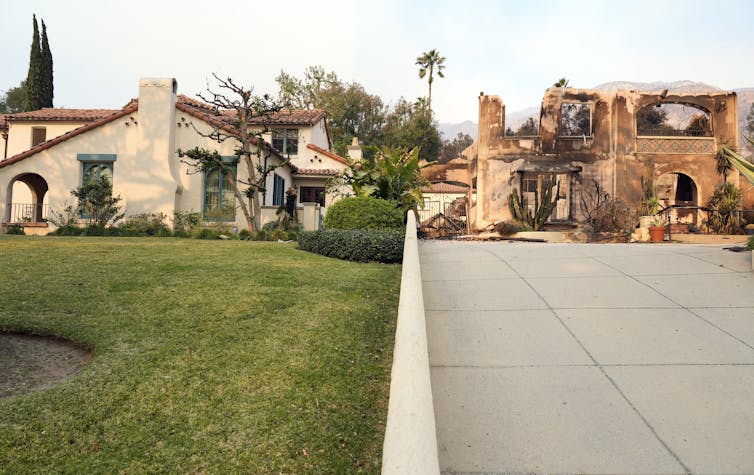
Photos after the Los Angeles fires in January 2025 show many yards where vegetation didn’t burn while neighboring houses did. AP Photo/Chris Pizzello

One of the most striking patterns in the aftermath of many urban fires is how much unburned green vegetation remains amid the wreckage of burned neighborhoods.

In some cases, a row of shrubs may be all that separates a surviving house from one that burned just a few feet away.

As scientists who study how vegetation ignites and burns, we recognize that well-maintained plants and trees can actually help protect homes from wind-blown embers and slow the spread of fire in some cases. So, we are concerned about new wildfire protection regulations being developed by the state of California that would prohibit almost all plants and other combustible material within 5 feet of homes, an area known as “Zone 0.”

Two images show neighboring houses before and after the Palisades Fire. One house burned, the other, separated by a large green hedge next to both houses, is undamaged. The hedge is still green next to the unburned house.
Photos before and after the 2025 Palisades Fire show thick green vegetation between two closely spaced homes. The arrow shows the direction of the fire’s spread. Max Moritz; CAL FIRE Damage Inspection photos, CC BY

Wildfire safety guidelines have long encouraged homeowners to avoid having flammable materials next to their homes. But the state’s plan for an “ember-resistant zone,” being expedited under an executive order from Gov. Gavin Newsom, goes further by also prohibiting grass, shrubs and many trees in that area.

If that prohibition remains in the final regulation, it’s likely to be met with public resistance. Getting these rules right also matters beyond California, because regulations that originate in California often ripple outward to other fire-prone regions.

Lessons from the devastation

Research into how vegetation can reduce fire risk is a relatively new area of study. However, the findings from plant flammability studies and examination of patterns of where vegetation and homes survive large urban fires highlight its importance.

When surviving plants do appear scorched after these fires, it is often on the side of the plant facing a nearby structure that burned. That suggests that wind-blown embers ignited houses first: The houses were then the fuel as the fire spread through the neighborhood.

We saw this repeatedly in the Los Angeles area after wildfires destroyed thousands of homes in January 2025. The pattern suggests a need to focus on the many factors that can influence home losses.

A burned home, with only brick walls standing in some areas, with a green lawn and shrubs in adjacent to the house.
Shrubs in Zone 0 of a home did not ignite during the Eaton Fire, despite the home burning. Max Moritz

Several guides are available that explain steps homeowners can take to help protect houses, particularly from wind-blown embers, known as home hardening.

For example, installing rain gutter covers to keep dead leaves from accumulating, avoiding flammable siding and ensuring that vents have screens to prevent embers from getting into the attic or crawl space can lower the risk of the home catching fire.

However, guidance related to landscaping plants varies greatly and can even be incorrect.

For example, some “fire-safe” plant lists contain species that are drought tolerant but not necessarily fire resistant. What matters more for keeping plants from becoming fuel for fires is how well they’re maintained and whether they’re properly watered.

How a plant bursts into flames

When living plant material is heated by a nearby energy source, such as a fire, the moisture inside it must be driven off before it can ignite. That evaporation cools the surrounding area and lowers the plant’s flammability.

In many cases, high moisture can actually keep a plant from igniting. We’ve seen this in some of our experimental work and in other studies that test the flammability of ornamental landscaping.

With enough heat, dried leaves and stems can break down and volatilize into gases. And, at that point, a nearby spark or flame can ignite these gases and set the plant on fire.

Two sets of image showing testing The dried plant burns pretty quickly, becoming engulfed in flames within 30 seconds.
Plant flammability testing shows how quickly twigs, grasses, plants and leaves will burn at different moisture levels. The images on the right are from an experiment at the University of California’s South Coast Research and Extension Center to test flammability of a living but overly dry plant. Max Moritz (left); Luca Carmignani (right)

Even when the plant does burn, however, its moisture content can limit other aspects of flammability, such as how hot it burns.

Up to the point that they actually burn, green, well-maintained plants can slow the spread of a fire by serving as “heat sinks,” absorbing energy and even blocking embers. This apparent protective role has been observed in both Australia and California studies of home losses.

How often vegetation buffers homes from igniting during urban conflagrations is still unclear, but this capability has implications for regulations.

California’s ‘Zone 0’ regulations

The Zone 0 regulations California’s State Board of Forestry is developing are part of broader efforts to reduce fire risk around homes and communities. They would apply in regions considered at high risk of wildfires or defended by CAL FIRE, the state’s firefighting agency.

Many of the latest Zone 0 recommendations, such as prohibiting mulch and attached fences made of materials that can burn, stem from large-scale tests conducted by the National Institute of Standards and Technology and the Insurance Institute for Business and Home Safety. These features can be systematically analyzed.

But vegetation is far harder to model. The state’s proposed Zone 0 regulations oversimplify complex conditions in real neighborhoods and go beyond what is currently known from scientific research regarding plant flammability.

A view across Altadena with some burned homes, others unburned, but bright green trees and shrubs among the burned properties. Photo taken Feb. 5, 2025.
Green lawns, trees and shrubs were still visible after the Eaton Fire burned homes in Altadena, Calif., in January 2025. Mario Tama/Getty Images

A mature, well-pruned shrub or tree with a high crown may pose little risk of burning and can even reduce exposure to fires by blocking wind and heat and intercepting embers. Aspen trees, for example, have been recommended to reduce fire risk near structures or other high-value assets.

In contrast, dry, unmanaged plants under windows or near fences may ignite rapidly and make it more likely that the house itself will catch fire.

As California and other states develop new wildfire regulations, they need to recognize the protective role that well-managed plants can play, along with many other benefits of urban vegetation.

We believe the California proposal’s current emphasis on highly prescriptive vegetation removal, instead of on maintenance, is overly simplistic. Without complementary requirements for hardening the homes themselves, widespread clearing of landscaping immediately around homes could do little to reduce risk and have unintended consequences.The Conversation

Max Moritz, Wildfire Specialist, University of California Cooperative Extension; Adjunct Professor at the Bren School, University of California at Santa Barbara, University of California, Santa Barbara and Luca Carmignani, Assistant Professor of Engineering, San Diego State University

This article is republished from The Conversation under a Creative Commons license. Read the original article.

Search leads to discovery of missing teen’s body Sunday night

Details
Written by: Elizabeth Larson
Published: 09 June 2025

andrewroberts

Andrew Robert, 14, of Clearlake, California, was found dead after an hourslong search on Sunday, June 8, 2025. Photo courtesy of the Lake County Sheriff’s Office.


LAKE COUNTY, Calif. — A teenager reported missing from a Hidden Valley Lake beach on Sunday afternoon was found dead hours later by the North Shore Dive Team.

Andrew Robert, 14, of Clearlake was the subject of a search for much of Sunday afternoon and evening, leading to his discovery at about 10:40 p.m. Sunday, the Lake County Sheriff’s Office said.

Robert was reported missing from the Big Beach area of Hidden Valley Lake, where he was last seen around 4:15 p.m., the Lake County Sheriff’s Office reported.

Authorities said the teen was on a group trip and when he was last seen, he was telling others he was going to the pool.

The sheriff’s office released a Nixle about the missing boy just before 6 p.m.

At 6:30 p.m., the Lake County Search & Rescue Team, along with K9 Sadie, was deployed to begin the search, the sheriff’s office said.

Multiple agencies joined the search effort, including KCORP, Cal Fire, the North Shore Dive Team, South Lake Fire and Hidden Valley Security.

The sheriff’s office said the teams searched both on land and in the water.

The operations continued into the night, and in an update issued just after 9:30 p.m., authorities said the search was still underway.

It was about an hour later that the dive team members found his body, the sheriff’s office said in a report issued shortly before 11:30 p.m. Authorities did not specify exactly where they located him.

“The Lake County Sheriff’s Office extends our heartfelt condolences to Andrew’s family, friends, and the entire community during this difficult time,” the agency said in its report on the teen’s death.

The sheriff’s office also thanked the other agencies and organizations that assisted with the search.

“Thank you also to the community for your support and concern throughout the search efforts,” the sheriff’s office said.

Editor’s note: The victim’s last name previously was reported by authorities as “Roberts.” The articles about this case have been updated to reflect his correct last name, which is “Robert.”

Email Elizabeth Larson at This email address is being protected from spambots. You need JavaScript enabled to view it.. Follow her on Twitter, @ERLarson, and on Bluesky, @erlarson.bsky.social. Find Lake County News on the following platforms: Facebook, @LakeCoNews; X, @LakeCoNews; Threads, @lakeconews, and on Bluesky, @lakeconews.bsky.social.

  1. Supervisors to weigh new fire map, election office improvement, million-dollar road projects
  2. Clearlake Planning Commission meets June 10
  3. Lakeport Economic Development Advisory Committee to meet June 11
  • 262
  • 263
  • 264
  • 265
  • 266
  • 267
  • 268
  • 269
  • 270
  • 271
How to resolve AdBlock issue?
Refresh this page