How to resolve AdBlock issue?
Refresh this page
How to resolve AdBlock issue?
Refresh this page
Lake County News,California
  • Home
    • Registration Form
  • News
    • Education
    • Veterans
    • Community
      • Obituaries
      • Letters
      • Commentary
    • Police Logs
    • Business
    • Recreation
    • Health
    • Religion
    • Legals
    • Arts & Life
    • Regional
  • Calendar
  • Contact us
    • FAQs
    • Phones, E-Mail
    • Subscribe
  • Advertise Here
  • Login
How to resolve AdBlock issue?
Refresh this page

News

Space News: Is Mars really red? A physicist explains the planet’s reddish hue and why it looks different to some telescopes

Details
Written by: David Joffe, Kennesaw State University
Published: 21 June 2025

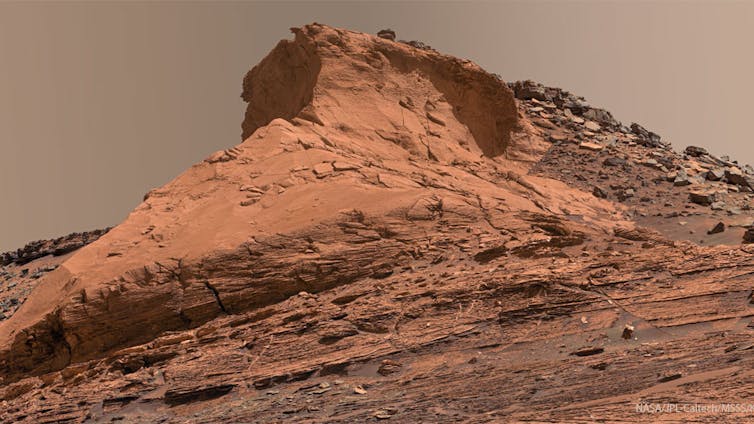
Siccar Point, photographed by the Curiosity rover, is near Mars’ Gale Crater. NASA/JPL-Caltech/MSSS; Processing & License: Kevin M. Gill

Curious Kids is a series for children of all ages. If you have a question you’d like an expert to answer, send it to This email address is being protected from spambots. You need JavaScript enabled to view it..


Is Mars really as red as people say it is? – Jasmine, age 14, Everson, Washington


People from cultures across the world have been looking at Mars since ancient times. Because it appears reddish, it has often been called the red planet.

The English name for the planet comes from the Romans, who named it after their god of war because its color reminded them of blood. In reality, the reddish color of Mars comes from iron oxide in the rocks and dust covering its surface.

Your blood is also red because of a mixture of iron and oxygen in a molecule called hemoglobin. So in a way, the ancient connection between the planet Mars and blood wasn’t completely wrong. Rust, which is a common form of iron oxide found here on Earth, also often has a reddish color.

Rust flakes on metal.
Iron oxide, found in rust on old metal machinery, is the compound that colors rocks and dust on Mars’ surface reddish brown. Lars Hammar/Flickr, CC BY-NC-SA

In my current research on exoplanets, I observe different types of signals from planets beyond Earth. Lots of interesting physics goes into how researchers perceive the colors of planets and stars through different types of telescopes.

Observing Mars with probes

If you look closely at pictures of Mars taken by rovers on its surface, you can see that most of the planet isn’t purely red, but more of a rusty brown or tan color.

A photo showing the front of a lander as well as dusty, rocky terrain.
You can see Mars’ rusty color in this photo taken by the Viking lander. NASA/JPL

Probes sent from Earth have taken pictures showing rocks with a rusty color. A 1976 picture from the Viking lander, the very first spacecraft to land on Mars, shows the Martian ground covered with a layer of rusty orange dust.

Not all of Mars’ surface has the same color. At the poles, its ice caps appear white. These ice caps contain frozen water, like the ice we usually find on Earth, but these ice caps are also covered by a layer of frozen carbon dioxide – dry ice.

This layer of dry ice can evaporate very quickly when sunlight shines on it and grows back again when it becomes dark. This process causes the white ice caps to grow and shrink in size depending on the Martian seasons.

A photo of Mars from space. It looks reddish brown in color, with white clouds at the poles.
This picture from the Hubble Space Telescope shows the planet with the same rusty color covering large parts of its surface. NASA, ESA, Zolt G. Levay (STScI)

Beyond visible light

Mars also gives off light in colors that you can’t see with your eyes but that scientists can measure with special cameras on telescopes.

Light itself can be thought of not only as a wave but also as a stream of particles called photons. The amount of energy carried by each photon is related to its color. For example, blue and violet photons have more energy than orange and red photons.

A diagram of the electromagnetic spectrum, with radio, micro and infrared waves having a longer wavelength than visible light, while UV, X-ray and gamma rays have shorter wavelengths than visible light.
The rainbow of visible light that you can see is only a small slice of all the kinds of light. Some telescopes can detect light with a longer wavelength, such as infrared light, or light with a shorter wavelength, such as ultraviolet light. Others can detect X-rays or radio waves. Inductiveload, NASA/Wikimedia Commons, CC BY-SA

Ultraviolet photons have even more energy than the photons you can see with your eyes. These photons are found in direct sunlight, and because they have so much energy, they can damage the cells in your body. You can use sunscreen to protect yourself from them.

Infrared photons have less energy than the photons you can see with your eyes, and you don’t need any special protection from them. This is how some types of night-vision goggles work: They can see light in the infrared spectrum as well as the visible color spectrum. Scientists can take pictures of Mars in the infrared spectrum using special cameras that work almost like night-vision goggles for telescopes.

Two photos of Mars from space -- one labeled 'visible true color' that looks reddish brown and one labeled 'infrared false color' that looks green and red.
The Hubble Space Telescope could take pictures in both visible light and infrared light. NASA, James Bell (Cornell University), Justin Maki (NASA-JPL), Mike J. Wolff (SSI)

The colors on the infrared picture aren’t really what the infrared light looks like, because you can’t see those colors with your eyes. They are called “false colors,” and researchers add them to look at the picture more easily.

When you compare the visible color picture and the infrared picture, you can see some of the same features – and the ice caps are visible in both sets of colors.

Mars shown from space, colored gray, green and brown.
A UV view of Mars with the MAVEN spacecraft. NASA/LASP/CU Boulder

NASA’s MAVEN spacecraft, launched in 2013, has even taken pictures with ultraviolet light, giving scientists a different view of both the surface of Mars and its atmosphere.

Each new type of picture tells scientists more about the Martian landscape. They hope to use these details to answer questions about how Mars formed, how long it had active volcanoes, where its atmosphere came from and whether it had liquid water on its surface.

Astronomers are always looking for new ways to take telescope pictures outside of the regular visible spectrum. They can even make images using radio waves, microwaves, X-rays and gamma rays. Each part of the spectrum they can use to look at an object in space represents new information they can learn from.

Even though people have been looking at Mars since ancient times, we still have much to learn about this fascinating neighbor.


Hello, curious kids! Do you have a question you’d like an expert to answer? Ask an adult to send your question to This email address is being protected from spambots. You need JavaScript enabled to view it.. Please tell us your name, age and the city where you live.

And since curiosity has no age limit – adults, let us know what you’re wondering, too. We won’t be able to answer every question, but we will do our best.The Conversation

David Joffe, Associate Professor of Physics, Kennesaw State University

This article is republished from The Conversation under a Creative Commons license. Read the original article.

Body of missing Mendocino County man located at vehicle wreck site in forest

Details
Written by: Elizabeth Larson
Published: 20 June 2025

LAKE COUNTY, Calif. — Authorities said they have located the body of a Mendocino County man who went missing in April at a crash site in northern Lake County.

Randolph Albert Wilson, 63, of Covelo was identified as the man found dead along with his wrecked vehicle on Thursday morning, according to Lauren Berlinn of the Lake County Sheriff’s Office. 

Lt. Commander Dan Fansler of the California Highway Patrol’s Clear Lake Area office said that on Thursday at 11:30 a.m. his officers, along with the Lake County Sheriff’s Office and fire personnel, responded to a report of a solo vehicle crash on Hull Mountain Road, approximately two miles east of Simmons Road.  

That location is a short distance away from Lake Pillsbury in the Mendocino National Forest in northern Lake County.

Fansler said the initial crash investigation led to the discovery of a 1990 Pontiac Sunbird sedan down a steep 400 foot embankment.  

He said Wilson, the Pontiac’s suspected driver and solo occupant, was found dead at the scene.

Fansler said investigators believe the crash occurred over a month ago.

A Feather Alert — used to help locate at-risk Indigenous people — was issued for Wilson after it was reported that he was last seen in Ukiah April 17. 

The Mendocino County Sheriff’s Office said Wilson was reported missing April 21 and had been believed to be driving the white Pontiac Sunbird convertible.

Fansler said the crash is still under investigation. 

Email Elizabeth Larson at This email address is being protected from spambots. You need JavaScript enabled to view it.. Follow her on Twitter, @ERLarson, and on Bluesky, @erlarson.bsky.social. Find Lake County News on the following platforms: Facebook, @LakeCoNews; X, @LakeCoNews; Threads, @lakeconews, and on Bluesky, @lakeconews.bsky.social. 

Board of Supervisors terminates Public Works director

Details
Written by: Elizabeth Larson
Published: 20 June 2025

LAKE COUNTY, Calif. — Lake County’s Public Works director was dismissed this week after just a year on the job.

On Tuesday afternoon, the Board of Supervisors emerged from closed session to vote to terminate Public Works Director Glen March.

The board appointed March to the job on a limited term basis last June. The goal was for him to work alongside retiring Public Works Director Scott DeLeon in order to facilitate a leadership transition before March’s permanent appointment became effective June 29, as Lake County News has reported.

March came to Lake County after serving three decades in what the county said at the time were “engineering-focused roles in the private and public sectors” in places including the cities of Hollister and East Palo Alto.

Department heads typically have reviews once or, occasionally, twice a year, especially if they are new. More closed session performance evaluations than that during a year are generally a sign that a department head may be about to leave.

Since his hire was announced in May of 2024, March had been evaluated Dec. 3, with the next evaluation set for June 3. Another evaluation followed at the board’s June 10 meeting, with “Public Employee Discipline/Dismissal/Release” included on this week’s agenda under closed.

After the closed door discussion, the board came back into open session, with Supervisor Brad Rasmussen moving to terminate March immediately. The board voted unanimously to approve the motion.

Rasmussen followed up with a second motion, also approved unanimously, to appoint County Administrative Officer Susan Parker and Public Services Director Lars Ewing as interim Public Works directors, effective immediately.

The Public Works director job has typically been one of the county’s more reliably filled department head positions.

Scott De Leon, who retired at the end of June 2024, held the job for 13 years, following Brent Siemer, who had resigned in 2011 after four years on the job because he said he couldn’t meet the board’s expectations.

Board dealing with other recruitment issues

In addition to now having to begin a recruitment to fill the Public Works director position, the supervisors continue to seek a permanent Animal Care and Control director.

Gregory Wilkins, who the board had appointed to head animal control in October, tendered his resignation on Feb. 25, the same day as he had a performance evaluation. His departure was effective May 28.

The supervisors were scheduled to hold a closed session to conduct interviews for an Animal Care and Control director on May 12.

On Tuesday, as part of the regular board consent agenda, the supervisors appointed Assistant County Administrative Officer Stephen Carter Jr. to the post on an interim basis, effective July 1.

This spring, Public Health Officer Dr. Noemi Doohan also resigned. 

Earlier this month, the board appointed Robert S. Bernstein, MD, MS, MPH, PhD, to succeed Doohan, effective Sept. 2.

Email Elizabeth Larson at This email address is being protected from spambots. You need JavaScript enabled to view it.. Follow her on Twitter, @ERLarson, and on Bluesky, @erlarson.bsky.social. Find Lake County News on the following platforms: Facebook, @LakeCoNews; X, @LakeCoNews; Threads, @lakeconews, and on Bluesky, @lakeconews.bsky.social. 

Are California’s efforts to address retail theft working?

Details
Written by: LAKE COUNTY NEWS REPORTS
Published: 20 June 2025

Is California making progress in addressing the rise of retail theft? 

That’s a question a new report is attempting to answer.

Reported retail theft has increased in California in recent years, growing by around 11 percent between 2014 and 2023. Current levels, however, remain below historic 1980s highs. 

In response to mounting public concern on this issue, the state is implementing new laws aimed at reducing retail theft, primarily by making prosecutions easier and increasing punishment for offenders. 

A new report from the state’s Legislative Analyst’s Office, or LAO, suggests that stronger oversight of these efforts, bolstered by enhanced data collection, is needed to assess whether the state is successfully curbing retail theft. 

This echoes the Little Hoover Commission’s call for an evidence-based approach to address retail theft in our state. 

The LAO report, Retail Theft in California: Looking Back at a Decade of Change, surveys a decade of changes — both inside and outside of the criminal justice system — that could have contributed to higher rates of retail theft. This includes reforms to increase prosecutorial flexibility through Proposition 47 or the expansion of store policies directing staff to not engage with suspected shoplifters.
 
The report concludes with a framework for enhancing legislative oversight of implementation of new enforcement and prosecutorial tools to reduce retail theft, including whether and how they are being used, and if promising practices are being shared and adopted. 

It also offers suggestions to better understand the outcomes and efficiencies of various strategies, such as whether reported retail theft is going down and by how much the justice system costs changed. 

It notes, however, that pursuing this research will require better and more complete data, and, in some cases, more rigorous analysis.
 
Last year, the Little Hoover Commission learned retail theft is not always reported and it’s challenging to estimate how frequently it actually occurs. At the time of the commission’s study, the state did not collect or track data on organized retail theft.
 
In its report, Retail Theft: A Data-Driven Response for California, the commission called on the state to mandate and appropriately fund the collection of detailed data to help California leaders and researchers better understand the circumstances around retail theft and the people involved in it. 

Specifically, the commission called on the California Department of Justice to expand its existing data initiatives to include:

• Circumstances surrounding the crime.
• Demographics on those arrested.
• Law enforcement response times.
• Whether and what charges prosecutors filed.
• Final case outcomes.
• The offender’s rehabilitation, reentry and recidivism.

Next, to build understanding and guide development of future solutions, the Commission urged the state to collaborate with universities or other nonpartisan research institutions to fund in-depth studies on:  

• Retail theft preventative measures and effectiveness.
• Underreporting of retail theft.
• Commercial victimization.
• Economic impact of retail theft.
• Drivers of public perception of retail theft.
• Fencing of stolen goods.

Without comprehensive data on retail theft, California lacks a vital tool to understand the effects of this crime or how to best stop it.

To read the commission’s full report on retail theft implementation and find more information about the commission’s work on the subject, visit its website.

  1. Clearlake Animal Control: ‘Bella’ and the dogs
  2. Companies haven’t stopped hiring, but they’re more cautious, according to the 2025 College Hiring Outlook Report
  3. Lake County Sheriff’s Office makes second fentanyl homicide arrest
  • 251
  • 252
  • 253
  • 254
  • 255
  • 256
  • 257
  • 258
  • 259
  • 260
How to resolve AdBlock issue?
Refresh this page