How to resolve AdBlock issue?
Refresh this page
How to resolve AdBlock issue?
Refresh this page
Lake County News,California
  • Home
    • Registration Form
  • News
    • Education
    • Veterans
    • Community
      • Obituaries
      • Letters
      • Commentary
    • Police Logs
    • Business
    • Recreation
    • Health
    • Religion
    • Legals
    • Arts & Life
    • Regional
  • Calendar
  • Contact us
    • FAQs
    • Phones, E-Mail
    • Subscribe
  • Advertise Here
  • Login
How to resolve AdBlock issue?
Refresh this page

News

Helping Paws: New dogs this week

Details
Written by: Elizabeth Larson
Published: 23 June 2025

LAKE COUNTY, Calif. — Lake County Animal Care and Control’s kennels are once again filled with animals needing homes.

The dogs available for adoption this week include mixes of Chihuahua, German shepherd, husky, Labrador Retriever, pit bull terrier, terrier and shepherd

Dogs that are adopted from Lake County Animal Care and Control are either neutered or spayed, microchipped and, if old enough, given a rabies shot and county license before being released to their new owner. License fees do not apply to residents of the cities of Lakeport or Clearlake.

Those dogs and the others shown on this page at the Lake County Animal Care and Control shelter have been cleared for adoption.

Call Lake County Animal Care and Control at 707-263-0278 or visit the shelter online for information on visiting or adopting.

The shelter is located at 4949 Helbush in Lakeport.

Email Elizabeth Larson at This email address is being protected from spambots. You need JavaScript enabled to view it.. Follow her on Twitter, @ERLarson, and on Bluesky, @erlarson.bsky.social. Find Lake County News on the following platforms: Facebook, @LakeCoNews; X, @LakeCoNews; Threads, @lakeconews, and on Bluesky, @lakeconews.bsky.social. 

    Clovis's preview photo
    Clovis

    Kennel#11a's preview photo
    Kennel#11a

    Kennel#11c(Zues)'s preview photo
    Kennel#11c(Zues)

    Kennel #13a's preview photo
    Kennel #13a

    Kennel #13c(Pink)'s preview photo
    Kennel #13c(Pink)

    Kennel #13d(Red)'s preview photo
    Kennel #13d(Red)

    Kennel #13e(Purple)'s preview photo
    Kennel #13e(Purple)

    Kennel#15a(Purple)'s preview photo
    Kennel#15a(Purple)

    Kennel#15b(Red)'s preview photo
    Kennel#15b(Red)

    Kennel#15c(Yellow)'s preview photo
    Kennel#15c(Yellow)
    Kennel#15e(Blue)'s preview photo
    Kennel#15e(Blue)
    Kennel #16d's preview photo
    Kennel #16d

    Macy's preview photo
    Macy

    Booster 's preview photo
    Booster

    Pyro's preview photo
    Pyro

    Felony's preview photo
    Felony

    Mika's preview photo
    Mika

    Pike's preview photo
    Pike

    Kona's preview photo
    Kona

    Kennel#3's preview photo
    Kennel#3

     
    Kennel#4's preview photo
    Kennel#4

    Kennel#8a's preview photo
    Kennel#8a

    Kennel#8b's preview photo
    Kennel#8b

    Kennel#9a's preview photo
    Kennel#9a

    Kennel#9b's preview photo
    Kennel#9b

    Telling the story of the nation’s smallest businesses

    Details
    Written by: Travis Shoemaker
    Published: 23 June 2025

    The nation’s 29.8 million nonemployer businesses — those with no paid employees and are subject to federal income tax — made up $1.7 trillion or about 6.8% of the 2022 U.S. economy, according to the 2022 Nonemployer Statistics, or NES, recently released by the U.S. Census Bureau.

    Most nonemployers are self-employed individuals operating small unincorporated businesses, which may be the owner’s principal source of income.

    NES can be used to uncover facts about U.S. nonemployers, like how California had the largest number of nonemployer establishments (3,502,950) but ranked 16th per capita, that Texas had the most nonemployer construction establishments (376,379) or that Delaware nonemployers had the highest average receipts ($85,950) in the country.

    In contrast, there were 8.3 million U.S. employer businesses (those with paid employees) in 2022, according to the Census Bureau’s 2022 County Business Patterns.

    State nonemployer rates

    The prevalence of nonemployer establishments varied widely across the country in 2022. A comparison of NES data and population estimates found that:

    • Florida had the greatest per capita rate of nonemployer establishments, boasting 13.3 such establishments for every 100 people. Wyoming and Georgia tied for a distant second (with 10.8 each), followed by Texas, Vermont, and Colorado (10.0 each).
    • West Virginia was the state with the lowest per capita rate, with 5.3 nonemployer establishments per 100 people.
    • California, which had the most nonemployer establishments, was home to nearly 500,000 more such entities than second place Texas (3,023,525), with Florida (2,968,201) rounding out the top three.
    • North Dakota had the lowest total number (59,106) of nonemployer establishments, followed close behind by Alaska (60,471). While low population states Wyoming and Vermont also had small numbers of nonemployer establishments (62,751 and 64,930, respectively), each boasted a relatively high per capita rate — 10.8 and 10.0 per 100 people, respectively — compared to the national average of 8.9.

    Industry leaders

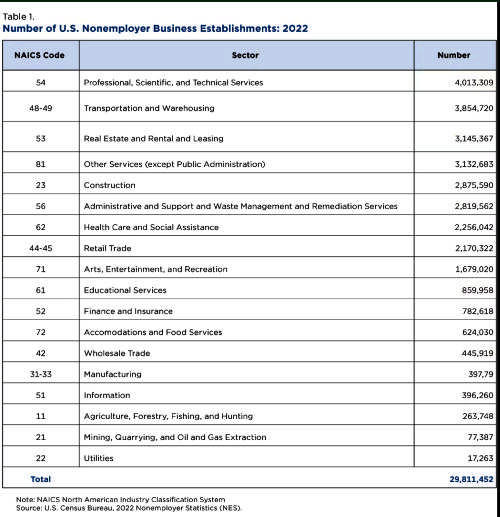
    Nonemployer Statistics covers 18 economic sectors as defined by the 2022 North American Industry Classification System or NAICS (Table 1). The three largest sectors in 2022 by number of establishments were Professional, Scientific, and Technical Services (4,013,209); Transportation and Warehousing (3,854,720); and Real Estate, Rental and Leasing (3,145,367).

    The Real Estate, Rental and Leasing sector had the largest receipts among nonemployers in 2022, bringing in 20.0% of total nonemployer receipts ($344.7 billion) despite making up just 10.6% of the nation’s nonemployer establishments.

    The Construction sector made up 9.6% of 2022 nonemployer establishments with 2,875,590 businesses. These firms shoveled up 13.8% of the U.S. total nonemployer receipts with $238.0 billion in Construction nonemployer receipts.

    The third-place sector was Professional, Scientific, and Technical Services, representing a 13.5% share of U.S. nonemployers with 4,013,209 nonemployer establishments and a commensurate 13.3% share ($229.4 billion) of total U.S. nonemployer receipts in 2022.

    Small business, big receipts

    The Census Bureau’s NES also sorts nonemployers into 11 receipt-size categories ranging from less than $5,000 to more than $5 million.

    The Finance and Insurance sector had 542 nonemployer establishments with receipt values exceeding $5 million, constituting more than half the total nonemployers with receipts that large. In second place: Arts, Entertainment, and Recreation which had 322 nonemployer establishments with $5 million or more in receipts.

    Four other sectors that had nonemployer establishments with receipts exceeding $5 million in 2022 were Transportation and Warehousing (40); Wholesale Trade (29); Retail Trade (25); and Professional, Scientific, and Technical Services (5).

    Travis Shoemaker is a writer/editor for America Counts in the Census Bureau’s Communications Directorate.

    How artificial intelligence controls your health insurance coverage

    Details
    Written by: Jennifer D. Oliva, Indiana University
    Published: 23 June 2025

    Evidence suggests that insurance companies use AI to delay or limit health care that patients need. FatCameraE+ via Getty Images

    Over the past decade, health insurance companies have increasingly embraced the use of artificial intelligence algorithms. Unlike doctors and hospitals, which use AI to help diagnose and treat patients, health insurers use these algorithms to decide whether to pay for health care treatments and services that are recommended by a given patient’s physicians.

    One of the most common examples is prior authorization, which is when your doctor needs to receive payment approval from your insurance company before providing you care. Many insurers use an algorithm to decide whether the requested care is “medically necessary” and should be covered.

    These AI systems also help insurers decide how much care a patient is entitled to — for example, how many days of hospital care a patient can receive after surgery.

    If an insurer declines to pay for a treatment your doctor recommends, you usually have three options. You can try to appeal the decision, but that process can take a lot of time, money and expert help. Only 1 in 500 claim denials are appealed. You can agree to a different treatment that your insurer will cover. Or you can pay for the recommended treatment yourself, which is often not realistic because of high health care costs.

    As a legal scholar who studies health law and policy, I’m concerned about how insurance algorithms affect people’s health. Like with AI algorithms used by doctors and hospitals, these tools can potentially improve care and reduce costs. Insurers say that AI helps them make quick, safe decisions about what care is necessary and avoids wasteful or harmful treatments.

    But there’s strong evidence that the opposite can be true. These systems are sometimes used to delay or deny care that should be covered, all in the name of saving money.

    A pattern of withholding care

    Presumably, companies feed a patient’s health care records and other relevant information into health care coverage algorithms and compare that information with current medical standards of care to decide whether to cover the patient’s claim. However, insurers have refused to disclose how these algorithms work in making such decisions, so it is impossible to say exactly how they operate in practice.

    Using AI to review coverage saves insurers time and resources, especially because it means fewer medical professionals are needed to review each case. But the financial benefit to insurers doesn’t stop there. If an AI system quickly denies a valid claim, and the patient appeals, that appeal process can take years. If the patient is seriously ill and expected to die soon, the insurance company might save money simply by dragging out the process in the hope that the patient dies before the case is resolved.

    Insurers say that if they decline to cover a medical intervention, patients can pay for it out of pocket.

    This creates the disturbing possibility that insurers might use algorithms to withhold care for expensive, long-term or terminal health problems , such as chronic or other debilitating disabilities. One reporter put it bluntly: “Many older adults who spent their lives paying into Medicare now face amputation or cancer and are forced to either pay for care themselves or go without.”

    Research supports this concern – patients with chronic illnesses are more likely to be denied coverage and suffer as a result. In addition, Black and Hispanic people and those of other nonwhite ethnicities, as well as people who identify as lesbian, gay, bisexual or transgender, are more likely to experience claims denials. Some evidence also suggests that prior authorization may increase rather than decrease health care system costs.

    Insurers argue that patients can always pay for any treatment themselves, so they’re not really being denied care. But this argument ignores reality. These decisions have serious health consequences, especially when people can’t afford the care they need.

    Moving toward regulation

    Unlike medical algorithms, insurance AI tools are largely unregulated. They don’t have to go through Food and Drug Administration review, and insurance companies often say their algorithms are trade secrets.

    That means there’s no public information about how these tools make decisions, and there’s no outside testing to see whether they’re safe, fair or effective. No peer-reviewed studies exist to show how well they actually work in the real world.

    There does seem to be some momentum for change. The Centers for Medicare & Medicaid Services, or CMS, which is the federal agency in charge of Medicare and Medicaid, recently announced that insurers in Medicare Advantage plans must base decisions on the needs of individual patients – not just on generic criteria. But these rules still let insurers create their own decision-making standards, and they still don’t require any outside testing to prove their systems work before using them. Plus, federal rules can only regulate federal public health programs like Medicare. They do not apply to private insurers who do not provide federal health program coverage.

    Some states, including Colorado, Georgia, Florida, Maine and Texas, have proposed laws to rein in insurance AI. A few have passed new laws, including a 2024 California statute that requires a licensed physician to supervise the use of insurance coverage algorithms.

    But most state laws suffer from the same weaknesses as the new CMS rule. They leave too much control in the hands of insurers to decide how to define “medical necessity” and in what contexts to use algorithms for coverage decisions. They also don’t require those algorithms to be reviewed by neutral experts before use. And even strong state laws wouldn’t be enough, because states generally can’t regulate Medicare or insurers that operate outside their borders.

    A role for the FDA

    In the view of many health law experts, the gap between insurers’ actions and patient needs has become so wide that regulating health care coverage algorithms is now imperative. As I argue in an essay to be published in the Indiana Law Journal, the FDA is well positioned to do so.

    The FDA is staffed with medical experts who have the capability to evaluate insurance algorithms before they are used to make coverage decisions. The agency already reviews many medical AI tools for safety and effectiveness. FDA oversight would also provide a uniform, national regulatory scheme instead of a patchwork of rules across the country.

    Some people argue that the FDA’s power here is limited. For the purposes of FDA regulation, a medical device is defined as an instrument “intended for use in the diagnosis of disease or other conditions, or in the cure, mitigation, treatment, or prevention of disease.” Because health insurance algorithms are not used to diagnose, treat or prevent disease, Congress may need to amend the definition of a medical device before the FDA can regulate those algorithms.

    If the FDA’s current authority isn’t enough to cover insurance algorithms, Congress could change the law to give it that power. Meanwhile, CMS and state governments could require independent testing of these algorithms for safety, accuracy and fairness. That might also push insurers to support a single national standard – like FDA regulation – instead of facing a patchwork of rules across the country.

    The move toward regulating how health insurers use AI in determining coverage has clearly begun, but it is still awaiting a robust push. Patients’ lives are literally on the line.The Conversation

    Jennifer D. Oliva, Professor of Law, Indiana University

    This article is republished from The Conversation under a Creative Commons license. Read the original article.

    Rotary Club of Lakeport to celebrate centennial with Aug. 9 gala

    Details
    Written by: LAKE COUNTY NEWS REPORTS
    Published: 22 June 2025
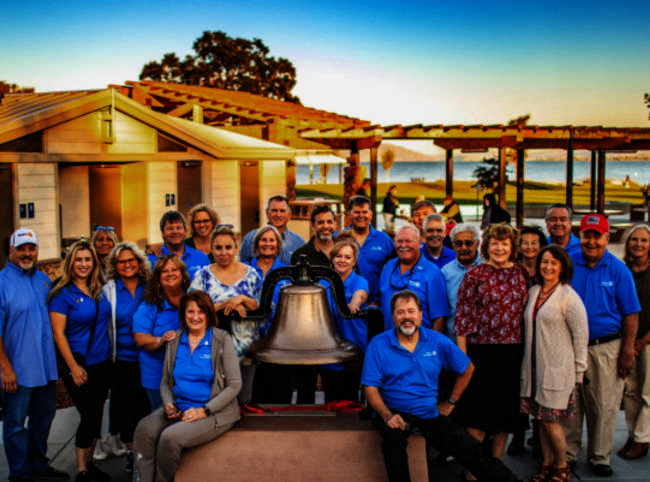
    Lakeport Rotary Club members at the curfew bell dedication in 2024. Courtesy photo.

    LAKEPORT, Calif. — The Rotary Club of Lakeport is celebrating its centennial this year, marking a century of dedicated service to the community. 

    The commemorative event will take place on Saturday, Aug. 9, at 5:30 p.m. at the Soper Reese Theatre, 275 S. Main Street, Lakeport.   

    Founded on May 3, 1925, the Rotary Club of Lakeport has been a cornerstone of community service, embodying the Rotary International motto of "Service Above Self." 

    Over the past century, the club has initiated numerous projects aimed at improving education, health, and overall quality of life in Lakeport and beyond.

    The centennial celebration promises an evening filled with history, camaraderie, and entertainment.

    Attendees will enjoy heavy appetizers, a special Centennial Program highlighting the club's achievements, and live music by the LC Diamonds. Tickets for the event are $75 per person.

    "This milestone is not just a celebration of our club's longevity, but a testament to the enduring spirit of service that defines our members," said Pam Harpster, president of the Rotary Club of Lakeport. "We invite all community members to join us in honoring our past and looking forward to a future of continued service."

    The Rotary Club of Lakeport has been a pillar of community service for nearly a century. Over the decades, the club has initiated numerous programs and projects that have left a lasting impact on Lakeport and beyond.

    Local impact:

    • Easter Egg Hunt: Since 1926, the club has organized the annual Easter Egg Hunt, a cherished tradition that has delighted generations of Lakeport families. 
    • Educational support: The club has distributed dictionaries and National Geographic books to third-grade students, fostering literacy and a love for learning among young minds. 
    • Scholarships: Providing scholarships to graduating seniors, the club supports higher education and empowers youth to pursue their academic goals. 
    • Community projects: From hosting crab feeds, to funding local infrastructure improvements, the club has been actively involved in various community enhancement projects. 

    Global impact:

    As part of Rotary International, the Lakeport club contributes to worldwide initiatives, including efforts to eradicate polio. 

    Through the PolioPlus program, Rotary has helped immunize over 2.5 billion children in 122 countries, reducing polio cases by 99.9% globally. 

    The club's commitment to service, both locally and internationally, exemplifies the Rotary motto: "Service Above Self."

    For more information and to purchase tickets, please visit the Rotary Club of Lakeport's website at www.lakeportrotary.org. 

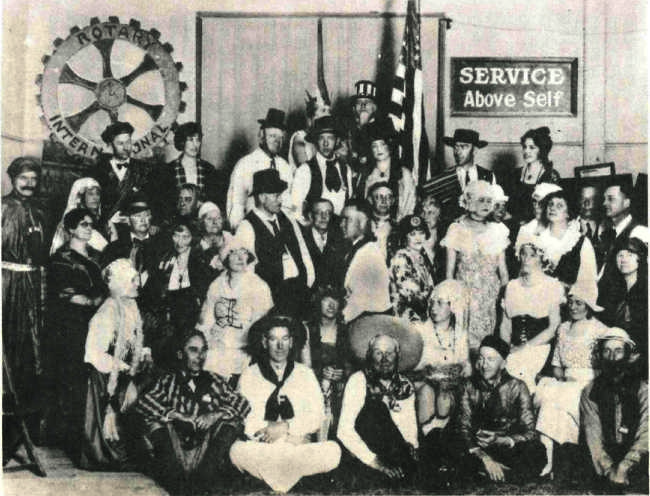
    The Lakeport Rotary Club was founded in 1925. Courtesy photo.
    1. First-of-its-kind partnership will support older adults in higher education and workforce development
    2. Thompson responds to bombing of Iranian nuclear sites, continues call for Congress to convene
    3. Low-income homeowners hit by disasters may get less help from the government, as Trump administration nixes rules on fairness, community input and resilience
    • 248
    • 249
    • 250
    • 251
    • 252
    • 253
    • 254
    • 255
    • 256
    • 257
    How to resolve AdBlock issue?
    Refresh this page