 How to resolve AdBlock issue?
Recreation
- Details
- Written by: California Department of Fish and Wildlife
Hunters, anglers and other members of the public can once again visit these CDFW sales offices to purchase hunting and fishing licenses, tags, report cards, hunt applications, lands passes, Warden Stamps and other CDFW offerings. Customer service representatives are available once again in-person to answer questions.
CDFW’s six license sales offices are located in Eureka, Rancho Cordova, Fairfield, Stockton, Fresno and San Diego. Locations and hours are available on CDFW’s website. CDFW licenses, permits, tags and other entitlements may be also purchased through the following sales channels:
• Online via CDFW’s Online License Sales and Services website;
• Over the telephone through CDFW’s authorized telephone sales agent at (800) 565-1458; and
• Through an authorized independent license sales agent (ex: local sporting goods store, large discount store, or bait and tackle shop).
CDFW’s Redding sales counter remains closed though customer service staff are available in-person to validate hunting tags, answer questions and provide and receive applications to be fulfilled by mail.
Following the relocation of CDFW’s License and Revenue Branch to the California Natural Resources Building in downtown Sacramento in October 2021, license sales and customer support continue to be available by phone, mail, fax, email and internet.
- Details
- Written by: Anderson Marsh State Historic Park
The November nature walk will be led by volunteer State Parks Docent Roberta Lyons.
The hike will cover parts of the Cache Creek Nature Trail, the Marsh Trail and the Ridge Trail.
The hike will be over mostly level terrain and will cover about 3 miles at a leisurely pace. The hike should last between 1.5 and two hours.
Bring binoculars and meet in the parking lot at 8:15 a.m. for time to experience the early morning wildlife that can be found in the Ranch House and Barn complex yard.
The walk will begin at 8:30 a.m.
There is no charge for the guided nature walk and parking is free for those attending.
Anderson Marsh State Historic Park is located on Highway 53, between Lower Lake and Clearlake.
For more information about the guided walk, email
- Details
- Written by: California Department of Fish and Wildlife
Q: How do CDFW fish hatcheries prepare for wildfires?
A: First, we’d like to acknowledge the commitment of many California Department of Fish and Wildlife (CDFW) hatchery staff who have worked during wildfire season in challenging conditions. Multiple fires have occurred near CDFW fish hatcheries, including one at Trinity River Hatchery in Trinity County which prompted an 11-day evacuation of the facility. During that wildfire, one or two employees were escorted into the facility by law enforcement each day to feed fish, clean screens and check on operations.
In 2020, the Walbridge Fire burned more than 55,000 acres in Sonoma County and came within a mile of — and one ridgeline away from — the Warm Springs Fish Hatchery in Geyserville.
The hatchery’s supervisor, the late Brett Wilson, and three staff who lived onsite — Bryan Freele, Danny Garcia and Alan Pariani — stayed behind after evacuation orders were given to make sure fish were cared for. Power was out at the hatchery for several days requiring staff to refill diesel generators every few hours around the clock.
As helicopters and planes carrying flame retardant circled above, one after another, hatchery staff periodically rode motorcycles to the ridgeline to scout the fire. At one point, the fire came so close that staff connected all the hatchery’s fire hoses in the dark of night. The fire was contained after several days, and all the fish survived.
Wildfire defense at CDFW hatcheries begins with year-round facility maintenance. This includes ground maintenance such as cleaning ponds, trimming trees, mowing and clearing brush around on-site homes and at the hatchery. It also includes equipment maintenance such as making sure generators, fire hydrants, hoses and nozzles are in good working order.
There are also requirements in place for when wildfire causes poor air quality at a hatchery. Even if a wildfire isn’t directly threatening a hatchery, the air quality can be poor. This can be especially tough for hatchery staff whose jobs often involve labor and time spent outdoors. CDFW follows Cal/OSHA standards pertaining to Air Quality Index (AQI).
Anytime there’s an AQI above 150 to 499, employees are encouraged to wear N95 masks. If the AQI is 500 or above, staff are required to wear a fitted P100 respirator mask to work outside, or they must work inside in a ventilated building. A CDFW safety officer conducts fit testing for the masks, and each hatchery has an AQI monitor.
Hatchery supervisors also recognize the challenges that staff take on when there’s a wildfire near a facility impacting air quality. During these events, supervisors take extra precautions to make sure staff are taken care of and offered additional breaks and plenty of shade and water. Keeping staff, facilities and hatchery fish safe is a year-round effort for CDFW. A sincere thanks to our team whose dedication makes that possible.
Chumming
Q: When I fish in lakes in California, can I “chum”? I’d like to use corn or other food to help attract fish.
A: Whether you can chum will depend on where in California you’re fishing. Chumming is defined in California Code of Regulations (CCR), Title 14, section 1.32 as follows:
“Placing any material in the water, other than on a hook while angling, for the purpose of attracting fish to a particular area in order that they may be taken.”
There are a few waterways in California where chumming is legal as outlined in CCR, Title 14, section 2.40. Chumming is only permitted in:
(a) The Colorado River District, but only approved bait fishes may be used as chum (see section 4.15) except in the Salton Sea where corn may also be used.
(b) Carquinez Strait and Suisun Bay and their tributaries and saltwater tributaries.
(c) Sacramento River and tidewater of tributaries downstream from Interstate 80 bridge.
(d) San Joaquin River and tidewater of tributaries downstream from Interstate 5 bridge.
Ferrets
Q: I’m traveling around the country in an RV, and I have ferrets. I would like to visit a few of the amazing parks in California. Is there a permit or any kind of exemption to bring my ferrets with me in my RV?
A: Ferrets are a restricted animal in California, and a Restricted Species Permit is required for every person who imports, exports, or possesses any restricted animal listed in California Code of Regulation (CCR), Title 14, Section 671(c). Restricted Species Permits are issued for limited purposes and involve stringent requirements, laid out in CCR Title 14, Section 671.1.
Unfortunately, a recreational vehicle trip would not be one of those purposes.
We do appreciate your effort to get your question answered before you enter the state. We wish you safe travels on your RV trip.
- Details
- Written by: California Department of Fish and Wildlife
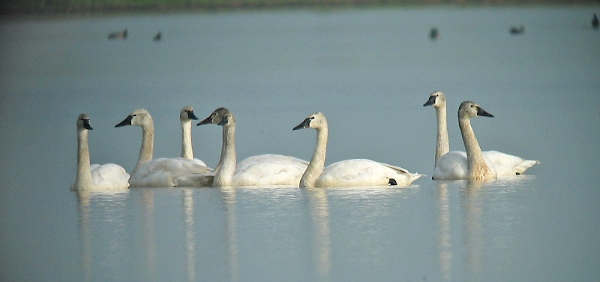
NORTHERN CALIFORNIA — Tundra swans feed and rest in the Sacramento Valley's harvested, flooded rice fields.
The California Department of Fish and Wildlife is offering free swan tours in Yuba County near Marysville on select Saturdays, November through early January.
Held in partnership with Mathews Rice farming operation, this area boasts one of the largest populations of overwintering tundra swans in the Central Valley as well as abundant geese, ducks, shorebirds and raptors.
These popular, naturalist-led tours last approximately two hours. In caravan fashion, the tours traverse flooded rice fields filled with migratory and resident birds, with periodic stops to watch and learn about the wildlife.
The 2022-23 swan tour dates are:
• Nov. 5, 12, 19, 26;
• Dec. 3, 10, 17, 31;
• Jan. 7.
Two tours are offered each day at 9:30 a.m. and at 1 p.m.
Pre-registration is required by contacting Genelle Treaster, CDFW North Central Region, at