 How to resolve AdBlock issue?
Recreation
- Details
- Written by: Carrie Wilson
Question: When fishing from a boat in San Francisco Bay, can some anglers target striped bass with barbed hooks while others target sturgeon using barbless hooks?
If one angler who is fishing from a boat with a barbless hook legally lands and retains a sturgeon, can all anglers on the boat switch over to target striped bass and continue to use barbed hooks? (Craig. H.)
Answer: There is no regulation that requires all persons fishing aboard a vessel with a sturgeon on board to use barbless hooks.
However, the definition of “take” may get anglers in trouble if they are observed fishing in a manner consistent with those methods used to “take” sturgeon.
“Take” is defined as “to hunt, pursue, catch, capture or kill, or attempt to hunt, pursue, catch, capture or kill” (Fish and Game Code, section 86).
Game wardens are watching out for people who may be attempting to take sturgeon with barbed hooks, or are trying to circumvent the requirement to purchase a sturgeon report card by saying they are “just striper fishing.”
So, be sure that there is no ambiguity over what you are targeting to avoid any questions of intent.
Mouth calls for deer?
Question: My question is regarding deer season. I am wondering if it is ok to use mouth calls for deer hunting here in California. I have found this legal to do in other states but have not heard it mentioned one way or the other here in this state. (Richard T.)
Answer: Yes, you can use mouth calls for deer as long as the sounds are not electronically generated or electronically amplified (Fish and Game Code, section 3012).
Where to fish loop crab snares?
Question: Are there restrictions on where loop crab snares (used with fishing poles) in California can be used? I fish in the southern and central management areas. (Ted B., Oxnard)
Answer: “Crab traps, including crab loop traps, may be used north of Point Arguello, Santa Barbara County, to take all species of crabs….” (CCR Title 14, section 29.80(e)). Make sure the area you’d like to fish is not a Marine Protected Area where take is not allowed.
Marine invertebrates for personal collections
Question: I am a marine biology student who wants to have a simple native “tide pool” type of aquarium for my own personal delight. I have had a tropical salt water reef ecosystem in my home for years but I am also interested in a local cold water reef system.
I live in the Orange County area of Southern California and am wondering if it is possible to collect for a non-scientific reason, and if so, what do I need to do? What are the explicit regulations concerning the collection of live marine organisms for use in a personal marine aquarium?
From what I understand, live fish are not to be taken under any circumstances. But I am interested in collecting octopus, and it seems that some organisms are allowed as long as they do not come from a protected area. I do have a California sport fishing license. (Cristiana A.)
Answer: Octopus may be collected for a home aquarium and transported live under the authority of a sport fishing license as long as they are exclusively for that person’s personal aquarium display.
Maintaining live sport-taken octopus in a home aquarium is not considered public “display” and thus does not fall under the provisions of the marine aquaria pet trade (FGC, sections 8596-8597). Transporting live “finfish” (as opposed to mollusks and crustaceans) is prohibited (CCR Title 14, section 1.62).
Invertebrates collected under the authority of a sport fishing license may not be used to establish breeding colonies for sale or trade with other people.
Any trading, selling or possession for sale or trade of these animals constitutes commercial marine aquaria pet trade activity and requires all parties to hold “marine aquaria collectors permits” authorizing this practice. A marine collector’s permit is also required for any animals on display for the public.
People collecting live marine invertebrates for a home aquarium may do so only under the authority of a sport fishing license, and only those species allowed under a sport fishing license may be taken. In addition, any species with sport fishing restrictions (bag, size, possession or season limits, methods of take, etc.) are still covered under those regulations, so collectors must also abide by these laws.
Carrie Wilson is a marine environmental scientist with the California Department of Fish and Wildlife. While she cannot personally answer everyone’s questions, she will select a few to answer each week in this column. Please contact her at
- Details
- Written by: Carrie Wilson
Question: I have a fly fishing question on rigging flies for nymphing.
There is a very popular technique called “bounce nymphing,” which involves using three nymphs on short droppers off of a long leader with a weight attached to the bottom of the leader.
The idea is to bounce the shot off of the stream bottom in order to keep the nymphs in the bottom of the water column.
After the cast, a mend is thrown downstream to create a belly and loop in the fly line so that the current catches the line, and drags the rig along in the current. My interpretation of this technique (under California Code of Regulations Title 14, section 2.10 (b)(4)) is that it is an illegal setup, although it is one that’s widely used by guides in the Eastern Sierra.
Can you clarify this, please? (Craig B., Oroville)
Answer: There is often confusion regarding this set-up as it is very popular in other states given the presentation, not to mention when the split-shot snag is on the bottom, the angler usually only loses the weights.
Unfortunately, in California if the weight is oriented below the flies, it would be illegal (CCR Title 14, section 2.10 (b)(4)).
If an angler is uncertain, an easy way to test the setup would be to hold the leader in the air, grasping the section above the flies. If the weight hangs below the lowest fly, it's illegal.
One option that fly anglers use in California to emulate this technique is to use a heavily weighted nymph to replace the spilt-shot, but that runs the risk of losing that terminal fly to snags.
The origins of the previously mentioned regulation stem from an unethical technique that uses weights below hooks to snag salmon, but the regulation is also applicable for protecting inland fisheries as well.
Crab fishing with both traps and snares simultaneously?
Question: Is it legal (and ethical) to drop a crab trap, and then use my fishing pole to cast out a crab snare? In other words, can I use them simultaneously? I am hoping to get the most out of my gear. (An avid fisher)
Answer: Yes. On a public pier, this would be the maximum amount of gear you could use at one time (CCR Title 14, section 28.65(b)).
Selling elk antlers from Idaho?
Question: I work at Moscow Hide and Fur in Moscow, Idaho (not Russia). We received an email recently referring us to your Q and A Web site. It’s a great resource and we appreciate the time you put into it and all the other things you do. We think we may be one of the companies referred to in this previous question about elk antlers.
I remember that CDFW used to publish a brochure about selling wildlife. It parsed out the language of 3039(c) in a way that is more readable, the same way your answers do. I’ve asked people much smarter than me to read 3039(c) and they don’t seem to be able to agree exactly how to interpret it either. So since we are not sure, we strictly follow the information from the old brochure we have from CDFW. In one part of the brochure it states that no part of an elk or various other animals can be sold.
We assume the status of elk antlers has changed at some point since that brochure was printed, but not by statute. Can you please point me to someone who could clarify this to satisfy our lawyers? (Barrett S., Moscow, ID)
Answer: Statutes regulating trade in wildlife parts have changed over the years, so CDFW doesn’t recommend relying on a brochure that is out of print.
As you mentioned, Fish and Game Code, section 3039 is the key statutory provision regarding elk to be aware of. Within this code section, subdivision (a) provides that:
(a) Except as otherwise provided in this section, Section 3087 [relating to unclaimed taxidermy mounts], Section 4303 [allowing sale of lawfully taken deer hide], another provision of this code, or a regulation adopted pursuant to this code, it is unlawful to sell or purchase a bird or mammal found in the wild in California.
It doesn’t matter whether a species is indigenous. This language would also apply to wild pigs that are not native, but “found in the wild.”
Subdivision (c) makes an exception for shed antlers and some other antlers, but complete antlers or mounts may not be sold. Here’s the statutory language:
(c) Shed antlers, or antlers taken from domestically reared animals that have been manufactured into products or handicraft items, or that have been cut into blocks or units which are to be handcrafted or manufactured into those articles may be purchased or sold at any time. However, complete antlers, whole heads with antlers, antlers that are mounted for display, or antlers in velvet may not be sold or purchased at any time, except as authorized by Section 3087.
Carrie Wilson is a marine environmental scientist with the California Department of Fish and Wildlife. While she cannot personally answer everyone’s questions, she will select a few to answer each week in this column. Please contact her at
- Details
- Written by: Elizabeth Larson
Sturgis will point out the flora and fauna along the trail and discuss how the American Indians used the native vegetation in their everyday lives.
The trail is about half a mile long and has a moderately strenuous grade.
The walk will start at 9 a.m. at the entrance station to the park and will last about half hour to an hour.
All participants should dress appropriately for the summer mornings and wear sturdy shoes and bring sunscreen, mosquito repellant, binoculars and water. Rain will cancel the walk.
Clear Lake State Park volunteers will lead nature walks on the first and third Saturdays during the summer. Remember to mark your calendars and plan on attending a free nature walk.
Clear Lake State Park is located at 5300 Soda Bay Road, Kelseyville, and entry into the park is free for those attending the walk.
Anyone having special needs should contact the Clear Lake State Park Sector Office Tuesday through Thursday between 8 a.m. and 5 p.m. at 707-279-2267.
For further information on California State Parks go to www.parks.ca.gov.
- Details
- Written by: Carrie Wilson
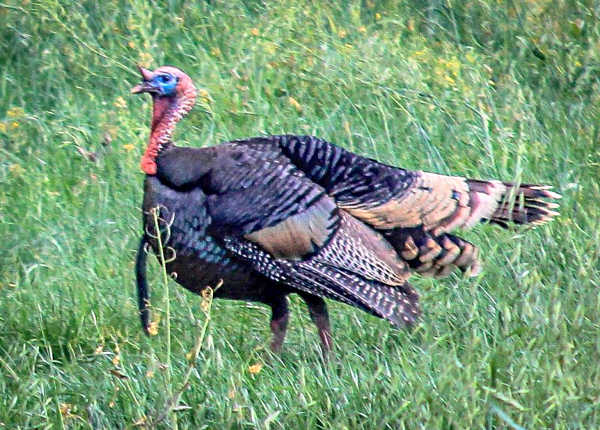
Collecting pre-roasted turkeys?
Question: From your column, I’ve learned that roadkill is illegal to recover (so that I don’t hunt with my truck).
Here’s my question: In our hilly neighborhood the turkeys often fly into the power lines, causing a power outage right around breakfast time. On my way to work I see the roasted turkey near the road.
Since PG&E killed it while it was flying during spring turkey season, and it was obviously fresh, I’m curious if it could have gone into my fridge?
If so, I assume it would have counted against my possession limit. Or is PG&E meat treated the same as roadkill? (Respectfully, Scott S.)
Answer: Good one!! Thanks so much for your entertaining question. However, unfortunately, you still can’t load these roasted turkeys into your fridge even if it occurred during an open turkey season.
Powerline-killed turkeys are not legal to keep because electrocution is not a legal method of take.
To keep a turkey, you must hunt it during the open season with a valid hunting license and upland validation and use a legal method of take.
How to stay safe on the right side of the 50 fathom line?
Question: I have a question about the 50 fathom depth contour boundary for groundfish.
I figured out the boundary is defined as a series of GPS waypoints at approximately the 50 fathom depth. Some areas seaward of the boundary are shallower than 50 fathoms (300 feet) and some areas on the land side are greater than 50 fathoms.
So, am I OK as long as I stay on the land side of this boundary no matter the depth? (Jeff L.)
Answer: Yes! A depth constraint means that during the open season, any species with depth restraints may only be taken or possessed in water depths shallower than the specified depth.
Two specific definitions of “depth” apply off California. In waters shallower than 30 fathoms, “depth” is defined by general depth contour lines. In waters equal to or deeper than 30 fathoms, “depth” is defined by approximating a particular depth contour by connecting the appropriate set of waypoints adopted in Federal regulations (50 Code of Federal Regulations Part 660, Subpart C) (California CR Title 14, section 27.20(a)).
Bowhunting during a general season?
Question: Is it legal to hunt deer and/or big game in California with a bow during the general season? (Clayton S.)
Answer: Yes, as long as your archery equipment meets the general requirements in section 354(c) of the California Code of Regulations Title 14. This regulation can be found in the California Mammal Hunting Regulations booklet beginning on page 28.
Do you need a fishing license to fish at the Fishing in the City events?
Question: I’ve never fished but I’m planning to take my 13-year-old and his friend to a California Department of Fish and Wildlife (CDFW) Fishing in the City event in the San Francisco Bay Area.
He has little outdoors experience and is always consumed by his cell phone. I know he does not need a fishing license, but do I if I want to participate? (Nancy M., Burlingame)
Answer: Fishing in the City offers a great opportunity to introduce a person to fishing, even if they have no experience or equipment. You and your son (and his friend) are the exact people this program is designed for and we are excited to have you participate.
CDFW has rods to loan you and tackle available, and we will teach you what you need to know to get started. Many, many people have caught their first fish at one of these events.
You are correct about your son not needing a fishing license as he is 15 years old or younger, but you will need one to participate.
Keep in mind, CDFW frequently conducts clinics on either or both of the Free Fishing Days of the year. This year the Free Fishing Days will be July 1 and Sept. 2. More information on the program is available on the Fishing in the City website.
One more thing … many of us parents would like to pull our kids away from the cell phones to enjoy the outdoors, but we recognize how important those devices are to today’s youth. There are many fishing apps available for download that may pique your son’s interest in other fishing opportunities. Even CDFW has a new online map-based Fishing Guide you can access with good cell reception. Turn him loose with the app and see if he comes up with any ideas for the next fishing spot he would like to try!
Carrie Wilson is a marine environmental scientist with the California Department of Fish and Wildlife. While she cannot personally answer everyone’s questions, she will select a few to answer each week in this column. Please contact her at