 How to resolve AdBlock issue?
Recreation
- Details
- Written by: Elizabeth Larson
The season opens Saturday, Oct. 7, in the Northeastern California Zone and on Saturday, Oct. 21, in most other zones.
“Habitat conditions look good in most areas and the majority of waterfowl populations continue to be at all-time highs,” said Melanie Weaver, waterfowl program leader with the California Department of Fish and Wildlife (CDFW).
Opening and closing dates vary by zone. These dates, along with detailed information about daily bag and possession limits, can be found in the 2017-2018 Waterfowl Regulations booklet.
Most season dates and bag limits remain similar to last year with the exception of pintail, which has been reduced to one bird per day.
Quality public hunting access can be found on more than two dozen national wildlife refuges and wildlife areas and ecological reserves managed by CDFW.
Please note that nonlead ammunition is required when hunting on CDFW wildlife areas and ecological reserves. For more information please see the CDFW nonlead ammunition Web page.
It is common for waterfowl hunting areas to close periodically throughout the season due to safety concerns caused by flooding.
Areas that most commonly experience flood closures include Sutter National Wildlife Refuge, Yolo Bypass Wildlife Area, Delevan National Wildlife Refuge, Little Dry Creek and Howard Slough.
Waterfowl hunters should keep informed about current reservation and quota numbers, which can fluctuate.
Reservations for state-operated wildlife areas that are closed due to flooding will not be accepted at other hunting areas, and refunds will not be issued for applications submitted to areas that are closed or if reservations are not available. Hunters can follow the Twitter tag #cawildlifeareaclosures for updates on state-operated wildlife area closures.
A valid California hunting license, HIP registration, appropriate validations and a signed federal waterfowl conservation stamp must be obtained before entering the field.
In addition, a wildlife area pass is required to hunt on many state-operated wildlife areas. Licenses, validations and passes are not sold at wildlife areas, so hunters must purchase these items in advance.
California hunters are required to complete a hunter education training course before purchasing a hunting license for the first time in California. Approximately 30,000 students complete this requirement annually.
- Details
- Written by: Editor
Changes to authorized fishing depths described below take effect Monday, Oct. 16 at 12:01 a.m., and will remain in place through the remainder of 2017.
The recreational groundfish fishery depth restrictions will be as follows:
- Northern Management Area (Oregon/California border to Cape Mendocino): Take is prohibited seaward of 20 fathoms (120 feet) in depth. The ‘all-depth’ groundfish fishery slated for November and December 2017 in this area is canceled.
- Mendocino Management Area (Cape Mendocino to Point Arena): Take is prohibited seaward of 20 fathoms (120 feet) in depth. The ‘all-depth’ groundfish fishery slated for November and December 2017 in this area is canceled.
- San Francisco Management Area (Point Arena to Pigeon Point): Take is prohibited seaward of the 30 fathom depth contour (180 feet).
- Central Management Area (Pigeon Point to Point Conception): Take is prohibited seaward of the 40 fathom depth contour (240 feet).
- Southern Management Area (Point Conception to the US/Mexico border): Take is prohibited seaward of the 60 fathom depth contour (360 feet). No changes are slated for this area.
Based on recent bycatch estimates for yelloweye rockfish (Sebastes ruberrimus) from the California sport fishery, CDFW projects that the harvest guideline specified in federal regulation for 2017 (3.9 metric tons) will be exceeded unless changes are made.
Pursuant to CCR Title 14, section 27.20(e), CDFW has the authority to make modifications to the fishery to avoid exceeding the limit, and must issue notice of any changes at least 10 days in advance of the effective date.
Yelloweye rockfish are a long-lived, slow-growing shelf rockfish species that were declared overfished in 2002 and cannot be retained in the recreational fishery.
They are currently managed under a strict federal rebuilding plan to allow the population to recover, which has required significant cutbacks to west coast sport and commercial fisheries for more than a decade.
Although fishing for rockfish and other groundfish will remain open through the end of the year, CDFW urges anglers to avoid fishing in areas where yelloweye rockfish are known to occur (e.g., rocky outcrops and pinnacles).
If taken, yelloweye rockfish should be immediately returned to the water with a descending device to minimize injury and mortality.
CDFW also encourages anglers who encounter them to change fishing locations to prevent catching additional yelloweye rockfish.
For more information regarding groundfish regulations, management, stock status information, fish identification tools, and current catch trends, please visit the CDFW Marine Region Groundfish Central website at www.wildlife.ca.gov/Conservation/Marine/Groundfish.
- Details
- Written by: Editor
The ladder is opening unusually early in the season to accommodate the arrival of returning adult fall-run Chinook salmon that hatched in the Coleman National Fish Hatchery, or CNFH, in Battle Creek in 2014.
Eggs from fall-run Chinook salmon that stray to Nimbus Hatchery will be returned to CNFH to ensure a healthy population of these fish for commercial, recreational and ecological purposes.
“These fish were born at the height of the drought in 2014,” said Jay Rowan, California Department of Fish and Wildlife (CDFW) North Central Region senior environmental scientist. “They were trucked to the Delta as fry and released near Rio Vista and the San Pablo Bay as part of a massive effort to improve their chances for survival in a year of poor river conditions.”
Returning now as adults, many of these salmon will stray into the American River and not return to their home waters to spawn.
The lack of returning fish will make it extremely difficult for the CNFH to reach their goal of producing 12 million fall-run Chinook salmon this fall to release in the waters below Lake Shasta.
CDFW is partnering with the U.S. Fish and Wildlife Service (USFWS), with the support of the Bureau of Reclamation, to collect eggs at Nimbus Fish Hatchery to assist CNFH in meeting its production goals and maintaining a stable salmon population on Battle Creek and the upper Sacramento River.
When the salmon reach Nimbus Hatchery, staff will separate out the fish that have had their adipose fin removed, indicating that they carry a tiny coded wire tag that records their hatchery of origin.
Fish identified as being of CNFH origin will be spawned with one another, and their fertilized eggs returned to CNFH. Fish that have not had their adipose fin removed will be spawned and their eggs held until it is determined if they will be needed to meet CNFH production goals.
Fish that are not yet ready to spawn will have a colored tag attached to their dorsal fin and will be returned to the American River, where they will be available to anglers until they either spawn naturally or climb the ladder again and are spawned at the hatchery to meet the Nimbus Fish Hatchery egg collection goals.
While anglers are able to catch and keep fish marked with these tags, the tags have no monetary value and do not need to be returned to CDFW.
Nimbus Hatchery visitors can observe salmon in the fish ladder and view the spawning process through windows in the visitor center.
For more information about spawning schedules and educational opportunities at Nimbus Hatchery, please visit the CDFW Web site at www.wildlife.ca.gov/fishing/hatcheries/nimbus.
- Details
- Written by: California Department of Fish and Wildlife
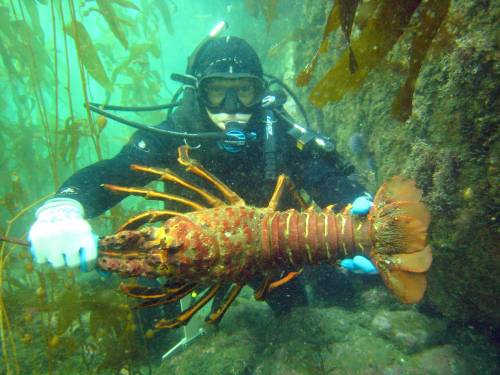
Measuring lobsters safely
Question: I use a hoop net to catch lobsters. Is there a change to the regulations to allow me to measure my lobsters on the pier? (Robert M., Oceanside)
Answer: In response to safety concerns over lobster fishermen pulling up hoop nets and leaning over the boat in an attempt to measure lobsters at the surface of the water, the California Fish and Game Commission amended the regulations related to measuring lobster from a hoop net.
Lobster fishermen who use hoop nets are now authorized to bring lobster onto a boat, pier or platform from which they are fishing to immediately measure lobster from their hoop nets. Any sub-legal sized lobsters must still be returned immediately to the water after measuring. Recreational lobster divers are still required to measure all lobster while in the water. It remains unlawful to hold onto undersized lobsters, leave them on the deck of your boat, or place any sub-legal sized lobster into any type of receptacle by either divers or hoop netters.
CCR Title 14, section 29.90 (c) states that the minimum size is 3 ¼ inches measured in a straight line on the mid-line of the back from the rear edge of the eye socket to the rear edge of the body shell.
Additionally, “All lobsters shall be measured immediately and any undersize lobster shall be released immediately into the water. Divers shall measure lobsters while in the water and shall not remove undersized lobsters from the water. Hoop netters may measure lobsters out of the water, but no undersize lobster may be placed in any type of receiver, kept on the person or retained in any person’s possession or under his or her direct control.”
For the rest of the regulations related to take of spiny lobsters, please see the rest of CCR Title 14, sections 29.90 and 29.91.
Hunting with a .223 caliber for deer
Question: Deer season opens soon and I’m wondering if I can legally use my Ruger Mini-14 rifle. It is a .223 caliber and has a 10-round capacity magazine. I have a hunting license and tags for D3-5. (James C., Placerville)
Answer: Yes, you can use the rifle you describe. California hunting regulations restrict the cartridge and bullet type for hunting big game, but not the rifle itself. In short, big game may only be taken by rifles using centerfire cartridges with softnose or expanding projectiles.
Pay close attention to be sure your .223 bullets fit this description, as most .223 bullets are manufactured with full metal jackets (FMJs), which would be unlawful to use.
It is best to buy .223 ammunition manufactured specifically for hunting. See the California Code of Regulations Title 14, section 353 for more details on authorized methods of take for big game.
Your 10-round magazine is also legal to use. The California Penal Code prohibits use of a magazine in excess of 10-round capacity. Good luck on your hunt!