 How to resolve AdBlock issue?
Recreation
- Details
- Written by: California Department of Fish and Wildlife
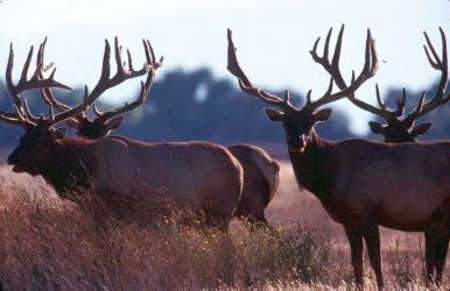
Question: Why does the California Department of Fish and Wildlife issue elk tags? Is it because herds get too large for the land to support them? What is the criteria? Are the animals ever relocated to other far away spots? (Allison H.)
Answer: CDFW does manage elk populations that, for example, get too large or are having conflicts with existing land uses. But that is not the only reason CDFW recommends limited harvest of elk.
CDFW's mission is to manage California's diverse fish, wildlife and plant resources, and the habitats upon which they depend, for their ecological values and for their use and enjoyment by the public.
"Too large" is a subjective descriptor, and there are always going to be differing opinions on how many elk are too many. Tags are issued in areas where a limited harvest is appropriate. Historically, the number of tags issued is low compared to the overall population. This allows for a limited harvest while still allowing the population to expand in most areas.
In some areas where the population is causing damage to property or the population is healthy but there is not a lot of room to expand, CDFW will approve a higher level of harvest to maintain the current conditions (this has been the case at Grizzly Island Wildlife Area). Some of the relocations have not been that far from the source population.
In recent years, CDFW has augmented existing populations with elk relocated from restricted habitats that cannot expand. This is done in order to prevent elk populations from exceeding their carrying capacity and subsequent habitat destruction, and to assist with genetic diversity.
Sturgeon fishing
Question: If there are three of us in a boat fishing for sturgeon, and I catch a sturgeon and then tag and retain it, do I have to then totally stop fishing or can I rebait my line and fish for other species? (Jim K.)
Answer: If you are in the ocean, boat limits, as described by California Code of Regulations Title 14, section 27.60, do not apply to sturgeon, per section 27.60(c)(6), so you would be done sturgeon fishing for that day but can continue fishing for other species. Boat limits do not apply in inland waters either, so if you are in inland waters, you are also done sturgeon fishing for that day.
In either the ocean or bay you may continue to fish for other species, but it would be good practice to switch baits/gear set-up, techniques, etc. so that there is no question of your intent when an officer comes to conduct a compliance check.
Can I keep bones of animals that I find along the road?
Question: I saw an opossum dead on the side of the road (not playing possum, but actually dead!). I wanted to take it home to keep the bones but I left it there untouched because I didn't know the laws on that. If I find an animal like that, can I take it home and process it? If I can't, is there anyone I can talk to about keeping the bones after the state processes it? (Wynter P.)
Answer: Road-killed wildlife may not be retained by the driver of the vehicle that hits the animal, nor by anyone else. Only authorized personnel of state and/or local agencies are permitted to dispatch and remove injured or dead animals (Fish and Game Code, section 2000.5).
In addition, some teachers or instructors can obtain a scientific collecting permits to retain road killed specimens for educational purposes as specified in CCR Title 14, section 650.
How much digging is too much?
Question: We are heading to the North Coast soon and are planning to camp out and go clamming. How much help can I give my 5-year-old son who will be digging for clams with us for his first time? I want to be able to help him as much as he needs but don't want the clams he digs up to count against my individual bag limit? Can I use the shovel and dig the hole for him while he uses his hands to dig around further and retrieve the clam? I will just be helping him to access the clam, but he will be retrieving it himself. (Harvey T., Stockton)
Answer: People have been cited for taking an overlimit of clams by doing exactly what you describe above. You can teach your son how to dig, but you cannot dig his limit of clams for him. Part of taking the clam is digging for it, so he would need to do the work. If you feel you are "doing it for him," you are probably helping him too much.
If he is too young to dig for clams himself, he will probably need to wait until he is old enough to do so. Otherwise, you two can dig for clams together, and we encourage you to do just that so he learns, but they will all become part of your limit.
If you have a question for the California Department of Fish and Wildlife, email
- Details
- Written by: California Department of Fish and Wildlife
A projected return of 379,600 spawning Sacramento River fall-run Chinook Salmon to Central Valley rivers has allowed fishery managers to return to a two salmon daily limit with four salmon in possession.
This is a welcome increase over last year's regulations, which restricted anglers to one salmon per day and two in possession.
The Klamath River fall Chinook Salmon ocean abundance forecast of 274,200 adults allows anglers a daily limit of two Chinook salmon, no more than one of which may be greater than 22 inches, and a possession limit of six, of which only three may be greater than 22 inches.
"It is excellent that the predicted Central Valley returns are high enough to offer anglers the opportunity to take two salmon daily and four in possession," said California Department of Fish and Wildlife Fisheries Branch Chief Kevin Shaffer. "Klamath River fall Chinook Salmon returns are predicted to be above average, and that should provide good angling opportunity."
State and federal fisheries managers crafted conservative ocean seasons to return even more Sacramento fall-run Chinook Salmon back to the spawning grounds than normal this fall.
This is required under the federal Fisheries Management Plan because long-term stock abundance has fallen below minimum management goals after several recent years when spawning salmon returns were too low.
Inland fishing seasons adopted by the California Fish and Game Commission reflect this ongoing effort to rebuild stocks while providing angling opportunity.
The following bag, possession limits and seasons were adopted by the California Fish and Game Commission at its meeting earlier this week.
Central Valley rivers:
Daily limit of two fish per day and a possession limit of four fish.
On the American and Feather rivers, the general season opener is July 16.
On the Sacramento River below Deschutes Road Bridge to the Red Bluff Diversion Dam, the season opens Aug. 1 and closes Dec. 16. From below the Red Bluff Diversion Dam to the Carquinez Bridge, the season opens July 16 and closes Dec. 16.
Chinook Salmon fishing opportunity was expanded on the Mokelumne and Feather River. On the Feather River, the season change will extend fishing opportunity by additional two weeks. On the Mokelumne River, almost 10 miles of additional habitat is open to salmon fishing.
Klamath River Basin:
Daily limit of two Chinook Salmon, no more than one of which may be greater than 22 inches, and a possession limit of six, of which only three may be greater than 22 inches.
The Klamath River adult fall run Chinook Salmon quota is 7,637 adults and the season opens Aug. 15 and closes Dec. 31, while the Trinity River opens to salmon fishing on Sept. 1 and closes Dec. 31. Seasons and areas with defined sub-quotas are subject to closure once the quota is reached in each subsection.
The 2019-20 sport seasons, dates, locations, bag limits and gear restrictions will be published in the 2019-20 Sport Fishing Regulations Supplement, which will be posted on the CDFW Web site in May.
Additional season information can be found on CDFW's ocean salmon Web page or by calling CDFW's ocean salmon hotline at 707-576-3429 or the Klamath-Trinity River hotline at 800-564-6479.
- Details
- Written by: California Department of Fish and Wildlife
CDFW strongly recommends that hunters acquire and practice with nonlead ammunition well before heading afield, particularly in advance of upcoming big game seasons, to make sure rifles are sighted in and to understand how their firearms perform with nonlead ammunition.
The nonlead ammo requirement includes hunting on public land, private property and licensed game bird clubs, and applies to rifles, shotguns, pistols and muzzleloaders in any gauge or caliber for the take of any legal species.
The nonlead ammo requirement extends to the legal take of nongame birds and mammals and includes firearms used for depredation to take species causing property damage.
The requirement does not apply to hunting with pellet rifles. Since pellet rifles are not classified as firearms, the use of lead pellets is allowed. Lead ammunition is allowed for target shooting where that activity is permitted.
California will become the first state in the nation to require nonlead ammunition for all firearms-related hunting.
California’s phase-in of nonlead ammunition for hunting originated with state legislation signed into law in 2013.
In 2015, the California Fish and Game Commission adopted regulations to phase in the requirement over time with full implementation July 1, 2019.
In recent years, with advances in technology and more states and the federal government restricting the use of lead hunting ammunition, manufacturers have responded with an increasing variety of nonlead ammunition offerings.
Nonlead ammunition has been required for waterfowl hunting nationwide since 1991, and many California hunters already have made a voluntary change to nontoxic hunting ammunition due to health and environmental concerns.
The first California hunting seasons impacted by the lead ammunition ban include the general rabbit season, which opens statewide July 1, and the A Zone general deer season, which opens Aug. 10 along much of the California coast.
CDFW advises hunters to shop carefully when purchasing nonlead hunting ammunition, particularly from out-of-state-based sporting goods stores and other mass retailers that may stock their California outlets with lead hunting ammunition in advance of upcoming seasons.
All ammunition in a hunter’s possession may be inspected by wildlife officers. Hunters are encouraged to assist in confirming compliance by retaining and carrying in the field ammunition boxes or other packaging.
For more information, please visit CDFW’s Nonlead Ammunition in California webpage at www.wildlife.ca.gov/hunting/nonlead-ammunition . For in-depth research and ballistics analysis of nonlead hunting ammunition, please visit www.huntingwithnonlead.org/index.html .
- Details
- Written by: California Department of Fish and Wildlife
Since opening day on May 1, many north coast anglers have braved less-than-perfect weather and ocean conditions and were successful in pursuing this highly prized fish.
Preliminary catch data available to the California Department of Fish and Wildlife, or CDFW, through the first five days of the fishery indicates almost 2,500 pounds of fish were caught.
“This is a level of success more typically seen during the summer months,” said CDFW Environmental Scientist Melanie Parker.
Again this year, the public can follow the progress of catch through the season compared to the quota on the CDFW Pacific Halibut webpage, which is updated weekly.
The fishery is scheduled to be open through Oct. 31, or until the quota has been met, whichever comes first.
The 2019 quota is 39,000 pounds, approximately 8,000 pounds greater than last year.
Up-to-date information on the status of the season can also be obtained by calling the National Marine Fisheries Service Halibut Hotline at 800-662-9825 or the CDFW Recreational Groundfish Regulations Hotline at 831-649-2801.
State regulations for Pacific Halibut automatically conform to federal regulations using the process described in the California Code of Regulations Title 14, section 1.95.
Federal regulations for Pacific halibut were published in Federal Register 84, section 17960, on April 29, 2019 and took effect as of that date.