 How to resolve AdBlock issue?
Recreation
- Details
- Written by: Elizabeth Larson
Both the Senate and Assembly Budget Subcommittees on Resources and Transportation approved the governor’s request for $3 million to carry out the next steps outlined in Sen. Mike McGuire’s landmark legislation SB 1029.
Separately, the North Coast Railroad Authority, or NCRA, Board of Directors approved a legal settlement, bringing an end to a near decade old bitter fight over its environmental impact report.
“It’s been a great week for the North Coast and for the Great Redwood Trail,” said Sen. McGuire. “Settling the lawsuit, which had gone on for way too long, allows for the next chapter to unfold. The $3 million requested by the governor and approved by the Legislative budget committees, will usher in a new day for the North Coast. The funds will be put to work to wind down NCRA and formally kick off the all-important master planning process for the Great Redwood Trail.”
The Assembly and Senate subcommittees overwhelmingly approved the governor’s request for the implementation funding.
This budget follows the course laid out by SB 1029, authorizing $1 million for an initial assessment of the right-of-way for the trail, $1.5 million for research on the estimated 1,900 property easements along the 300 mile rail-to-trail line, and $500,000 to complete the audit of NCRA’s finances and the possible transfer of a portion of the line to the Sonoma Marin Area Rail Transit District, or SMART.
These findings will help facilitate the closure of NCRA and the transfer of the right-of-way to successor agencies.
In another major development, after hiring new legal counsel earlier this year, the NCRA Board of Directors authorized its staff to begin settlement negotiations with the litigants in the environmental impact report lawsuit that reached the California and US Supreme courts.
NCRA counsel met with the Friends of the Eel River and Californians for Alternatives to Toxics, co-litigants in the case, and worked out an agreement that involves decertifying the controversial EIR and approving legal fees already awarded by the court.
“Resolving the issues that have plagued this rail line over the last 30 years will not be quick or easy, and we know there is a lot of work in front of us. That said, we’re off to a strong start and have made dramatic progress over the last year, and I’m excited to start working with the community on the ultimate design of the Great Redwood Trail and beginning the transition of a functionally bankrupt rail agency to a thriving trail organization,” Sen. McGuire said.
The trail will replace the crumbing railroad on much of the 300-mile-long track, and will become a significant economic driver for the rural North Coast communities it winds through.
California outdoor recreational economy is one of the fastest growing economic sectors of the Golden State. It generates over $92 billion a year, is responsible for nearly 700,000 jobs, over $30 billion in wages, and brings over $6 billion in tax revenues back to state and local communities.
Once completed, the trail will attract hundreds of thousands of locals and visitors alike to hike this spectacular landscape and inject needed funds into the greater North Coast region.
Earlier this year a whopping $32 million was secured to build out urban portions of the trail in Marin, Mendocino and Humboldt counties. The funds came through trail grant programs from both the California Transportation Commission and the Metropolitan Transportation Commission.
- Details
- Written by: Dorothy De Lope
This requirement which became effective Jan. 1, 2018, is being phased in over a period of seven years.
The next class is scheduled for April 20 from 8:30 a.m. to 4:30 p.m. with the cost being $25 per person. Reservations are required.
As of Jan. 1, 2019, any person 25 years old or younger will be required to have in their possession this boater card.
The new boating law also states that when supervising a younger person who is operating a vessel, the supervisor or young person must have a boater card in their possession.
This includes operating all motorized vessels including personal water crafts on any waters in the jurisdiction of the state.
For location of class and additional information, please contact Flotilla Public Education Officer Betty Strach at 707-657-3029.
Dorothy De Lope is public affairs officer for Flotilla 88.
- Details
- Written by: John Jensen
Newton, the club president, said Sunday's tournament included nine boats and 18 anglers using a variety of artificial baits.
"Pretty much everybody caught limits," he said. “It was all good, the bite was good. It was a good trip."
While all anglers got limits, the top three winners were:
– First place: Tracy Newton, 18.42 pounds;
– Second place: Jeff Klinstiver, 16.68 pounds;
– Third place: Kelley Allard, 15.56 pounds.
Newton said the club fishes Clear Lake a couple of times each year with plans to return to Lake County again on July 13.
Founded in 1975, Bass Busters of Yuba City is one of the oldest bass clubs on the West Coast, Newton said, adding that he joined when he was 18.
Email John Jensen at
- Details
- Written by: CALIFORNIA DEPARTMENT OF FISH AND WILDLIFE
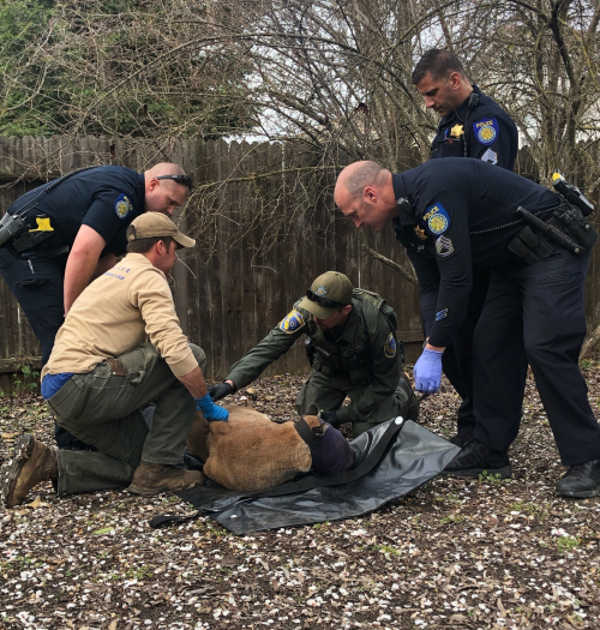
‘Translocating’ mountain lions
Question: Recently in Sacramento, a mountain lion somehow ended up in the suburban neighborhood of Natomas. I read online that biologists tranquilized it and moved it out of the area. No one was hurt (including the lion) and it seems like a good ending to the story all the way around. But I noticed a lot of people online are commenting that it's actually against state policy to translocate a mountain lion. Can you explain why this lion was moved? (Marie)
Answer: Thank you for asking. "Translocation" is an often misunderstood concept. The California Department of Fish and Wildlife uses the term to describe the action of purposefully taking an animal out of suitable habitat in one area, and moving it to suitable habitat in another area. In many cases, this is done to encourage a struggling species to repopulate in a new area (for example, bighorn sheep herds or sage-grouse). Mountain lions are not threatened or endangered in California, and we do not currently "translocate" them in this sense.
There are times when wildlife take a wrong turn and end up in unsuitable habitat - as was the case of the lion that ended up in the Natomas neighborhood. When possible, CDFW staff can and do make the call to tranquilize an animal so it can be moved from the unsuitable habitat to the nearest suitable habitat (in the case of the lion in Natomas, the nearest suitable habitat was determined to be the Placer foothills). Providing an animal with the means to escape an unsafe situation is not considered "translocation," but rather relocation.
Catch and cook
Question: I have some questions on "catch and cook." If we are on an overnight fishing trip and want to cook what we've caught, is it legal for us to do so? Is catch and cook legal? If so, how do I show that the fish (if it's a species with a size limit) that I'm cooking is of legal size?
I spoke to some CDFW officials who told me that it is okay to cook our catch as long as they are fish that have no size limits. They also told me that for the species that do have size limits, we just need to keep a picture or video of the fish to show they are of legal size. Is that true? (KACA)
Answer: No, your interpretation is not correct. It is unlawful to possess either on a boat or to bring ashore any fish in such a condition that its size, weight or species cannot be determined (Fish and Game Code, sections 5508-5509). You must keep them in an identifiable condition until they have been prepared for immediate consumption.
The law is not intended to prevent anglers from eating their legal catch as this is fairly common on boats with cooking facilities, such as houseboats on lakes and larger boats at sea. You should only clean your catch immediately before it is eaten, and only clean the number of fish/invertebrates you plan to eat during that meal.
There are a number of fillet laws that allow you to clean many ocean finfish species (check the California Code of Regulations Title 14, section 27.65 on page 34 of the ocean regulations booklet.) All fillets must be in the condition listed unless they are being prepared for immediate consumption.
In inland waters, there are no provisions for filleting on a lake/reservoir. The possession of fillets in this situation could only occur if the fish is being prepared for immediate consumption. A photograph or video, just like a retained carcass in a bucket, cannot be established to belong to that specific fish. Remember that daily bag limits always apply whether the fish is on a stringer, in a live well or in your stomach after a meal. If you are at a campground or ashore, you could fillet your fish for cooking.
Showing photos or videos to a wildlife officer to prove what you have filleted will not suffice. If the officer has any questions as to what species the fish is or if they have any reason to believe that it may have been a species with size or species regulations, they will cite you under the two code sections mentioned before. The officers cannot measure a picture or be 100% certain that the photos/videos you provide are the same fish you have already filleted.
If you have a question for the California Department of Fish and Wildlife, email