 How to resolve AdBlock issue?
Recreation
- Details
- Written by: California Department of Fish and Wildlife
If you would like to fish the rest of the year, you can purchase a license online through CDFW’s Web site.
“Free Fishing Day is a great opportunity for seasoned anglers to introduce friends and neighbors to their love of the sport,” said California Department of Fish and Wildlife Director Charlton H. Bonham.
A basic annual resident sport fishing license in California currently costs $49.94, while a one-day sport fishing license costs $16.20.
CDFW offers two Free Fishing Days each year – usually around the Fourth of July and Labor Day weekend – when it’s legal to fish without either an annual or one-day license.
This year, the first of the two Free Fishing Days falls on the Saturday of Independence Day weekend. The second will be on Saturday, Aug. 31.
All fishing regulations, such as bag and size limits, gear restrictions, report card requirements, fishing hours and stream closures remain in effect.
Every angler must have an appropriate report card if they are fishing for steelhead or sturgeon anywhere in the state, or salmon in the Smith and Klamath-Trinity river systems.
Anglers can review the sport fishing regulations online or use CDFW’s mobile Web site to view freshwater limits and regulations specific to a body of water.
Please note: CDFW has recently been made aware of customer complaints that third party websites are offering California fishing licenses for sale at greatly inflated prices. The agency urges customers not to provide credit card numbers, Social Security numbers or any other personal information to these sites.
The CDFW Web site, license and revenue branch locations and CDFW license agents are the only state-authorized sources for California fishing licenses.
- Details
- Written by: Nadine Strauss
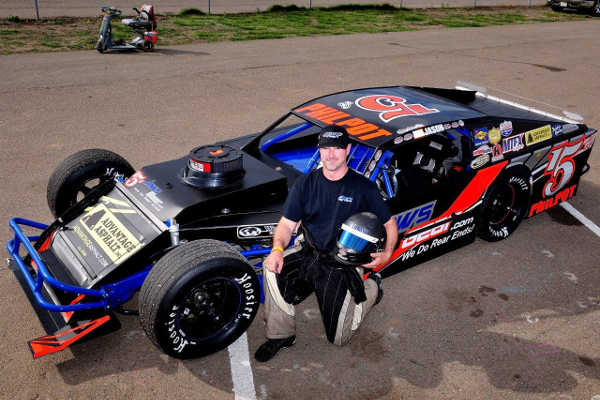
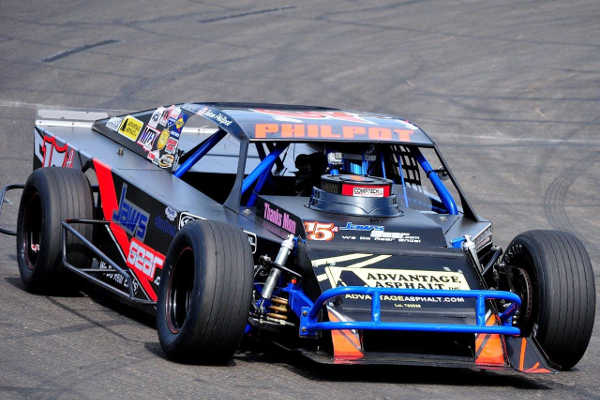
ANDERSON, Calif. – Jason Philpot of Sacramento took the lead away from Oregon driver Rich Cobb on a lap 14 restart, and held off the challenges of Medford, Oregon’s Randy Houston the final 30 laps to capture his first season victory in the North State Modified Series, presented by Protect the Harvest, at Shasta Speedway Saturday night.
Santa Rosa’s Cameron Austin finished a strong third, and with setting fast time over the 14 car field, regained the NSMS points lead from Robbie Knittel of Lodi.
Austin’s fast time was a 16.407, Charlie Collins, on his first run with NSMS in several seasons, clocked in second with a 16.442 second lap. Darrin Knight was third (16.747) and Knittel was fourth (16.503). Austin drew the number 10 chip to set up the staring grid, placing Ian Elliott and Cobb in the front row.
Cobb darted out in front at the start of the 60 lap feature with Philpot driving the high side around Elliott on lap five. Both Houston and Keith Bloom swapped places with Elliott on lap seven as Cobb and Philpot were pulling away from the pack.
Bloom lost power and stalled on the track on lap 12 to bring out the first yellow flag. He pitted and returned to take the next green flag. Cobb and Philpot ran side-by-side the next two rounds before Philpot took control of the race. The race was slowed again two rounds later when Bloom and Herman Pulyer made contact.
The restart saw Darrin Sullivan drive under Houston for third as Austin and Knittel were battling for fifth. Pulyer spun on lap 33 for another caution. Houston swapped places with Sullivan on the restart, inched by Cobb two circuits later, and set his sights on Philpot.
Pulyer lost a rear end, spilling grease the entire length of the front-stretch, resulting in a lengthy cleanup. When action resumed Austin powered by Cobb for third. With only nine laps to go Knittel drove under Cobb, and at the Sunoco checkered flag it was Philpot, Houston, Austin, Knittel and Cobb. Next across the line were Knight, Bloom, Collins, Sullivan, Elliott, Stuart Campbell and Sal Lopez.
Cobb won $100 in the Lucas Oil Dash for Cash. Bloom collected $50 for second. They both took home Lucas Oil products as well as the Scribner jugs. Philpot earned the Naake Shocks certificate.
Austin was named the Keyser Hard Charger for passing the most cars. Frank's Radios gift cards went to Houston, Campbell and Pulyer.
The next North State Modified series race will be at All American Speedway in Roseville, Ca on July 6.
The North State Modified Series is presented by: Protect the Harvest, Lucas Oil, Hoosier Tire West, Sunoco Race Fuels, Naake Suspension, Five Star Bodies, Racer Bling, Keyser Racing Products, Scribner Plastics, Gone Fishin' Marine, and Franks Radios.
HOOSIER TIME TRIALS:
Cameron Austin, 16.407; Charlie Collins, 16.442; Darrin Knight, 16.474; Robbie Knittel, 16.503; Randy Houston, 16.552; Darrin Sullivan, 16.577; Jason Philpot, 16.659; Keith Bloom, 16.746; Rich Cobb, 16.771; Terry Deal, 16.803; Stuart Campbell, 17.151; Sal Lopez, 17.161; Herman Pulyer, 17.290; Rick Avila, 17.386
LUCAS OIL DASH FOR CASH:
Rich Cobb, Keith Bloom, Ian Elliott, Jason Philpot Sal Lopez Stuart Campbell
PROTECT THE HARVEST / SUNOCO MAIN EVENT:
Jason Philpot, Randy Houston, Cameron Austin, Robbie Knittel, Rich Cobb, Darrin Knight, Keith Bloom, Charlie Collins, Darrin Sullivan, Ian Elliott, Stuart Campbell, Rick Avila, Sal Lopez, Herman Pulyer
- Details
- Written by: California Department of Fish and Wildlife
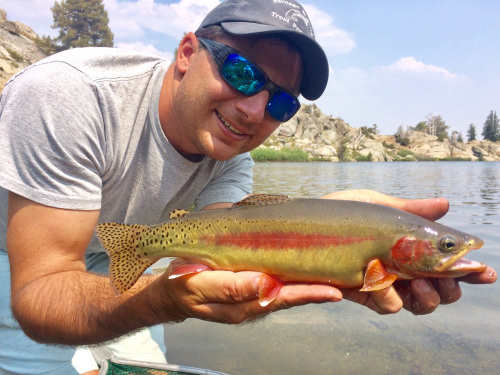
Question: I have to do a report on the California golden trout at my school. Is the California golden trout important to California because it looks colorful, or is it because the state of California is called the ''Golden State'' and the fish's colors are close to looking gold? California golden trout are amazing fish to me! (Kaito N., 4th grade)
Answer: What a great school project! We hope the project helps you develop a better appreciation not just for golden trout, but for all of California's native fishes.
Golden trout were first described by fish biologists in 1892 and were named golden trout because of their brilliant golden yellow body color.
Some say they are the most beautiful trout in the world. They were designated as the official state fish of California in 1947, in recognition of their great beauty and because they are native only to California.
Other state symbols, such as the golden poppy (state flower) were also designated for the same reasons; they are distinctive to California.
We encourage you to establish a goal to see golden trout with your own eyes in its natural habitat. (Hint: it may require you to hike to a high elevation stream!)
If your family enjoys fishing, you might also want to check out the Western Native Trout Challenge, a recently launched program that challenges anglers to catch native trout in their home state, at their own pace. California golden trout is included on California's list!
Bears in urban areas?
Question: It seems like there have been a lot of instances of bears in urban areas recently. I've heard of several cases where the California Department of Fish and Wildlife (CDFW) had to tranquilize a bear and move it out of a residential neighborhood. Why does this seem to be happening more frequently? (Stephanie)
Answer: Yes, there's been an increase in the number of bear calls, compared to other times of the year. But that's something we see every year in the springtime. A lot of these bears are two-year-olds that are venturing out on their own for the first time. They're exploring their surroundings, following food and water sources, and they sometimes take a wrong turn and end up where they're not supposed to be.
Sometimes adult bears can find themselves in a similar predicament. Bears are in search of food (and sometimes mates) this time of year, and that search can lead them into areas with a dense human population.
Often these bears can find their own way home, given enough time and space. In some cases, if there are too many people or other reasons why the bear cannot safely retreat to the wild on its own, CDFW staff will intervene.
We recently published a list of seven things to know about California bear activity that you might find interesting.
Boat owner liability?
Question: I'm the owner of a small recreational boat for ocean fishing. If somebody on my boat violates Fish and Wildlife laws (such as a hook barb not completely removed for salmon fishing), am I liable in any way for this violation? What are my legal "game law" responsibilities for my boat guests? (John S.)
Answer: In ocean waters, boat limits apply to all persons on board. "All persons aboard a vessel may be cited where violations involving boat limits are found, including, but not limited to the following violations: A-Over limits: B-Possession of prohibited species: C-Violation of size limits: D-Fish taken out of season or in closed areas" (California Code of Regulations Title 14, section 27.60). If the issue is illegal gear, the officer will try to determine who was using the illegal gear.
Regulation books are usually available wherever fishing licenses are sold, via our website, or your phone. We encourage California anglers to learn ahead of time what regulations may apply to the species of fish you are targeting and the location where you are fishing. Understanding the regulations helps everyone enjoy their time out fishing.
Ownership of alligator or crocodile parts in 2020
Question: I have heard starting in 2020 that the sale of any alligator or crocodile parts will be banned in the state. What if a person acquires parts (like a skull, teeth or hide) before the law goes into effect? Will they be able to possess their parts but just not be able to sell them? (Christian F.)
Answer: Yes. Once the ban goes into effect on Jan 1, 2020, it will be a misdemeanor punishable by a fine between $1,000 and $5,000 "to import into this state for commercial purposes, to possess with intent to sell, or to sell within the state, the dead body, or any part or product thereof, of a crocodile or alligator," per California Penal Code 653o.
People who already possess parts or products prior to when the ban goes into effect can continue to possess what they have, but they cannot sell these items.
If you have a question for the California Department of Fish and Wildlife, email
Draft California Waterfowl Habitat Program proposal solicitation notice available for public comment
- Details
- Written by: California Department of Fish and Wildlife
The passing of Proposition 68 in June of 2018 approved $10 million in funding for the program.
Created by the California Waterfowl Habitat Preservation Act in 1987, the CWHP provides technical guidance and economic incentives to private landowners who agree to manage their properties in accordance with a wetland management plan developed cooperatively by CDFW biologists and participating landowners.
These plans are designed to contribute to large-scale conservation objectives identified by the Central Valley Joint Venture, a coalition of 21 state and federal agencies and private conservation organizations that directs efforts to provide for the habitat needs of migrating and resident birds in the Central Valley.
CDFW will be holding a public meeting to provide information about the priorities and requirements of the 2019 CWHP PSN, and gather public input and comments that will help finalize the solicitation.
The meeting will be held July 3 from 10 a.m. to noon at the CDFW Wildlife Branch second floor conference room, 1812 Ninth St., Sacramento, Calif. 95811. This facility is wheelchair accessible.
Members of the public may also submit comments in writing to
All comments received by 5 p.m. on July 21, 2019 will be considered by staff prior to finalizing the solicitation.
To view the draft 2019 California Waterfowl Habitat Program proposal solicitation notice, please visit www.wildlife.ca.gov/lands/cwhp/private-lands-programs/waterfowl-habitat .
For additional information, please email