 How to resolve AdBlock issue?
Recreation
- Details
- Written by: Editor
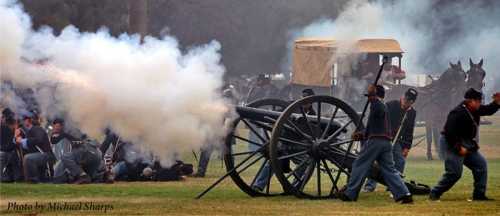
LAKEPORT, Calif. – On Friday, Oct. 26, starting at about 7:30 p.m., Lakeport will experience the booming of a Civil War cannon being fired due to this year’s Bass Bowl having to be moved to Lakeport.
The game had to be moved due to some safety concerns with the Kelseyville High School stadium bleachers.
The cannon was a feature of last year’s Bass Bowl. It fired to open the game, at half time, to end the game and after each score.
Last year’s final was Clear Lake High, 7, and Kelseyville High, 3, so it fired just five times. But this year, much more scoring is expected, so the cannon could fire as many as 10 to 15 times.
Regardless of the length of the game, it will not fire after 10 p.m.
“Residents in the vicinity of the stadium should take precaution with their pets who might be sensitive to the loud booms of the cannon,” Bass Bowl Director Phil Smoley said. “It will be like New Year’s Eve or July 4 during the game.”
The cannon will be at the game courtesy of the California Historical Artillery Association.
“The Bass Bowl helped them with their ‘Civil War Days’ event last July, and in return, they bring an artillery team to the Bass Bowl. It makes the game much more entertaining, and it gives our local area a taste of living history,” Smoley said. “It is also a way for Lake County to commemorate the Sesquicentennial of the Civil War.”
This is the third year of the Bass Bowl. The series is tied 1 to 1.
Both communities are encouraged to attend the game, support their communities and watch the cannon fire.
For further information, contact Phil Smoley at 707-264-4905.
- Details
- Written by: Carrie Wilson
Question: I was recently told that I can hunt anywhere along the San Joaquin Delta for waterfowl as long as the boat is not moving and I don't use a motor to retrieve the ducks and geese. I am wondering if this is true or are there only specific areas where waterfowl hunting is allowed? (Ryan S.)
Answer: Many areas of the San Joaquin Delta are open to waterfowl hunting from a boat, but general laws do apply so you could not hunt or shoot a firearm within 150 yards of an occupied dwelling, cannot hunt on private property or within prohibited areas such as municipalities.
It is important to research your specific hunting area and know legal access points. No person shall pursue, drive, herd or take any bird or mammal from any type of motor-driven air or land vehicles, motorboat, airboat, sailboat or snowmobile (California Code of Regulations Title 14, section 251).
Exceptions are also listed, including 1) When the motor of such motorboat, airboat, or sailboat has been shut off and/or the sails furled and its progress therefrom has ceased, and it is drifting, beached, moored, resting at anchor, or is being propelled by paddle, oar or pole.
Although you cannot shoot a bird while your boat is under power, you can use your motor to retrieve dead waterfowl.
Lobster report cards
Question: I have a question regarding lobster report cards. I was wondering if I have to buy a new one every time I go out. The lady at the sporting goods store said I had to. This doesn’t seem right because the limit is seven lobsters and there are about 100 spaces to fill out. Please let me know as I don’t want to keep buying these every time if I don’t really have to. (Ryan T.)
Answer: No, you do not need to buy a new report card each time you go on a lobster trip. Here are some basic tips for filling out your card properly:
Prior to beginning lobster fishing activity, you must record the month, day, location and gear code on the first available line on the report card.
When you move to another location, switch gear or finish fishing for the day, you must immediately record on the card the number of lobster kept for that location using a particular gear type. New lines must be used when changing locations, days or gear types.
Enter only one gear type per line. Even if multiple gear types are deployed simultaneously, each gear type must be entered on its own line with the catch correctly split between the gear types.
Only a handful of cards are returned to the Department of Fish and Game (DFG) each year with every single line filled in – using new lines for each instance of changing gear, location, etc. will NOT cause you to have to buy a new card!
Make sure to write the correct information in each field (for example, don't enter the location code where the number of lobster is supposed to be). Use the location code number – do not write in the name of the location.
Fill in all of the fields. For example, if two locations are fished on the same day, fill in the date for both locations. If no lobsters are taken, fill in “0.”
An additional lobster report card may be purchased in the event an individual fills in all lines and returns the card.
All lobster report cards need to be returned, even if no lobster were taken. In the event a card was bought but not used, you should write, “did not lobster fish” across the card, and turn it in.
DFG will accept late cards but the data is important for monitoring the fishery, so returning it by the deadline helps greatly.
One last thing, don’t forget to use indelible ink.
Carrying a sidearm while upland and small game hunting?
Question: I am a person who does everything by the book and I have a question regarding sidearms while hunting. Is it legal to carry a sidearm for protection while upland game bird and/or small game hunting or is it considered a method of take and illegal? If it is legal, does the lead-free ammunition restriction apply when in the condor range? (Bao N.)
Answer: Yes, it is legal to carry a sidearm for protection while upland game bird and/or small game hunting as long as you don't use it to take the game.
If hunting in condor country, the ammunition for your sidearm must be lead-free.
Carrie Wilson is a marine biologist with the California Department of Fish and Game. While she cannot personally answer everyone's questions, she will select a few to answer each week. Please contact her at
- Details
- Written by: Editor
CLEARLAKE, Calif. – Glory Days Flag Football League will hold an open scrimmage on Saturday, Oct. 27.
The scrimmage will begin at 10 a.m. Austin Park, 14077 Lakeshore Drive, Clearlake.
As the name implies, this is an open style scrimmage that any adult (18 years or older, unless with signed parental consent) who wants to play flag football can attend for free.
This is a good way for individuals or teams to get orientated to the league, which will begin the 2012-013 Winter Season on Saturday, Nov. 17.
They also are hoping to find people who are looking for an “active lifestyle change” opportunity other than playing, by volunteering to help them officiate. Since the league can provide training, no experience is necessary.
Please contact Bob Hopkins, 707-994-4720/707-350-1411, or Vince Lamb, 707-295-0223, if you’re interested, visit the league on Facebook or at www.HTOsports.com/?GDFFL1 .
- Details
- Written by: Carrie Wilson
Question: While out lobster fishing last weekend, I caught a lobster with a tag attached to it. What should I do with it? (Anonymous, San Diego)
Answer: Most lobster tags are small colored strips of plastic inserted into the underside or back of the lobster.
Look closely for a unique identification code (tag number) and phone number (or Web site) printed on the tag.
Please record the date, location where the lobster was caught (GPS coordinates are best, but distance to a recognized landmark will work if you don’t have a GPS), the carapace length of the lobster (to the nearest millimeter, if possible) and the tag number.
All four pieces of information (date, location, length and tag number) are important when reporting a tagged lobster to scientists.
Lobsters may be brought to the surface to measure. However, if the lobster is less than legal size and is tagged, please quickly record the number on the tag and immediately release the lobster. Do not remove tags from any short lobsters.
No undersize lobster (even if tagged) may be brought aboard a boat, placed in any type of receiver or retained in any manner.
In 2011 and 2012, scientists from the Department of Fish and Game (DFG), San Diego Oceans Foundation, San Diego State University and the Scripps Institution of Oceanography in La Jolla collaborated with lobster fishermen and volunteers on a project to tag and monitor thousands of lobsters in Southern California.
By reporting tagged lobsters, the data can then be analyzed to determine current abundance levels, size composition of the population, and movement and growth of individuals over time.
To learn more about the tagging programs or to report a lobster tagged with a blue, yellow, or green tag, please visit www.taggedlobster.com .
Road hunting
Question: How far off the road must one be to begin hunting/shoot an animal? I see guys hunting ditches just off the road for pheasants all the time. Also, what constitutes a “road” for this purpose? (Michael O., Woodland)
Answer: There are several laws that apply to what you describe.
Most counties regulate the distance from a public roadway a firearm may be discharged under a county ordinance. Many counties require 150 feet, but this is highly variable and you would have to check with your county to find out.
It is always unlawful to negligently discharge a firearm, and California Penal Code, section 374c prohibits the discharge of a firearm from or upon a public road or highway.
Fish and Game Code, section 3004(b) makes it unlawful to discharge a firearm or release an arrow or crossbow bolt over or across any public road or other established way open to the public in an unsafe and reckless manner.
Definitions for road and roadway can be found in sections 527 and 530 of the California Vehicle Code.
Bear bait
Question: I live on a 50-acre ranch and want to hunt bears this year. I have been using a single bale of alfalfa as an arrow stop to practice shooting my bow on the ranch.
Would this alfalfa bale be considered feed, bait or a material capable of attracting a bear in section 365 of the regulations? If so, how many days must I wait before hunting bear? (Bret G.)
Answer: Bears are more likely to be attracted to fruits and vegetables and meat products rather than alfalfa. As long as the bears aren’t attracted to the alfalfa then it would not be considered bait.
However, if the alfalfa does prove to be an attractant, you will need to completely remove it and not hunt within 400 yards of the area for 10 days.
“Baiting” for bears is prohibited and this means placing or using any feed, bait or other materials capable of acting as an attractant for the purpose of taking or pursuing bears (California Code of Regulations Title 14, section 365(e)).
A “baited area” is defined as any area where shelled, shucked or unshucked corn, wheat or other grains, salt, or other feed whatsoever capable of luring, attracting or enticing such birds or mammals is directly or indirectly placed, exposed, deposited, distributed or scattered, and such area shall remain a baited area for ten days following complete removal of all such corn, wheat or other grains, salt or other feed (CCR Title 14, section 257.5).
Carrie Wilson is a marine biologist with the California Department of Fish and Game. While she cannot personally answer everyone’s questions, she will select a few to answer each week. Please contact her at