 How to resolve AdBlock issue?
Recreation
- Details
- Written by: Editor
The California Department of Fish and Game (DFG) has created and posted two different Steelhead Report and Restoration Card (SHRRC) location code maps to help anglers easily identify location code boundaries and accurately report their catch.
The newly available maps include a printable pocket guide for use in the field and an interactive, web-based, map that not only allows anglers to identify location code boundaries, but also helps them explore potential fishing areas within each location code.
Additional layers available on the interactive map can be used to help identify fishable waters, satellite images, topography, roads, and more.
A list of location code descriptions has also been posted to accompany these maps or act as stand-alone reference.
Both maps and location code descriptions can be found by visiting the SHRRC Web site at www.dfg.ca.gov/steelheadcard .
Steelhead are carefully monitored by DFG and have special fishing regulations. Anglers are responsible for knowing these regulations.
All wild steelhead caught must be released unharmed. Wild steelhead are identified by their intact adipose fin. Hatchery steelhead are missing their adipose fin and have a scar in place of the missing fin.
Anglers must have a valid California fishing license as well as a non-transferable Steelhead Fishing Report and Restoration Card in their possession when fishing for steelhead.
Complete fishing regulations can be found at http://dfg.ca.gov/regulations/ .
- Details
- Written by: Editor
HIDDEN VALLEY LAKE, Calif. – The HVL Men’s Niners Golf Club held a medal play tournament on Nov. 15.
The results were as follows.
- First Flight: Bill Brewster finished first at net 34. Tom Gibbs, Jim Wilson, and Dave Mann finished tied for second at 36.
- Second Flight: Bill Helt was first with 35. Mike Casolo and Jim Hodges tied for second with 36.
- Third Flight: Don Holland and Ed Carver tied for the top spot at 37. Jim DeRosa and Pete Gumina tied for third at 38.
Closest to the par 3 pins were Arch Madsen and Bill Brewster.
Chip-ins were scored by Bill Stricklan, Ed Carver and Bill Helt.
Thirty-eight men participated in this event.
Congratulations to Bill Brewster for earning the 2012 HVL Men’s Niners Golf Club Points Championship.
- Details
- Written by: Editor
NOAA Fisheries, the California Department of Fish and Game (DFG) and the Fishery Foundation of California recently completed removal of a 7-foot dam, re-opening more than six miles of spawning habitat for federally protected steelhead.
In the San Francisco Bay Area, fish barriers have been identified as a limiting factor for the steelhead population. The removal of this dam on Bear Creek, a tributary to San Francisquito Creek, will allow steelhead for the first time in decades to access historic habitat for spawning and rearing, and improve ecological connectivity for other fish and wildlife resources.
“With few streams left in the Bay Area that support self-sustaining steelhead populations, protecting and enhancing these watersheds is vital for the continued existence of these fish,” said DFG Environmental Scientist Kristine Atkinson.
Steelhead migrate as adults from the Pacific Ocean into freshwater streams and rivers to spawn. The dam at Bear Creek was on private property in Woodside and blocked fish passage for more than 60 years.
The population of steelhead native to Bear Creek, the Central California Coastal Evolutionarily Significant Unit was listed as threatened under the federal Endangered Species Act in 1997. DFG and NOAA’s Office of Law Enforcement worked collaboratively with the property owner to remedy the situation.
“Habitat loss and degradation is a high priority for us under ESA, and this case is a good example of how providing compliance assistance helps us solve problems collaboratively,” said Martina Sagapolu, acting Special Agent in Charge for NOAA’s Office of Law Enforcement’s Southwest Division. “Partnering with landowners as well as agencies such as DFG and NOAA Fisheries Restoration Center is critical to our success.”
The removal of the dam took two years to complete and cost approximately $30,000. Funding for the project was provided by both the private landowner and the National Fish and Wildlife Foundation’s San Francisco Bay Salmonid Habitat Restoration Fund.
“Recovery of threatened and endangered species is a tremendous, long-term challenge that offers lasting benefits to the health of our environment and communities,” said biologist Joe Pecharich, of the NOAA Fisheries Restoration Center. “Our work is far from over in the San Francisquito Creek watershed. There are still a number of barriers that DFG and NOAA are looking into for enhancement opportunities.”
- Details
- Written by: Editor
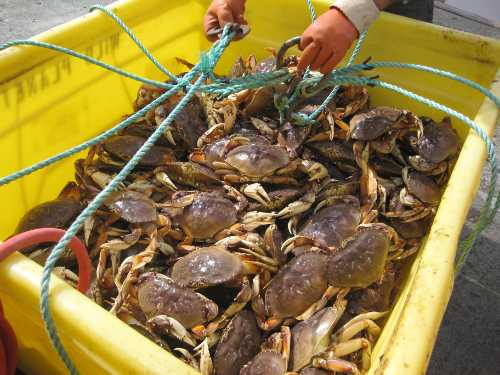
The commercial Dungeness crab season north of Sonoma County will be delayed at least two weeks to allow crabs more time to grow to ensure they are of suitable quality.
The California Department of Fish and Game (DFG) delayed the opening of the commercial Dungeness crab season after tests showed crabs in the area lacked the required body mass.
The decision means the scheduled Dec. 1 opening will be pushed back at least two weeks and possibly longer if the crabs need more time to mature.
The central California commercial Dungeness crab season is set to open on schedule Nov. 15.
The North Coast crab fishery is subject to tests to ensure the crabs are not harvested prematurely.
“Tests are routinely performed each year by the commercial fishing industry and market buyers to determine if the crabs are mature enough for harvest,” said DFG Environmental Scientist Christy Juhasz.
“Crabs ready for harvest should contain 25 percent of their body weight as meat. In tests performed two weeks ago, crabs from the North Coast contained only 16-18 percent body mass,” Juhasz added.
Additional testing will be done in December, and depending on those results a further delay could be ordered. A similar delay was implemented last year off the North Coast.
“Crabs from the Central Coast do not fall under the same restrictions and so their season will open as normal on Nov. 15. Fresh crab should then be immediately available to consumers, provided the fishermen and the markets can agree on market prices,” Juhasz said.