 How to resolve AdBlock issue?
Recreation
- Details
- Written by: Carrie Wilson
Question: I would like a definition of “stowed” in regard to fishing gear while transiting a state marine reserve.
The reason I ask is that a sport fisherman reported he was stopped by a patrol boat at the Channel Islands and told he could have been cited for having his rods in the rod holders. He was told he should have had them in his small cuddy.
It does not seem reasonable to require my buddies and I “stow” all our rods and reels in my cabin every time we need to make a move across a state marine reserve. Or when we are at an island, we should not be required to drive six miles out, then whatever distance across, and then back in another six miles … at $4 or more a gallon.
All of this would be quite a hardship for those of us fishing from private sport boats just to stow our fishing gear when maneuvering around state marine reserves. (Fred H., Anaheim)
Answer: There is no requirement for equipment to be stowed under the Marine Life Protection Act laws covered in section 632 of the California Code of Regulations Title 14. CCR Title 14, section 632(8) covers the law you are referring to as follows:
Transit or Drifting. Vessels shall be allowed to transit through marine protected areas and marine managed areas with catch onboard. Fishing gear shall not be deployed in the water while transiting through a state marine reserve. Fishing gear, except legal fishing gear used to take species identified as allowed for take in subsection 632(b), shall not be deployed in the water while transiting through a state marine recreational management area, state marine park or state marine conservation area.
How to catch an octopus?
Question: My Italian grandmother asked my brother and me to bring home some fresh octopus so that she can make her favorite pasta dish. The only problem is we don’t know how to catch them. Can you help us out? (Joe K.)
Answer: You will have to be creative on this one. Fortunately, there are no size limits on octopus and the bag limit for each of you is 35 (CCR Title 14, section 29.05(a)).
California sport fishing regulations allow you to catch them only by hook and line or with the hands (CCR Title 14, section 29.10(a)). You cannot catch them with traps or spears.
The most common way to successfully catch them in California is by hand while diving with snorkel or scuba equipment.
It’s also unlawful to use any chemicals, such as bleach, to attempt to disturb octopi from their hiding locations.
Use of electronic calls out of season?
Question: I was wondering if it is legal to use electronic calls for animals and birds out of season for things such as bird watching or scouting? I have heard yes and no from different people, so I want to clarify. Also is it even legal to call with non-electronic calls out of season? (Taylor F.)
Answer: Yes, this would be legal as long as you do not have any methods of take with you. The prohibition against electronic calls only applies when “taking” birds/mammals (Fish and Game Code, section 3012 & CCR Title 14, section 475(b)).
Don’t eat those mussels!
Question: We collected a few mussels at low tide at Chicken Ranch Beach with the kids (past the Inverness Yacht Club). They are of a decent size, about 3 to 4 inches, and all black. Are they safe to eat? (Ben)
Answer: Don’t eat those mussels! There is currently an advisory out against consuming sport-taken shellfish in Marin County – please see www.cdph.ca.gov/Pages/NR13-009.aspx .
A great Q&A about mussel quarantines is located at www.cdph.ca.gov/Pages/MusselQuarantineFAQ.aspx .
The California Department of Public Health shellfish biotoxin information line is 510-412-4643 or toll-free at 800-553-4133 – you can check with them at any time to see whether there are advisories in effect for your area.
And finally, the California Department of Fish and Wildlife (CDFW) posts advisories on the CDFW Web site at www.dfg.ca.gov/marine/healthadvisory.asp .
Carrie Wilson is a marine environmental scientist with the California Department of Fish and Wildlife. While she cannot personally answer everyone’s questions, she will select a few to answer each week in this column. Please contact her at
- Details
- Written by: Editor
COBB, Calif. – Join Mr. Mike & Ms. Gigi on a one-hour exploration hike of Boggs Mountain Demonstration State Forest on Sunday, May 19.
The hike, which takes place from 2 p.m. to 3 p.m., is suitable for preschoolers up to 121 years old.
Please bring water, a healthy snack, your invisible light saber and wear sturdy shoes.
They meet in the Boggs parking lot.
The forest entrance is located off Highway 175 just 1.5 miles north of Cobb Village. Turn at the blue State Fire Station/Boggs Mountain Forest sign.
For more information, email
Visit the Friends of Boggs Mountain Web site at http://boggsmountain.net/calendar/hiking-events/ for updates and changes to the schedule.
- Details
- Written by: Editor

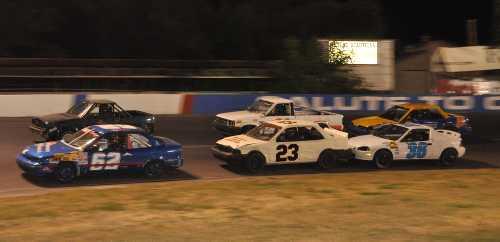
LAKEPORT, Calif. – It was the Founders Cup Night at Lakeport Speedway this last weekend, which saw the induction of four very important people to Lakeport Speedway and Northern California Racing Association.
The induction ceremony came prior to the start of the action-packed main events at the speedway and saw Rick Rose of Lakeport being inducted, along with Danny Bishop, Chuck Pruett and Arlene Pruett Lavoie.
It was a very good ceremony with many friends and families present.
Everyone who was there also got to experience the best short track racing on the West Coast.
In the Volvo Rents Mini Stock Division it was Mike Peterson starting on the pole with Chubbs Williamson starting on the outside pole.
At the drop of the green it was Chubbs who jumped out into the lead followed by Kyle Tellstrom. Tellstrom took the lead on lap 5 followed by Stillman.
A late race caution caused the two leaders to have to restart at the rear of the field and at the fall of the green flag it was Eddie Barnett that jumped out to the lead.
It was a short fought lead as he could not hold of the challenge of Tellstrom who made the pass for the lead again on lap 21 where he went on to take another victory at Lakeport Speedway.

In the Legend division it saw a very shortened heat race with only one lap being completed as a loose oil line caused the majority of the field to have to retire to the pits to make repairs.
This led to a very exciting main event which put Mark Miller on the on pole with Bill Kistenmacher on the outside pole.
It was Kistenmacher who took the early lead, only to be passed by Gilliland, who held the lead for a few laps but then was challenged by Ian Elliot who went on to win the main event over Gilliland.
In the Jammer division 16 cars took to the track, with both veterans and rookies on the track.
At the drop of the green it was Wayne Young and Scott Strugnell who were making their way up through the field.
An early race caution came out for contact between Amanda Smith and Casey Blocher. At the restart it was Young in the lead fighting off the challenges of Roy Ingalls Jr.
The race featured a lot of trading paint between drivers and the wall, but no cars were hurt very badly.
Young held the lead until lap 23 when lap traffic came in to play and Scott Strugnell was making a run for the border in his Taco Bell Jammer. At the Checkers it was Strugnell, followed by Young and Cubbage.
In the Jr. Jammers at the checkers it was Derek Jones in his first start taking the win and Roy Ingalls Jr coming in a close second.
The Gravitate Modifieds took to the track for an action packed race, and after an inversion pill of a two was drawn it put Mike Nielson starting on the pole with David Lyndall on the outside pole.
The two battled back and forth at the front of the field before Lyndall was able to assume the lead. Late race caution came out when contact between Sierra Furia and Alex Andrews caused Furia to spin into the infield.
At the restart it was another turn four incident that caused Byers to lose control and with Furia started right behind him, slowing to avoid the wreck and proceeding past, but Andrews was not as fortunate, striking the back of Furia’s car, sending him into the outside retaining wall ending his run for the night. At the checkers it was Lyndall, Nielson and Kuecker.
The Taco Bell Bombers took to the track with a full field of 20 cars and at the drop of the green it was Joey Brackett jumping out to the lead followed by Trevor Kollenborn.
It was Mike Collins and Eddie Klein working their way up from the back of the field while Brackett was making his way to extending his lead followed by Kollenborn. Brackett was holding a strong lead until Collins made contact with him in turn number three trying to make room for a pass for the lead, causing Brackett and Collins to go to the rear of the field.
On the restart contact between Taylor and Tim Buzzard Jr. sent the pair to the rear of the field. On the restart with only three laps to go it was Klein that jumped out to the lead not looking back to take the Taco Bell car on to win the Taco Bell Bomber main event, followed by Jesse Frey and George Abella.
The racing action continues this next weekend on Friday at Ukiah Speedway with the continuation of the Go-Karts next points’ race.
Then the racing action continues at Ukiah Speedway with the Midgets making this year’s debut at the race track along with Bandoleros, Extreme Asphalt Outlaws, Legend Cars and Jammers.
- Details
- Written by: Carrie Wilson
Question: My neighbor who lives a few houses down from me has a 15-year-old son who shoots his BB gun in his backyard. I used to shoot my bow in my backyard until my dad found out it’s illegal.
I am 13 and live in the mountains of Southern California (close to San Bernardino) and am hoping it might be legal to practice my archery by shooting down a dirt road? Can you please let me know ASAP? Thanks. (Ashmanger)
Answer: Generally, Fish and Game Code laws only regulate the use of archery equipment or firearms while hunting. However, the same rules for firearms apply to archery equipment in this situation – you may not shoot over or across a road or within 150 yards of a neighbor’s home, barns or outbuildings, even if just archery target shooting (Fish and Game Code, section 3004).
If you are on a private road on private property (off the public roadway), no Fish and Game Code law prohibits target practice with your bow and arrow.
Beyond this, different counties and communities may have more restrictive ordinances that they enforce so you should check with your local law enforcement office for this information.
The most important factor to always keep in mind is public safety. Well-traveled roads and highways, or even those occasionally traveled, are not appropriate places to shoot.
If you were to injure another person or livestock, or damage property, you could be subject to civil and possibly criminal prosecution. While shooting even just off a road may be legal, it may not be safe.
Hooks for salmon in San Francisco Bay
Question: When fishing for salmon from the bank in the San Francisco Bay with spinning lures, is a single barbless hook ok or does it have to be a barbless circle hook attached to the spinning lure? (Terry D.)
Answer: Barbless circle hooks are only required when fishing with bait and angling by any means other than trolling. Since you're not using bait, no circle hooks are required, even though you are not trolling.
You must be doing both things – using bait, and fishing in a manner that is not trolling – to be required to use barbless circle hooks. In addition, you should be using no more than two single-point, single-shank barbless hooks with your spinning lure (California Code of Regulations Title 14, section 27.80.)
Fishing attractant or pollutant?
Question: I have heard that using WD-40 as a fish attractant works well. Is it legal to use? There seems to be much confusion as to what is actually in WD-40. I would also like to know if the sunscreen I put on before entering the water is hazardous to marine life. (Ray I.)
Answer: It is not legal to spray WD-40 on your fishing lures as an attractant. The same goes for any substance that may be harmful to fish (e.g. sunscreen).
WD-40 contains petroleum and is specifically prohibited by law to be deposited or introduced into the waters of the state (Fish and Game Code, section 5650).
When it comes to sunscreen, I would just try to use discretion as any foreign substance, even sunscreen, may carry chemicals that may be harmful to fish and other aquatic life if introduced in large enough quantities.
How to determine private vs. public property?
Question: How do I find if a body of water is legal to fish out of? I am wondering about a local lake with a public road that leads up to it. There are no private property signs posted anywhere. However, from a boat you can see signs are posted in some of the yards. (Anonymous)
Answer: Even though private property perimeters are required to be either fenced, under cultivation, or posted with no trespassing signs at one-third of a mile intervals (Penal Code Section 602.8) so the public knows or can determine correctly if the property is private, it’s best to stay on the safe side.
If you can’t find signs specifically prohibiting access, trespassing and fishing, you may want to contact your local sheriff’s office, which should be able to define which waters and properties are public, which are private and where the boundaries are.
Carrie Wilson is a marine environmental scientist with the California Department of Fish and Wildlife. While she cannot personally answer everyone’s questions, she will select a few to answer each week in this column. Please contact her at