 How to resolve AdBlock issue?
Recreation
- Details
- Written by: Editor
MENDOCINO NATIONAL FOREST, Calif. – Due to the incoming storm and flood predictions, the Mendocino National Forest facilities at Lake Red Bluff Recreation Area and Chico Resource Conservation Center were closed to the public Wednesday evening.
The Chico facility is scheduled to reopen to the public at 7 a.m. Friday. Lake Red Bluff is scheduled to reopen at noon Friday.
Both closures are formally referenced as Order Number 08-14-10 for Chico Resource Conservation Center and 08-14-11 for Lake Red Bluff Recreation Area. They will be available online at www.fs.usda.gov/mendocino .
In both areas, officials are concerned about high winds and the potential for falling trees, limbs and for dead branches to be dislodged. At Lake Red Bluff, anticipated flooding is also a factor.
“Public safety is our primary concern in these popular recreation areas,” said Acting Mendocino National Forest Supervisor John Exline. “Given the current forecast, this is the best way for us to protect our visitors until we are able to assess the situation after the storm and take needed measures to provide as safe a trip as possible.”
Roads on the Mendocino Forest are also a concern with the storm. Individuals planning a trip to the forest should be prepared not only for changing conditions, but also be watchful of roadways either impacted by rain or fallen trees and limbs from high winds.
While crews plan to start assessing popular areas Friday after the storm passes, visitors are asked to be aware and help report impacted roads.
If you come across an area where the road is compromised or washed out, please report it to Forest Engineer Shannon Pozas at 530-934-3316.
As winter conditions return to the Mendocino National Forest, all visitors are asked to be cautious when recreating on the forest, whether they are driving, hiking, camping or enjoying other recreational pursuits – including selecting a Christmas tree.
“While this wet weather is a welcome relief, it also presents some challenges for those who enjoy the Mendocino National Forest from late fall through spring,” said acting Forest Supervisor John Exline. “Changing conditions can present hazards to both visitors and forest resources. We want everyone to have a safe and enjoyable trip to the forest, while preserving resources so they can be enjoyed for years to come. To help with this, visitors are asked to be prepared for changing conditions, aware of their surroundings, and minimize impacts to saturated roads and trails.”
Many popular trails and some access points to recreation sites on the Mendocino involve crossing normally small creeks and streams.
Caution should be used at these stream crossings. People and vehicles can be swept away by currents in even relatively shallow water. Also, conditions can change rapidly and a stream that was easy to cross in the morning can become impassable by afternoon, trapping people on the wrong side.
Following are some additional safety suggestions for those recreating in the forest this winter:
– Plan your trip – check the weather, bring plenty of warm clothes, water, emergency food, tire chains, shovel and any other supplies necessary for the activity. Call to check if the area you are planning to visit is still open and accessible.
– Make sure you have a full tank of gas when you leave and are prepared for changing conditions in the mountains!
– Let someone know where you are going and when you plan to be back.
– Keep vehicles on designated roads and trails and be aware of changing weather and road conditions. Wet dirt roads can quickly turn to mud, making it possible to get stuck and causing damage to road, soil and water resources. If there are puddles in the road, mud flipping off the tires or you can see your ruts in the rearview mirror, consider pulling over to hike or turning around and finding a different area.
For more information, please contact the Mendocino National Forest at 530-934-3316 or visit www.fs.usda.gov/mendocino .
- Details
- Written by: Editor
NORTHERN CALIFORNIA – The American River Trout Hatchery operated by the California Department of Fish and Wildlife (CDFW) reopened this week after warm water temperatures forced the closure of the facility in early summer.
Colder winter temperatures and recent rain are allowing hatchery staff to begin filling the raceways with cooler river water and start to produce rainbow trout for planting in northern California lakes this summer.
“The drought forced us to think quickly and make the best decisions for the health of the fish,” said Dr. Bill Cox, CDFW Fishery Program Manager. “Because of the rain and colder weather, we can start producing trout right away.”
In June, CDFW moved all rainbow trout out of the American River Hatchery to avoid losses of young fish due to rising water temperatures.
Both Nimbus and American River hatcheries’ water supply comes from Lake Natoma, upstream of the hatcheries.
Drought conditions resulted in reduced water supplies stored in Folsom Lake and warm summer temperatures increased the water temperature of the available water, exceeding tolerable temperatures for growing fish.
The trout being grown now will be available for planting in state waters beginning in January 2015.
For the fish stocking schedule, please visit https://nrm.dfg.ca.gov/FishPlants/ .
For complete fishing regulations, please visit www.wildlife.ca.gov/Regulations .
- Details
- Written by: Editor
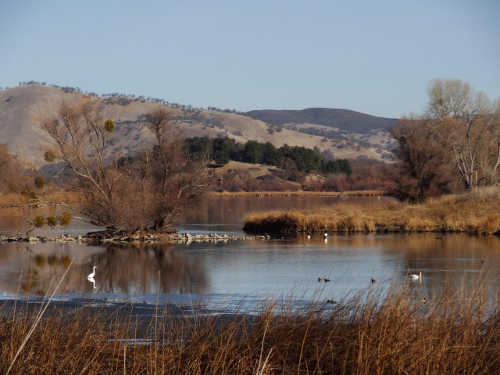
LOWER LAKE, Calif. – Anderson Marsh State Historic Park will hold a free, guided nature walk over the reopened McVicar Trail beginning at noon on New Year’s Day as part of America's State Parks First Day Hikes initiative.
The First Day Hikes offer individuals and families an opportunity to begin the New Year rejuvenating and connecting with the outdoors by taking a healthy hike on Thursday, Jan. 1, 2015, at a state park close to home.
First Day Hikes offer a great way to get outside, exercise, enjoy nature and welcome the New Year with friends and family.
Walkers on the McVicar Trail pass along the edge of Anderson Marsh and end up at the gravel beach on the lake across from Indian Island.
This will be a leisurely walk that will begin a noon and cover about 7 miles of mainly flat terrain.
The walk should take between three and four hours, depending on how many times the group stops to admire what we see along the way.
Participants are welcome to walk part way and make an early return at their own pace.
According to park docent Henry Bornstein, who along with Docent Gae Henry will lead the walk, “This is a fabulous opportunity to experience the Anderson Marsh Natural Preserve, with the McVicar Trail passing through grasslands, oak woodlands, willow and cottonwood riparian habitats and the tule marsh habitat of Anderson Marsh. Let’s get outside on New Year’s Day and share what we know about the geology and history of the area, and the flora, birds and other wildlife that we encounter on the walk.”
Participants should bring water and snacks and binoculars if they have them, and wear sturdy shoes and a hat. Rain will cancel the walk.
Anderson Marsh State Historic Park is located on Highway 53, between Lower Lake and Clearlake.
For more information about the walk, email
- Details
- Written by: Carrie Wilson
How well can waterfowl see?
Question: How well can ducks actually see? Can they see color? I know deer see different shades of gray, but what about ducks and geese? (David V.)
Answer: Waterfowl can control the curvature of both the lens and cornea (mammals, including humans, only control the lens). This is basically how birds can see extremely well while flying and while in the act of diving/feeding.
In addition, their eyes act independently and they use one at a time to allow for depth-perception since nearly all waterfowl have monocular, not binocular, vision (they can’t stare forward at objects).
Another unique thing about waterfowl is they can see in almost all directions. A few ducks are the exception to the rule, but usually the eye placement allows them to view in many different directions at the same time.
Secondly, waterfowl have a very high number of cones (which dictates color vision in humans) which allows them to see sharp images and have color vision where colors are more vivid than humans’ ability.
The breadth of color vision is much wider than our own since UV light can be observed by waterfowl (UV light is absorbed by lenses in humans). This allows waterfowl to fly at night or feed in the dark or at low light conditions.
Diving in MPA reserves with game onboard?
Question: If I am on a commercial sport diving boat and we have legally caught lobster on board, may we go into a marine protected area (MPA) to dive and be assured that we will not get a ticket if we are boarded?
We would of course have lobster report cards all properly filled out and the lobsters would be of legal size and taken beforehand in a legal area.
Can the boat operator be assured that he will not be cited as well? (Rusty B., Montclair)
Answer: If you have lobsters on board your vessel, you may not dive in a marine reserve with gear that can be used to catch lobster (California Code of Regulations, Title 14, Section 632 (a)(7) and (8)).
A person can't have their "fishing gear" deployed in the water when anchored or transiting through a marine reserve or other MPA that prohibits fishing for the species you have on board.
Thus, if a diver dives with a game bag and gloves, then it could be argued they have their lobster "fishing gear" in the water. If divers really want to dive in a marine reserve off their boat with catch on board, they should do everything possible to ensure it does not appear they will be pursuing/taking lobster. This would include stowing their completed lobster report card, along with the lobster and dive bags.
A diver wearing gloves and diving with a game bag, or anything else that could be used to take fish, lobsters or abalone (a large dive knife or long stick with a hooked device, etc.) would appear to have another purpose in mind besides sightseeing. It would then be up to the wildlife officer to determine the appropriate action.
Are rules for selling on eBay different?
Question: From my understanding, it is illegal to sell deer skulls, deer antlers or deer mounts in the State of California.
I know that eBay is based in California and they allow the sale of deer antlers, mounts and deer taxidermy.
Obviously, they are receiving money from the online sale of deer parts so how did that come about, and has there been special legislation to cover it?
Was this a decision allowed by the California government, California Department of Fish and Wildlife (CDFW) or has it just happened this way? (Nate H.)
Answer: Just because eBay is selling these things or allowing them to be sold, doesn't mean it's legal.
Fish and Game Code, section 3039 generally prohibits selling or purchasing any part of a bird or mammal found in the wild in California.
Complete antlers, whole heads with antlers, antlers mounted for display or antlers in the velvet may not be sold or purchased at any time.
However, shed antlers or antlers taken from domestically reared animals that have been manufactured into products or handcrafted items, or that have been cut into blocks or units which are to be handcrafted, may be purchased or sold. Deer hides can also be sold.
Who can validate big game tags?
Question: I have a question regarding who can validate big game tags. In the regulations booklet there is a list of persons who may validate/countersign big game tags, but I noticed there is no mention of County Agricultural Standards Inspectors.
Each county has Agricultural and Standards Inspectors and/or Agricultural Biologists and Standards Inspectors who enforce the laws and regulations of California.
Would a hunter be within their legal right to have their big game tag countersigned by such a person? (Andy R., Escondido)
Answer: No. Only those people listed in the regulations booklet are authorized to validate big game tags (CCR, Title 14, section 708.6).
Carrie Wilson is a marine environmental scientist with the California Department of Fish and Wildlife. While she cannot personally answer everyone’s questions, she will select a few to answer each week in this column. Please contact her at