 How to resolve AdBlock issue?
Recreation
- Details
- Written by: Editor
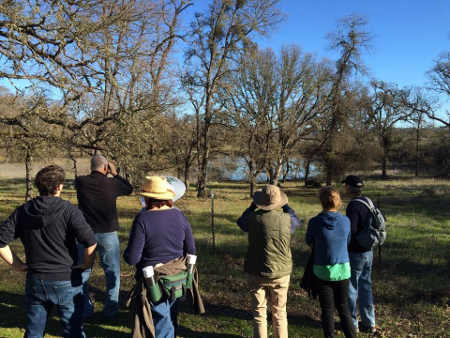
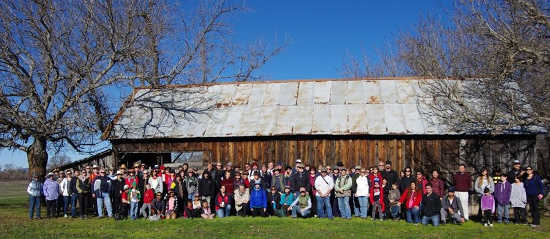
LOWER LAKE, Calif. – A large group of more than 110 people came to Anderson Marsh State Historic Park New Year’s Day as part of America's State Parks First Day Hikes program.
The First Day Hikes offer individuals and families an opportunity to begin the New Year rejuvenating and connecting with the outdoors by taking a healthy hike on Thursday, Jan. 1, at a state park close to home.
These hikes offer a great way to get outside, exercise, enjoy nature and welcome the new year with friends and family.
“Preliminary figures released by the state of California say that about 1,200 individuals participated in First Day Hikes in California State Parks,” said Anderson Marsh Interpretive Association (AMIA) Board member and park docent Gae Henry. “It’s incredible to realize that almost 10 percent of the first day hikers in California were at Lake County’s own Anderson Marsh State Historic Park.”
Beginning at noon on Jan. 1, two different hikes were offered through the park.
Led by AMIA volunteers and park docents Henry Bornstein, Gae Henry, Tom McFarling and former State Park Ranger Tom Nixon, both walks went through grasslands, oak woodlands and willow/cottonwood habitats.
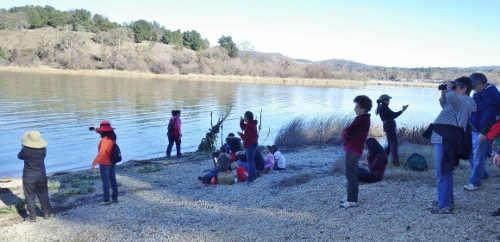
About 75 walkers took the McVicar Trail. This leisurely walk covered nearly eight miles of mainly flat terrain which passes along the edge of Anderson Marsh and ends up at the gravel beach on the lake across from Indian Island.
The walk took between three and four hours, depending on how many times the individuals stopped to admire what was seen along the way. Participants were welcome to walk part way and make an early return at their own pace.
Another group of about 35 walkers took a three and a half mile loop that included the Cache Creek, Marsh and Ridge Trails. Passing by a vernal pool near the end, this walk took about two to two and a half hours.
“It was wonderful to see so many Lake County residents taking advantage of this opportunity to start off the year right by getting out into nature,” said Bornstein. “We hope even more people will join us on next year’s Jan. 1 walk.”
Anderson Marsh State Historic Park is located on Highway 53, between Lower Lake and Clearlake.
For more information, email
- Details
- Written by: Carrie Wilson
When prohibited species are accidentally caught?
Question: I fly fish for calico bass using barbless hooks in the kelp beds off Catalina Island and the coast, and it’s all strictly catch and release.
Garibaldi are abundant in this habitat and are very aggressive. When I can see them I can usually avoid catching them. However, rarely one will take my fly inadvertently.
Since they are only lightly hooked through the lip, they survive the accidental catch and release.
However, it is illegal to “take” garibaldi. Is this considered illegal if caught by accident and then released? How can one avoid catching them? (Rick B.)
Answer: No, it is not considered an illegal action to accidentally catch a prohibited species as long as it is immediately released back into the waters it came from. Intentionally targeting a prohibited species IS illegal, but you do not seem to be doing that.
As for how to avoid catching them, that’s a tricky question. About the only thing you can try would be to use a larger hook (that the garibaldi might have problems taking into their small mouths), but fly fishing generally doesn't allow for use of larger hooks.
You may need to employ a bit of ingenuity to figure out how to reduce the number of garibaldi you end up hooking.
What to do with banded waterfowl?
Question: This past weekend a banded speckled-belly goose was taken at my duck club.
I’d like to report this banded bird to the authorities. The time, date and place, as well as the tag number seem obvious to report.
Is there any other information needed, and who should I report this band to? (Larry L.)
Answer: Since waterfowl are migratory, the U.S. Geological Survey has the responsibility of collecting and analyzing all banding information.
Government and private sector scientists and waterfowl managers tag and monitor migratory waterfowl every year. This banding information helps them to assess population numbers and track their movement patterns.
You may also be asked to provide information about weather and any other waterfowl the goose was flying with when taken. Please go to www.reportband.gov to report banded birds.
Capturing largemouth bass for a home aquarium?
Question: One of my friends has a large aquarium and is interested in putting some largemouth bass in it.
I would like to know what the regulations are for catching a largemouth bass in a local lake and then transporting it live to his tank.
It would never be released into a different body of water, and it would be taken legally. (Azure C.)
Answer: Transporting fish alive from the water where they are taken is prohibited (California Code of Regulations, section 1.63).
Laws allowing certain species of live fish to be maintained alive in closed-systems do not authorize possession in home aquariums.
Your friend can legally buy bass for his or her aquarium from a licensed aquaculturalist, as long as he or she does not release it into the wild.
Qualifications for a disabled access hunting site?
Question: I have always enjoyed duck hunting but now after several orthopedic surgeries on my hips and knees, I have considerable difficulty in walking.
In the outdoors I must use a staff and can go about 100 yards on a level surface before resting. I am not currently confined to the use of a walker, crutches or a wheelchair, however, in the light of my walking disability, would I be eligible to apply for a disabled access hunting site?
I have a permanent disabled person parking card and I hold a Lifetime License. (Vivian N., Marysville)
Answer: Yes, you qualify because you possess a permanent disabled parking placard.
To hunt at a disabled accessible hunting site, you must have one of the following:
– a permanent disabled parking placard, and the paperwork from the Department of Motor Vehicles showing that the placard was issued to you;
– a disabled veteran license plate and the paperwork from the Department of Motor Vehicles showing that the plate was issued to you; or
– a mobility impaired disabled persons motor vehicle hunting license.
You might also be interested in the special hunts for disabled persons conducted through the California Department of Fish and Wildlife (CDFW) during pheasant season.
Information about these hunts can generally be found on our Web site in the fall prior to the season opener, at https://nrm.dfg.ca.gov/DFGSpecialHunts/Default.aspx .
Carrie Wilson is a marine environmental scientist with the California Department of Fish and Wildlife. While she cannot personally answer everyone’s questions, she will select a few to answer each week in this column. Please contact her at
- Details
- Written by: Editor
NORTH COAST, Calif. – The California Department of Fish and Wildlife (CDFW) invites the public to attend a meeting to discuss the 2015 recreational Pacific halibut fishing season dates under consideration for California.
The meeting is scheduled for Wednesday, Feb. 4, at the city of Eureka Wharfinger Building in the Bay Room, located at 1 Marina Way, from 6 to 8:30 p.m.
The meeting will provide information on Pacific halibut management and include a discussion on 2015 season options for the recreational fishery.
The public is encouraged to provide input to managers and representatives that will aid in the development of future Pacific halibut management for 2015 and beyond.
Pacific halibut fishing regulations are developed through a collaborative regulatory process involving the Pacific Fishery Management Council, National Marine Fisheries Service, California Fish and Game Commission and the International Pacific Halibut Commission.
For more information regarding Pacific halibut management, refer to the CDFW Web site at www.dfg.ca.gov/marine/pacifichalibut.asp .
- Details
- Written by: Editor
NORTH COAST – On Wednesday, state Sen. Mike McGuire introduced legislation – joining with Congressman Jared Huffman – calling on Congress to protect Northern California’s only wild river from the devastating effects of a proposed strip-mining operation along the North Fork of the Smith River in southern Oregon, just over the California border.
“The Smith River is one of the last unspoiled rivers in the west, and I plan to keep it that way,” said McGuire.
The legislation is officially known as SJR 03, or the Smith River Watershed Protection measure.
The resolution urges the president of the United States and Congress to permanently safeguard the currently unprotected North Fork of the Smith River watershed in Oregon from any mining activities.
Co-authoring the resolution are Senators Mark Leno and Fran Pavley, along with Assemblymembers Jim Wood, Marc Levine, Bill Dodd, Mark Stone and Das Williams.
Recently, the Panama-based Red Flat Nickel Corp. submitted a plan to drill up to 59 test mine shafts on 3,980 acres, which could allow for one of the largest nickel, cobalt and chromium mines in the Western United States.
Any mining would have irreversible negative impacts to water supplies, the North Coast’s economy and the environment in California’s portion of the Smith River Watershed.
“Mining of any kind in the Smith River Watershed is simply unacceptable. I will work tirelessly to protect our river, which is one of the premier salmon fisheries in the lower 48 states and the source of drinking water for tens of thousands of residents in Del Norte County, including Crescent City,” said McGuire.
The Smith River is the primary source of drinking water for the majority of Del Norte County’s 28,000 residents, and is a crucial waterway for the endangered Coho salmon and other important fish runs.
The Smith River also offers a multitude of recreational activities that are a primary driver of the Del Norte economy.