How to resolve AdBlock issue?
Recreation
- Details
- Written by: Editor
If you are looking for the perfect holiday gift for the outdoor enthusiasts in your life, the California Department of Fish and Wildlife (CDFW) has some suggestions.
The 2015 Warden Stamp, depicting the image of the iconic black bear, is a great way to brighten someone's holiday while also supporting California's wildlife officers.
For a donation of just $5, the decal can be displayed on vehicles, equipment and other items.
The Warden Stamp Program was initiated in 2010 to address the need for better equipment and training for the state's wildlife officers and to provide funding for special law enforcement programs.
There are fewer than 400 wildlife officers to patrol and protect 159,000 square miles of California's natural habitat.
All funds raised from the sales of the stamp go to purchase essential law enforcement equipment for wildlife officers and to support CDFW's K-9 program.
For the angler on your list, now is the perfect time to purchase a fishing license gift voucher for just $47.01.
CDFW fishing licenses are valid for the calendar year, so buying one early ensures you get to enjoy a full year of fishing.
From catching trout in the beautiful Sierra Nevada, to harvesting spiny lobster off the southern coast, California abounds with fishing opportunities.
In the Sacramento-San Joaquin Delta, there are striped bass and giant white sturgeon, and in the coastal and valley streams of northern California, steelhead trout provide an exhilarating challenge for anglers.
With more than 30,000 miles of rivers and streams, 4,172 lakes and reservoirs, 80 major rivers, and more than 1,100 miles of coastline, there are fishing opportunities for everyone.
And for those curious about the diverse work that CDFW does, consider purchasing an annual subscription to the department's award-winning publication Outdoor California for just $12, a 20-percent discount for the holidays.
Outdoor California magazine celebrates the state's natural habitat and wildlife with stunning photography and in-depth features. In the six issues that arrive with a year's subscription, subscribers receive a behind-the-scenes perspective into the fascinating field work done by environmental scientists and an up-close look at wildlife investigations conducted by dedicated wildlife officers.
Contact Editor Troy Swauger at 916-322-8932 or
All items can be purchased online at www.wildlife.ca.gov/Licensing/Online-Sales .
- Details
- Written by: Editor
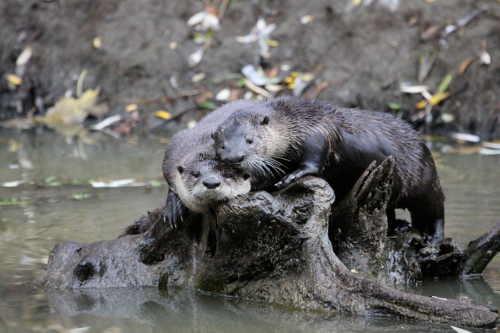
KELSEYVILLE, Calif. – Come and enjoy winter in Clear Lake State Park Saturday, Dec. 20, with retired California State Park Ranger Val Nixon.
The two-hour walk will begin at 8:30 a.m. at the visitor center parking lot and will be a slow walk along Cole Creek, Kelsey Creek and Kelsey Creek Slough.
The walk will cover about one mile of paved road and established trails.
Participants should wear sturdy shoes and bring binoculars and water. Rain will cancel the walk.
Clear Lake State Park is located at 5300 Soda Bay Road, Kelseyville. Entry into the park is free for those participating in the walk.
Anyone having special needs should contact the Clear Lake State Park Sector Office Tuesday through Thursday between 8 a.m. and 5 p.m. at 707-279-2267.
- Details
- Written by: Carrie Wilson
Sidearm while duck hunting?
Question: A friend and I recently had a situation where we found pig tracks at one of the areas where we like to duck hunt.
We both found it a little unnerving to be walking in knee- to waist-high grass armed with only bird shot if a pig were to charge.
The area where we are hunting doesn't explicitly prohibit handguns. We are wondering if California law allows us to carry a handgun, not as a method of take but rather for defense while hunting waterfowl.
I noticed the answer to the question on sidearms while hunting upland game and small game but don't know if duck hunting has any additional restrictions.
Also, if this is allowed, does the ammo in the handgun apply to the nonlead requirement while hunting duck, or is it exempt considering that it is not a method of take?
Any help is greatly appreciated. Thanks. (Rhyan P.)
Answer: Unless the area where you’re hunting explicitly prohibits the possession of (or hunting with) handguns, that part should not be a problem.
If that is the case and you feel that your life is in danger, you can shoot the pig. However, you are not authorized to take the carcass unless you have a pig tag and utilized a legal method of take. If you’re hunting in condor country, you must carry nonlead ammunition.
Are crabs with black spots safe to eat?
Question: I just bought two crabs and found one with black spots on the outside shell.
I’ve seen these before and usually avoid them, but this time the seller sneaked it into my package.
When I called him about it, he said he didn’t know what it is, but it doesn’t permeate the shell.
This isn’t true – I’ve seen this stuff on the flesh at the joints. It looks like oil.
Can you enlighten me? Besides being ugly, is it unsafe? (Mari V., Berkeley)
Answer: Black spots on the shells of crustaceans are typically composed of melanin, which is the end product of a series of immunological reactions.
This means the crab was likely responding to some shell damage that could be caused by physical trauma or a disease agent.
In this case, the black spotted crab is probably safe if cooked correctly. However, if the discolored shellfish tissue has an unpleasant taste or texture, or looks or smells unusual, we always recommend not eating it.
Where can I find bail fine information?
Question: How are fines determined and how can someone locate published documentation on fines? (John S., Bakersfield)
Answer: The State Judicial Council publishes the “Uniform Bail and Penalty Schedules” every year.
If you perform a web search, most courts will link to the most current edition. The link on our Web site, www.courts.ca.gov/documents/july2011_jcbail.pdf , is the 2011 edition.
Additionally, some fines are mandatory and established by the California legislature. Those can be found in the Fish and Game Code starting with Section 12000. See the California Legislative Information web site http://leginfo.legislature.ca.gov/faces/codes.xhtml to look up the code.
With some exceptions for mandatory fines, the uniform bail and penalty schedule is a guideline used by judges. In other words, judges have a great deal of discretion in setting fines and penalties for any violation.
Crossbows for wild pigs?
Question: I am trying to get some clarification on hunting wild pigs with a crossbow. The regulations state that crossbows may be used to take deer and wild pigs only during the regular seasons (California Code Regulations, Title 14, section 353).
Since wild pigs can be hunted all year, does that mean that a crossbow can be used (like a firearm) to hunt wild pigs? Can any legal hunter with a hunting license and a pig tag use a crossbow for wild pigs?
The regulations have a bit of a gray area here and I would like some clarification please. (Al Q.)
Answer: Yes, wild pigs can be taken year-round with a crossbow.
Importing a water buffalo skull?
Question: I purchased a water buffalo skull with horns in Thailand (Jan 2014). The Thai post office informed me I would need a “customs” form to have it delivered in the U.S. but they did not have them. The skull remains with my son in Thailand.
The skull is clean and dry. There is no remaining material on the skull. The skull was purchased from a buffalo farm for about $60. The animal was not mistreated or tortured. It died a natural death. The farm has a number of skulls for sale.
Can you please tell me what form I need and what I need to do to have it shipped to me here in California? (Jerry M.)
Answer: California wildlife law does not generally apply to this situation. The U.S. Fish and Wildlife Service would be the contact agency regarding importing parts from a water buffalo into California.
Carrie Wilson is a marine environmental scientist with the California Department of Fish and Wildlife. While she cannot personally answer everyone’s questions, she will select a few to answer each week in this column. Please contact her at
- Details
- Written by: Editor
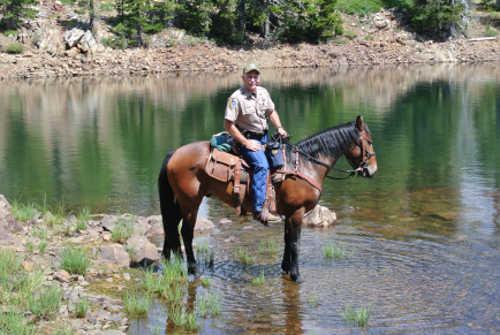
Wildlife officers at the California Department of Fish and Wildlife (CDFW) are turning to an age-old enforcement tool – the horse – to help protect California’s natural resources.
While there is no formal mounted patrol unit, some wildlife officers are using their own personal horses for routine patrol in the back country.
Much like canine partners, horses can see, hear and go places faster and quieter than modern technology.
Covering up to 20 miles a day, equine patrols can show up where you least expect them, even in the most adverse conditions.
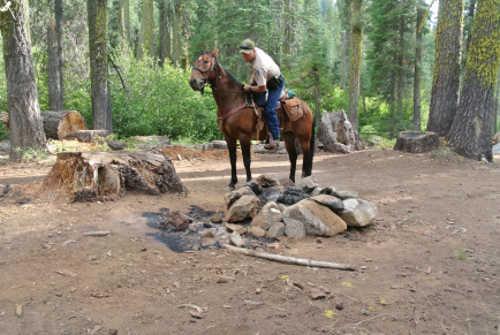
“As a 25-year law enforcement professional, I have used a variety of tools in my career and my six-year old mustang is by far, one of the most practical resources at my disposal,” said CDFW Wildlife Officer Jerry Karnow. “I can cover many miles a day in locations not accessible by any vehicle, which includes a huge portion of California’s outback. As a mounted unit, I have confiscated illegal firearms, helped hikers find their way, put out illegal campfires and made arrests in crimes that would otherwise go unnoticed.”
Karnow’s equine partner, Modoc, is a former wild mustang from Lassen County who was rounded up by the Bureau of Land Management.
At 2 years of age, Modoc entered the wild horse program at a correctional facility in Carson City.
Mustangs in the program are tamed, socialized and ridden for the first time by inmates.
Wild horses have a keen sense of awareness from living as a prey species, which is needed for their survival from day one.
They can hear, see and sense activity at a longer distance well before a human ear or eye can detect it, making them solid enforcement partners.
“Protecting California’s precious natural resources all comes down to boots on the ground, which includes covering large areas of rough terrain,” said CDFW Wildlife Officer Gary Densford. “Utilizing horses makes perfect sense for the duties and work of a wildlife officer in the back country.”
All horses used for patrol must be sound, reliable and in good working condition. Each horse and rider is observed yearly to ensure the equine under saddle is sound and trail ready.
All horse units are maintained in a healthy, groomed condition and shall not be ridden on patrol without appropriate hoof care.
CDFW is currently utilizing a handful of units with more interest on the rise.