How to resolve AdBlock issue?
Health
- Details
- Written by: Elizabeth Larson
The goal is to ensure continued excellent care for the communities that Adventist Health serves while also expanding health care career opportunities in both urban and rural communities.
When it comes to health care, rural communities find it difficult to recruit and retain physicians and medical professionals.
This includes medical assistants, who are often the first caregiver that patients see in a clinic or medical office as they check blood pressure, temperature and other key health indicators.
In fact, a recent poll shows one in three Californians believes their community does not have enough caregivers, and in rural areas that number jumps to 50%.
Unchecked, the situation could grow worse as demand for physicians, nurses and other health professionals is expected to outpace supply. Jobs for medical assistants, for example, are expected to increase by 19% by 2029 compared to 4% for all occupations over the same period.
An aging population and aging health care workforce, combined with current graduation rates for medical and health professionals, are leading to predictions of increasing workforce shortages.
“Adventist Health is launching this workforce development program with COPE Health Solutions to support our strategic vision of well-being, which means helping our community members live their best lives,” said John Beaman, Adventist Health chief people and business officer. “This program will provide opportunities for health care education in hopes that local residents will find fulfilling careers and remain in these at-need communities we serve, which also will help address the pressing need to attract more people into health professions.”
New education and training options
Adventist Health’s workforce development programs will provide opportunities to college and high school students, recent graduates and any community members seeking advancement or career changes.
Healthcare consulting and workforce development firm COPE Health Solutions developed the structure and curriculum of the programs in collaboration with Adventist Health and will run the programs on a day-to-day basis.
This year’s plans include:
· Opening the COPE Health Scholars Medical Assistant Program, a seven-month educational program that combines virtual courses with 200 hours of clinic-based learning and training with patients and clinician mentors. Scholarships will be available to make the program more accessible to local students. In the first year, Adventist Health’s hospitals and clinics in Mendocino County (Ukiah and Willits) and Central Valley communities (Kings, Fresno and Tulare counties) will be participating.
· Creating programs for recruiting, training and retaining clinical and allied health professionals such as clinical lab scientists, physical therapists and registered nurses.
· Expanding the experiential COPE Health Scholars program, which provides aspiring health care professionals the opportunity to gain in-person experience and learning while providing valuable support to patients and clinicians.
Graduates of the COPE Health Scholars programs will receive a Certificate of Completion from the UCLA Executive Programs in Health Policy and Management. Students who complete the COPE Health Scholars Medical Assistant program will also be well-positioned to take the Certified Clinical Medical Assistant exam pre-accreditation and the Certified Medical Assistant exam post-accreditation.
“Adventist Health is a leader in developing a skilled workforce that can adapt to new ways of delivering care and meet the changing health needs of Americans. Providing career opportunities, support and mentorships to our communities will grow the healthcare workforce, ensure we have diversity within our workforce and ultimately provide greater access and quality of care to patients, which is a shared priority for both Adventist Health and COPE Health Solutions,” said Elizabeth DuBois, DNP, FNP-BC, AAHIVS, the COPE Health Solutions’ senior vice president who is leading the partnership with Adventist Health and is a practicing provider at Adventist Health.
Since 2013, nearly 3,000 individuals have participated in COPE Health Scholars programs at Adventist Health in communities across California and Hawaii. Many past scholars have gone on to medical or nursing school to return to their community to practice.
For more information on the COPE Health Scholars program and the medical assistant school sponsored by Adventist Health, please visit https://copehealthscholars.org/programs/medical-assistant-school.
- Details
- Written by: Elizabeth Larson
This new update, which adds five new languages, is part of California’s larger initiative to make vaccines easily accessible for all residents, with a focus on those who have been hardest hit by COVID-19.
“California’s remarkable wealth of diversity is always top of mind as we create and perfect the tools that will ensure every resident can easily access life-saving COVID-19 vaccines — regardless of the language they speak,” said Tomás Aragón, CDPH director and State Public Health officer. “The My Turn website and hotline play a key role in alerting Californians when they are vaccine eligible, and helping them schedule an appointment, so we want to ensure it is accessible to everyone.”
Less than two months after launching My Turn, 1.6 million appointments have been scheduled through the platform. The website is now available in Armenian, Japanese, Khmer, Punjabi, and Russian, along with languages already offered: Chinese (Simplified), Chinese (Traditional), Korean, Spanish, Tagalog, Vietnamese and English.
Individuals who do not have access to the internet can sign up for an appointment by calling My Turn’s toll-free hotline 1-833-422-4255, open weekdays 8 a.m. to 8 p.m., and weekends from 8 a.m. to 5 p.m. My Turn operators can provide on-demand assistance in English and Spanish, translators who speak more than 250 languages are also available as needed.
Following a short pilot in San Diego and Los Angeles, California announced My Turn on Jan. 25 as a statewide tool to notify Californians of their eligibility to schedule an appointment for the COVID-19 vaccine. Californians in every county can sign up for My Turn’s vaccine eligibility notification at MyTurn.ca.gov. The My Turn scheduling feature is now widely available in a majority of counties and is expected to expand to all Californians in the coming weeks.
My Turn’s extensive multilingual support is just one way the state is working to vaccinate all Californians.
The state’s Five Point Plan for Equitable Vaccinations includes:
– Allocating 40 percent of the state’s vaccines to the lowest 25 percent of ZIP codes based on the Public Health Alliance of Southern CA’s Healthy Places Index, and reserving appointments for priority populations through My Turn.
– Creating a Statewide Vaccine Network with a Third Party Administrator (TPA) to include appropriate access in disproportionately impacted communities and supplements this access with evening/extended hours, transportation services, translation services, home-bound services, mobile vaccine services, and physical accessibility features at vaccination events, for example.
– Leveraging the work community-based organizations have been doing to provide critical services and information to Californians during the pandemic, the state has partnered with philanthropic organizations to support the work of 337 organizations with $52.7 million in grants.
– Using data analytics to accurately allocate vaccines, My Turn will be the cornerstone of the state’s efforts to understand the demographics of vaccine recipients. The TPA will perform real-time data analytics to understand how the doses administered in certain Zip codes compare to the age and sector prioritization framework that will be reviewed by health equity experts to adjust and intensify targeted efforts and resource allocations.
– The state will provide consistent messaging through a $40 million public education campaign, create content designed for specific languages and cultures and meet Californians where they can to reach California’s diverse populations.
- Details
- Written by: Elizabeth Larson
The CCLHO advises the California Department of Public Health, as well as other state health entities on all public health matters.
“I am delighted and honored to be appointed to such an important committee,” said Dr. Doohan. “It is my goal to ensure that health equity is strongly represented in state public health policies.”
“To have someone who has Mendocino County’s best interests at heart in this role gives our county a special opportunity to have our voice heard at the state level,” said Health Officer Dr. Andy Coren. “Moreover, Dr. Doohan's strong commitment to equity, proven here in Mendocino County, will now benefit all of California.”
Through this new appointment, Dr. Doohan will be able to bring the needs and perspectives of rural counties forward.
She will continue her long-standing advocacy and support of health equity throughout California with an awareness for the diversity of needs of counties such as Mendocino.
Additionally, she will share these differences with state health officials, which ultimately can affect each and every resident of rural counties throughout the state in supporting access to medical care.
- Details
- Written by: Elizabeth Larson
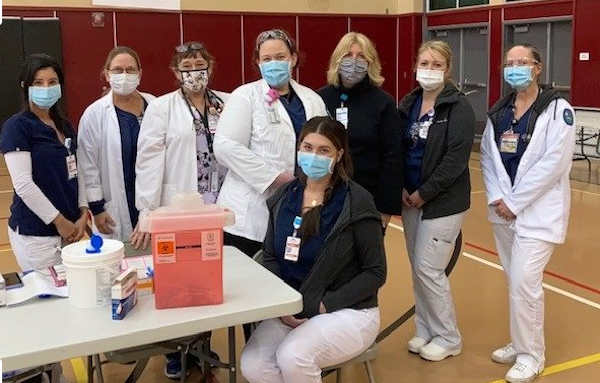
NORTH COAST, Calif. – Second-year Mendocino College Nursing students were recently able to get hands-on experience by working side by side with nurses from Adventist Health and other health care providers at the Alex Rorabaugh Center to administer 1000 COVID-19 vaccinations.
Each student was able to competently administer 50 to 75 vaccines under the supervision of Mendocino College Nursing Instructor Nancy Goodman and Director of Nursing Peggy Goebel.
Mendocino College Nursing Program Support Specialist Ginger Bushway coordinated all student requirements and schedules.
“The students did a fabulous job and were complemented by Adventist staff and multiple community clients,” said Goebel. “This is a wonderful example of Mendocino College Nursing Students gaining confidence and competence while serving their community during this pandemic crisis.”
“We are extremely grateful for the opportunity to be involved in community outreach through the participation in the vaccination clinic,” said Mendocino College Nursing student Hailey Young. “It was wonderful to hear all of the positive feedback and gratitude directly from the community members. This is an experience I will remember for a lifetime."
As required by the Center for Disease Control, all student vaccinators completed the CDC vaccinator course online and received their two doses of the COVID-19 vaccine at least two weeks prior to the clinic.
Students practiced CDC protocol, maintained social distancing requirements, wore masks, and washed hands frequently.
“We have made a commitment to Adventist Health to continue to partner with their clinics with supervised students here in Ukiah through mid-May,” said Goebel. “We have also made a commitment to partner with Mendocino County and EMS at the Ukiah Conference Center to provide faculty-supervised students at their Friday clinics through mid-May. We are all very proud of the professionalism, dedication and skill of our students.”