 How to resolve AdBlock issue?
Education
- Details
- Written by: Editor
NORTH COAST, Calif. — Are you ready to launch your firefighting career?
Mendocino College’s Fire Science Academy (FSC-90) is now accepting enrollment for the January to April 2026 session at the Ukiah Campus.
Classes will take place from 8 a.m. to 5 p.m. Monday through Friday.
This academy provides Firefighter 1 capstone testing, equipping students with the skills and knowledge needed to begin a career as a professional firefighter.
The program is offered in partnership with CalFire, the Ukiah Valley Fire District, and other regional fire agencies.
For info & enrollment packets, contact Chris Dewey at
- Details
- Written by: Editor
WASHINGTON, D.C. — On Wednesday, U.S. Sen. Alex Padilla (D-Calif.) and Representative Judy Chu (D-Calif.-28) introduced bicameral legislation to help students afford advanced education by restoring graduate students’ eligibility for receiving subsidized federal loans.
The Protecting Our Students by Terminating Graduate Rates that Add to Debt (POST GRAD) Act would prevent graduate students from accruing interest on their subsidized graduate loans while in school, just like their undergraduate counterparts.
Many professions, such as mental health clinicians, school administrators, nurse practitioners, and physical therapists, often require a graduate degree, but the high cost of borrowing can dissuade potential students from seeking these advanced degrees. Instead of addressing the higher education affordability crisis, Congressional Republicans recently passed a billionaire-first reconciliation bill that, among other harmful provisions, would eliminate the Grad PLUS loan program, a vital source of federal support for graduate students.
Nationally, over 1.6 million student loan borrowers have Grad PLUS loans, amounting to $91 billion in debt. California has nearly 57,000 Grad PLUS borrowers, according to the National Association of Independent Colleges and Universities.
“Graduate students help fuel our economy, filling workforce shortages in critical sectors like health care, education, and STEM that often require advanced degrees. Yet, too many talented students in California and nationally cannot afford to pursue advanced degrees due to the rising cost of higher education,” said Sen. Padilla. “As Republicans threaten to slash the Grad PLUS program entirely, we are taking a stand to make graduate school more affordable by reinstating subsidized federal student loans for graduate students so they don’t accrue interest while they are in school. We did this for decades, and now is the time to support our 21st century graduate workforce and expand educational opportunities for low-income communities.”
“Many of the most rewarding and in-demand jobs in the U.S. require advanced degrees, but do not always come with high earning potential. A lifetime of debt should never be the cost for obtaining a graduate degree,” said Rep. Chu. “At a time when our country is facing a shortage of specialized workers in critical fields, we should be doing everything we can to encourage students to enter these fields, rather than creating additional barriers to higher education. Democrats in Congress are committed to lowering costs and reducing debt, and that’s why I’m proud to be joined by Senator Padilla in introducing the POST GRAD Act as one important step in making higher education more attainable to everyone in America.”
“The cost of graduate education often serves as a barrier to pursuing advanced degrees, including in psychology, where shortages of qualified, culturally competent providers persist. By reinstating subsidized federal student loans for graduate students, the POST GRAD Act would relieve a portion of the financial burden associated with financing a graduate degree. APA applauds Congresswoman Chu and Senator Padilla for their leadership on this important legislation, which would make graduate study more affordable and help build a workforce ready to meet the growing needs of our population,” said Arthur C. Evans Jr., PhD, CEO of the American Psychological Association.
The Budget Control Act of 2011 stripped graduate students of eligibility for Federal Direct Subsidized Loans, which they had access to from 1994-2012, costing students thousands of dollars, particularly as interest rates on graduate loans are now at their highest rate since 2006.
The POST GRAD Act would reverse the harmful provision of the Budget Control Act and restore the eligibility of graduate students to receive Federal Direct Subsidized Loans. Furthermore, it would prevent graduate and professional students who fall into deferment due to economic hardship from accruing interest on their Federal Direct Subsidized Loans.
The POST GRAD Act is cosponsored by Senators Cory Booker (D-N.J.), Tammy Duckworth (D-Ill.), Andy Kim (D-N.J.), Chris Van Hollen (D-Md.), and Ron Wyden (D-Ore.).
The bill is endorsed by the following organizations: American Psychological Association, National Association of School Psychologists, National Education Association, AccessLex, Association of Public and Land-grant Universities, National Association of Student Financial Aid Administrators, American Physical Therapy Association, American Association of Veterinary Medical Colleges, American Occupational Therapy Association, Association of Schools Advancing Health Professions, Association of Schools and Colleges of Optometry, Physician Assistant Education Association, American Association of Colleges of Osteopathic Medicine, Council on Social Work Education, American Dental Education Association, American Association of Colleges of Nursing, American Association of the Colleges of Podiatric Medicine, and the University of California System.
- Details
- Written by: Editor
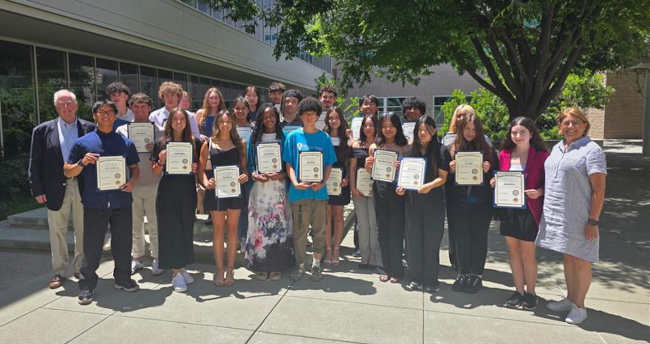
Rep. Mike Thompson (CA-04) and Assembly Majority Leader Cecilia Aguiar-Curry along with 2025 Student Leadership Council graduates. Courtesy photo.
DAVIS, Calif. — Rep. Mike Thompson (CA-04) and Assembly Majority Leader Cecilia Aguiar-Curry recently recognized the 2025 Student Leadership Council graduates at an end-of-year town hall and graduation ceremony hosted at the University of California, Davis.
The event, which took place May 24, featured special guest speakers and a town hall hosted by Rep. Thompson.
Graduates were able to ask questions and discuss any issues of importance to them and our community.
Rep. Thompson then presented graduating students with certificates marking their achievement serving on the Council. Among the graduates were seven outstanding students from Lake County.
“I’m inspired by the passion and drive of the students graduating from Assembly Majority Leader Aguiar-Curry’s and my 2024–2025 Student Leadership Council,” said Rep. Thompson. “This year’s students brought incredible energy and ideas to the table—from tackling the climate crisis to gun violence prevention to protecting our democracy. It was an honor to host a town hall with them and hear their thoughtful perspectives firsthand. To our 2025 graduating student leaders: Congratulations! I can’t wait to see all you accomplish for our community and our country.”
“I am incredibly proud of the collaboration with Congressman Thompson to give our future leaders an opportunity to experience the inner workings of government and learn how to become successful community members. Congratulations to all the students who are completing this program. I hope it has broadened their horizons and sparked their curiosity, inspiring them to dedicate their lives to improving their communities,” said Assembly Majority Leader Aguiar-Curry.
Rep. Thompson and Assembly Majority Leader Aguiar-Curry’s Student Leadership Council is an exciting program that allows local students to work directly with their elected officials and staff to develop leadership skills, learn how government works, and engage with our community.
The council is open to all high school students who live in California's Fourth Congressional District or California's Fourth Assembly District. Selected students meet several times a month over the course of a semester.
Learn more about the Student Leadership Council here.
Thompson represents California’s Fourth Congressional District, which includes all or part of Lake, Napa, Solano, Sonoma and Yolo counties.
- Details
- Written by: Editor
U.S. Senator Alex Padilla (D-Calif.) joined Senator Bernie Sanders (I-Vt.), Ranking Member of the Senate Committee on Health, Education, Labor, and Pensions (HELP), Representative Pramila Jayapal (D-Wash.-07), and eight Senate colleagues this week in introducing legislation to make public colleges and universities tuition free for 95 percent of students.
The College for All Act would be the most transformative investment in higher education in 60 years and would substantially improve the lives of millions of students throughout the United States.
Nearly 4 million student borrowers live in California, owing an average of $38,168 and a total of $148.6 billion in student loan debt.
“As a first-generation college graduate from a low-income household, I know a good education is the foundation of the American dream, but I’ve seen firsthand the challenges of accessing and affording higher education,” said Sen. Padilla. “We need bold, proactive solutions to make college more affordable — not the Trump Administration’s short-sighted plan to eradicate student financial aid and put higher education out of reach for millions of American families. The College for All Act would help millions of working families shoulder the financial burden of paying for their children’s college. When we invest in all students, we support our nation’s financial interests by ensuring that opportunity and economic prosperity are attainable for all, regardless of income.”
“In a highly competitive global economy where technology is changing the very nature of work and the jobs we perform, we need the best educated workforce in the world,” said Sen. Sanders. “Our nation used to lead the world in the percentage of adults with a college degree. Today, we are in 11th place behind countries like Japan, South Korea, Canada, the United Kingdom and Switzerland. That is not a prescription for a strong American economy of the future. It is a prescription for failure. Instead of increasing the cost of college in order to give more tax breaks to billionaires, we have a better idea. We are going to make public colleges and universities tuition free so that working class students can succeed and are not burdened with a lifetime of debt.”
Making public colleges and universities tuition free is not a radical idea. In 1944, as World War II was coming to an end, the U.S. government made free higher education available to all those who served in the armed forces.
That act not only improved the financial well-being of the Greatest Generation, but it also laid the groundwork for the greatest expansion of the American middle class in U.S. history. Moreover, over 50 years ago, many of America’s most prestigious public colleges and universities were also tuition free or virtually tuition free.
Since this legislation was first introduced 10 years ago, several colleges and universities in America have provided free tuition for working class and middle-class students, including every state college in New Mexico, the State University of New York, the University of Texas, the University of Wisconsin, and Arkansas State University.
Other wealthy countries like France, Germany, Denmark, Sweden, Norway, and Finland have made their public colleges and universities tuition free or virtually tuition free because they understand the value of investing in their young people.
The College for All Act would guarantee tuition-free community college for all students and allow students from single households earning up to $150,000 a year, and married households earning up to $300,000 a year, to attend college without fear of being saddled with student loan debt.
Specifically, the College for All Act would also:
- Double the maximum Pell Grant award for students enrolled at public and private non-profit colleges;
• Establish a $10 billion grant program to improve student outcomes and address equity gaps at underfunded public colleges and universities;
• Triple federal TRIO program funding;
• Double GEAR UP funding; and
• Double mandatory funding for Historically Black Colleges and Universities, Tribal Colleges and Universities (HBCUs), and other Minority-Serving Institutions (MSIs).
In addition to Senator Padilla, the legislation is also cosponsored by Senators Richard Blumenthal (D-Conn.), Cory Booker (D-N.J.), Ed Markey (D-Mass.), Jeff Merkley (D-Ore.), Chris Murphy (D-Conn.), Chris Van Hollen (D-Md.), Elizabeth Warren (D-Mass.), and Peter Welch (D-Vt.).