 How to resolve AdBlock issue?
Business News
- Details
- Written by: Jay Van Rein
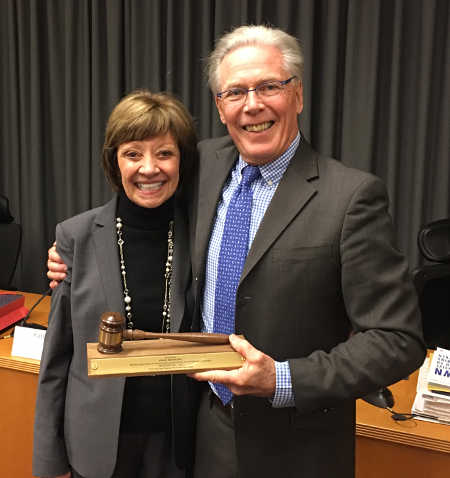
After more than 16 years on the California State Board of Food and Agriculture, with the last seven years as Board President, Craig McNamara is stepping down from his position on the Board to participate as a 2018 Fellow in the Stanford Distinguished Careers Institute program.
The fellowship program offers an extraordinary opportunity for individuals to advance social impact at the local, national and global levels.
“Craig has been a visionary leader for the State Board and has been an unwavering advocate for California’s farmers and ranchers to both me and the Governor,” said CDFA Secretary Karen Ross. “I’m happy for Craig in his new pursuit, but will deeply miss his counsel and thoughtfulness on the issues impacting the agricultural community.”
Under McNamara’s leadership the board further advanced the California Ag Vision, helped to double farm contributions to food banks, addressed agricultural immigration issues, and was a critical voice for agriculture in a variety of water discussions related to drought and sustainable groundwater management.
As McNamara departs the State Board he leaves behind a legacy of dedication to California’s farmers and ranchers and a reinvigorated board mission of engagement and representation of the diversity of California’s agricultural sector to the governor and CDFA secretary.
The California State Board of Food and Agriculture advises the governor and the CDFA secretary on agricultural issues and consumer needs.
The state board conducts forums that bring together local, state and federal government officials, agricultural representatives and citizens to discuss current issues of concern to California agriculture.
Jay Van Rein works for the CDFA Office of Public Affairs.
- Details
- Written by: Editor
The CFPB protects consumers from fraud, abuse and unfair business practices, and has returned $12 billion to American consumers since being created in the wake of the financial crisis. It was carefully crafted by Congress to be an independent agency.
On Nov. 24, CFPB Director Richard Cordray stepped down and Deputy Director Leandra English became acting director pursuant to the law governing the CFPB, 12 USC s. 5491(b)(2), which states: “There is established the position of Deputy Director, who shall - (A) be appointed by the Director; and (B) serve as acting Director in the absence or unavailability of the Director."
That same day, President Donald Trump moved to politically appoint a known antagonist of the CFPB, Mick Mulvaney, the Office of Management and Budget director, as the acting CFPB Director.
"Sick, sad joke" are the words Mulvaney has used to describe the agency which protects consumers, veterans and loan borrowers.
“Under the leadership of Richard Cordray, the CFPB set new standards for protecting mortgage and student borrowers, brought landmark actions against big banks, and proposed critical reforms to payday lending practices, mandatory arbitration, and bank overdraft fees,” said Attorney General Becerra. “President Donald Trump, however, is attempting a hostile takeover of this independent agency by contravening the Dodd-Frank Act and installing as acting director a man who has repeatedly sided with Wall Street instead of Main Street. It is an absolute insult to hardworking Americans.
"In California and the Attorney General's Office, we are committed to moving forward, and we will do everything in our power to defend this critical agency," added Attorney General Becerra. “The CFPB must remain independent of Wall Street and politics. Its job is to protect and empower consumers.”
In the amicus brief filed Friday, Attorney General Becerra and 17 attorneys general argue that while there is a legal mechanism for President Trump to nominate a new director for the CFPB – an appointment subject to the advice and consent of the Senate – President Trump has not taken that path here.
Undermining the statutory structure of the agency harms the States’ ability to enforce myriad consumer financial laws that protect their residents.
Attorney General Becerra joins the attorneys general of Washington D.C., Connecticut, Delaware, Hawai'i, Illinois, Iowa, Maine, Maryland, Massachusetts, Minnesota, New Mexico, New York, Oregon, Pennsylvania, Rhode Island, Vermont, And Washington in filing this amicus brief.
Since taking office, Attorney General Becerra has supported and worked with the CFPB. Among other actions, he stands with the agency for issuing its Payday Lending Rule, which will prevent the worst harms associated with short-term payday lending, and for launching its Arbitration Rule, which would have allowed people to pursue justice against financial services companies had it not been overturned by Republicans in Congress.
In addition, Attorney General Becerra, joined by 12 attorneys general and the Consumer Financial Protection Bureau, secured a settlement with Aequitas Capital Management Inc., a private equity firm, to provide over $51 million in debt relief to Californians who attended Corinthian Colleges and $183 million nationwide.
- Details
- Written by: Editor
SERVPRO franchise owners in the Lakeport area caution homeowners to follow some important American Red Cross guidelines for holiday decorating and entertaining to make sure that the glow in their holiday celebrations is from twinkling lights and not a costly and potentially deadly fire.
– Place Christmas trees and other holiday decorations at least 3 feet away from heat sources like fireplaces, portable heaters, radiators, heat vents, and candles.
– Purchase flame-retardant metallic or artificial trees. If you purchase a real tree, make sure that it has fresh, green needles that aren’t easily broken. Keep live trees as moist as possible by giving them plenty of water.
– Make sure that light strings and other holiday decorations are in good condition. Do not use anything with frayed electrical cords and always follow the manufacturer’s instructions.
– If you are celebrating Hanukkah or Kwanzaa, keep flammable items, including curtains and holiday decorations, at least three feet away from your candles. Place your menorah or kinara on a non-flammable surface, such as a tray lined with aluminum foil, to catch the melting candle wax. Never leave lit candles unattended.
– Ensure all candles and smoking materials are properly extinguished after guests leave and always unplug tree and holiday lights before leaving home or going to bed.
“If, in spite of all your precautions, a fire does break out, the most important thing you can do to help save lives is to install and maintain smoke alarms throughout your property,” said Sue Steen, Servpro Industries Inc., chief executive officer. “Having a working smoke alarm reduces everyone’s chances of dying in a fire by nearly half.”
Steen said that the American Red Cross is joining with fire departments and community groups nationwide to deliver and install a limited number of free smoke alarms in homes for those in need. Contact your local American Red Cross chapter for more information.
The disaster response professionals at SERVPRO, a leader and provider of fire and water cleanup and restoration services, witness the devastation that home fires can cause far too often. They also know that when fire causes a loss of life, there is no “remediation” possible.
To keep the focus on fire prevention, rather than fire restoration, SERVPRO has teamed up with the American Red Cross by supporting the ARC Disaster Responder program, and in particular the Home Fire Preparedness Campaign.
As a Disaster Responder, SERVPRO pledges dollars and support in advance to help the American Red Cross develop and distribute educational materials and respond immediately when they are needed.
“SERVPRO professionals know that even the most diligent fire prevention planning can’t prevent all home fires. That’s why fire safety planning, like installing and maintaining smoke detectors and having a family escape plan, is also important,” said Steen. “If a fire does break out in your home this holiday season, make sure all your family members follow this life-saving advice from the American Red Cross: Get Out, Stay Out, and Call for Help.”
For more fire prevention and fire safety tips and information about fire and water damage restoration services, please visit www.servpro.com.
- Details
- Written by: Editor
This ruling defines the unique grape-growing area in southern Sonoma County and northern Marin County and acknowledges the region's distinctive aspects based on topography and the effects of persistent wind and fog on the grapevines.
Of the 4,000 acres of vineyards in the 200,000-acre region, 75 percent are planted to Pinot Noir with most of the remaining acres equally planted to Chardonnay and Syrah; other grape varieties comprise less than 1 percent of the planted acreage.
"We are very excited to announce the official approval of the Petaluma Gap AVA in the Federal Register," said Rickey Trombetta, president of the board of directors of the Petaluma Gap Winegrowers Alliance. "Being able to proudly include this designation on our labels makes it easier for consumers to seek out and identify the wines of our members. Local winemakers have long known that grapes grown in the Petaluma Gap ripen more slowly than in surrounding regions, allowing later harvest times, which results in more complex flavor development while preserving natural acidity. With today's finalization of the AVA, wine lovers and members of the wine trade will have the opportunity to become more familiar with the distinctive quality and flavor profile of Petaluma Gap wines."
The Petaluma Gap Winegrowers Alliance petition was submitted to the Alcohol and Tobacco Tax and Trade Bureau in February 2015 and the proposal to establish the Petaluma Gap as an official AVA was published by the bureau in October, 2016. The final rule was published on Dec. 7.
The Petaluma Gap AVA includes some 80 winegrowers and nine wineries, with additional fruit sold to many other wineries throughout northern California.
For more information, see www.petalumagap.com.