 How to resolve AdBlock issue?
Arts & Life
- Details
- Written by: Ted Kooser
Lovers of poetry will be pleased to learn that Louisiana State University Press has just published Pulitzer Prize winner Henry Taylor’s new and selected poems, “This Tilted World is Where I Live.”
Some of his finest poems are longer than the space this column permits, but here’s a shorter one that will give you a taste. Taylor lives in New Mexico.
Art and Life
In the Portland Museum of Art’s snack bar
one July morning, a young woman worked
at the board that lists the specials of the day.
From her little stepladder she leaned in
with various colored chalks, using both point
and edge, adjusting with her fingertips,
experimenting with size and color, print
and script, once or twice stepping down and back,
then homing in on what was to be solved.
The whole thing might have taken her ten minutes.
At last she moved a little farther back
to see how what she’d done had changed the room,
while we, who had the good luck to be there
at the beginning of her day, beheld
the change she couldn’t know that she had wrought
merely by how her red hair caught the light.
American Life in Poetry does not accept unsolicited manuscripts. It is made possible by The Poetry Foundation, publisher of Poetry magazine. It is also supported by the Department of English at the University of Nebraska, Lincoln. Poem copyright ©2020 by Henry Taylor, “Art and Life," from This Tilted World is Where I Live, (Louisiana State University Press, 2020). Poem reprinted by permission of Henry Taylor and the publisher. Introduction copyright @2020 by The Poetry Foundation. The introduction’s author, Ted Kooser, served as United States Poet Laureate Consultant in Poetry to the Library of Congress from 2004-2006.
- Details
- Written by: Tim Riley
“Every government has its secret service branch. America, the CIA; France, Deuxieme Bureau; England, MI5. A messy job? Well, that’s when they usually call on me or someone like me. Oh yes, my name is Drake, John Drake.”
That’s the introduction, voiced by Patrick McGoohan, to each episode of the early Sixties spy thriller series “Danger Man,” also known as “Secret Agent,” now streaming on Amazon Prime Video.
It’s interesting how McGoohan introduces himself as Drake, John Drake, in the style of James Bond before Agent 007 introduced himself in 1962’s “Dr. No” at a gambling table to the fetching Sylvia Trench (Eunice Gayson).
Before achieving cult status as Number Six in the series “The Prisoner,” Patrick McGoohan carried out espionage exploits in exotic locales around the globe in “Danger Man.”
A charismatic agent much like Roger Moore’s Simon Templar in “The Saint” series, McGoohan’s John Drake relied even more on his ability to be quick with his sharp wit and innate intelligence to deal with a variety of intense conflicts on the international scene.
A fascinating aspect to this spy series that predates James Bond and the plethora of films and TV series that followed in the same genre is that John Drake would routinely resolve any problems without the use of a gun.
The absence of personal firepower in no way turned Drake’s exploits to be devoid of action. On the contrary, Drake is very adept with his fists when necessary, while others may resort to shooting one another.
Another consideration is that the John Drake adventures are straight secret agent stories that forego the tongue-in-cheek facets that creeped into the Bond films and defined TV shows like “The Man From U.N.C.L.E.”
An appealing aspect of each standalone half-hour episode is that Drake is assigned a mission that gets settled with tidy resolution involving a compelling cast of international characters.
The fast pace of each episode, imaginative plots, snappy dialogue and credible characters for the most part makes “Danger Man” must-see television for anyone that would enjoy serious spy escapades.
Besides, Patrick McGoohan is so perfect for the role that binge-watching “Danger Man” is not an unreasonable proposition.
NOTES ON THE US OPEN TENNIS TOURNAMENT
The annual US Open grand slam tennis tournament that takes place in New York’s Flushing Meadows is underway this year, albeit without some major players like Rafael Nadal, the 2019 US Open men’s champion, and Ashleigh Barty, last year’s French Open women’s champion.
Due to pandemic concerns, Nadal and Barty opted out of traveling to the United States, and so did other lesser known players. A major star and winner of five US Open titles, Roger Federer is not playing because he’s rehabbing a knee injury.
For the past 15 years, we have covered the US Open in person, but that was not to be this year. The only media personnel in attendance are apparently the few working for broadcast entities that televise the matches, including ESPN here at home.
In the past we have focused in large measure on the wonderful fan experience of the US Open, noting the excitement of tennis activity on various courts and the culinary delights not found in other sports.
The experience is just not the same watching matches on television. Being there in person has so much energy that even the players are certain to get a vigorous boost from spectators.
We can be grateful that the US Open has not resorted to having idiotic cardboard cutouts of fans. Yet, there are a few lucky spectators, namely family members and tournament workers who might otherwise have been pressed into service for the fans.
Not surprisingly, the pandemic not only deterred a number of players from entering the tournament, but contact tracing created a bit of a stir for French player Adrian Mannarino who had been in contact with fellow countryman Benoit Paire, who tested positive for COVID-19.
Mannarino, ranked 35th for the Open, was scheduled to play German Alexander Zverez, ranked 5th, for an afternoon match, until apparently New York State health officials said the Frenchman shouldn’t play.
Meanwhile, the USTA public relations department issued an email statement on the situation that was rather cryptic, “The Zverez-Mannarino match was delayed while a collaborative dialogue with health officials was conducted today.”
The enigmatic part of the message was stated in these terms: “Given the sensitivity of medical issues involved, the USTA is not able to provide further details.” It was left to the players themselves to fill in the blanks, as if anyone couldn’t guess it was virus-related.
The American men are not off to a good start. John Isner, ranked 16th, did not survive the first round. Taylor Fritz, was bounced in the third round.
As for the American women, last year’s teen sensation Coco Gauff, who amazed with a third-round victory, faltered right out of the gate. At this writing, Serena Williams, win or lose, is the one to watch.
Tim Riley writes film and television reviews for Lake County News.
- Details
- Written by: Middletown Art Center
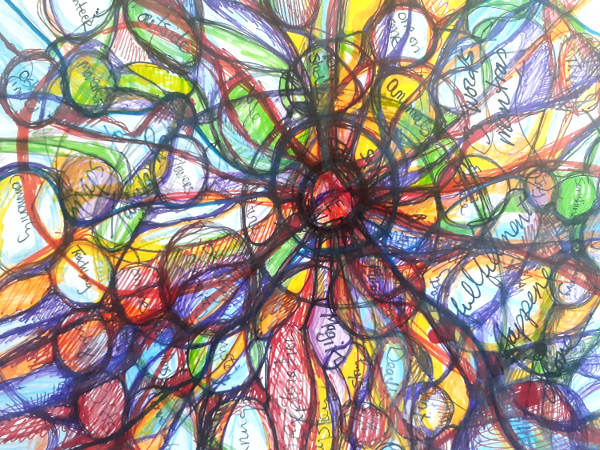
MIDDLETOWN, Calif. – The Middletown Art Center invites community members to participate in “Reframing Trauma: A Therapeutic Drawing and Writing Workshop,” this Saturday, Sept. 5, from 12:30 to 3:30 p.m. on Zoom.
Artist Antje Howard and Lake County Poet Laureate Georgina Marie will guide participants in a drawing and writing workshop to process and reframe trauma into creative expression. This class is the first of MAC’s current Second Responder series.
The workshop will include a drawing process, a writing process and time to share.
“Drawing will help us to ground and explore the breadth of the emotions we are feeling at this current time,” explained Antje Howard. “We will use the Neurographica technique, a simple intuitive drawing process that can help us to see things from a new perspective. No prior art experience is required, and all you need is a piece of paper, thin and thick black markers or pens and colored pencils, markers, or crayons."
A certified Neurographica specialist, artist, creative coach and mentor, Howard uses Neurographica and mindfulness to catalyze personal and practical change. Her guidance is solution-oriented, with focus on concrete steps to support holistic well-being and growth. Learn more about Howard’s work at http://neuroartproject.net.
Georgina Marie will facilitate the writing portion which will build upon the drawing process. “The trauma we are experiencing may be a result of recent wildfires and evacuations, the Covid-19 crisis, current events, or personal experience. Our work together will help us cleanse, reframe and create new meaning through creative expression in a supportive, and welcoming environment.”
Georgina Marie is the 2020-2022 Lake County Poet Laureate, the first Mexican-American and youngest local poet to serve in this role. She facilitated writing workshops for MAC’s “Resilience” and “Restore” projects and served as co-editor for both projects’ chapbook of writings and art. She has facilitated and participated in poetry readings and workshops in Northern California and online. Visit her website at georginamariepoet.com to learn more about her work.
Upon the community’s return from Valley fire evacuation, the MAC began offering free and low-cost healing art classes. Subsequent fires in Lake County and regionally combined with Covid-19 have triggered flight or fight mechanisms and trauma upon trauma.
“The recent LNU Complex Fire and evacuations further impacted our already vulnerable nervous systems,” said MAC Programs Director Lisa Kaplan “The arts and creative expression can help us integrate experiences and emotions, reconnect us with ourselves, and support a sense of balance, and purpose.”
Participation is by donation $5-25. Pre-registration is required at www.middletownartcenter.org/classes. A Zoom link will be provided upon registration. No one turned away for lack of funds. Email
Find out more about MAC and ways to support their efforts to weave the arts and culture into the fabric of life in Lake County at www.middletownartcenter.org.
- Details
- Written by: Ted Kooser
We’ve published more than 800 weekly columns to date, and soon I’m retiring as editor and part-time professor.
This column will continue under my name until the end of the year, when my colleague Kwame Dawes will take over.
I’m immensely grateful to my talented and efficient longtime assistant editor, Pat Emile, to the Library of Congress and The Poetry Foundation, and to the English Department at the University of Nebraska.
And, of course, for the wonderful support we’ve had from all of you readers since the day Pat and I started out, uncertain, 15 years ago.
Rather than riding a horse into the sunset, let me clop away down the block on handmade stilts with this title poem from my new book, to be published Sept. 8 by Copper Canyon Press.
Here’s how life looks to me, at eighty-one:
Red Stilts
Seventy years ago I made a pair of stilts
from six-foot two-by-twos, with blocks
to stand on nailed a foot from the bottom.
If I was to learn to walk on stilts I wanted
them red and I had to wait almost forever
for the paint to dry, laid over the arms
of a saggy, ancient Adirondack chair
no longer good for much but holding hoes
and rakes and stakes rolled up in twine,
and at last I couldn’t wait a minute longer
and took the stilts into my hands and stepped
between them, stepped up and stepped out,
tilted far forward, clopping fast and away
down the walk, a foot above my neighborhood,
the summer in my hair, my new red stilts
stuck to my fingers, not knowing how far
I’d be able to get, and now, in what seems
just a few yards down the block, I’m there.
American Life in Poetry does not accept unsolicited manuscripts. It is made possible by The Poetry Foundation, publisher of Poetry magazine. It is also supported by the Department of English at the University of Nebraska, Lincoln. Poem copyright ©2020 by Ted Kooser, "Red Stilts," from Red Stilts, (Copper Canyon Press, 2020). Poem reprinted by permission of Ted Kooser and the publisher. Introduction copyright @2020 by The Poetry Foundation. The introduction’s author, Ted Kooser, served as United States Poet Laureate Consultant in Poetry to the Library of Congress from 2004-2006.