 How to resolve AdBlock issue?
Arts & Life
- Details
- Written by: Lake County News Reports
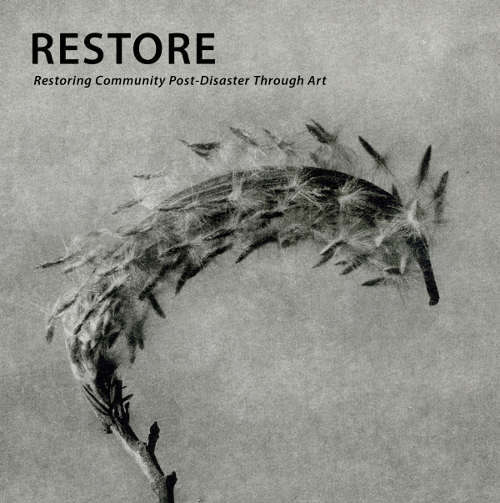
MIDDLETOWN, Calif. – The Middletown Art Center invites the public to a reading of poetry and prose from its newly released chapbook “RESTORE: Restoring Community Post-Disaster Through Art.”
The reading will take place on Zoom this Saturday, Oct. 17, from 5 to 7 p.m. and is hosted by Lake County Poet Laureate 2020-2022, workshop facilitator and RESTORE chapbook editor, Georgina Marie.
As the people of Lake County, and so many others in California, grapple with the trauma and uncertainty of six consecutive years of devastating wildfires and loss, the value of the arts as a sanctuary for healing, transformation, and connection has become urgently clear.
The writings and images in the book convey a sacred negotiation with both the reality of ecological disaster and basic human needs of love, safety, connection, a sense of belonging and home.
The book is a poignant collection of works by 26 writers and 25 printmakers who participated in MAC’s RESTORE workshops July 2018 through May 2019.
RESTORE is a wildfire recovery project supported in part by the California Arts Council, and the generosity of local businesses, organizations and individuals.
The MAC has been involved in community recovery through the arts since the Valley fire of 2015 which devastated the area and 1,300 homes.
“The writing workshops of the RESTORE project inspired and supported poems of grief, trauma, vulnerability, and authenticity of the self,” explained Georgina Marie. “As an editor of the RESTORE book, I had the opportunity to read a variety of personal and creative original work; as a writer of the RESTORE book, I had the chance to write poems which explored my own grief and sensitivity. To write about loss, heartache, and even wildfire lead to a deeper sense of creativity and a realization of perseverance, of my own and of our community.”
Preregistration is required at www.middletownartcenter.org/chapbook. Participation is by donation $5 to $25, no one will be turned away for lack of funds. A Zoom link will be provided upon registration.
Proceeds from this event will support MAC’s Literary Arts programming.
The MAC Gallery is open Friday to Sunday, 11 a.m. to 5 p.m. or by appointment; call 707-809-8118. You can also visit the show virtually at www.middletownartcenter.org/current.
Farmers Markets and Maker’s Faire are offered Fridays from 4 to 7 p.m. during fall months.
The MAC continues to adjust and adapt its programming during this time of COVID-19. Social distancing and masking are observed at MAC.
Find out more about events, programs, opportunities and ways to support the MAC’s efforts to weave the arts and culture into the fabric of life in Lake County at www.middletownartcenter.org.
- Details
- Written by: Ted Kooser
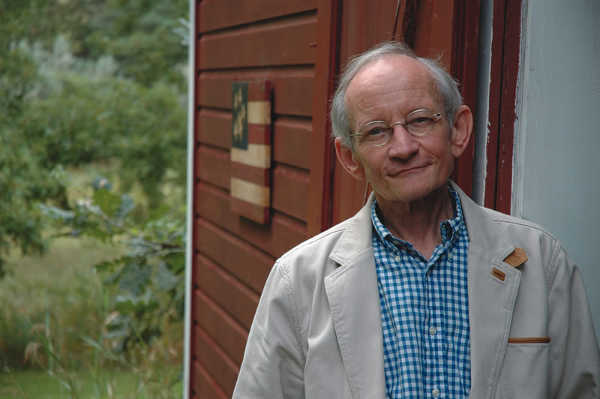
Edward Muir’s poem, “The Horses,” published many years ago, envisioned a future in which the work horse would return, and with them we’d have a new beginning.
Today, some of our fellow creatures aren’t to come back.
Here’s a poem by Robert Hedin, of Minnesota, that I found in the most recent Alaska Quarterly Review.
Hedin’s most recent book is “At the Great Door of Morning,” from Copper Canyon Press.
Monarchs, Viceroys, Swallowtails
For years they came tacking in, full sail,
Riding the light down through the trees,
Over the rooftops, and not just monarchs,
But viceroys, swallowtails, so many
They became unremarkable, showing up
As they did whether we noticed them or not,
Swooping and fanning out at the bright
Margins of the day. So how did we know
Until it was too late, until they quit coming,
That the flowers in the flower beds
Would close their shutters, and the birds
Grow so dull they’d lose the power to sing,
And how later, after the river died,
Others would follow, admirals, buckeyes,
All going off like some lavish parade
Into the great overcrowded silence.
And no one bothered to tell the trees
They wouldn’t be coming back any more,
The huge shade trees where they used
To gather, every last branch and leaf sagging
Under the bright freight of their wings.
American Life in Poetry does not accept unsolicited manuscripts. It is made possible by The Poetry Foundation, publisher of Poetry magazine. It is also supported by the Department of English at the University of Nebraska, Lincoln. Poem copyright ©2019 by Robert Hedin, “Monarchs, Viceroys, Swallowtails,” from the Alaska Quarterly Review (Vol. 36, No. 3 & 4). Poem reprinted by permission of Robert Hedin and the publisher. Introduction copyright @2020 by The Poetry Foundation. The introduction’s author, Ted Kooser, served as United States Poet Laureate Consultant in Poetry to the Library of Congress from 2004-2006.
- Details
- Written by: Tim Riley
‘ENOLA HOLMES’ ON NETFLIX
While the summer is now over and gone and Hollywood held back almost all of its major film releases during the prime season, entertaining family fun at the movies dwindled down to streaming service offerings.
Turning to Netflix, the choices weren’t always that welcoming for families. Consider the controversy that erupted over eleven-year-old girls in a provocative dance crew twerking their moves in “Cuties.”
But now there is something for people of practically every age to enjoy on Netflix, and that would be “Enola Holmes,” starring the delightful Millie Bobby Brown as the titular character, the much younger sister of Sherlock and Mycroft Holmes.
Set in England’s Victorian era of 1884, “Enola Holmes” delights as much with its gorgeous scenery of the countryside that contrasts with the urban jungle of bustling London as it does with appealing characters, of which Enola is the most engaging and charming.
Living far from England’s capital city, Enola (who’s name she reminds us often spells “alone” backwards) is a free-spirited independent living with her mother Eudoria (Helena Bonham Carter), where she’s homeschooled on everything from great literature to self-defense.
She’s never really known her older brothers who live and work in London. Sherlock (Henry Cavill), the famous detective, and the even older Mycroft (Sam Claflin), a government functionary, only appear on the scene after Eudoria goes missing.
On the morning of her sixteenth birthday, Enola wakes to find that her mother has disappeared, leaving behind an odd assortment of gifts and no immediately apparent reason as to where she’s gone or why, and yet a few cryptic clues only a sleuth could figure are left behind.
Enola’s unconventional upbringing is now uprooted when her siblings decide she’ll be under the guardian care of the stiff, uncaring Mycroft, who decides what’s best is placement of his sister in a girls’ finishing school run by the austere Miss Harrison (Fiona Shaw).
Wanting to prove that she has innate detective skills and to express a thoroughly modern sentiment of feminism, Enola runs off to catch a train to London in search of her wayward mother.
Often breaking the fourth wall, Enola speaks directly to the audience in frequently comical self-aware declarations of her pursuits. After crashing her bicycle and landing in the dirt, she dryly explains that “cycling is not one of my core strengths.”
What is certainly one of her strengths is a fearless willingness to confront adventure and danger with enormous self-confidence, such as rescuing fellow teenage train passenger Viscount Tewksbury (Louis Partridge) escaping an assassin.
A bond is formed between the young lord and the runaway budding sleuth, but romance is not what is on the mind of Enola. In fact, she seems initially to regard her new companion as more of a hindrance until realizing they share common interests.
Disguising herself on occasion in boyish clothes, Enola has no problem expressing a defiance of the existing social order of the Victorian period, and this will serve her well to navigate the treacherous pitfalls of the big city.
While focused on her primary mission to locate her mother, Enola gets caught up in the political turmoil that surrounds an upcoming critical vote in the House of Lords that would consider the granting of suffrage to women.
The mystery of why the life of the young aristocrat is in danger could be related to actions pending in Parliament. At this point, any political issues are just another subplot that may prove important to the story, or it’s just another diversion.
Due to her uncanny ability to break codes and solve puzzles, Enola displays ingenuity by even going undercover as a widow and then later uncovering a secret underground group that might lead to the whereabouts of Eudoria.
Near the end, there is an element of violence that plays out at Tewksbury’s mansion when the young viscount is placed in mortal danger, which allows Enola to be as daring as she is resilient and adaptable to fierce challenges.
Courage is not the only virtue for the plucky Enola. Her wits and clever skills are particularly effective in outsmarting adults and the various bad guys. For that matter, her brain power poses a real threat to the more experienced Sherlock.
Since “Enola Holmes” is based on the Nancy Springer young adult novel “The Case of the Missing Marquess,” the first installment in a series of mysteries, sequels could be on the horizon.
Keep in mind that Arthur Conan Doyle’s original stories of literature’s most famous detective did not include a spirited younger sister, perhaps because it would not fit with the expected propriety of the times.
As long as Millie Bobby Brown remains in the picture to carry on the Holmes tradition, Netflix would do well to continue adapting the Springer books. Sherlock’s catchphrase “the game is afoot” should be the guide.
Tim Riley writes film and television reviews for Lake County News.
- Details
- Written by: Ted Kooser

There will be many, many poems written about these days of great fear the world is enduring, just as there were after 9/11, and I like to think this one by Richard Levine, who lives in Brooklyn, will have long legs, one generation leading the next as they walk together into an uncertain future. His most recent book is Richard Levine: Selected Poems, (Future Cycle Press, 2019).
Sheltered in Place
You watch your boy struggle with giving
up the turtle, returning it to the pond
where he’d found it on a walk—
first time you’d all been out in days.
How thoughtful he thought he’d been,
making it a home in the home
where the family sheltered in place.
How he cared for his armored friend.
Having picked flowers, knowing they’d die,
you understand the urge to pluck
the exotic, the beautiful—any diversion
from fear, which is in itself a disease.
That morning, you helped your boy
give up the idea of living forever.
American Life in Poetry does not accept unsolicited manuscripts. It is made possible by The Poetry Foundation, publisher of Poetry magazine. It is also supported by the Department of English at the University of Nebraska, Lincoln. Poem copyright ©2020 by Richard Levine, “Sheltered in Place.” Poem reprinted by permission of Richard Levine. Introduction copyright @2020 by The Poetry Foundation. The introduction’s author, Ted Kooser, served as United States Poet Laureate Consultant in Poetry to the Library of Congress from 2004-2006.