How to resolve AdBlock issue?
Refresh this page
How to resolve AdBlock issue?
Refresh this page
Lake County News,California
  • Home
    • Registration Form
  • News
    • Education
    • Veterans
    • Community
      • Obituaries
      • Letters
      • Commentary
    • Police Logs
    • Business
    • Recreation
    • Health
    • Religion
    • Legals
    • Arts & Life
    • Regional
  • Calendar
  • Contact us
    • FAQs
    • Phones, E-Mail
    • Subscribe
  • Advertise Here
  • Login

News

Space News: Astronomy has a major data problem – simulating realistic images of the sky can help train algorithms

A simulation of a set of synthetic galaxies. Photons are sampled from these galaxies and have been simulated through the Earth’s atmosphere, a telescope and a sensor using a code called PhoSim. John Peterson/Purdue

Professional astronomers don’t make discoveries by looking through an eyepiece like you might with a backyard telescope. Instead, they collect digital images in massive cameras attached to large telescopes.

Just as you might have an endless library of digital photos stored in your cellphone, many astronomers collect more photos than they would ever have the time to look at. Instead, astronomers like me look at some of the images, then build algorithms and later use computers to combine and analyze the rest.

But how can we know that the algorithms we write will work, when we don’t even have time to look at all the images? We can practice on some of the images, but one new way to build the best algorithms is to simulate some fake images as accurately as possible.

With fake images, we can customize the exact properties of the objects in the image. That way, we can see if the algorithms we’re training can uncover those properties correctly.

My research group and collaborators have found that the best way to create fake but realistic astronomical images is to painstakingly simulate light and its interaction with everything it encounters. Light is composed of particles called photons, and we can simulate each photon. We wrote a publicly available code to do this called the photon simulator, or PhoSim.

The goal of the PhoSim project is to create realistic fake images that help us understand where distortions in images from real telescopes come from. The fake images help us train programs that sort through images from real telescopes. And the results from studies using PhoSim can also help astronomers correct distortions and defects in their real telescope images.

The data deluge

But first, why is there so much astronomy data in the first place? This is primarily due to the rise of dedicated survey telescopes. A survey telescope maps out a region on the sky rather than just pointing at specific objects.

These observatories all have a large collecting area, a large field of view and a dedicated survey mode to collect as much light over a period of time as possible. Major surveys from the past two decades include the SDSS, Kepler, Blanco-DECam, Subaru HSC, TESS, ZTF and Euclid.

The Vera Rubin Observatory in Chile has recently finished construction and will soon join those. Its survey begins soon after its official “first look” event on June 23, 2025. It will have a particularly strong set of survey capabilities.

The Rubin observatory can look at a region of the sky all at once that is several times larger than the full Moon, and it can survey the entire southern celestial hemisphere every few nights.

An observatory, which looks like a building with a dome atop it, on a mountainside, with a starry sky shown in the background.
The Vera Rubin Observatory will take in lots of light to construct maps of the sky. Rubin Observatory/NSF/AURA/B. Quint, CC BY-SA

A survey can shed light on practically every topic in astronomy.

Some of the ambitious research questions include: making measurements about dark matter and dark energy, mapping the Milky Way’s distribution of stars, finding asteroids in the solar system, building a three-dimensional map of galaxies in the universe, finding new planets outside the solar system and tracking millions of objects that change over time, including supernovas.

All of these surveys create a massive data deluge. They generate tens of terabytes every night – that’s millions to billions of pixels collected in seconds. In the extreme case of the Rubin observatory, if you spent all day long looking at images equivalent to the size of a 4K television screen for about one second each, you’d be looking at them 25 times too slow and you’d never keep up.

At this rate, no individual human could ever look at all the images. But automated programs can process the data.

Astronomers don’t just survey an astronomical object like a planet, galaxy or supernova once, either. Often we measure the same object’s size, shape, brightness and position in many different ways under many different conditions.

But more measurements do come with more complications. For example, measurements taken under certain weather conditions or on one part of the camera may disagree with others at different locations or under different conditions. Astronomers can correct these errors – called systematics – with careful calibration or algorithms, but only if we understand the reason for the inconsistency between different measurements. That’s where PhoSim comes in. Once corrected, we can use all the images and make more detailed measurements.

Simulations: One photon at a time

To understand the origin of these systematics, we built PhoSim, which can simulate the propagation of light particles – photons – through the Earth’s atmosphere and then into the telescope and camera.

A simulation of photons traveling from a single star to the Vera Rubin Observatory, made using PhoSim. The layers of turbulence in the atmosphere move according to wind patterns (top middle), and the mirrors deform (top right) depending on the temperature and forces exerted on them. The photons with different wavelengths (colors) are sampled from a star, refract through the atmosphere and then interact with the telescope’s mirrors, filter and lenses. Finally, the photons eject electrons in the sensor (bottom middle) that are counted in pixels to make an image (bottom right). John Peterson/Purdue

PhoSim simulates the atmosphere, including air turbulence, as well as distortions from the shape of the telescope’s mirrors and the electrical properties of the sensors. The photons are propagated using a variety of physics that predict what photons do when they encounter the air and the telescope’s mirrors and lenses.

The simulation ends by collecting electrons that have been ejected by photons into a grid of pixels, to make an image.

Representing the light as trillions of photons is computationally efficient and an application of the Monte Carlo method, which uses random sampling. Researchers used PhoSim to verify some aspects of the Rubin observatory’s design and estimate how its images would look.

Rubin simulation with PhoSim, showing black dots representing stars and galaxies against a bright background
A simulations of a series of exposures of stars, galaxies and background light through the Rubin observatory using PhoSim. Photons are sampled from the objects and then interact with the Earth’s atmosphere and Rubin’s telescope and camera. John Peterson/Purdue

The results are complex, but so far we’ve connected the variation in temperature across telescope mirrors directly to astigmatism – angular blurring – in the images. We’ve also studied how high-altitude turbulence in the atmosphere that can disturb light on its way to the telescope shifts the positions of stars and galaxies in the image and causes blurring patterns that correlate with the wind. We’ve demonstrated how the electric fields in telescope sensors – which are intended to be vertical – can get distorted and warp the images.

Researchers can use these new results to correct their measurements and better take advantage of all the data that telescopes collect.

Traditionally, astronomical analyses haven’t worried about this level of detail, but the meticulous measurements with the current and future surveys will have to. Astronomers can make the most out of this deluge of data by using simulations to achieve a deeper level of understanding.The Conversation

John Peterson, Assoc. Professor of Physics and Astronomy, Purdue University

This article is republished from The Conversation under a Creative Commons license. Read the original article.
Supervisors approve $420 million for Lake County’s 2025-26 recommended budget

LAKE COUNTY, Calif. — The Board of Supervisors approved a $420 million spending plan for fiscal year 2025-2026 at noon on Wednesday, following a day and a half of hearings that began Tuesday morning. 

The final budget now totals $419,601,828, up from $397,175,387 in the 2024-25 fiscal year, according to Chief Deputy County Administrative Officer Matthew T. Rothstein. 

It also shows an increase of $967,717 from the originally recommended $418,634,111, 

Of the total budget, the county's General Fund appropriations rose from the recommended $99,735,475 to the approved $100,518,589 — a difference of approximately $783,114.

The board will hold another public hearing on the final budget, now scheduled for Sep. 23, ahead of the Oct. 2 adoption deadline set by state law. 

The recommended budget was approved largely as presented, with several immediate adjustments. The board also requested further discussions and information on a number of projects before finalizing the budget for adoption. 

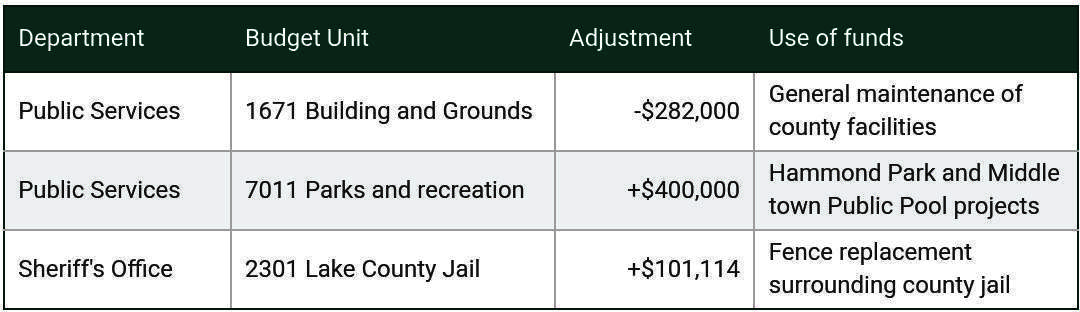
Adjustments approved during the two days of hearings include a $282,000 cut to the originally proposed $422,000 for general maintenance of county facilities. The board also approved additional $400,000 from the Park Reserve Fund — including $300,000 for improvements at Hammond Park and $100,000 to enclose and/or heat the Middletown Public Pool, to extend its seasonal use.

At the request of the Sheriff’s Office on Wednesday, the board also approved an additional $101,114 to replace the fence surrounding the county jail.

The following table shows a summary of budget adjustments at the hearings:

Additionally, Rothstein said discussions on policies and resource allocation considerations that came up during the hearings “could potentially result in adjustments to allocations during the final budget process in September, for example.” 

Uncertainties in budgeting, timeline friction

During the course of the budget hearings, several supervisors, county administrators and some department representatives expressed various uncertainties regarding the budget numbers and projects.

For one, the current fiscal year does not end until June 30, requiring the county to rely on projections rather than finalized revenues and expenditures. 

Such uncertainties drove some concerns over final budgeting timelines.

Before the hearings ended on Wednesday, Supervisor Helen Owen asked if the final budget hearing on Sep. 23 could be brought to an earlier date, as that date leaves little time — eight days, or effectively five workdays — to review and make any refinement before the Oct. 2 deadline. 

“If there's anything to change, it’d just be nice to have a little cushion there, rather than right now we're up against the wall when our deadline is,” Owen said. 

Supervisor Bruno Sabatier added that he understood that the board’s calendar was set in December. “But a week is a difficult amount of time to digest the amount of information that is there,” Sabatier said of the five workdays left between the final hearings and the deadline. 

“If there's ever a way to allow at least two weeks to be able to go through, have conversations — it's a large amount of material, not just for the Board of Supervisors to be prepared with information and questions to come here, but also for the public to be able to digest,” Sabatier said.

Currently, the “budget book” has 412 pages. 

“There's a lot of details in it, and still lots of questions, because it's not exactly a novel,” he said. 

Auditor-Controller/County Clerk Jenavive Herrington explained that even after June 30, a “60-day accrual period” will allow the county to continue processing prior-year invoices and revenues, meaning books won’t officially close until Aug. 30.

Herrington said that staff will need the three weeks before Sep. 23 to finalize the numbers. 

Owen reiterated that she would like to have an earlier hearing to allow two weeks of review, rather than the current one week. 

“I wouldn't know how to accommodate that under current standards, but we can definitely look at it,” Herrignton responded.

Supervisors request ‘deeper dive’ conversations, greater transparency

Several supervisors asked for more information, details and specifics for a number of budget items, which appeared to be insufficient or absent in the current book or presentations.

The board reached a consensus in having further discussions in the coming months before the final hearings, which may lead to more adjustments to the final budget. 

Supervisor Sabatier asked for “deeper dive” conversations on various subjects.

Following Deputy County Administrative Officer Casey Moreno’s overview presentation that called this year’s budget “perfectly balanced, " Sabatier said it’s “fluffy” when it came to salary raises and position allocations.  

He asked to have “harsh discussion” on a tighter, more realistic budget regarding “how to reduce the position allocation to be realistic, especially after signing a four-year contract with our unions,” Sabatier said. 

Last week, the board approved a series of raises for county employees for the next four years where Sabatier was the sole dissenting vote. 

Salary increases in the first year alone is $5,206,119.25, assuming all positions are filled, according to Rothstein. 

Sabatier also asked for more discussion after Public Works’ presentation about roads and funds that go into it. 

“We see huge amounts — $28 million, $30 million — and then we only spend $9 million, and then it just stays there,” he said. “I'd love to have in the future, within the next three months, a deeper dive conversation to make sure that we have a good plan in place and be able to fulfill what the public is expecting us to fulfill.”

Supervisor Jessica Pyska also asked Public Works regarding “what’s scheduled for this summer, what those budget amounts for those projects are anticipated to be,” she said. “We are in construction season, and it's something that we do ask for every year. So I think that level of transparency is something that we've desperately needed on an annual basis.”

Supervisor Owen pointed to the eight-page “Capital Assets List” that has hundreds of items and questioned the fact that every single one of them has a “yes” for “purchase authorized prior to the adopted budget.”

All the items included on the list are “funded mostly by grants or special funding sources,” Moreno said. “We did not include ones that do not have funding.”

“It's usually more appropriate to pull up things that we actually have to fund immediately and then wait for the final to actually fund the rest of the items. No?” Owen said, adding that the county’s former Chief Administrative Officer Kelly Cox had told her so. 

Sabatier asked to also include timelines for the capital projects as it would cause confusion to the public who would think “this is everything we’re planning to do this year, when it’s not; it’s what we’ve allocated the funds for some of these projects.” 

Lake County News Editor and Publisher Elizabeth Larson asked during public comment about the Lakeside Slide-Hill Road — which is on the Capital Assets List with a “yes” beside its $4.6 million allocation. 

“Is that scheduled to take place this year?” Larson asked. 

“At this point, I don’t know. I haven’t done a deep-dive into all of them,” said Public Services Director Lars Ewing who also serves as interim director for Public Works. “The ‘yes’ means authorization to spend the money.”

That slide repair project on Hill Road is meant to address a long-running landslide that began at the Lakeside Heights subdivision in north Lakeport in early 2013. 

It led to the destruction of numerous homes and, in wet winters, the hillside continues to slide, sometimes blocking Hill Road near the entrance to Sutter Lakeside Hospital. K-rail barriers remain in place to keep dirt from pushing into the roadway.

In December 2017, the county reached a $4.5 million settlement with the Lakeside Heights Homeowners Association and 45 property owners. The county was sued over the property owners’ allegations that it was county water infrastructure that caused the land instability. The settlement was reached while trial in the case was underway.

Last week, the board terminated the department’s former director Glen March with immediate effect. Now the department is in transition under leadership of Ewing and County Administrative Officer Susan Parker.

The county is now seeking a new director for Public Works. The recruitment was open on June 20, three days after the termination. 

Email staff reporter Lingzi Chen atThis email address is being protected from spambots. You need JavaScript enabled to view it.. 

County Recorder’s Office to implement eRecording July 1

LAKE COUNTY, Calif. — A new county service meant to help both businesses and individuals is coming in July.

To improve their services to county residents submitting documents through title companies, such as real estate transactions, the Lake County’s Recorder’s Office is implementing an electronic recording document system, or ERDS, which also is known as eRecording.  

This service is expected to “go live” July 1, culminating a long-time effort.  

Title companies will be able to submit documents via the county of Lake’s ERDS platform from 8 a.m. to 3 p.m. Monday through Friday, except holidays listed on the county of Lake’s website.  

Documents received after the deadline cannot be processed until the next business day.

As of Aug. 1, due to eRecording capabilities, title companies will not be able to submit documents in-person at the Lake County Recorder’s office.  

This is a standard practice used by many counties throughout California, and is expected to make recording services more effective.  

Any questions can be addressed to the Recorder’s Office, at 707-263-2302.

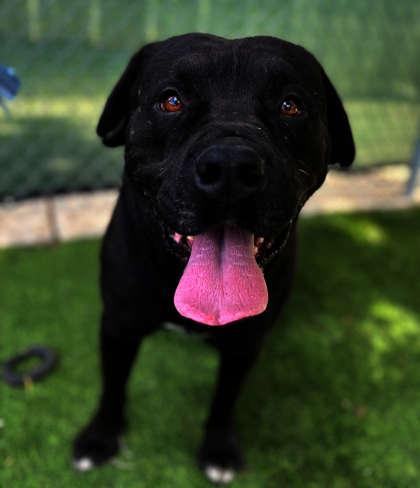
Clearlake Animal Control: ‘Sinbad’ and the dogs

“Sinbad.” Photo courtesy of Clearlake Animal Control.


CLEARLAKE, Calif. — Clearlake Animal Control has dogs ready to spend the summer in new homes.

The shelter has 49 adoptable dogs listed on its website.

This week’s dogs include “Sinbad,” a male mastiff mix with a short black coat.

The shelter is located at 6820 Old Highway 53. It’s open from 9 a.m. to 6 p.m. Tuesday through Saturday. 

For more information, call the shelter at 707-762-6227, email This email address is being protected from spambots. You need JavaScript enabled to view it., visit Clearlake Animal Control on Facebook or on the city’s website.

This week’s adoptable dogs are featured below.

Email Elizabeth Larson at This email address is being protected from spambots. You need JavaScript enabled to view it.. Follow her on Twitter, @ERLarson, and on Bluesky, @erlarson.bsky.social. Find Lake County News on the following platforms: Facebook, @LakeCoNews; X, @LakeCoNews; Threads, @lakeconews, and on Bluesky, @lakeconews.bsky.social. 


Charitable giving grew to $593B in 2024, propelled by a strengthening US economy and a booming stock market

Paul Newman, the late actor and philanthropist, co-founded Camp Boggy Creek, which children with serious illnesses and their families attend for free. AP Photo/Phelan M. Ebenhack

U.S. charitable giving increased 3.3% to US$593 billion in 2024, lifted by the strength of the economy.

The annual report from the Giving USA Foundation, produced in partnership with the Indiana University Lilly Family School of Philanthropy, found that this was the second-highest level on record after adjusting for inflation.

Giving grew at the fastest pace since 2021, when the COVID-19 pandemic led many Americans to make larger-than-usual donations. It was also the first time since then that growth in giving outpaced inflation.

As two of the report’s lead researchers, we see many signs of healthy growth in charitable giving in 2024. Our data shows that the strong economy, which grew 2.8% in 2024, bolstered individual and corporate giving and allowed foundations to maintain the historically high level of giving seen from them in recent years.

It also helped that stock markets performed well in 2024, consumer sentiment was generally positive, personal income rose and inflation continued to ease.

Donations to nearly every charitable category we track grew.

Individuals and corporations led overall growth

Individual donors continued to provide the bulk of the nation’s charitable gifts. The $392 billion they gave to charity accounted for two-thirds of the year’s total. Giving by individuals grew 5.1% from 2023 − a swifter pace than for all donations.

Corporate giving rose even faster. It was up 6% to a record $44 billion.

This growth reflects the high pretax profits earned by corporations in 2024 and the trend toward corporations donating a higher share of pretax profits in recent years.

For example, corporations generally donated less than 1% of pretax profits from 2004-2018. But our research team started to see corporate giving rise to 1% or more in the 2019 data. This was also the case in 2024, when corporate giving stood at 1.1% of pretax profits.

Corporate philanthropy has grown by more than 50% since 2019, a trend that has coincided with rising in-kind donations of insulin products and other pharmaceuticals. Drugmakers made an estimated $24 billion in these donations in 2024 − up 41% since 2019.

To be sure, corporations’ donations amounted to just 7% of overall giving in 2024.

Meanwhile, grants made by foundations exceeded $100 billion for the third straight year. Almost $1 out of every $5 contributed to charity was from a foundation in each of those years.

Giving by foundations in the five years ending in 2024 was higher than any other period since Giving USA has tracked this data. Foundation giving, however, remained fairly flat from 2023 to 2024, at about $110 billion.

Around 8% of all gifts made in 2024 were from bequests included in people’s wills, the same as in 2023. Bequests totaled $44 billion, down 4.4% when adjusted for inflation. But the total given through bequests varies quite a bit from year to year.

Most kinds of donations increased

Donations to most of the nine charitable categories Giving USA tracks increased. The one exception: Gifts to churches and other religious institutions fell 1%. But religious giving remained by far the top category, followed by human services and education.

Religious causes received 23% of all donations, a total of $147 billion. Giving to human services nonprofits, such as food banks and homeless shelters, increased considerably during the pandemic. It now accounts for about 14% of all donations. In 2024, these gifts totaled $91 billion.

Giving to education, which primarily consists of donations to colleges and universities has tended to grow more slowly than overall giving in recent years.

Giving for education rebounded to a record high in 2024, however, rising nearly 10% from a year earlier. And these gifts have grown at a quick pace over the past decade, increasing by more than 22% from 2015 to 2024. The $88 billion in gifts received for education in 2024 was the third-largest of the nine categories we follow.

Several other categories also reached all-time highs of giving in 2024: health, at $61 billion; arts, culture and humanities, at $25 billion; and environment and animals, at $22 billion.

The increases in giving for most kinds of nonprofits, supported by strong growth in giving by individuals and corporations, indicate that the charitable sector ended 2024 in a relatively solid position.The Conversation

Jon Bergdoll, Associate Director of Data Partnerships at the Lilly Family School of Philanthropy, Indiana University and Christina Daniken, Research Associate in Philanthropy and Editor-in-Chief of Giving USA, Indiana University

This article is republished from The Conversation under a Creative Commons license. Read the original article.

Lakeport Rotary Club buries 2050 time capsule

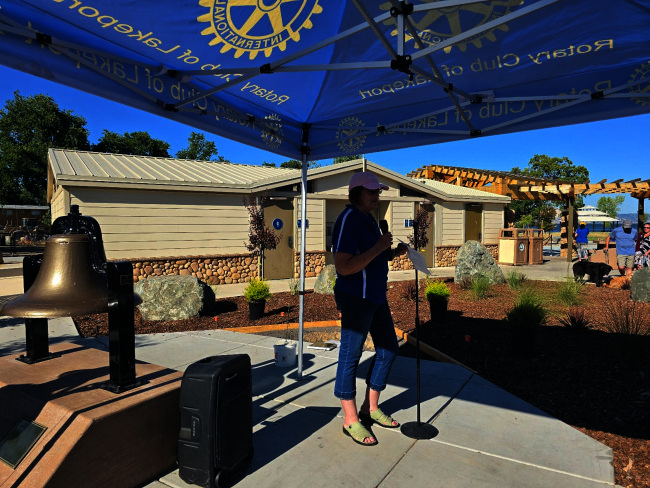
Lakeport Rotary President Pam Harpster stands next to the spot where the time capsule was to be buried at Xabatin Park in Lakeport, California, during a ceremony on Wednesday, June 25, 2025. Photo by Lingzi Chen/Lake County News.

LAKEPORT, Calif. — Rotarians and community members gathered in Lakeport on Wednesday evening to build a bridge between the present and the future.

The Lakeport Rotary Club celebrated the burial of a community time capsule at Lakeport's Xabatin Park.

The time capsule, to be covered by a layer of concrete, is located near the park’s North Main Street entrance next to the curfew bell, a project Lakeport Rotary finished last fall.

With the time capsule, the club — celebrating its 100th anniversary this year — is looking toward 2050. That’s the year that the time capsule will be reopened.

Rotary President Pam Harpster credited numerous individuals for their help in the project, including city of Lakeport staff Jim Kennedy, Ron Ladd and Kevin Ingram, and many Rotarians.

“It’s been a group effort,” she said. 

Harpster also explained the reason for a time capsule.

“Why a time capsule? What the heck?” she asked.

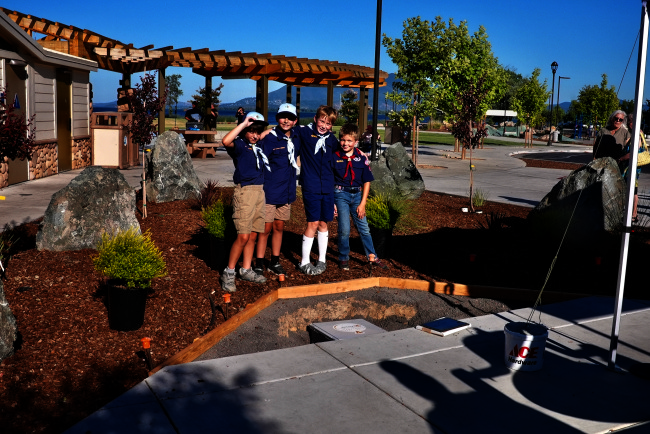
A group of youngsters with the Rotary time capsule. It’s hoped they will be around to help open it in 25 years. Photo by Nathan Powers. The time capsule up close. Photo by Nathan Powers.


For one, it will say hello to the future, and will preserve a bridge between now and 2050, Harpster said.

The time capsule will contain numerous items that she said represent the community, including letters, mementos and objects with sacred importance, such as a medicine bag gifted to the effort by Les Miller of the Scotts Valley Band of Pomo Indians, containing soil from the grave of his grandmother, a tribal matriarch.

Miller called the time capsule a “super idea,” adding he is proud of Lakeport, the city where he grew up.

Harpster said a 5-foot-tall eagle statue also is planned to be located near the time capsule.

She said she and the club are looking forward to working with the city more.

Rotarian Jennifer Strong said being a Rotary president during a centennial is a tall order, but Harpster, who has had health challenges in the midst of it, met the moment.

“This park is a gift,” said Strong, who also grew up in Lake County. 

The park represents the past, present and future, Strong added.

The time capsule up close. Photo by Nathan Powers.


Rotary has clubs in Kelseyville, Clearlake and Lakeport, with a satellite in Middletown. Strong said the club’s mission is to give back, and leave things better than they found them.

Strong said it’s overwhelming to think about all that volunteers do, and it’s a gift to be part of it. 

Rotary welcomes new members with the motto, “Service Above Self.” However, Strong said she thinks it’s more accurate to say “service feeds self.”

“We get more out of it than we give,” Strong said.

Rotary invites the community to take part in their centennial celebration, set for Saturday, Aug. 9, at 5:30 p.m. at the Soper Reese Theatre, 275 S. Main St. in Lakeport.  

For more information and to purchase tickets, please visit the Rotary Club of Lakeport's website at www.lakeportrotary.org. 

Below is the list of items included in the time capsule.


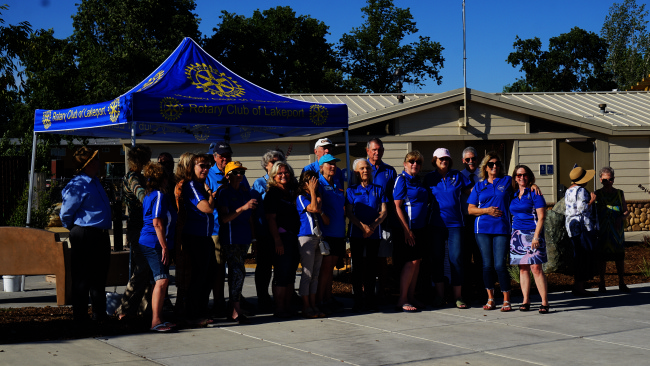
Lakeport Rotary members at the site of a new time capsule at Xabatin Park on Wednesday, June 25, 2025. Photo by Elizabeth Larson/Lake County News.
Rotary Club of Lakeport: Time Capsule 2025

*Rotary Club of Lakeport
Polo shirt with logo
Polo shirt — Centennial logo 1925-2025
Tote bag — Rotary Youth Exchange 2024 (Strong Financial Network)
District Conference Lake County 1952
Membership Classification List
Sources of Revenue 1992-1993
Polio Plus Society Certificate x2
District 5130 Newsletter June 2025

Packet from Pam Harpster – President
Letter to Future Presidents
Power Point Prez of last meeting, June 18, 2025
Time Travel – Capsule Invitation
District Grant Proposal for Time Capsule
District 5130 Letter from Governor
Sample of Rotogram

Letters to People (from Pam Harpster)
City of Lakeport
Jacob Glenn Thomsen
Clara Luchsinger
Kennedy and Quin Karkin
Colton and Connor Todd
Future Community Members

Letters from Rotary Members
April Leiferman
Dennis Fordham
Greg Scott
John Lawson
Faith Hornby
Pam Harpster

Club Brochure
Meeting Attendance List n.d.
Invocation
Songs-Lyric Book
A History of 57 Years of Service (booklet)
Manual of Information for Presidents and Secretaries
Banner
Golf Ball with Rotary logo
Wine Bottle-Crab Feed 2025
Time Capsule Flier

Rotary packet
Flag, pin, badge, magazine

Rotary Projects-Photos
Crab Feed 2025
Christmas Basket
Easter Egg Coloring 225
Hospice Lending Closet

Letters from Students
Upper Lake Elementary School-Teachers
Fourth Grade Classes:  Heather Hunt, Payton Conrad, Kathy Verstoppen, LanaVanBuskirk
Fifth Grade Classes:  Chelsie Gracia, Morgan Psalmonds, Allison Pivniska-Clouse

Book of Why
Thank You Letters from Upper Lake Elementary School Third Grade Class of Jasmin Harwell

*Rotary Club of Kelseyville Sunrise
-Membership -Projects    -Challenges
Banner x2
Rotary Pin – The Magic of Rotary + Thumb Drive
2024 Lincoln Penny
Gold Bell with Mount Konocti “K”

*Pins
City of Lakeport
Lake County Fair
Mendocino College
Mendocino College Foundation
Lake County Office of Education

*Assorted Items
Back Stage (magazine) May-June 2025
Belt buckle, city of Lakeport centennial, gifted by Lakeport Kiwanis Club
Best of Lake & Mendocino 2025 Magazine
Big Valley Rancheria – Medicine Bag; Sealed Envelope with Contents
Business Design Services
Brochures of service, Lake County Tribal Health
Certified Tourism Ambassador – Pin, Brochure; Welcome Anglers Sign
County of Lake – Business cards – Board of Supervisors, Administrators
Cub Scouts
Ganoung,Tom – CD, Laughter in the River
General Aviation News – May 22, 2025 - Clear Lake Splash In  
Habematolel (Pomo of Upper Lake) – Arrow March 2025 Magazine
Lake County Land Trust – Newsletter Spring 2025; Magnet; Brochure
Lake County Theatre Company – Shows for 2024-2
Lakeport Events 2025
Lake Family Resource Center – Services
Lake County Tourism Improvement District – Official Visitors Map, LAKELife 2024 
Lakeport Unified School District – Spring/Summer 2025 Reports to Community
Luchsinger, Clara – News Clippings, Sealed Envelope, Lake County Record-Bee, 4/4/2025
Mendocino College – 2024-25 Catalog, Fall 2025 Class Schedule, Degrees & Certificates,  
 Assorted Brochures; Dual Enrollment Stole
Shakespeare at the Lake 2025
Soper Reese Theatre – Shows, Classic Cinema
Strong Financial Network
That Ranch – Packet
The Ripe Choice Farm
Walk Through Time – CD, The Story of Anderson Marsh
100+ Women Strong Lake County
One-Team One Dream 
Silver Foundation
Sutter Health/Sutter Lakeside Hospital
Skylark Shores Resort
Lake County Fair – Lake County Rodeo 2025 poster
Lake County Library & Bookmobile – services, summer reading program
CLERC – Clear Lake Environment Research Center
Lake County Winegrape Commission – reports
Lake County Economic Development Corporation – rack card with services
Scotts Valley Band of Pomo Indians – medicine bag

*City of Lakeport
Xabatin Park – Big Water, Bold Vision – background on park planning/funding
Guide to Doing Business in Lakeport
Postcards – 7 City scenes
Movement Moai April 2025 - flier
Lakeport Economic Development Advisory Committee Members – rack card
Tote Bag with City seal
Public Works/Utilities – group photo plus accomplishments 2024-2025
City Manager’s Message; Budget Book FY 2024/2025

Email Elizabeth Larson at This email address is being protected from spambots. You need JavaScript enabled to view it.. Follow her on Twitter, @ERLarson, and on Bluesky, @erlarson.bsky.social. Find Lake County News on the following platforms: Facebook, @LakeCoNews; X, @LakeCoNews; Threads, @lakeconews, and on Bluesky, @lakeconews.bsky.social. 
  • 161
  • 162
  • 163
  • 164
  • 165
  • 166
  • 167
  • 168
  • 169
  • 170

Community

  • Lake County Wine Alliance offers sponsor update; beneficiary applications open 

  • Mendocino National Forest announces seasonal hiring for upcoming field season

Public Safety

  • Lakeport Police logs: Thursday, Jan. 15

  • Lakeport Police logs: Wednesday, Jan. 14

Education

  • Woodland Community College receives maximum eight-year reaffirmation of accreditation from ACCJC

  • SNHU announces Fall 2025 President's List

Health

  • California ranks 24th in America’s Health Rankings Annual Report from United Health Foundation

  • Healthy blood donors especially vital during active flu season

Business

  • Two Lake County Mediacom employees earn company’s top service awards

  • Redwood Credit Union launches holiday gift and porch-to-pantry food drives

Obituaries

  • Rufino ‘Ray’ Pato

  • Patty Lee Smith

Opinion & Letters

  • The benefits of music for students

  • How to ease the burden of high electric bills

Veterans

  • CalVet and CSU Long Beach team up to improve data collection related to veteran suicides

  • A ‘Big Step Forward’ for Gulf War Veterans

Recreation

  • Wet weather trail closure in effect on Upper Lake Ranger District

  • Mendocino National Forest seeking public input on OHV grant applications

  • State Parks announces 2026 Anderson Marsh nature walk schedule 

  • BLM lifts seasonal fire restrictions in central California

Religion

  • Kelseyville Presbyterian to host Ash Wednesday service and Lenten dinner Feb. 18

  • Kelseyville Presbyterian Church to hold ‘Longest Night’ service Dec. 21

Arts & Life

  • Auditions announced for original musical ‘Even In Shadow’ set for March 21 and 28

  • ‘The Rip’ action heist; ‘Steal’ grounded in a crime thriller

Government & Politics

  • Lake County Democrats issue endorsements in local races for the June California Primary

  • County negotiates money-saving power purchase agreement

Legals

  • March 3 hearing on ordinance amending code for commercial cannabis uses

  • Feb. 12 public hearing on resolution to establish standards for agricultural roads

How to resolve AdBlock issue?
Refresh this page