How to resolve AdBlock issue?
Refresh this page
How to resolve AdBlock issue?
Refresh this page
Lake County News,California
  • Home
    • Registration Form
  • News
    • Education
    • Veterans
    • Community
      • Obituaries
      • Letters
      • Commentary
    • Police Logs
    • Business
    • Recreation
    • Health
    • Religion
    • Legals
    • Arts & Life
    • Regional
  • Calendar
  • Contact us
    • FAQs
    • Phones, E-Mail
    • Subscribe
  • Advertise Here
  • Login

News

Record 8.9 million people expected to travel domestically July 4 week

A record 72.2 million people are expected to travel at least 50 miles or more from home over the Independence Day holiday period from Saturday, June 28 to Sunday, July 6, according to a new report from AAA.

This represents an increase of 1.7 million domestic travelers compared to last year and 7 million more than in 2019.

More than 8.9 million Californians are expected to travel for the holiday, marking an increase of nearly 182,000 compared to 2024 and over 615,000 from than in 2019. 

AAA’s Independence Day forecast includes two weekends instead of one to better reflect the flow of holiday travelers.

“Summertime is one of the busiest travel seasons of the year, and July 4 is one of the most popular times to get away,” said AAA Mountain West Group spokesperson Doug Johnson. “Following Memorial Day’s record forecast, AAA is seeing strong demand for road trips and air travel over Independence Day week. With the holiday falling on a Friday, travelers have the option of making it a long weekend or taking the entire week to make memories with family and friends.”

Independence day travelers by mode of transportation

By car: AAA projects 61.6 million people will travel by car, a 2.2% increase over last year, and the highest volume on record. This Independence Day holiday period is expected to see an additional 1.3 million road travelers compared to 2024. In California, more than 7 million people will be traveling by car throughout the Golden State.

By air: Air travel is also projected to set a new record. AAA expects 5.84 million travelers will fly to their destinations; that’s 8% of all Independence Day travelers. This year’s projection is a 1.4% increase over the previous record set last Independence Day week of 5.76 million air travelers. In California, more than 1.2 Million residents will be flying this holiday weekend, about 24,000more than in 2024.

By other modes: AAA projects 4.78 million people will travel by bus, train, or cruise, a 7.4% increase over 2024. This year’s number is just shy of the 2019 record of 4.79 million. Cruising is driving the popularity of this category, particularly this time of year, when Alaska cruise season is in full swing. About 593 thousand Californians are expected to travel by bus, train, or cruise.

July 4th travel tips

Save on gas. Use the AAA Mobile App to find the cheapest gas stations along your route, plan your trip, request roadside assistance and more. 

Be road trip ready. Pack an emergency kit and get a pre-trip inspection to prevent common breakdowns like dead batteries and blown tires.

Avoid speeding. Fuel economy peaks around 50 mph on most cars, then drops off as speeds increase. Reducing highway speeds by 5 to 10 mph can increase fuel economy by as much as 14%.

Hit the road early. Wednesday, July 2 and Sunday, July 6 are projected to be the busiest travel days with 12 p.m. to 8 p.m. being the most congested hours. Keep in mind construction, crashes, or severe weather could impact your travel times. 

Stay alert while driving. Avoid distractions while on the road and slow down, move over for emergency vehicles, tow trucks, or disabled vehicles on the side of the road.

Cal Fire unit showcases firefighting helicopters and helitack crews

A Cal Fire event showcasing aerial firefighting resources at Napa County Airport on Monday, June 23, 2025. Photo By Lingzi Chen/Lake County News.

NAPA COUNTY, Calif. — As cool winds blew and aircrafts taxied nearby, Cal Fire’s Sonoma-Lake-Napa Unit showcased its aerial firefighting muscles — helicopters and crews — at the Napa County Airport on Monday. 

Each of the three helicopters on display is based in a different county within the unit: a Cal Fire Hawk — a Sikorsky S-70i in signature red-and-white — with its helitack crew stationed at the Boggs Mountain Helitack Base in Lake County.

Also featured were a Boeing CH-47D Chinook based at the Napa County Airport and a Sikorsky UH-60A+ Blackhawk based at the Charles M. Schulz Sonoma County Airport. 

The later two are contracted with Cal Fire for exclusive aerial firefighting operations this summer into the fall. 

“These aircraft displayed behind me today represent a strategic investment in wildfire preparedness and rapid response," said Unit Chief Matt Ryan in his speech. “Cal Fire has deployed aircraft across California ahead of peak fire conditions to ensure a rapid, aggressive initial attack.”

Ryan highlighted the helicopters’ capability.

Cal Fire Sonoma-Lake-Napa Unit Chief Matt Ryan spoke at the event at Napa County Airport on Monday, June 23, 2025. Photo By Lingzi Chen/Lake County News.

The Fire Hawk is “a state-of-the-art firefighting helicopter as an initial attack with wildfire suppression and rescue operations, Ryan said. It delivers a helitack crew directly to the fire line with 1m000 gallons of water.

The Chinook can carry up to 26,000 pounds, delivers up to 2,300 gallons of water and is qualified for night operations; The Blackhawk has a capacity of 1100 gallons of water designed for rapid deployment.

“These aviation resources are key to achieving one of Cal Fire's core objectives — containing 95% of wildfires at 10 acres or less,” Ryan said. “Together, our air and ground resources enhance our ability to protect the lives, property and natural resources of California.”

As Ryan spoke, firefighters in dark blue uniforms stood against the backdrop of their towering mechanical counterparts.

Since 2021, Napa County “has seen just eight wildfires that exceeded 10 acres in size, an average of just two per year,” said the county’s Board of Supervisors Chair Anne Cottrell during her speech. Over the 10 years prior to 2021, Cottrell said, Napa had 46 wildfires over 10 acres — nearly five a year.

The reduction in wildfire was “remarkable” and “a testament to Cal Fire’s rapid response strategy,” she said. 

The unit’s Public Information Officer Jason Clay told Lake County News that aircraft or helicopters are “strategically positioned throughout California” to be able to respond to any fire across the state within 20 minutes. 

Equipment at the Cal Fire event showcasing aerial firefighting resources at Napa County Airport on Monday, June 23, 2025. Photo By Lingzi Chen/Lake County News.


The Fire Hawk and helitack team based in Lake County

It took the Fire Hawk 15 minutes to fly the helitack team from their base in Boggs Mountain, Lake County to the event in Napa, according to the crew. By car, the trip would have taken two hours. 

For some firefighters there, the commute to work is even longer. 

Jake Gallant, a firefighter who lives in San Luis Obispo, said he has a four-hour drive to Lake County. “I have the farthest commute,” he said with a laugh. 

Gallant explained that their shifts are “three days on, four days off” so that he does not have to make the drive every day. 

“I mean, it’s actually pretty common in Cal Fire for people to live further away from where they work,” he said. “I wouldn't get this opportunity to work on a Cal Fire Hawk closer to where I live. So it’s worth it to me.”

Firefighters in bright yellow uniforms getting ready for dispatch from the event on Monday, June 23, 2025. Photo By Lingzi Chen/Lake County News.


Gallant has spent three of his seven years in firefighting on the helicopter crew. “I love it. It’s the best job I ever had,” he said. 

Before firefighting, Gallant said he had done many jobs in construction, moving — mostly manual labor. 

“Well, they do a lot of manual labor,” Gallant said of transitioning to firefighting. “And I’m pretty good at that, so might as well do something cool with it.”

This year, the heliteck crew has attended and landed for 13 fires so far, according to Fire Captain Chris Batey who has been in firefighting since 2001 and came to the base four years ago.

Speaking of the fire trends throughout the year, “We get highs and lows,” Batey said. “Last year we started off much busier than this year — we went straight into a couple fires that burned down 10,000 acres each.”

“This year, it’s been really slow — small fires, not doing a whole lot — which is the way we like it; it’s way better,” Batey said.

In 2024, the Boggs Mountain helitack team landed and took action on 54 fires, Batey and Gallant recalled. “There's probably 100 more that we started to but they didn't need us, or we were canceled,” Gallant added.

Batey told Lake County News that it costs about $7,000 an hour for the Fire Hawk and crew to work on an ongoing fire, covered by the unit’s operating budget. 

Fire Hawk helicopter and crew of Boggs Mountain Helitack preparing to leave the event for a fire emergency in Contra Costa County on Monday, June 23, 2025. Photo By Lingzi Chen/Lake County News.


This Fire Hawk-Sikorsky S-70i is the only helicopter at the helitack base right now, according to Gallant. The aircraft and the crew, while showing up in the event, were actively on call. 

“So if there is a fire, we will leave,” Batey said. 

For the pilot, Michael Schanley, firefighting from the sky has “a tremendous amount of variables — whether it’s the wind, the heat.” 

Schanley has been with Cal Fire for six years of his total of 38 years primarily for aerial firefighting, having previously worked as a contractor. 

He likened the job to a boxing match. “I have an opponent in a fire, and the fire doesn't just wait for me to go make another drop,” Schanley said in explaining his theory. 

“The fire is doing its thing and we're chasing it right?” he said. “We chased it down. And then at some point, we kind of reached an equilibrium, and then we started getting the upper hand — getting a little head of the fire, and we're doing our part. And then eventually it goes out …”

“Mike, I think we got a job at Contra Costa,” a crew member interrupted.

The conversation ended. Quickly, dark blue uniforms were swapped for bright yellow as the Fire Hawk’s engine started humming, rotors spinning, kicking up dust on the ramp before taking off.

Four minutes later, they arrived at the fire scene. 

Email staff reporter Lingzi Chen at This email address is being protected from spambots. You need JavaScript enabled to view it.. 

The Cal Fire Hawk Sikorsky S-70i took off for a fire emergency in Contra Costa County on Monday, June 23, 2025. Photo By Lingzi Chen/Lake County News.

Clearlake City Council approves $83 million budget, largest in city history

LAKE COUNTY, Calif. — The Clearlake City Council on Thursday wrapped up work on the new fiscal year budget, the largest in the city’s 45-year history.

The council held a 2025-26 budget workshop Thursday evening, just ahead of its regular meeting, to go over the numbers with staff. 

The budget the council eventually approved included $83,149,510 in expenses and $81,034,188 in revenue.

City Manager Alan Flora told Lake County News that the 2025-26 budget is the largest in the city’s history, and is significantly larger than in past years. 

Compare this year’s budget, at nearly $84 million in appropriations, to last year’s, at $50 million. 

“Our General Fund has not really increased, this is the result of grant funds for various projects,” said Flora.

For this new fiscal year, Flora said the city budget includes more than $45 million in grant funds to support the Clearlake Apartments project near Adventist Health Clear Lake Hospital.

“The state has provided these grant funds to the city to pass through to the housing developer,” Flora said.

Despite being the largest budget Clearlake has had to date, Flora said in his budget message on the city’s Open Gov page that, “Revenue constraints require us to take a more conservative approach to spending, prioritizing essential services and carefully evaluating discretionary expenditures.”

The city is prioritizing core services such as public safety, road maintenance and essential municipal operations, all of which Flora said remain fully funded.

The city is taking a strategic approach to spending reductions by identifying efficiencies across departments to minimize costs while maintaining service quality, Flora said in his message.

Meantime, the city remains committed to key infrastructure projects — which Flora said include road rehabilitation and downtown revitalization efforts — while maximizing grand funding from state and federal sources. 

During the workshop, staff outlined the main capital projects for the coming year, which total approximately $15,783,013.

They include: 

• Arrowhead Burns Valley Road Rehabilitation Project: $5,483,774.
• Burns Valley Sports Complex: $9,116,279.
• Dam Road roundabout: $483,925.
• Austin Park Skate Park: $400,000.
• Clearlake Police Department radio/communication infrastructure: $210,675.
• Airport Road Project, $88,360.

“While fiscal prudence is necessary, our guiding principle remains progress and stability for Clearlake’s residents. Through careful planning and resourceful decision-making, we will continue improving our city’s livability while ensuring long-term financial sustainability,” Flora wrote.

Matt Pressey, the city’s acting finance director, told the council that the state has seen strong growth over the past five years, including steady growth in its revenues. He referred to California surpassing Japan last year to become the world's fourth-largest economy. However, there is now limited economic growth.

On the city level, Pressey reported that the economy is stable but not growing. Property tax revenues are seeing a slight increase while sales tax revenues are dropping slightly. Population growth is on a stable trend.

Flora told the council that the budget is not “structurally sound,” which means that they are using one-time funding for ongoing expenses.

He said that’s not where they want to be, explaining that the city is relying heavily on using other funding sources to support expenses in the general fund which they wouldn’t have to do if they hadn’t a healthier economy.

As a result, he’s implemented a general fund hiring freeze for jobs not in the background check process.

The city has had significant increases in retirement and insurance costs this year. In spite of those increases, Flora said the budget still shows reductions in all general fund budget units.

During the regular meeting, which lasted just under 45 minutes, the council unanimously approved the new fiscal year budget with no additional discussion.

Email Elizabeth Larson at This email address is being protected from spambots. You need JavaScript enabled to view it.. Follow her on Twitter, @ERLarson, and on Bluesky, @erlarson.bsky.social. Find Lake County News on the following platforms: Facebook, @LakeCoNews; X, @LakeCoNews; Threads, @lakeconews, and on Bluesky, @lakeconews.bsky.social. 

Lake Area Planning Council seeks public input for State Route 53 Corridor safety improvements study

LAKE COUNTY, Calif. — The Lake Area Planning Council, or Lake APC, is inviting residents of Clearlake and the surrounding areas to participate in an important study focused on enhancing transportation safety along the State Route 53 corridor.

The study will determine public transportation needs and priorities along Highway 53 within the city limits of Clearlake.

Lake APC said public participation is a key component in the study, and community members’ insights are critical for securing future grant funding for transportation safety improvements in the area.

To share your comments and help shape the future of Highway 53, residents are encouraged to complete the online survey and explore the interactive project map by July 16.

Fill out the survey here.

Community members may also complete paper surveys, available at the following designated drop-box locations:

• Clearlake City Hall, 14050 Olympic Drive.
• Lake Transit Authority, 9240 Highway 53, Lower Lake.
• Lake County Social Services Department, 15975 Anderson Ranch Parkway, Lower Lake.

For more information about the SR 53 Corridor Project Prioritization Study, contact John Speka of the Lake Area Planning Council at This email address is being protected from spambots. You need JavaScript enabled to view it. or call 707-263-7799.

To spur the construction of affordable, resilient homes, the future is concrete

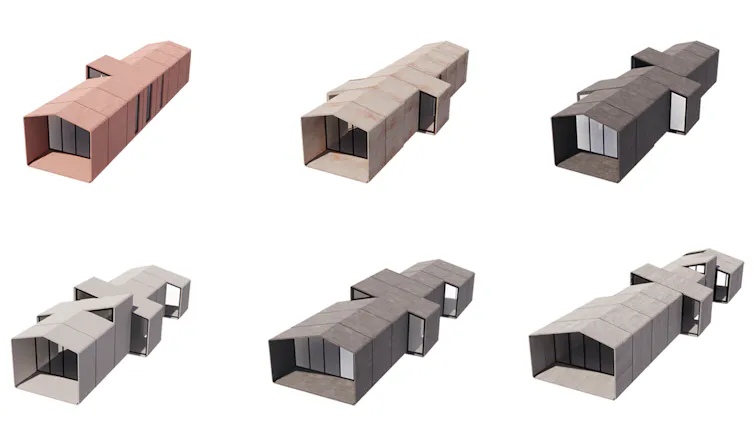
A modular, precast system of concrete ‘rings’ can be connected in different ways to build a range of models of energy-efficient homes. Pablo Moyano Fernández, CC BY-SA

Wood is, by far, the most common material used in the U.S. for single-family home construction.

But wood construction isn’t engineered for long-term durability, and it often underperforms, particularly in the face of increasingly common extreme weather events.

In response to these challenges, I believe mass-produced concrete homes can offer affordable, resilient housing in the U.S. By leveraging the latest innovations of the precast concrete industry, this type of homebuilding can meet the needs of a changing world.

Wood’s rise to power

Over 90% of the new homes built in the U.S. rely on wood framing.

Wood has deep historical roots as a building material in the U.S., dating back to the earliest European settlers who constructed shelters using the abundant native timber. One of the most recognizable typologies was the log cabin, built from large tree trunks notched at the corners for structural stability.

A mother holds her child in the front doorway of their log cabin home.
Log cabins were popular in the U.S. during the 18th and 19th centuries. Heritage Art/Heritage Images via Getty Images

In the 1830s, wood construction underwent a significant shift with the introduction of balloon framing. This system used standardized, sawed lumber and mass-produced nails, allowing much smaller wood components to replace the earlier heavy timber frames. It could be assembled by unskilled labor using simple tools, making it both accessible and economical.

In the early 20th century, balloon framing evolved into platform framing, which became the dominant method. By using shorter lumber lengths, platform framing allowed each floor to be built as a separate working platform, simplifying construction and improving its efficiency.

The proliferation and evolution of wood construction helped shape the architectural and cultural identity of the nation. For centuries, wood-framed houses have defined the American idea of home – so much so that, even today, when Americans imagine a house, they typically envision one built of wood.

A row of half-constructed homes surrounded by piles of dirt.
A suburban housing development from the 1950s being built with platform framing. H. Armstrong Roberts/ClassicStock via Getty Images

Today, light-frame wood construction dominates the U.S. residential market.

Wood is relatively affordable and readily available, offering a cost-effective solution for homebuilding. Contractors are familiar with wood construction techniques. In addition, building codes and regulations have long been tailored to wood-frame systems, further reinforcing their prevalence in the housing industry.

Despite its advantages, wood light-frame construction presents several important limitations. Wood is vulnerable to fire. And in hurricane- and tornado-prone regions, wood-framed homes can be damaged or destroyed.

Wood is also highly susceptible to water-related issues, such as swelling, warping and structural deterioration caused by leaks or flooding. Vulnerability to termites, mold, rot and mildew further compromise the longevity and safety of wood-framed structures, especially in humid or poorly ventilated environments.

The case for concrete

Meanwhile, concrete has revolutionized architecture and engineering over the past century. In my academic work, I’ve studied, written and taught about the material’s many advantages.

The material offers unmatched strength and durability, while also allowing design flexibility and versatility. It’s low-cost and low-maintenance, and it has high thermal mass properties, which refers to the material’s ability to absorb and store heat during the day, and slowly release it during the cooler nights. This can lower heating and cooling costs.

Properly designed concrete enclosures offer exceptional performance against a wide range of hazards. Concrete can withstand fire, flooding, mold, insect infestation, earthquakes, hail, hurricanes and tornadoes.

It’s commonly used for home construction in many parts of the world, such as Europe, Japan, Mexico, Brazil and Argentina, as well as India and other parts of Southeast Asia.

However, despite their multiple benefits, concrete single-family homes are rare in the U.S.

That’s because most concrete structures are built using a process called cast-in-place. In this technique, the concrete is formed and poured directly at the construction site. The method relies on built-in-place molds. After the concrete is cast and cured over several days, the formwork is removed.

This process is labor-intensive and time-consuming, and it often produces considerable waste. This is particularly an issue in the U.S., where labor is more expensive than in other parts of the world. The material and labor cost can be as high as 35% to 60% of the total construction cost.

Portland cement, the binding agent in concrete, requires significant energy to produce, resulting in considerable carbon dioxide emissions. However, this environmental cost is often offset by concrete’s durability and long service life.

Concrete’s design flexibility and structural integrity make it particularly effective for large-scale structures. So in the U.S., you’ll see it used for large commercial buildings, skyscrapers and most highways, bridges, dams and other critical infrastructure projects.

But when it comes to single-family homes, cast-in-place concrete poses challenges to contractors. There are the higher initial construction costs, along with a lack of subcontractor expertise. For these reasons, most builders and contractors stick with what they know: the wood frame.

A new model for home construction

Precast concrete, however, offers a promising alternative.

Unlike cast-in-place concrete, precast systems allow for off-site manufacturing under controlled conditions. This improves the quality of the structure, while also reducing waste and labor.

The CRETE House, a prototype I worked on in 2017 alongside a team at Washington University in St. Louis, showed the advantages of a precast home construction.

To build the precast concrete home, we used ultra-high-performance concrete, one of the latest advances in the concrete industry. Compared with conventional concrete, it’s about six times stronger, virtually impermeable and more resistant to freeze-thaw cycles. Ultra-high-performance concrete can last several hundred years.

The strength of the CRETE House was tested by shooting a piece of wood at 120 mph (193 kph) to simulate flying debris from an F5 tornado. It was unable to breach the wall, which was only 2 inches (5.1 centimeters) thick.

The wall of the CRETE House was able to withstand a piece of wood fired at 120 mph (193 kph).

Building on the success of the CRETE House, I designed the Compact House as a solution for affordable, resilient housing. The house consists of a modular, precast concrete system of “rings” that can be connected to form the entire structure – floors, walls and roofs – creating airtight, energy-efficient homes. A series of different rings can be chosen from a catalog to deliver different models that can range in size from 270 to 990 square feet (25 to 84 square meters).

The precast rings can be transported on flatbed trailers and assembled into a unit in a single day, drastically reducing on-site labor, time and cost.

Since they’re built using durable concrete forms, the house can be easily mass-produced. When precast concrete homes are mass-produced, the cost can be competitive with traditional wood-framed homes. Furthermore, the homes are designed to last far beyond 100 years – much longer than typical wood structures – while significantly lowering utility bills, maintenance expenses and insurance premiums.

The project is also envisioned as an open-source design. This means that the molds – which are expensive – are available for any precast producer to use and modify.

A computer graphic showing a prototype of a small, concrete home.
The Compact House is made using ultra-high-performance concrete. Pablo Moyano Fernández, CC BY-SA

Leveraging a network that’s already in place

Two key limitations of precast concrete construction are the size and weight of the components and the distance to the project site.

Precast elements must comply with standard transportation regulations, which impose restrictions on both size and weight in order to pass under bridges and prevent road damage. As a result, components are typically limited to dimensions that can be safely and legally transported by truck. Each of the Compact House’s pieces are small enough to be transported in standard trailers.

Additionally, transportation costs become a major factor beyond a certain range. In general, the practical delivery radius from a precast plant to a construction site is 500 miles (805 kilometers). Anything beyond that becomes economically unfeasible.

However, the infrastructure to build precast concrete homes is already largely in place. Since precast concrete is often used for office buildings, schools, parking complexes and large apartments buildings, there’s already an extensive national network of manufacturing plants capable of producing and delivering components within that 500-mile radius.

There are other approaches to build homes with concrete: Homes can use concrete masonry units, which are similar to cinder blocks. This is a common technique around the world. Insulated concrete forms involve rigid foam blocks that are stacked like Lego bricks and are then filled with poured concrete, creating a structure with built-in insulation. And there’s even 3D-printed concrete, a rapidly evolving technology that is in its early stages of development.

However, none of these use precast concrete modules – the rings in my prototypes – and therefore require substantially longer on-site time and labor.

To me, precast concrete homes offer a compelling vision for the future of affordable housing. They signal a generational shift away from short-term construction and toward long-term value – redefining what it means to build for resilience, efficiency and equity in housing.

A bird's-eye view of a computer-generated neighborhood featuring plots of land with multiple concrete homes located on them.
An image of North St. Louis, taken from Google Earth, showing how vacant land can be repurposed using precast concrete homes. Pablo Moyano Fernández, CC BY-SA

This article is part of a series centered on envisioning ways to deal with the housing crisis.The Conversation

Pablo Moyano Fernández, Assistant Professor of Architecture, Washington University in St. Louis

This article is republished from The Conversation under a Creative Commons license. Read the original article.
Supervisors to discuss how to spend over $400 million in annual budget hearings

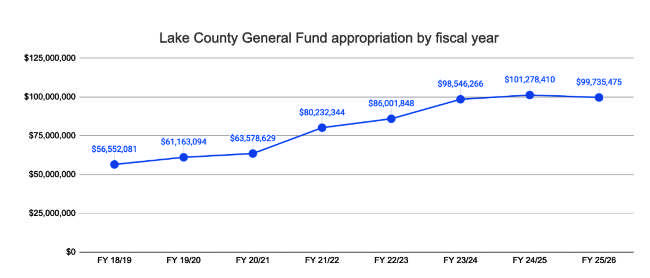
Chart by Lingzi Chen/Lake County News.


LAKE COUNTY, Calif. — The Board of Supervisors this week will hold two days of budget hearings to discuss where and how to allocate more than $400 million in county funds.

The‌ ‌board will meet beginning ‌at‌ ‌9‌ a.m. on both Tuesday, June 24 and Wednesday, June 25, in the board chambers on the first floor of the Lake County Courthouse, 255 N. Forbes St., Lakeport.

The‌ ‌meeting‌ ‌can‌ ‌be‌ ‌watched‌ ‌live‌ ‌on‌ ‌Channel‌ ‌8, ‌online‌ ‌at‌ ‌https://countyoflake.legistar.com/Calendar.aspx‌‌ and‌ ‌on‌ ‌the‌ ‌county’s‌ ‌Facebook‌ ‌page. ‌Accompanying‌ ‌board‌ ‌documents, ‌the‌ ‌agenda‌ ‌and‌ ‌archived‌ ‌board‌ ‌meeting‌ ‌videos‌ ‌also‌ ‌are‌ ‌available‌ ‌at‌ ‌that‌ ‌link. ‌ ‌

To‌ ‌participate‌ ‌in‌ ‌real-time, ‌join‌ ‌the‌ ‌Zoom‌ ‌meeting‌ ‌by‌ ‌clicking‌ ‌this‌ ‌link‌. ‌ ‌

The‌ ‌meeting‌ ‌ID‌ ‌is‌ 865 3354 4962, ‌pass code 726865.‌ ‌The meeting also can be accessed via one tap mobile at +16694449171,,86533544962#,,,,*726865#. The meeting can also be accessed via phone at 669 900 6833.

Over the two days, the board will consider the recommended budget for fiscal year 2025-26. 

According to the staff memo, the final budget must be approved by June 30 and adopted by Oct. 2. Final adoption will take place following public hearings currently scheduled for Sept. 23. 

For the upcoming fiscal year, recommended appropriations for all funds total $418,634,111 — an increase of $21,458,724 from the previous year, according to the staff memo. 

The increase, the staff memo said, is attributable to additional appropriations to a range of special revenue funds such as $19.5 million to Behavioral Health Services, $2 million to roads, $3.4 million to Spring Valley,  $2.7 million to Northwest Regional Wastewater System, and $9 million to public safety facilities.

Out of the total amount, the county’s General Fund appropriations take up about 24% — just under $100 million at $99,735,475 — showing a decrease of $1.54 million from the previous year's adopted budget.

According to the data presented in the memo, General Fund appropriations have increased in dollar amount over the past seven years. 

However, the proposed allocation for fiscal year 2025-26, if approved, would mark the first decrease in eight years.

The staff memo attributes the $1.5 million decrease to economic uncertainty, accommodating increases in Memorandum of Understanding, or MOUs, and projects that may be allocated one-time funding at final budget. 

Last week, the Board of Supervisors approved at least $5 million in raises for county employees as part of the MOUs. 

The staff memo identifies the primary sources of discretionary revenue for the General Fund, with property tax as the largest single source “by a great margin."

“General Fund appropriations ebb and flow, in direct relationship to General Fund discretionary revenues available,” the staff memo said. “Property tax revenues have steadily increased over time.”

Anticipated property tax revenue for FY 2024 - 25 is shown as $33.2 million, with budgeted revenue for FY 2025 - 26 projected at $34.5 million.

Other revenues include sales tax received through May 2025 total $8.1 million, transient occupancy tax revenues $0.8 million and cannabis tax $2.7 million. 

Email staff writer Lingzi Chen at This email address is being protected from spambots. You need JavaScript enabled to view it.. 

  • 163
  • 164
  • 165
  • 166
  • 167
  • 168
  • 169
  • 170
  • 171
  • 172

Community

  • Lake County Wine Alliance offers sponsor update; beneficiary applications open 

  • Mendocino National Forest announces seasonal hiring for upcoming field season

Public Safety

  • Lakeport Police logs: Thursday, Jan. 15

  • Lakeport Police logs: Wednesday, Jan. 14

Education

  • Woodland Community College receives maximum eight-year reaffirmation of accreditation from ACCJC

  • SNHU announces Fall 2025 President's List

Health

  • California ranks 24th in America’s Health Rankings Annual Report from United Health Foundation

  • Healthy blood donors especially vital during active flu season

Business

  • Two Lake County Mediacom employees earn company’s top service awards

  • Redwood Credit Union launches holiday gift and porch-to-pantry food drives

Obituaries

  • Rufino ‘Ray’ Pato

  • Patty Lee Smith

Opinion & Letters

  • The benefits of music for students

  • How to ease the burden of high electric bills

Veterans

  • CalVet and CSU Long Beach team up to improve data collection related to veteran suicides

  • A ‘Big Step Forward’ for Gulf War Veterans

Recreation

  • Wet weather trail closure in effect on Upper Lake Ranger District

  • Mendocino National Forest seeking public input on OHV grant applications

  • State Parks announces 2026 Anderson Marsh nature walk schedule 

  • BLM lifts seasonal fire restrictions in central California

Religion

  • Kelseyville Presbyterian to host Ash Wednesday service and Lenten dinner Feb. 18

  • Kelseyville Presbyterian Church to hold ‘Longest Night’ service Dec. 21

Arts & Life

  • Auditions announced for original musical ‘Even In Shadow’ set for March 21 and 28

  • ‘The Rip’ action heist; ‘Steal’ grounded in a crime thriller

Government & Politics

  • Lake County Democrats issue endorsements in local races for the June California Primary

  • County negotiates money-saving power purchase agreement

Legals

  • March 3 hearing on ordinance amending code for commercial cannabis uses

  • Feb. 12 public hearing on resolution to establish standards for agricultural roads

How to resolve AdBlock issue?
Refresh this page