How to resolve AdBlock issue?
Refresh this page
How to resolve AdBlock issue?
Refresh this page
Lake County News,California
  • Home
    • Registration Form
  • News
    • Education
    • Veterans
    • Community
      • Obituaries
      • Letters
      • Commentary
    • Police Logs
    • Business
    • Recreation
    • Health
    • Religion
    • Legals
    • Arts & Life
    • Regional
  • Calendar
  • Contact us
    • FAQs
    • Phones, E-Mail
    • Subscribe
  • Advertise Here
  • Login

News

Low-income homeowners hit by disasters may get less help from the government, as Trump administration nixes rules on fairness, community input and resilience

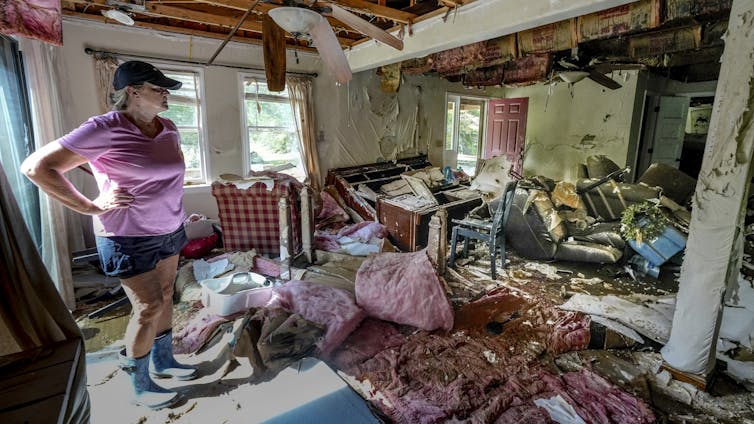
Hurricane Helene caused extensive damage to homes in North Carolina in 2024. AP Photo/Kathy Kmonicek

Imagine that a hurricane has destroyed your home.

The roof is gone. The floors are flooded. Your family’s belongings are ruined.

When this happens, you can apply for federal disaster aid, hoping for a lifeline. For many low-income families and other people of modest means, funding for that aid is often channeled to the states through the Department of Housing and Urban Development’s Community Development Block Grant Disaster Recovery program.

Known as CDBG-DR, this program mainly provides funding to repair and rebuild homes belonging to people of low-to-moderate income who either have no insurance at all or whose coverage falls short of what is needed to making housing safe again.

When homes are damaged beyond repair or located in areas where it’s too dangerous to rebuild because of the likelihood of future bouts of flooding in the same place, the CDBG-DR program can help pay for residents to move somewhere else that is less prone to disasters. In both cases, it covers costs that the Federal Emergency Management Agency does not pay for.

But in 2025, with hurricane season underway, the rules for who gets help and how it’s distributed have changed significantly.

As an urban planner who has researched disaster recovery efforts, I’m alarmed by Memorandum 2025-02, which HUD .

The memo changes the rules for nearly US$12 billion in disaster recovery funding approved by Congress for disasters occurring in 2023 and 2024. And HUD is implementing these changes early in the process, before any of this money has been distributed.

A house that's been destroyed is covered by tarps.
This home in Puerto Rico was destroyed when Hurricane Fiona struck the island in September 2022. Ivis Garcia

What has changed

The memo does away with the civil rights certifications, fair housing assessments, environmental standards and citizen advisory groups that have long been mandatory for the recipients of disaster recovery funds.

Civil rights certification means that CDBG-DR grantees must verify that disaster aid will be distributed without discrimination based on race, ethnicity, age, disability status, or other characteristics known as “protected classes.” Without this certification, there’s no formal process to ensure disaster aid is distributed fairly.

Fair housing obligations are assessments of whether middle- and lower-income families, people of color or people with disabilities can find safe, affordable housing without facing any discrimination.

In addition, HUD no longer requires detailed demographic reporting on who is applying for or receiving aid. This includes information such as gender, race, age, disability status and the language someone speaks.

Another change is that HUD’s updated disaster recovery guidelines no longer require economic development funds to emphasize people of modest incomes or their communities. Under the new rules, any business hit by a disaster can get recovery funds. It doesn’t matter how much money the owners make, as long as they can show that the disaster affected them.

And several important environmental protections have been rolled back. HUD previously mandated that disaster recovery projects comply with federal building standards.

Those codes are tougher than the local housing codes. These included rules for building homes higher off the ground to avoid future flooding and using stronger construction methods to withstand extreme weather events. Without them, new construction may be less durable and less safe – especially in areas hit hard by hurricanes or other natural disasters.

Strong energy efficiency standards help keep long-term utility costs low and reduce pressure on power grids during extreme weather events. They also make rebuilt homes more sustainable by reducing greenhouse gas emissions.

A woman and a child sift through the detritus where a business once stood.
Tina Brotherton, 88, right, gets help from 9-year-old neighbor Lainey Hamelink as she surveys the wreckage of her business, Tina’s Dockside Inn. It was completely destroyed in Hurricane Idalia, as was Brotherton’s nearby home, in Horseshoe Beach, Fla., in 2023. AP Photo/Rebecca Blackwell

Less coordination and communication

HUD has also removed a requirement for the nonprofits, local governments and other recipients of CDBG-DR grants to create and convene citizen advisory groups. That change took effect on March 24, 2025.

These groups, which have long made it easier for local communities to have a say regarding federally funded disaster recovery efforts, have played an important role in making sure those efforts reflect the needs and priorities of local residents – especially those most affected.

While eliminating this step may make it easier and faster for local governments to spend the recovery funds allocated for their communities, it also means there’s less opportunity for their own communities to influence how those funds are spent. Without that input, recovery efforts fail to resolve the real challenges people are facing.

Staffing and funding cuts

The White House’s 2026 budget proposal retains the HUD program that distributes disaster recovery grants while eliminating the related Community Development Block Grant program, which helps people experiencing homelessness and also funds everything from child care to services for older people.

I’m concerned about how CDBG-DR grants will be distributed, apart from the program’s changes. HUD’s Office of Community Planning and Development, which administers the CDBG-DR program, is slated to lose 84% of its staff, according to widespread media reports published earlier this year.

The Trump administration is also calling for cutting HUD’s staff, and President Donald Trump’s proposed 2026 budget would cut the agency’s entire budget in half.

In its March 25 HUD memo, the Trump administration framed these policy changes as a way to streamline recovery efforts and provide greater flexibility in the use of federal disaster funds. The memo also asserted that the changes were needed for compliance with executive orders that banned the use of diversity, equity and inclusion criteria and hiring practices that the administration considers to be discrimintory.

But critics of the policy rollbacks, including the National Low Income Housing Coalition, which advocates affordable housing, worry that removing long-standing safeguards could weaken the CDBG-DR program’s core mission of equitably distributing aid and building resilient communities. The standards and community input systems HUD has abandoned, the coalition says, have historically helped ensure that disaster recovery funds reach the people who need them most.The Conversation

Ivis García, Associate Professor of Landscape Architecture and Urban Planning, Texas A&M University

This article is republished from The Conversation under a Creative Commons license. Read the original article.

Space News: NASA engineers simulate lunar lighting for Artemis III moon landing


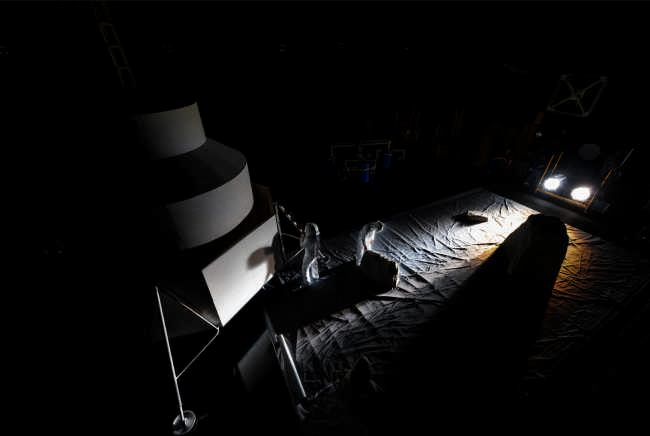
NASA engineers inside the Flat Floor Facility at Marshall Space Flight Center in Huntsville, Alabama, mimic lander inspection and assessment tasks future Artemis astronauts may do during Artemis III. Lights are positioned at a low angle to replicate the strong shadows that are cast across the lunar South Pole. Photo: NASA/Charles Beason.


Better understanding the lunar lighting environment will help NASA prepare astronauts for the harsh environment Artemis III Moonwalkers will experience on their mission. 

NASA’s Artemis III mission will build on earlier test flights and add new capabilities with the human landing system and advanced spacesuits to send the first astronauts to explore the lunar South Pole and prepare humanity to go to Mars.

Using high-intensity lighting and low-fidelity mock-ups of a lunar lander, lunar surface, and lunar rocks, NASA engineers are simulating the Moon’s environment at the Flat Floor Facility to study and experience the extreme lighting conditions. The facility is located at NASA’s Marshall Space Flight Center in Huntsville, Alabama.

“The goal is really to understand how shadows will affect lander visual inspection and assessment efforts throughout a future crewed mission,” said Emma Jaynes, test engineer at the facility. “Because the Flat Floor Facility is similar to an inverted air hockey table, NASA and our industry partners can rearrange large, heavy structures with ease — and inspect the shadows’ effects from multiple angles, helping to ensure mission success and astronaut safety for Artemis III.”

Data and analysis from testing at NASA are improving models Artemis astronauts will use in preparation for lander and surface operations on the Moon during Artemis III. The testing also is helping cross-agency teams evaluate various tools astronauts may use.

The 86-foot-long by 44-foot-wide facility at NASA is one of the largest, flattest, and most stable air-bearing floors in the world, allowing objects to move across the floor without friction on a cushion of air.

Test teams use large, 12-kilowatt and 6-kilowatt lights to replicate the low-angle, high contrast conditions of the lunar South Pole. Large swaths of fabric are placed on top of the epoxy floor to imitate the reflective properties of lunar regolith. All the mock-ups are placed on air bearings, allowing engineers to easily move and situate structures on the floor.

“The Sun is at a permanent low angle at the South Pole of the Moon, meaning astronauts will experience high contrasts between the lit and shadowed regions,” Jaynes said. “The color white can become blinding in direct sunlight, while the shadows behind a rock could stretch for feet and ones behind a lander could extend for miles.”

The laboratory is large enough for people to walk around and experience this phenomenon with the naked eye, adding insight to what NASA calls ‘human in-the-loop testing.

NASA is working with SpaceX to develop the company’s Starship Human Landing System to safely send Artemis astronauts to the Moon’s surface and back to lunar orbit for Artemis III.

Through the Artemis campaign, NASA will send astronauts to explore the Moon for scientific discovery, economic benefits, and to build the foundation for the first crewed missions to Mars – for the benefit of all. 

For more information about Artemis missions, visit https://www.nasa.gov/artemis. 

The Flat Floor Facility is an air-bearing floor, providing full-scale simulation capabilities for lunar surface systems by simulating zero gravity in two dimensions. Wearing low-fidelity materials, test engineers can understand how the extreme lighting of the Moon’s South Pole could affect surface operations during Artemis III. Photo: NASA/Charles Beason.

UC Cooperative Extension Tribal Extension Office opens at Middletown Rancheria


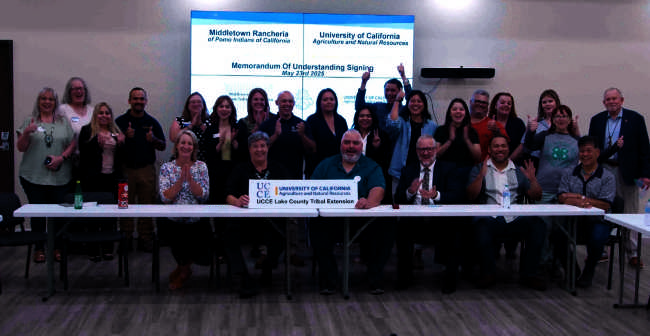
Middletown Rancheria leaders, UC ANR and UC Cooperative Extension teams, and county officials gather to celebrate the signing of the historic agreement. Image by Ethan Ireland.

MIDDLETOWN, Calif. — A historic agreement between the Middletown Rancheria of Pomo Indians of California and University of California Agriculture and Natural Resources has created the first-ever UC Cooperative Extension Tribal Extension Office.

Located on tribal land at the Middletown Rancheria headquarters, the office opened on June 2. 

It will facilitate culturally informed research and education projects on a variety of challenges facing local agriculture and natural resources. 

UC ANR and Middletown Rancheria signed a strategic memorandum of understanding, or MOU, on May 23, formalizing a partnership deeply rooted in mutual respect, traditional ecological knowledge and community-driven scientific research — establishing a model for future tribal-academic collaborations nationwide.

“When we talk about collaboration, a lot of times it is just talking — you sit in a room, you go away from a meeting,” said Middletown Rancheria Tribal Chairman Moke Simon. “That won't happen here at Middletown; all of our folks are genuinely dedicated to making things happen and improving our communities.”

Simon specifically mentioned their collaboration with Mike Jones, UCCE forestry advisor. Jones already has developed a work plan for managing a devastating pest, Mediterranean oak borer, on tribal lands.

“Our Cooperative Extension offices in the counties — and the people that are sitting here  — they're a conduit; they’re a door to so many resources above and beyond just themselves,” said Glenda Humiston, UC vice president for agriculture and natural resources, during the signing ceremony. “And we've got some amazing people that have joined us to serve in these county offices.”

Humiston also noted that the agreement represents a “very comprehensive MOU” that will facilitate collaborations on a wide array of issues and opportunities. 

The signing ceremony provided an overview of planned activities, reflecting both parties' dedication to environmental stewardship, cultural heritage, sustainable agriculture and resilience.

The historic signing event was attended by prominent community leaders, including Humiston; Brent Hales, UC ANR associate vice president for research and Cooperative Extension; Middletown Tribal Council members; Lake County Supervisor Jessica Pyska and Board of Supervisors Chair EJ Crandell, along with representatives from the offices of U.S. Rep. Mike Thompson and state Sen. Mike McGuire.

“We have been working toward co-managing this region together as partners,” Pyska said. “When you talk about local government, it is all the local governments in this region sitting down together and working through a lot of the issues facing our people … and working towards more climate adaptation for all of our communities, when we've got all of these threats that we are facing year-round now.”

Collaborations are already underway on a range of critical environmental issues. Clebson Gonçalves, UCCE diversified agriculture advisor and Chris Chen, integrated vineyard systems advisor have initiated farm assessments, supporting sustainable agriculture and vineyard management practices. 

Additional collaborations with Louise Pagone of the UC Master Gardeners of Lake County integrate local horticultural expertise and community gardening initiatives.

Looking to the future, an Institute for Tribal Environmental Professionals student intern – guided by Laura Garza-Diaz, UCCE water resources management advisor – will lead a community-driven drought resilience assessment.

In addition, UC ANR hired Ally Sung-Jereczek in 2024 as the beneficial burning and land stewardship advisor. Sung-Jereczek has been actively engaging with tribes in Lake and Mendocino counties, and this new formalized partnership with Middletown Rancheria will provide a robust foundation for her continued work and broader initiatives.

UC ANR leaders anticipate this MOU to set a precedent, leading to expanded educational opportunities, research partnerships and dedicated tribal academic advisor positions within tribal communities across the nation.

"Beyond tangible projects, this partnership is fundamentally about building lasting relationships rooted in respect and shared vision,” said Matthew Barnes, UCCE director for Lake and Mendocino counties. “It's a commitment to a brighter, resilient future.”

UC Agriculture and Natural Resources brings UC information and practices to all 58 California counties. Through research and Cooperative Extension in agriculture, natural resources, nutrition, economic and youth development, our mission is to improve the lives of all Californians. Learn more at ucanr.edu.

Thompson leads letter demanding Congress reconvene to address evolving situation in the Middle East

Rep. Mike Thompson (CA-04) has led a formal letter to Speaker of the House Mike Johnson urging him to reconvene the House of Representatives so Congress can be thoroughly briefed on the evolving situation in the Middle East and fulfill its Constitutional responsibilities related to any potential authorization of military force. 

This letter comes following statements from President Trump indicating the United States is seriously considering military action in Iran.

“We call on you to immediately reconvene the U.S. House of Representatives so that Members can be properly briefed on the situation, debate the security situation, and fulfill our Constitutional responsibilities related to any potential authorization of military force,” wrote the lawmakers.

“Congress has the sole power to declare war under Article 1 of our Constitution. It is of the highest importance that no military action take place without Congressional authorization. The stakes are too high. As representatives of the American people, it is the duty of every Member to ensure that we fulfill our Constitutional role,” they continued.

The full text of the letter is available here and below.

Dear Speaker Johnson,

We write to you following statements from President Trump indicating the United States is seriously considering military action in Iran. Media reports indicate the President has reviewed attack plans with senior aides.

We call on you to immediately reconvene the U.S. House of Representatives so that Members can be properly briefed on the situation, debate the security situation, and fulfill our Constitutional responsibilities related to any potential authorization of military force.

Congress has the sole power to declare war under Article 1 of our Constitution. It is of the highest importance that no military action take place without Congressional authorization. The stakes are too high. As representatives of the American people, it is the duty of every Member to ensure that we fulfill our Constitutional role.

Sending our men and women in uniform into conflict is always a matter of the highest

seriousness and should not be undertaken lightly. Proper Congressional consideration of the issues will help our country step away from the emotion of the moment to weigh the complexities of engaging in armed conflict.

We strongly urge you to immediately bring the U.S. House of Representatives back into session. This matter is urgent and cannot be postponed. For the good of our country, we must fulfill our duty to our Constitution and our constituents.

Thank you for your immediate attention to this urgent matter.

50 years after ‘Jaws,’ researchers have retired the man-eater myth and revealed more about sharks’ amazing biology

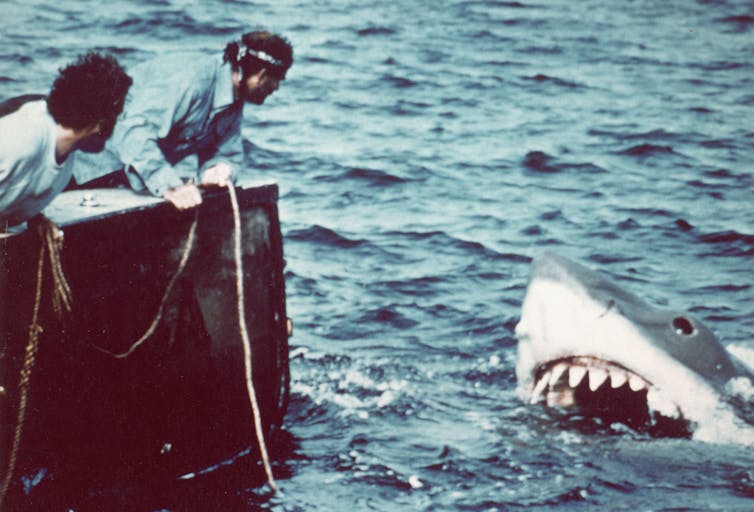
The shark in ‘Jaws’ became a terrifying icon. Universal Pictures via Getty Images

The summer of 1975 was the summer of “Jaws.”

movie poster for 'Jaws' with shark's toothy mouth under the water with a swimmer on the surface
The movie was adapted from a novel by Peter Benchley. Universal History Archive/Universal Images Group via Getty Images

The first blockbuster movie sent waves of panic and awe through audiences. “Jaws” – the tale of a killer great white shark that terrorizes a coastal tourist town – captured people’s imaginations and simultaneously created a widespread fear of the water.

To call Steven Spielberg’s masterpiece a creature feature is trite. Because the shark isn’t shown for most of the movie – mechanical difficulties meant production didn’t have one ready to use until later in the filming process – suspense and fear build. The movie unlocked in viewers an innate fear of the unknown, encouraging the idea that monsters lurk beneath the ocean’s surface, even in the shallows.

And because in 1975 marine scientists knew far less than we do now about sharks and their world, it was easy for the myth of the rogue shark as a murderous eating machine to take hold, along with the assumption that all sharks must be bloodthirsty, mindless killers.

moviegoers lined up under the theater's marquee with 'JAWS' on it
People lined up to get scared by the murderous shark at the center of the ‘Jaws’ movie. Bettmann Archive via Getty Images

But in addition to scaring many moviegoers that “it’s not safe to go in the water,” “Jaws” has over the years inspired generations of researchers, including me. The scientific curiosity sparked by this horror fish flick has helped reveal so much more about what lies beneath the waves than was known 50 years ago. My own research focuses on the secret lives of sharks, their evolution and development, and how people can benefit from the study of these enigmatic animals.

The business end of sharks: Their jaws and teeth

My own work has focused on perhaps the most terrifying aspect of these apex predators, the jaws and teeth. I study the development of shark teeth in embryos.

pinkish white fish embryo next to a larger yellowish sphere
Small-spotted catshark embryo (Scyliorhinus canicula), still attached to the yolk sac. This is the stage when the teeth begin developing. Ella Nicklin, Fraser Lab, University of Florida

Sharks continue to make an unlimited supply of tooth replacements throughout life – it’s how they keep their bite constantly sharp.

Hard-shelled prey, such as mollusks and crustaceans, from sandy substrates can be more abrasive for teeth, requiring quicker replacement. Depending on the water temperature, the conveyor belt-like renewal of an entire row of teeth can take between nine and 70 days, for example, in nurse sharks, or much longer in larger sharks. In the great white, a full-row replacement can take an estimated 250 days. That’s still an advantage over humans – we never regrow damaged or worn-out adult teeth.

about a dozen rows of pointy teeth, all lined up
Magnified microscope image of a zebra shark (Stegostoma tigrinum) jaw. They have 20 to 30 rows of teeth in each jaw, each a new generation ready to move into position like on a conveyor belt. Humans have only two sets! Gareth Fraser, University of Florida

Interestingly, shark teeth are much like our own, developing from equivalent cells, patterned by the same genes, creating the same hard tissues, enamel and dentin. Sharks could potentially teach researchers how to master the process of tooth renewal. It would be huge for dentistry if scientists could use sharks to figure out how to engineer a new generation of teeth for human patients.

Extraordinary fish with extraordinary biology

As a group, sharks and their cartilaginous fish relatives – including skates, rays and chimaeras – are evolutionary relics that have inhabited the Earth’s oceans for over 400 million years. They’ve been around since long before human beings and most of the other animals on our planet today hit the scene, even before dinosaurs emerged.

Sharks have a vast array of super powers that scientists have only recently discovered.

Their electroreceptive pores, located around the head and jaws, have amazing sensory capabilities, allowing sharks to detect weak electrical fields emitted from hidden prey.

looks like a face with a big eye and an open mouth, everything covered with little bumps
CT scan of the head of a small-spotted catshark (Scyliorhinus canicula) as it hatches. Skin denticles cover the surface, and colored rows of teeth are present on the jaws. Ella Nicklin, Fraser Lab, University of Florida

Their skin is protected with an armor of tiny teeth, called dermal denticles, composed of sensitive dentin, that also allows for better drag-reducing hydrodynamics. Biologists and engineers are also using this “shark skin technology” to design hydrodynamic and aerodynamic solutions for future fuel-efficient vehicles.

green glowing sections on the front part of a fish against a black background
Fluorescent skin of the chain catshark (Scyliorhinus retifer). Gareth Fraser, University of Florida

Some sharks are biofluorescent, meaning they emit light in different wavelengths after absorbing natural blue light. This emitted fluorescent color pattern suggests visual communication and recognition among members of the same species is possible in the dark depths.

Sharks can migrate across huge global distances. For example, a silky shark was recorded traveling 17,000 miles (over 27,000 kilometers) over a year and a half. Hammerhead sharks can even home in on the Earth’s magnetic field to help them navigate.

Greenland sharks exhibit a lengthy aging process and live for hundreds of years. Scientists estimated that one individual was 392 years old, give or take 120 years.

Still much about sharks remains mysterious. We know little about their breeding habits and locations of their nursery grounds. Conservation efforts are beginning to target the identification of shark nurseries as a way to manage and protect fragile populations.

Tagging programs and their “follow the shark” apps allow researchers to learn more about these animals’ lives and where they roam – highlighting the benefit of international collaboration and public engagement for conserving threatened shark populations.

Sharks under attack

Sharks are an incredible evolutionary success story. But they’re also vulnerable in the modern age of human-ocean interactions.

Sharks are an afterthought for the commercial fishing industry, but overfishing of other species can cause dramatic crashes in shark populations. Their late age of sexual maturity – as old as 15 to 20 years or more in larger species or potentially 150 years in Greenland sharks – along with slow growth, long gestation periods and complex social structures make shark populations fragile and less capable of quick recoveries.

Take the white shark (Carcharodon carcharias), for example – Jaws’ own species. Trophy hunting, trade in their body parts and commercial fishery impacts caused their numbers to dwindle. As a result, they received essential protections at the international level. In turn, their numbers have rebounded, especially around the United States, leading to a shift from critically endangered to vulnerable status worldwide. However, they remain critically endangered in Europe and the Mediterranean.

shark swims toward the camera with teeth visible in mouth, against blue ocean background
Protections and conservation measures have helped white sharks make a comeback. Dave Fleetham/Design Pics Editorial/Universal Images Group via Getty Images

“Jaws” was filmed on the island of Martha’s Vineyard, in Massachusetts. After careful management and the designation of white sharks as a prohibited species in federal waters in 1997 and in Massachusetts in 2005, their populations have recovered well over recent years in response to more seals in the area and recovering fish stocks.

You might assume more sharks would mean more attacks, but that is not what we observe. Shark attacks have always been few and far between in Massachusetts and elsewhere, and they remain rare. It’s only a “Jaws”-perpetuated myth that sharks have a taste for humans. Sure, they might mistake a person for prey; for instance, surfers and swimmers can mimic the appearance of seals at the surface. Sharks in murky water might opportunistically take a test bite of what seem to be prey.

But these attacks are rare enough that people can shed their “Jaws”-driven irrational fears of sharks. Almost all sharks are timid, and the likelihood of an interaction – let alone a negative one – is incredibly rare. Importantly, there more than 500 species of sharks in the world’s oceans, each one a unique member of a particular ecosystem with a vital role. Sharks come in all shapes and sizes, and inhabit every ocean, both the shallow and deep-end ecosystems.

Most recorded human-shark interactions are awe-inspiring and not terrifying. Sharks don’t really care about people – at most they may be curious, but not hungry for human flesh. Whether or not “Jaws” fans have grown beyond the fear of movie monster sharks, we’re gonna need a bigger conservation effort to continue to protect these important ocean guardians.The Conversation

Gareth J. Fraser, Associate Professor of Evolutionary Developmental Biology, University of Florida

This article is republished from The Conversation under a Creative Commons license. Read the original article.
Estate Planning: Conflicts of interest and trustees


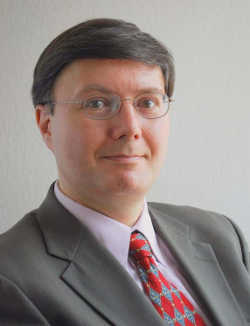
Dennis Fordham. Courtesy photo.

Potential and actual conflicts of interest are important considerations when selecting who to serve as successor trustee as they are being trusted with the authority to manage, disburse (i.e., use assets to pay expenses) and distribute (make gifts of) trust assets pursuant to the terms of the trust. Let us discuss.

A trustee’s primary duty of loyalty is to manage the trust assets strictly according to the terms of the trust for the sole benefit of the trust beneficiaries. That is a high standard. While the settlor(s) of a revocable living trust is alive, all of the trustee’s duties are owed to the settlor who may direct the trustee’s administration. Typically, however, the settlor is the trustee until they are incapacitated or die.


A conflict of interest means that the trustee, for one reason or another, has interests that are at odds with the trustee’s duty of loyalty. Conflicts of interest are either potential, meaning they might occur, or they are actual, meaning they already exist (to one degree or another). 


Conflicts should be identified and addressed within the estate planning. Existing estate planning documents, if possible, should be revised when such conflicts emerge. Ignoring conflicts and allowing them to go unaddressed can result in unintended and otherwise avoidable negative consequences that can even ruin the intended estate planning. Let us consider some illustrations. 


Consider a person who appointed his trusted friend to serve as trustee of a special needs trust in favor of the person’s special needs (disabled) sister and names his friend as death beneficiary. As trustee “the friend” had discretionary authority either to make or not make payments for the sister’s benefit. The trustee chose not to make distributions for the sister’s benefit and so preserved more trust assets for inheritance by the friend when the sister dies. 


Clearly, naming the untrustworthy friend to be both trustee and beneficiary of a discretionary trust intended for the benefit of a disabled person was very bad planning. A professional private fiduciary who is bonded and is not a trust beneficiary would have been a much better choice.


Next, a trustee with authority to value trust assets might possibly use that authority to favor themselves, family or friends, when selling assets from the trust or when distributing assets, if asset valuations are relevant. Such improper “self dealing” use of authority could be eliminated by requiring the trustee to utilize unbiased (neutral) professional valuations. 


Conflicts of interest may also arise if a representative’s spouse has an interest in the trust assets. For example, perhaps the representative sells estate assets to their own spouse on unduly favorable terms to the detriment of trust beneficiaries. This is more likely if assets are already co-owned by the representative’s spouse (e.g., a co-owned business) and the spouse wants full ownership.  


Under California’s Uniform Directed Trust Act, a trusted (neutral) advisor can be appointed as a trust director with authority (i.e., a power of direction) to direct the trustee in those aspects of the trust administration where a potential or actual conflict of interest arises. The trust director would control the trustee’s actions in such conflicts and the trustee would act pursuant to the director’s control. 


The foregoing is not legal advice.  Consult a qualified estate planning attorney for guidance. 

Dennis A. Fordham, Attorney, is a State Bar-Certified Specialist in estate planning, probate and trust law. His office is at 870 S. Main St., Lakeport, Calif. He can be reached at This email address is being protected from spambots. You need JavaScript enabled to view it. and 707-263-3235.  
  • 165
  • 166
  • 167
  • 168
  • 169
  • 170
  • 171
  • 172
  • 173
  • 174

Community

  • Lake County Wine Alliance offers sponsor update; beneficiary applications open 

  • Mendocino National Forest announces seasonal hiring for upcoming field season

Public Safety

  • Lakeport Police logs: Thursday, Jan. 15

  • Lakeport Police logs: Wednesday, Jan. 14

Education

  • Woodland Community College receives maximum eight-year reaffirmation of accreditation from ACCJC

  • SNHU announces Fall 2025 President's List

Health

  • California ranks 24th in America’s Health Rankings Annual Report from United Health Foundation

  • Healthy blood donors especially vital during active flu season

Business

  • Two Lake County Mediacom employees earn company’s top service awards

  • Redwood Credit Union launches holiday gift and porch-to-pantry food drives

Obituaries

  • Rufino ‘Ray’ Pato

  • Patty Lee Smith

Opinion & Letters

  • The benefits of music for students

  • How to ease the burden of high electric bills

Veterans

  • CalVet and CSU Long Beach team up to improve data collection related to veteran suicides

  • A ‘Big Step Forward’ for Gulf War Veterans

Recreation

  • Wet weather trail closure in effect on Upper Lake Ranger District

  • Mendocino National Forest seeking public input on OHV grant applications

  • State Parks announces 2026 Anderson Marsh nature walk schedule 

  • BLM lifts seasonal fire restrictions in central California

Religion

  • Kelseyville Presbyterian to host Ash Wednesday service and Lenten dinner Feb. 18

  • Kelseyville Presbyterian Church to hold ‘Longest Night’ service Dec. 21

Arts & Life

  • Auditions announced for original musical ‘Even In Shadow’ set for March 21 and 28

  • ‘The Rip’ action heist; ‘Steal’ grounded in a crime thriller

Government & Politics

  • Lake County Democrats issue endorsements in local races for the June California Primary

  • County negotiates money-saving power purchase agreement

Legals

  • March 3 hearing on ordinance amending code for commercial cannabis uses

  • Feb. 12 public hearing on resolution to establish standards for agricultural roads

How to resolve AdBlock issue?
Refresh this page