 How to resolve AdBlock issue?
News
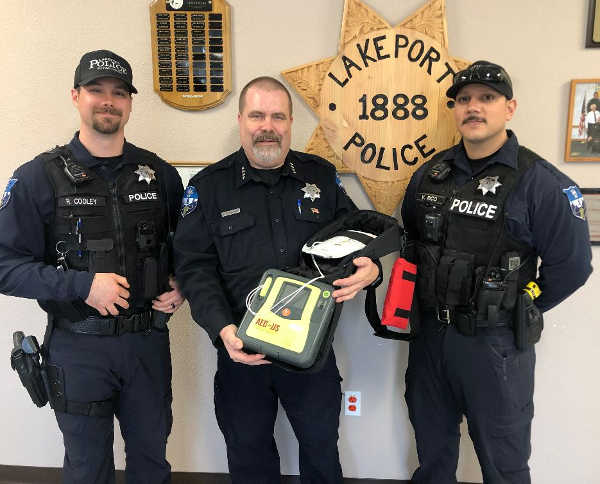
LAKEPORT, Calif. – The Lakeport Police Department has a new piece of life-saving equipment to use in service to the community.
On Thursday, Chief Brad Rasmussen said his department won an automated external defibrillator, more commonly known as an AED, from the company AED.us.
The company sells the defibrillators and also gives one away a week as part of its commitment to reduce the number of preventable sudden cardiac arrest deaths by placing as many of the AEDs in communities as possible.
“This is our mission, passion and duty,” the company said on its website.
Rasmussen said he applied to the company online for one of its AEDs in the fall. The new unit arrived on Wednesday.
“We are planning on getting more to have in the field and around city facilities,” Rasmussen said.
He said winning the new piece of equipment is particularly timely since all of the department’s officers just completed their annual first responder certification update, which included the use of AEDs.
For the past two years, the training has included certifying officers in the use of AED units, Rasmussen said.
During a daylong training on Jan. 22, all of the officers updated their first responder, AED and CPR certifications and skills, among other training topics, he said.
That was the same day that the Clearlake Police Department sent over some units to patrol the streets for a shift while the training took place, as Lake County News has reported.
Rasmussen said the new unit is valued at $1,200, but such units can cost anywhere from $500 to more than $2,000.
“We will get started with carrying this one I won but will need more,” he said.
The AED.us website cites statistics from the American Heart Association that show that out-of-hospital cardiac arrest survival rates have risen steadily alongside increased use – and knowledge of – CPR by bystanders.
To enter to win an AED, visit the AED.us website.
To find CPR, AED and other life-saving classes, visit the Red Cross website.
Email Elizabeth Larson at
LAKE COUNTY, Calif. – With excitement and expectations running high for the Super Bowl on Feb. 2, the California Highway Patrol reminds everyone their game plan for the day should include getting home safely.
Whether people are attending parties or hanging out in a bar, planning for a safe ride home will be their best defensive move.
Option plays include calling a cab or ride-sharing service, using public transportation, or lining up a designated driver in advance.
Those who host parties should take care of the most valuable player, the designated driver, with plenty of non-alcoholic beverages.
“Driving impaired is completely preventable,” CHP Commissioner Warren Stanley said. “Lives are on the line. Not only are innocent people at risk, impaired drivers stand to lose money, their freedom, their license, and their vehicle.”
Alcohol is not the only substance that can lead to an arrest for driving under the influence. Cannabis, prescription drugs, and illegal drugs all can impair driving. Driving is a complex task, and any drug can slow reaction time.
The CHP will have a full team of officers ready to intercept dangerous drivers. In addition to stopping impaired drivers, they will be watching for seat belt usage, speeding and distracted driving.
Three people died in alcohol-involved collisions in California on Super Bowl Sunday in 2019. Another 140 people were injured, preliminary CHP data shows. The CHP made 187 DUI arrests that day.
The public can help keep California roadways safe by calling 9-1-1 if they suspect an impaired driver.
Callers should be prepared to give the vehicle’s description, location, license plate number, and direction of travel.
Whether people are attending parties or hanging out in a bar, planning for a safe ride home will be their best defensive move.
Option plays include calling a cab or ride-sharing service, using public transportation, or lining up a designated driver in advance.
Those who host parties should take care of the most valuable player, the designated driver, with plenty of non-alcoholic beverages.
“Driving impaired is completely preventable,” CHP Commissioner Warren Stanley said. “Lives are on the line. Not only are innocent people at risk, impaired drivers stand to lose money, their freedom, their license, and their vehicle.”
Alcohol is not the only substance that can lead to an arrest for driving under the influence. Cannabis, prescription drugs, and illegal drugs all can impair driving. Driving is a complex task, and any drug can slow reaction time.
The CHP will have a full team of officers ready to intercept dangerous drivers. In addition to stopping impaired drivers, they will be watching for seat belt usage, speeding and distracted driving.
Three people died in alcohol-involved collisions in California on Super Bowl Sunday in 2019. Another 140 people were injured, preliminary CHP data shows. The CHP made 187 DUI arrests that day.
The public can help keep California roadways safe by calling 9-1-1 if they suspect an impaired driver.
Callers should be prepared to give the vehicle’s description, location, license plate number, and direction of travel.
LAKE COUNTY, Calif. – The Board of Supervisors is seeking applicants for the Lake County Building Board of Appeals.
First formed in 1967, the board acts as the hearing board to appeal decisions of building inspectors and the building and safety director.
The board is seeking one member for each supervisorial district: District 1, District 2, District 3, District 4 and District 5.
Interested parties must reside within the boundaries of the district for which they are applying.
Membership on the board is voluntary.
Applications are available at the Lake County Courthouse, Clerk of the Board Office, Room 109, 255 North Forbes Street, Lakeport, California, or on the county website.
First formed in 1967, the board acts as the hearing board to appeal decisions of building inspectors and the building and safety director.
The board is seeking one member for each supervisorial district: District 1, District 2, District 3, District 4 and District 5.
Interested parties must reside within the boundaries of the district for which they are applying.
Membership on the board is voluntary.
Applications are available at the Lake County Courthouse, Clerk of the Board Office, Room 109, 255 North Forbes Street, Lakeport, California, or on the county website.
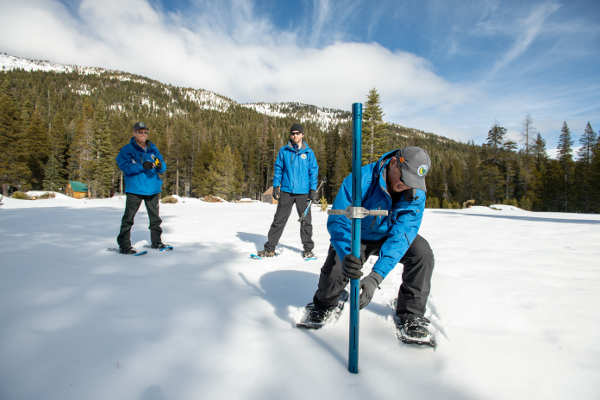
California’s critical snowpack continues to trend below the seasonal average, according to the latest manual readings taken by state officials.
The California Department of Water Resources on Thursday conducted the second manual snow survey of 2020 at Phillips Station.
The manual survey recorded 40.5 inches of snow depth and a snow water equivalent, or SWE, of 14.5 inches, which is 79 percent of average for this location.
The SWE measures the amount of water contained in the snowpack, which provides a more accurate forecast of spring runoff.
On average, the snowpack supplies about 30 percent of California’s water needs as it melts in the spring and early summer.
“After a good start in December, January saw dry conditions that added little to the Sierra snowpack,” said DWR Director Karla Nemeth. “As climate change continues to impact California’s snowpack, we look to actions described in the recently released California Water Resilience Portfolio to meet the challenges brought by weather variability to California’s water supply.”
In addition to the manual surveys, DWR collects readings from 130 electronic snow sensors scattered throughout the state. Measurements indicate that statewide, the snowpack’s water equivalent is 12 inches, or 72 percent of the January 30 average.
“The foundation of California’s water supply forecasting system remains the manual snow surveys,” said Sean de Guzman, chief of DWR’s Snow Surveys and Water Supply Forecasting Section. “The data gathered from these surveys are used to create seasonal runoff forecasts and define how wet or dry a year is based on the total precipitation, including both rain and snow, and runoff.”
This critical snow survey data and forecasts are used by:
– Operators of flood control projects to determine how much water can safely be stored in a reservoir while reserving space for predicted inflows. This includes the State Water Project, U.S. Bureau of Reclamation for the Central Valley Project, and local reservoir operators.
– Other state agencies, including the Office of Emergency Services and the State Water Resources Control Board, to develop responses to drought or flood emergencies.
Public and private utilities to determine what percentage of their electric energy generation will be hydropower.
– Water districts to manage surface and groundwater storage, allocate the available supply, plan water deliveries, and coordinate conjunctive use operations.
– Agricultural interests to determine crop planting patterns, groundwater pumping needs, and irrigation schedules.
– Researchers to improve snow melt runoff forecasting methods and perform climate change analyses.

CLEARLAKE, Calif. – The Clearlake City Council has indicated it is open to considering a city contribution to the opening of a facility to help address the homeless problem in the county, but that it wants more financial information on the project.
The council reached a consensus to consider supporting the Hope Center project at its Jan. 23 meeting.
The Hope Center is a proposed transitional housing facility with 20 beds to be located in a remodeled building that Adventist Health purchased at 3400 Emerson Drive.
It will use a “housing first” approach and be open to people experiencing homelessness who are referred by agencies, individuals or who ask to gain entry by admitting themselves.
At the council’s Jan. 9 meeting, Councilman Russell Perdock had asked that the Hope Center be put on the next agenda, along with consideration of a $500,000 contribution from city bond proceeds.
The discussion on the proposal begins at the 9:15 mark in the video above.
The Hope Center is a project of Hope Rising, a nonprofit for which Adventist Health Clear Lake served as the “backbone agency,” according to a Jan. 17 press release issued by Adventist Health.
During the discussion, Allison Panella, Hope Rising’s executive director, said Adventist Health has guaranteed funding to run the facility for 15 years.
While Perdock himself also works for Adventist Health Clear Lake, city officials said that after consideration of a potential conflict of interest, they determined that Perdock did not need to recuse himself from the discussion.
Panella was joined by Shannon Kimbell-Auth, Adventist Health’s manager for community integration, in offering the presentation on the Hope Center to the council.
A root cause analysis on Lake County’s challenges linked all of them back to poverty, Panella said.
A little over two years ago, Partnership HealthPlan of California gave Hope Rising and Adventist Health $1.3 million to open up a transitional housing facility. Following that, Adventist Health purchased the Emerson Drive property for $500,000, she said.
In the time since, with Lake County continuing to experience disasters, the project has had setbacks such as finding available contractors and rising remodeling costs. Panella said their initial estimate was for remodeling to cost $500,000.
The remaining $300,000 is to be used for the first year of operational costs, she explained during the discussion.
“As we are looking at the homeless interventions, we want to keep in mind that there is no one right solution,” said Kimbell-Auth.
She said they are looking at a wide variety of options and long-term solutions to fit individuals, from emergency shelters to homeownership.
A study they did of homeownership in Lake County’s various zip codes showed it was lowest in percentage in Clearlake with Lucerne coming in second-lowest. It’s highest in Upper Lake, followed by Kelseyville.
At Project Restoration, which has a seven-bed transitional housing and respite facility called Restoration House in Lower Lake, one woman who came into the facility is now a homeowner, although Kimbell-Auth said homeownership won’t be the total solution for everyone.
The Hope Center’s clients will receive intensive one-on-one counseling as part of determining the best interventions for them, Kimbell-Auth said.
Two years ago, a point-in-time count for Lake County identified 612 people experiencing homelessness. Kimbell-Auth said some people said that number is high, but she said data they have access to in the health industry showed that from January to November they had 3,370 unique patients identify as homeless in Lake County, with one out of five of them children under age 18.
Kimbell-Auth said Hope Center won’t house children but as part of its wraparound service will work on family reunification.
“Our vision is really to impact poverty in Lake County,” she said, adding that it’s not a pie in the sky idea because, with the right intervention, people can find housing.
Panella said they have purchased the building, hired an architect, completed a feasibility study along with a design process and plans which were submitted to the city for approval, and are now accepting bids for the remodeling work.
Kimbell-Auth said once Hope Center is open, it will be joined by partners including Lake County Behavioral Health, the Lake County Health Department, the Department of Social Services, North Coast Opportunities, Adventist Health and Redwood Community Services.
“Our partners know what they're doing. They just haven't had the right tools,” she said.
She explained that the city of Clearlake is one of the most important partners at this exact moment “because this is the place where the poverty is the deepest.”
When the homeless problem is solved in Clearlake, Kimbell-Auth said it will translate into communities across the state and nation.
“We can do it. But it has to be done now,” she said.
Panella said they need $1 million to get the center open. They are planning to pursue a $1.5 million grant in June but need to show that the doors are open and they’re doing the work. “We’re almost there.”
She asked the city to join the effort. “This will be something that Clearlake can be proud of.”
Shelly Trumbo, Adventist Health’s vice president of community integration who had served as Hope Rising’s interim executive director at its inception, suggested that the county needed to prioritize its challenges and pool its resources to take on one problem at a time rather than being spread thin across many efforts.
Kimbell-Auth said people come to homelessness through many paths – from fire to flood, to alcohol and drugs. But what causes homelessness by itself isn’t drinking or drug use but not having other support, such as the lack of a living wage.
Some people experiencing homelessness have mental health issues but many of them get those diagnoses after living on the street. Kimbell-Auth questioned how someone could stay sane while being without a home or hope.
Council members raise questions, concerns
Councilwoman Joyce Overton said she doesn’t believe the homeless issue can be solved until there is a detox center in Lake County, because she said they need to be clean and sober before going into facilities like Hope Center.
Kimbell-Auth didn’t disagree that a majority of the homeless have drug and alcohol addictions, but she said there is no purpose in sending somebody to do the difficult work of detoxing and recovery when in three months they are going to be back on the street.
Lake County Behavioral Health will have offices at Hope Center so it can assist with getting people into recovery programs, she said.
“There is no one right solution. It is a continuum of solutions. And one piece of the puzzle is without question having a detox facility,” said Kimbell-Auth.
Overton said she wanted to see a lot more in writing about the center’s plans and financials before she was willing to commit city money to it.
Councilman Phil Harris asked how much time each occupant would spend at the center. Kimbell-Auth said the legal definition of transitional housing is six months to two years. At Project Restoration, the average is six months, but they’ve seen everything from two days to a year and a half.
City Manager Alan Flora asked if Clearlake residents would be given preference. Kimbell-Auth said it would be easier for them, as people who are experiencing homelessness tend to stick to their communities.
She said they found housing in Clearlake for a man at the Lakeport warming center, but he refused it. “He would rather be homeless in Lakeport than housed in Clearlake,” she said.
Toward the end of the discussion, Panella asked if the city could actually contribute $1 million rather than the originally proposed $500,000.
Flora asked what the impact would be if the city didn’t contribute. Panella said they will open the facility in stages if necessary.
Flora said there are funding options, including more than $2 million bonds issued by the former redevelopment agency which he also has in mind for other projects that he expects to bring forward in the coming year.
There also are Community Development Block Grant disaster funds for the 2017 disasters for which the Clearlake zip code has been allocated $1.1 million. He said he’s not sure if Hope Center would qualify for the funds, which may not be available for a year.
He suggested that at the midyear budget update on Feb. 20 he could bring forward a budget amendment that could include any direction the council wanted to pursue.
Harris asked about guarantees that the facility would continue to operate and what kind of security the city would have if it didn’t. Flora said the council can ask for any restrictions for the funds; the only parameters of the bond funding is that it be spent on lower- and moderate-income housing.
Panella said Adventist Health has signed a memorandum of understanding with Partnership HealthPlan to operate the facility as transitional housing for 15 years, regardless of funding.
Supervisor Bruno Sabatier said the Hope Center is the kind of project needed in the county, and asked them to come to the county government to see what assistance it can offer.
“I think this needs to be a partnership,” he said, suggesting that if the money isn’t there now, it will be in the future.
Flora said he had talked earlier in the day to Mayor Russell Cremer – who was absent for the meeting – and Cremer’s preference is for the council to consider funding up to $500,000 if another agency will provide matching funds.
Vice Mayor Dirk Slooten said his preference is the same as Cremer’s.
“This is sorely needed. We need to do something,” he said.
Slooten suggested getting it on the agenda and moving forward, adding that it’s a social issue that needs to be addressed now.
Perdock said he wanted to move forward. “Time has been wasted,” he said, with people living under bushes and squatting in homes. “We need to remedy that as soon as possible.”
Flora got consensus from the council to work on a $500,000 addition to the midyear budget review, and he said he would help get the information Overton wanted about the project.
Harris said he wanted an agreement to include verbiage that if the facility is used for anything other than transitional housing in the first 15 years that the city would receive a prorated return of investment.
Email Elizabeth Larson at

LAKEPORT, Calif. – Midway through the Lake County Library’s Winter Reading Challenge, champions are emerging.
The champions have read 1,000 pages each, and Lake County readers have already logged more than 87,600 pages.
The Winter Reading Challenge concludes Feb. 29, so there’s still time to sign up and join the fun.
Everyone can participate – babies, toddlers, children, teens and adults are all welcome in the challenge.
If your children don’t read on their own yet, you can still sign them up and read with them.
If you don’t have a library card, it’s easy to get one by bringing your photo ID to your nearest library branch.
If you complete the 1,000 point challenge you get to pick out a brand new book donated by the Friends of the Lake County Library, sign your name in it, and be the first person to check it out.
Each branch library will award a raffle prize for teens and one for adults. The raffle drawings will take place at the end of the program and the winners will be announced on March 3. Raffle baskets contain books and cold-weather treats for adults. Teens get candy bouquets.
For more information about the Winter Reading Challenge can be found at http://library.lakecountyca.gov under Events.
The Lake County Library is on the internet http://library.lakecountyca.gov.
Jan Cook is a library technician for the Lake County Library.