 How to resolve AdBlock issue?
News
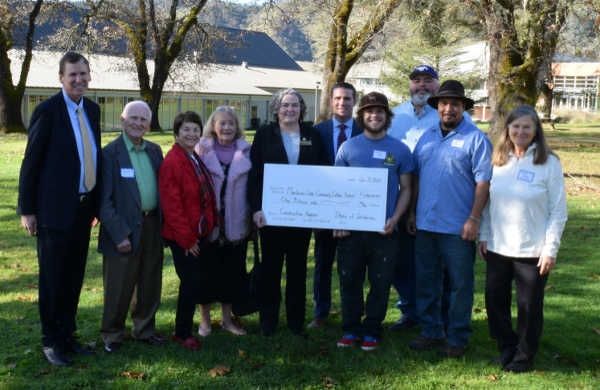
NORTH COAST, Calif. – Sen. Mike McGuire on Friday announced that $1 million has been dedicated over the next three years to expanding construction trades programs at Mendocino College in order to assist in the fire rebuild.
McGuire, who represents both the counties of Lake and Mendocino, has been working to secure funding to meet the workforce needs to spur the rebuilding of these communities.
In an event at Mendocino College in Ukiah on Friday morning, McGuire announced that $1 million has been secured to expand the college’s construction career program – over the next three years.
The expansion dollars will be focused on recruiting additional students into the program in both Lake and Mendocino counties, which will expand the construction workforce, grow business partnerships, hire additional faculty and purchase needed equipment.
“The fires over the last five years have greatly exacerbated the labor shortages Mendocino and Lake counties have traditionally witnessed in the construction trades,” McGuire said. “Today’s investment will be a shot in the arm for the local economy, but more importantly, an opportunity to provide young people with the tools they need for a construction career and a family-sustaining wage. We’re grateful to partner with the College on this potentially life-changing program.”
Mendocino College is currently working to expand its Sustainable Construction and Energy Technology program and will be able to offer additional courses with specific training opportunities immediately.
The $1 million investment will allow the college’s construction core program to expand by approximately 40 percent and the college has set a benchmark that 75 percent of the students who participate in the additional offerings will either gain employment or increase wages in the construction field within six months of participating in the program.
“Mendocino College is thrilled to expand its critical role in supporting the region’s economic development. This significant investment for fire recovery construction training spearheaded by Sen. McGuire for Mendocino and Lake counties will provide tremendous support for our communities’ recovery by addressing the labor shortage and preparing our Sustainable Construction and Energy Technology students for improved earnings and living wage attainment. This funding will serve as a catapult to a more robust, self-sufficient and continuously evolving construction program,” said Eileen Cichocki, Mendocino College interim superintendent/president.
The fires throughout Northern California have been unprecedented in size and scope. Because construction workers could make more money rebuilding homes in Sonoma and Napa counties, many skilled workers traveled south and west, which left an even greater shortage in both Mendocino and Lake counties.
LAKE COUNTY, Calif. – The National Weather Service has issued a special weather statement for parts of Northern California including Lake County due to chances of rain and wind in the coming days.
Forecasters said a cold Pacific storm will bring rapid changes to Northern California on Sunday and Monday.
Although rain and snow amounts will be light, forecasters predict the storm will bring much colder temperatures and gusty northerly winds Sunday and Monday.
The forecast calls for light precipitation Saturday night into early Sunday over the Coastal Range and Shasta County mountains, then mainly over the west slope of the Sierra Nevada and foothills Sunday and Sunday night.
In Lake County, light winds are expected on Saturday, with stronger winds with gusts of up to 32 miles per hour forecast on Sunday.
Temperatures during the daytime over the weekend will rise into the low 60s and drop into the low 30s at night, based on the forecast.
In the coming week, daytime temperatures will hover in the high 50s before rising once again into the 60s, and the high 30s to mid-40s at night, the forecast said.
Email Elizabeth Larson atThis email address is being protected from spambots. You need JavaScript enabled to view it. . Follow her on Twitter, @ERLarson, or Lake County News, @LakeCoNews.
Forecasters said a cold Pacific storm will bring rapid changes to Northern California on Sunday and Monday.
Although rain and snow amounts will be light, forecasters predict the storm will bring much colder temperatures and gusty northerly winds Sunday and Monday.
The forecast calls for light precipitation Saturday night into early Sunday over the Coastal Range and Shasta County mountains, then mainly over the west slope of the Sierra Nevada and foothills Sunday and Sunday night.
In Lake County, light winds are expected on Saturday, with stronger winds with gusts of up to 32 miles per hour forecast on Sunday.
Temperatures during the daytime over the weekend will rise into the low 60s and drop into the low 30s at night, based on the forecast.
In the coming week, daytime temperatures will hover in the high 50s before rising once again into the 60s, and the high 30s to mid-40s at night, the forecast said.
Email Elizabeth Larson at
The California Department of Public Health reported that a third case of novel coronavirus 2019 has been confirmed in the state.
The agency said it was informed that one person in Santa Clara County has tested positive for the virus, information that was confirmed by the Santa Clara County Public Health Department and the U. S. Centers for Disease Control and Prevention laboratory.
CDPH did not provide additional information about the patient beyond what is being shared by the Santa Clara County Public Health Department.
The novel coronavirus 2019, or nCoV 2019, originated in Wuhan, Hubei Province, China.
Health officials said coronaviruses are a large group of viruses that are common among animals and humans. Animal coronaviruses have been known to be transmitted to humans in rare cases.
The nCoV 2019 strain has not been previously detected in animals or humans, and the source of it is still being investigated, according to health officials.
Currently, the California Department of Public Health confirms a total of three cases of novel coronavirus in California: one individual in Santa Clara County, one individual in Los Angeles County and one individual in Orange County have tested positive for novel coronavirus 2019.
“It is understandable that some Californians may be nervous about potential spread of novel coronavirus, but the risk to the general public in California remains low,” said Dr. Sonia Angell, California Public Health Department director and state health officer. “The Department of Public Health has been closely tracking this virus and we are actively engaged with our local health departments, the CDC and local governments to make sure Californians remain safe and healthy.”
At this time, no other persons infected with novel coronavirus have been identified in California. Currently, the immediate health risk from novel coronavirus 2019 to the general public is low.
In neighboring Napa County, Health Officer Dr. Karen Relucio said they are monitoring the situation closely and preparing to protect the health of Napa County residents by limiting the spread of this virus
“We are working closely with health care partners to review testing and infection control procedures and communicating with community partners and are prepared to take action should someone in our county become infected with this virus,” said Dr. Relucio.
The newest California case brings the total confirmed cases nationwide to seven in four states: Arizona, California, Illinois and Washington, according to state and federal officials.
Officials said that all but one case have traveled from Wuhan, China; one of the Chicago cases was a result of person-to-person spread from another confirmed case.
The latest numbers from the national Centers for Disease Control said that 121 cases in 36 states are under investigation, with test results pending. Another 114 cases tested negative.
The CDC has also recommended that travelers avoid all nonessential travel to China. The agency is conducting monitoring for potential illness among travelers arriving from China at 20 U.S airports, officials said.
On Thursday, the International Health Regulations Emergency Committee of the World Health Organization declared that the outbreak of 2019-nCoV constitutes a public health emergency of international concern.
Locations across the globe with confirmed 2019-nCoV cases include China, Hong Kong, Macau, Taiwan, Australia, Cambodia, Canada, Finland, France, Germany, India, Italy, Japan, Malaysia, Nepal, Philippines, Russia, Sri Lanka, Singapore, Sweden, Thailand, The Republic of Korea, United Arab Emirates, United Kingdom, United States and Vietnam.
On Friday, United States Health and Human Services Secretary Alex M. Azar II declared a public health emergency for the United States to aid the nation’s healthcare community in responding to nCoV 2019.
CDPH said it is very important for people who have recently traveled and who become ill to notify their health care provider of their travel history. Those who have recently traveled to China or who have had contact with a person with possible novel coronavirus infection should contact their local health department or health care provider.
The Department of Public Health has been prepared and is continuing with the following actions:
– Providing information about the outbreak and how to report suspect cases to local health departments and health care providers in California.
– Coordinating with CDC personnel who are doing screening of travelers from China at SFO and LAX.
– Assuring that health care providers know how to safely manage persons with possible novel coronavirus 2019 infection.
– Supporting hospitals and local public health laboratories for collection and shipment of specimens for testing at CDC for novel coronavirus 2019.
– Activating the Department of Public Health’s Emergency Operations Center to coordinate response efforts across the state.
The novel coronavirus 2019 outbreak in China continues to evolve and California is prepared for more cases that may arise.
“The California Department of Public Health considers this a very important public health event; we are closely monitoring the situation and providing updates to partners across the state to support their preparedness efforts,” the agency reported.
As with any virus, especially during the flu season, the Health Department reminds you there are a number of steps you can take to protect your health and those around you:
– Washing hands with soap and water.
– Avoiding touching eyes, nose or mouth with unwashed hands.
– Avoiding close contact with people who are sick are all ways to reduce the risk of infection with a number of different viruses.
– Staying away from work, school or other people if you become sick with respiratory symptoms like fever and cough.
The agency said it was informed that one person in Santa Clara County has tested positive for the virus, information that was confirmed by the Santa Clara County Public Health Department and the U. S. Centers for Disease Control and Prevention laboratory.
CDPH did not provide additional information about the patient beyond what is being shared by the Santa Clara County Public Health Department.
The novel coronavirus 2019, or nCoV 2019, originated in Wuhan, Hubei Province, China.
Health officials said coronaviruses are a large group of viruses that are common among animals and humans. Animal coronaviruses have been known to be transmitted to humans in rare cases.
The nCoV 2019 strain has not been previously detected in animals or humans, and the source of it is still being investigated, according to health officials.
Currently, the California Department of Public Health confirms a total of three cases of novel coronavirus in California: one individual in Santa Clara County, one individual in Los Angeles County and one individual in Orange County have tested positive for novel coronavirus 2019.
“It is understandable that some Californians may be nervous about potential spread of novel coronavirus, but the risk to the general public in California remains low,” said Dr. Sonia Angell, California Public Health Department director and state health officer. “The Department of Public Health has been closely tracking this virus and we are actively engaged with our local health departments, the CDC and local governments to make sure Californians remain safe and healthy.”
At this time, no other persons infected with novel coronavirus have been identified in California. Currently, the immediate health risk from novel coronavirus 2019 to the general public is low.
In neighboring Napa County, Health Officer Dr. Karen Relucio said they are monitoring the situation closely and preparing to protect the health of Napa County residents by limiting the spread of this virus
“We are working closely with health care partners to review testing and infection control procedures and communicating with community partners and are prepared to take action should someone in our county become infected with this virus,” said Dr. Relucio.
The newest California case brings the total confirmed cases nationwide to seven in four states: Arizona, California, Illinois and Washington, according to state and federal officials.
Officials said that all but one case have traveled from Wuhan, China; one of the Chicago cases was a result of person-to-person spread from another confirmed case.
The latest numbers from the national Centers for Disease Control said that 121 cases in 36 states are under investigation, with test results pending. Another 114 cases tested negative.
The CDC has also recommended that travelers avoid all nonessential travel to China. The agency is conducting monitoring for potential illness among travelers arriving from China at 20 U.S airports, officials said.
On Thursday, the International Health Regulations Emergency Committee of the World Health Organization declared that the outbreak of 2019-nCoV constitutes a public health emergency of international concern.
Locations across the globe with confirmed 2019-nCoV cases include China, Hong Kong, Macau, Taiwan, Australia, Cambodia, Canada, Finland, France, Germany, India, Italy, Japan, Malaysia, Nepal, Philippines, Russia, Sri Lanka, Singapore, Sweden, Thailand, The Republic of Korea, United Arab Emirates, United Kingdom, United States and Vietnam.
On Friday, United States Health and Human Services Secretary Alex M. Azar II declared a public health emergency for the United States to aid the nation’s healthcare community in responding to nCoV 2019.
CDPH said it is very important for people who have recently traveled and who become ill to notify their health care provider of their travel history. Those who have recently traveled to China or who have had contact with a person with possible novel coronavirus infection should contact their local health department or health care provider.
The Department of Public Health has been prepared and is continuing with the following actions:
– Providing information about the outbreak and how to report suspect cases to local health departments and health care providers in California.
– Coordinating with CDC personnel who are doing screening of travelers from China at SFO and LAX.
– Assuring that health care providers know how to safely manage persons with possible novel coronavirus 2019 infection.
– Supporting hospitals and local public health laboratories for collection and shipment of specimens for testing at CDC for novel coronavirus 2019.
– Activating the Department of Public Health’s Emergency Operations Center to coordinate response efforts across the state.
The novel coronavirus 2019 outbreak in China continues to evolve and California is prepared for more cases that may arise.
“The California Department of Public Health considers this a very important public health event; we are closely monitoring the situation and providing updates to partners across the state to support their preparedness efforts,” the agency reported.
As with any virus, especially during the flu season, the Health Department reminds you there are a number of steps you can take to protect your health and those around you:
– Washing hands with soap and water.
– Avoiding touching eyes, nose or mouth with unwashed hands.
– Avoiding close contact with people who are sick are all ways to reduce the risk of infection with a number of different viruses.
– Staying away from work, school or other people if you become sick with respiratory symptoms like fever and cough.
In order to meet the requirements of a 2014 state bill, local agencies representing 19 of California’s most stressed groundwater basins were required to submit plans to the state by 12 a.m. Saturday on how they will manage their basins to achieve sustainability by 2040.
Several plans were submitted early and were posted online Friday, starting a public comment period which closes on April 15.
The remaining plans will be posted online in the coming weeks for a 75-day public comment period.
The plans had to be submitted under the auspices of California’s Sustainable Groundwater Management Act.
Overpumping of groundwater has led to a variety of negative effects including reduced groundwater levels, seawater intrusion, and degraded water quality. It has also led to subsidence, which causes damage to critical water infrastructure.
In some cases, years of overpumping have left entire California communities and farms without safe and reliable local water supplies.
“Groundwater is a critical component of the state’s water supply resources,” said Karla Nemeth, director of the California Department of Water Resources. “California’s groundwater basins must be managed for long-term sustainability rather than for short-term need.”
California’s Sustainable Groundwater Management Act, or SGMA, signed into law in 2014, requires locally led groundwater sustainability agencies, or GSAs, to develop groundwater sustainability plans outlining actions and implementation measures to halt overdraft and bring groundwater basins into sustainable conditions.
Plans for critically overdrafted basins are were due on Friday.
High- and medium-priority basins have until 2022 to submit plans and are required to reach sustainability by 2042.
In Lake County, the Big Valley basin is listed as a medium priority, while the other 11 are listed as low priority.
SGMA allows for more than one groundwater sustainability plan to be prepared for a single basin as long as the GSAs demonstrate the plans work together through a coordination agreement.
“The premise of SGMA is that local agencies are best suited to craft plans to sustainably manage groundwater basins,” said Joaquin Esquivel, chair of the State Water Resources Control Board. “If the state finds a groundwater plan is unlikely to achieve sustainability, the Water Board will temporarily step in to work with the local agency and DWR to bring the basin back into compliance.”
GSAs are submitting plans to DWR, the lead state agency providing compliance and regulatory oversight. The State Water Resources Control Board can intervene in basins when local management of groundwater is not successful.
Once a plan is submitted, DWR has 20 days to post it on the website, at which point the plans are open to public comment for 75 days. GSAs will begin implementing their plans immediately after they adopt them.
SGMA directs DWR to evaluate and assess all plans to determine whether each plan is adequate, based on best available science and information, and whether implementation of the plan is likely to achieve the groundwater basin’s sustainability goal.
More information about the plan submittal and review process and the significance of managing groundwater for long-term sustainability can be found on DWR’s website.
Groundwater accounts for about 40 percent of the state’s water use in a normal year and up to 60 percent during dry years.
Groundwater is the only water supply for approximately a third of California residents, and many municipal, agricultural, and disadvantaged communities rely on groundwater for all of their water supply needs. Implementation of SGMA is an important component of Gov. Gavin Newsom’s recently released draft Water Resilience Portfolio.
“Groundwater storage will become even more important as California’s changing climate produces less snow and more rain,” Nemeth said. “Groundwater acts as a drought buffer by providing water that is available to use when surface water supplies are diminished.”
Several plans were submitted early and were posted online Friday, starting a public comment period which closes on April 15.
The remaining plans will be posted online in the coming weeks for a 75-day public comment period.
The plans had to be submitted under the auspices of California’s Sustainable Groundwater Management Act.
Overpumping of groundwater has led to a variety of negative effects including reduced groundwater levels, seawater intrusion, and degraded water quality. It has also led to subsidence, which causes damage to critical water infrastructure.
In some cases, years of overpumping have left entire California communities and farms without safe and reliable local water supplies.
“Groundwater is a critical component of the state’s water supply resources,” said Karla Nemeth, director of the California Department of Water Resources. “California’s groundwater basins must be managed for long-term sustainability rather than for short-term need.”
California’s Sustainable Groundwater Management Act, or SGMA, signed into law in 2014, requires locally led groundwater sustainability agencies, or GSAs, to develop groundwater sustainability plans outlining actions and implementation measures to halt overdraft and bring groundwater basins into sustainable conditions.
Plans for critically overdrafted basins are were due on Friday.
High- and medium-priority basins have until 2022 to submit plans and are required to reach sustainability by 2042.
In Lake County, the Big Valley basin is listed as a medium priority, while the other 11 are listed as low priority.
SGMA allows for more than one groundwater sustainability plan to be prepared for a single basin as long as the GSAs demonstrate the plans work together through a coordination agreement.
“The premise of SGMA is that local agencies are best suited to craft plans to sustainably manage groundwater basins,” said Joaquin Esquivel, chair of the State Water Resources Control Board. “If the state finds a groundwater plan is unlikely to achieve sustainability, the Water Board will temporarily step in to work with the local agency and DWR to bring the basin back into compliance.”
GSAs are submitting plans to DWR, the lead state agency providing compliance and regulatory oversight. The State Water Resources Control Board can intervene in basins when local management of groundwater is not successful.
Once a plan is submitted, DWR has 20 days to post it on the website, at which point the plans are open to public comment for 75 days. GSAs will begin implementing their plans immediately after they adopt them.
SGMA directs DWR to evaluate and assess all plans to determine whether each plan is adequate, based on best available science and information, and whether implementation of the plan is likely to achieve the groundwater basin’s sustainability goal.
More information about the plan submittal and review process and the significance of managing groundwater for long-term sustainability can be found on DWR’s website.
Groundwater accounts for about 40 percent of the state’s water use in a normal year and up to 60 percent during dry years.
Groundwater is the only water supply for approximately a third of California residents, and many municipal, agricultural, and disadvantaged communities rely on groundwater for all of their water supply needs. Implementation of SGMA is an important component of Gov. Gavin Newsom’s recently released draft Water Resilience Portfolio.
“Groundwater storage will become even more important as California’s changing climate produces less snow and more rain,” Nemeth said. “Groundwater acts as a drought buffer by providing water that is available to use when surface water supplies are diminished.”

After more than 16 years studying the universe in infrared light, revealing new wonders in our solar system, our galaxy, and beyond, NASA's Spitzer Space Telescope's mission has come to an end.
Mission engineers confirmed at 2:30 p.m. PST (5:30 p.m. EST) Thursday the spacecraft was placed in safe mode, ceasing all science operations. After the decommissioning was confirmed, Spitzer Project Manager Joseph Hunt declared the mission had officially ended.
Launched in 2003, Spitzer was one of NASA's four Great Observatories, along with the Hubble Space Telescope, the Chandra X-ray Observatory and the Compton Gamma Ray Observatory.
The Great Observatories program demonstrated the power of using different wavelengths of light to create a fuller picture of the universe.
"Spitzer has taught us about entirely new aspects of the cosmos and taken us many steps further in understanding how the universe works, addressing questions about our origins, and whether or not are we alone," said Thomas Zurbuchen, associate administrator of NASA's Science Mission Directorate in Washington. "This Great Observatory has also identified some important and new questions and tantalizing objects for further study, mapping a path for future investigations to follow. Its immense impact on science certainly will last well beyond the end of its mission."
Among its many scientific contributions, Spitzer studied comets and asteroids in our own solar system and found a previously unidentified ring around Saturn.
It studied star and planet formation, the evolution of galaxies from the ancient universe to today, and the composition of interstellar dust.
It also proved to be a powerful tool for detecting exoplanets and characterizing their atmospheres.
Spitzer's best-known work may be detecting the seven Earth-size planets in the TRAPPIST-1 system – the largest number of terrestrial planets ever found orbiting a single star – and determining their masses and densities.
In 2016, following a review of operating astrophysics missions, NASA made a decision to close out the Spitzer mission in 2018 in anticipation of the launch of the James Webb Space Telescope, which also will observe the universe in infrared light. When Webb's launch was postponed, Spitzer was granted an extension to continue operations until this year.
This gave Spitzer additional time to continue producing transformative science, including insights that will pave the way for Webb, which is scheduled to launch in 2021.
"Everyone who has worked on this mission should be extremely proud today," Hunt said. "There are literally hundreds of people who contributed directly to Spitzer's success, and thousands who used its scientific capabilities to explore the universe. We leave behind a powerful scientific and technological legacy."
Though it was not NASA's first space-based infrared telescope, Spitzer was the most sensitive infrared telescope in history when it launched, and it delivered a deeper and more far-reaching view of the infrared cosmos than its predecessors.
Above Earth's atmosphere, Spitzer could detect some wavelengths that cannot be observed from the ground. The spacecraft's Earth-trailing orbit placed it far away from our planet's infrared emissions, which also gave Spitzer better sensitivity than was possible for larger telescopes on Earth.
Spitzer's prime mission came to an end in 2009, when the telescope exhausted its supply of the liquid helium coolant necessary for operating two of its three instruments – the Infrared Spectrograph, or IRS, and Multiband Imaging Photometer for Spitzer, or MIPS.
The mission was deemed a success, having achieved all of its primary science objectives and more.
But Spitzer's story wasn't over. Engineers and scientists were able to keep the mission going using only two out of four wavelength channels on the third instrument, the Infrared Array Camera, or IRAC.
Despite increasing engineering and operations challenges, Spitzer continued to produce transformational science for another 10 1/2 years – far longer than mission planners anticipated.
During its extended mission, Spitzer continued to make significant scientific discoveries. In 2014, it detected evidence of asteroid collisions in a newly formed planetary system, providing evidence that such smash-ups might be common in early solar systems and crucial to the formation of some planets.
In 2016, Spitzer worked with Hubble to image the most distant galaxy ever detected. From 2016 onward, Spitzer studied the TRAPPIST-1 system for more than 1,000 hours.
All of Spitzer's data are free and available to the public in the Spitzer data archive. Mission scientists say they expect researchers to continue making discoveries with Spitzer long after the spacecraft’s decommissioning.
"I think that Spitzer is an example of the very best that people can achieve," said Spitzer Project Scientist Michael Werner. "I feel very fortunate to have worked on this mission, and to have seen the ingenuity, doggedness and brilliance that people on the team showed. When you tap into those things and empower people to use them, then truly incredible things will happen."
NASA's Jet Propulsion Laboratory (JPL) in Pasadena, California, conducts mission operations and manages the Spitzer Space Telescope mission for the agency's Science Mission Directorate in Washington. Science operations are conducted at the Spitzer Science Center at Caltech in Pasadena.
Spacecraft operations are based at Lockheed Martin Space in Littleton, Colorado. Data are archived at the Infrared Science Archive housed at IPAC at Caltech. Caltech manages JPL for NASA.
Lockheed Martin in Sunnyvale, California, built the Spitzer spacecraft, and during development served as lead for systems and engineering, and integration and testing. Ball Aerospace and Technologies Corporation in Boulder, Colorado provided the optics, cryogenics and thermal shells and shields for Spitzer.
Ball developed the IRS instrument, with science leadership based at Cornell University, and the MIPS instrument, with science leadership based at the University of Arizona in Tucson. NASA's Goddard Space Flight Center in Greenbelt, Maryland, developed the IRAC instrument, with science leadership based at the Harvard Smithsonian Astrophysics Observatory in Cambridge, Massachusetts.
View some of the amazing images showcasing some of Spitzer's greatest discoveries at https://www.jpl.nasa.gov/news/news.php?feature=7221 .

LAKE COUNTY, Calif. – A Kelseyville man arrested in September on suspicion of causing a wildland fire near his home has been sentenced to jail time.
On Wednesday, Jody Buck Hickey, 39, was sentenced to 90 days in jail and three years of probation for the Oak fire, according to Cal Fire.
The Oak fire burned 53 acres and an outbuilding, and forced the evacuation of 300 residents along with the closure of Highway 29 for several hours near Kelseyville on Sept. 7, as Lake County News has reported. It was fully contained the following day.
Authorities arrested Hickey on the day of the fire on suspicion of causing a wildland fire while using equipment. They said he was welding and grinding in dry grass.
Cal Fire reported that Hickey pleaded guilty to a misdemeanor, California Health and Safety Code 13001.
That code section states: “Every person is guilty of a misdemeanor who, through careless or negligent action, throws or places any lighted cigarette, cigar, ashes, or other flaming or glowing substance, or any substance or thing which may cause a fire, in any place where it may directly or indirectly start a fire, or who uses or operates a welding torch, tar pot or any other device which may cause a fire, who does not clear the inflammable material surrounding the operation or take such other reasonable precautions necessary to insure against the starting and spreading of fire.”
Cal Fire Sonoma-Lake-Napa Unit Chief Shana Jones reminded county residents to use caution when using equipment.
“Whether working to create defensible space around your home, mowing the lawn or pulling your dirt bike over to the side of the road, if you live in a wildland area you need to use all equipment responsibly,” Jones said. “Lawn mowers, weed-eaters, chain saws, grinders, welders, tractors and trimmers can all spark a wildland fire. Do your part the right way to keep your community fire safe.”
For more information on how you can help prevent wildfire visit www.readyforwildfire.org.
On Wednesday, Jody Buck Hickey, 39, was sentenced to 90 days in jail and three years of probation for the Oak fire, according to Cal Fire.
The Oak fire burned 53 acres and an outbuilding, and forced the evacuation of 300 residents along with the closure of Highway 29 for several hours near Kelseyville on Sept. 7, as Lake County News has reported. It was fully contained the following day.
Authorities arrested Hickey on the day of the fire on suspicion of causing a wildland fire while using equipment. They said he was welding and grinding in dry grass.
Cal Fire reported that Hickey pleaded guilty to a misdemeanor, California Health and Safety Code 13001.
That code section states: “Every person is guilty of a misdemeanor who, through careless or negligent action, throws or places any lighted cigarette, cigar, ashes, or other flaming or glowing substance, or any substance or thing which may cause a fire, in any place where it may directly or indirectly start a fire, or who uses or operates a welding torch, tar pot or any other device which may cause a fire, who does not clear the inflammable material surrounding the operation or take such other reasonable precautions necessary to insure against the starting and spreading of fire.”
Cal Fire Sonoma-Lake-Napa Unit Chief Shana Jones reminded county residents to use caution when using equipment.
“Whether working to create defensible space around your home, mowing the lawn or pulling your dirt bike over to the side of the road, if you live in a wildland area you need to use all equipment responsibly,” Jones said. “Lawn mowers, weed-eaters, chain saws, grinders, welders, tractors and trimmers can all spark a wildland fire. Do your part the right way to keep your community fire safe.”
For more information on how you can help prevent wildfire visit www.readyforwildfire.org.