 How to resolve AdBlock issue?
News
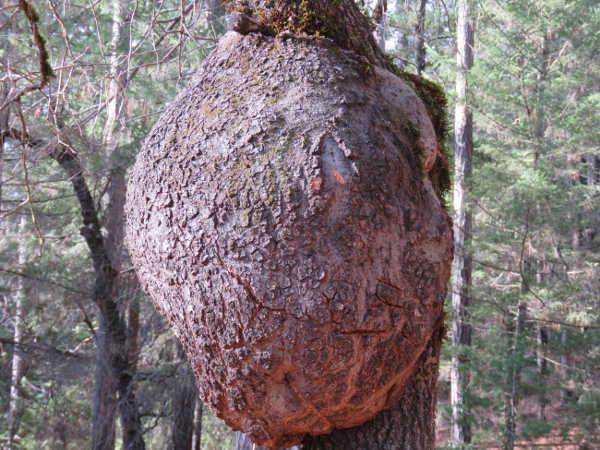
LAKE COUNTY, Calif. – Winter allows us to slow down and observe the underpinnings of nature.
With the autumn season's job of coloring, then dropping leaves, now it's easier to study a tree's distinctive covering – its bark.
Depending on the species, a tree's bark can be smooth as wet stone or deeply ridged with character-giving “craters.”
Anatomically speaking, bark – or the tree's periderm – is a protective layer that keeps it safe from disease, dehydration, harmful parasites, pests and pathogens.
According to Glenn Keator's “Life of an Oak,” all trees hold within them cells called vascular cambium which add to the tree's size each year, and a tree's bark secretly holds differing layers consisting of cork and cork parenchyma.
The tree's wood is a complicated coordination of fibers, vessels and cellulose molecules to name but a few parts.
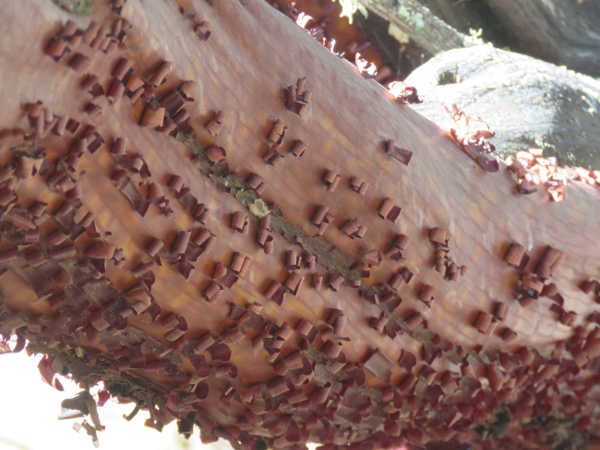
Tree bark often gives us features and hints to identify a tree's species.
The complex compounds that make up bark include tannins, lignins and suberins. Those components have the capacity to both reflect and hold certain wavelengths of light, thereby creating a bark's color.
Some trees, like mature oaks, hold deep ridges and furrows, gaps which are called rhytidome.
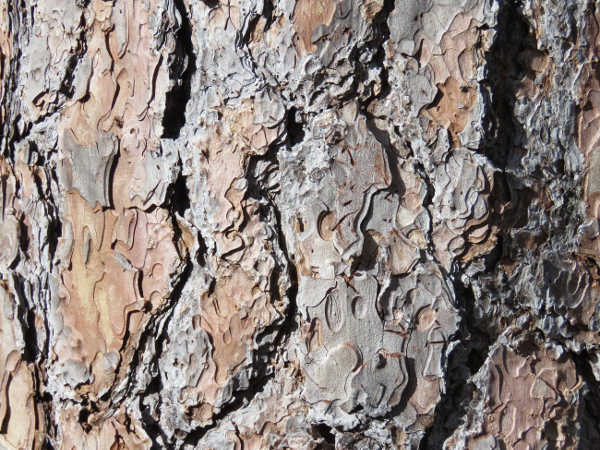
Other trees, such as pine, have bark with plates or scales, and flowering dogwood's bark is unusual with its little puzzle-piece plates.
According to Bay Nature Magazine, manzanita trees “are derived from a group of trees, the madrones, that have fossils dating as far back as 50 million years.”
While madrone trees exhibit flesh-colored, smooth bark, manzanita bark is often a deep, red-mahogany color.
Both trees have adapted a special way to protect their lovely, smooth bark surfaces by way of peeling. Each year their bark peels into papery scrolls which protects their smooth surfaces from the ravages of parasites, fungi, mosses and lichens.
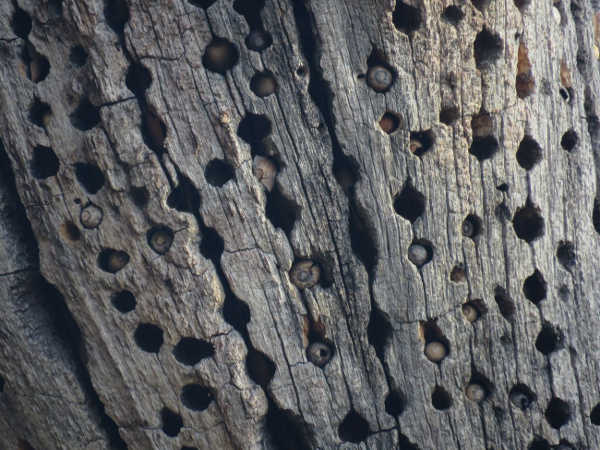
While a tree's bark can help to identify it when it is leafless, another way bark can aid in a tree's identification is by its unique smell.
Ponderosa pine is said to give off a unique scent with hints of vanilla, and Jeffrey pine holds a butterscotch smell, while other pine trees may smell of turpentine.
A tree's bark can show age or time in the sun, much like our sun-ravaged epidermis, and similar to us, a tree can sport a callus in response to a wound.
Over time, people have appreciated or been dependent on trees not only for their food and fuel. Trees have "generously" provided humankind with bark for boats and shelter, medicines, cork, cloth, mulch, shingles and so much more.
Sometimes you don't have to look very closely to examine tree bark's nuances; its patterns and textures. Many trees' furrowed, patchy or scaly skin can play host to numerous types of mosses, lichens and fungi, which stand out like a beacon in the woods.
Moss anchors to tree bark like a vivid, velvet cloak. When the season is dry, moss that grows on bark or stone places itself into a phase of dormancy. Then, it awaits life-giving moisture from fog, or rain when it plumps up like a wet sponge.
Trees, those intricate, stalwart life forces, give us much to ponder, so next time you are wandering the woods get up close and personal to a tree, hone in your art of perception and enjoy the varieties, nuances and textures – secrets that each tree has to offer.
Kathleen Scavone, M.A., is a retired educator, potter, freelance writer and author of “Anderson Marsh State Historic Park: A Walking History, Prehistory, Flora, and Fauna Tour of a California State Park” and “Native Americans of Lake County.”
Dogs available for adoption this week include mixes of bull terrier, Chihuahua, Labrador Retriever, pit bull, Pomeranian, Rhodesian Ridgeback and terrier.
Dogs that are adopted from Lake County Animal Care and Control are either neutered or spayed, microchipped and, if old enough, given a rabies shot and county license before being released to their new owner. License fees do not apply to residents of the cities of Lakeport or Clearlake.
If you're looking for a new companion, visit the shelter. There are many great pets hoping you'll choose them.
The following dogs at the Lake County Animal Care and Control shelter have been cleared for adoption (additional dogs on the animal control Web site not listed are still “on hold”).

Male pit bull terrier puppy
This male pit bull terrier puppy has a short black and tan coat and brown eyes.
He is in kennel No. 19a, ID No. 13489.

‘Hank’
“Hank” is a male bull terrier-Labrador Retriever mix with a short brown and white coat and gold eyes.
He’s in kennel No. 20, ID No. 13510.

‘Blossom’
“Blossom” is a female pit bull terrier with a short blue coat and brown eyes.
She has been spayed.
She’s in kennel No. 21, ID No. 11864.
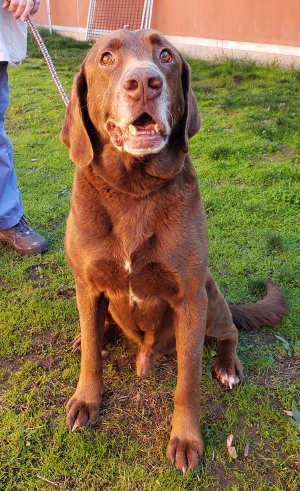
Male Labrador Retriever
This male Labrador Retriever has a short chocolate coat.
He is in kennel No. 25, ID No. 13465.

Male terrier
This male terrier has a curly black coat with white markings and gold eyes.
He is in kennel No. 27, ID No. 13495.

Male pit bull terrier
This male pit bull terrier has a short brindle coat and brown eyes.
He is in kennel No. 29, ID No. 13507.

‘Butter’
“Butter” is a female terrier with a long tricolor coat and brown eyes.
She’s in kennel No. 30A, ID No. 13534.

Male Pomeranian
This male Pomeranian has a long red coat and brown eyes.
He is in kennel No. 30B, ID No. 13535.

‘Goofy’
“Goofy” is a young male Rhodesian Ridgeback with a short tan and black coat.
Shelter staff said this boy is great with other dogs, although he is high energy and would benefit from obedience training. He would love to go jogging every day, he is very food motivated and willing to learn new things.
Goofy has been at the shelter since Nov. 5. He was originally taken from someone in Upper Lake and found on the highway in Clearlake. If anyone has any information on his owner please contact the shelter.
He’s in kennel No. 33, ID No. 13210.
Lake County Animal Care and Control is located at 4949 Helbush in Lakeport, next to the Hill Road Correctional Facility.
Office hours are Monday through Friday, 11 a.m. to 5 p.m., and 11 a.m. to 3 p.m., Saturday. The shelter is open from 11 a.m. to 4 p.m., Monday through Friday and on Saturday from 11 a.m. to 3 p.m.
Visit the shelter online at http://www.co.lake.ca.us/Government/Directory/Animal_Care_And_Control.htm.
For more information call Lake County Animal Care and Control at 707-263-0278.
Email Elizabeth Larson at

The 2020 Census hasn’t even started – but it has already kicked off spirited fights.
A Supreme Court case, decided last year, blocked a Trump administration proposal to ask every respondent if they were a citizen.
Meanwhile, there are three pending federal court suits in which plaintiffs for civil rights groups and one city claim that the administration has not done sufficient planning or provided enough funding for Census 2020.
Census 2020 is far from the first census to set off bitter political fights. One hundred years ago, results from Census 1920 initiated a decadelong struggle about how to allocate a state’s seats in Congress. The political arguments were so bitter that Congress eventually decided they would not use Census 1920 results.
Could this happen again?
Power in the census
The framers of the Constitution mandated a count of all people every ten years, in order to allocate seats in Congress and the Electoral College on the basis of each state’s population.
The results of the census shift political power and money. At present, US$1.5 trillion in federal spending is distributed to states and local governments every year on the basis of data gathered by the Census Bureau.
I am a demographer who has been teaching about the nation’s population trends since the early 1960s. I have analyzed census data for decades. In Census 2000, I was an enumerator and Census 2010, an address lister.
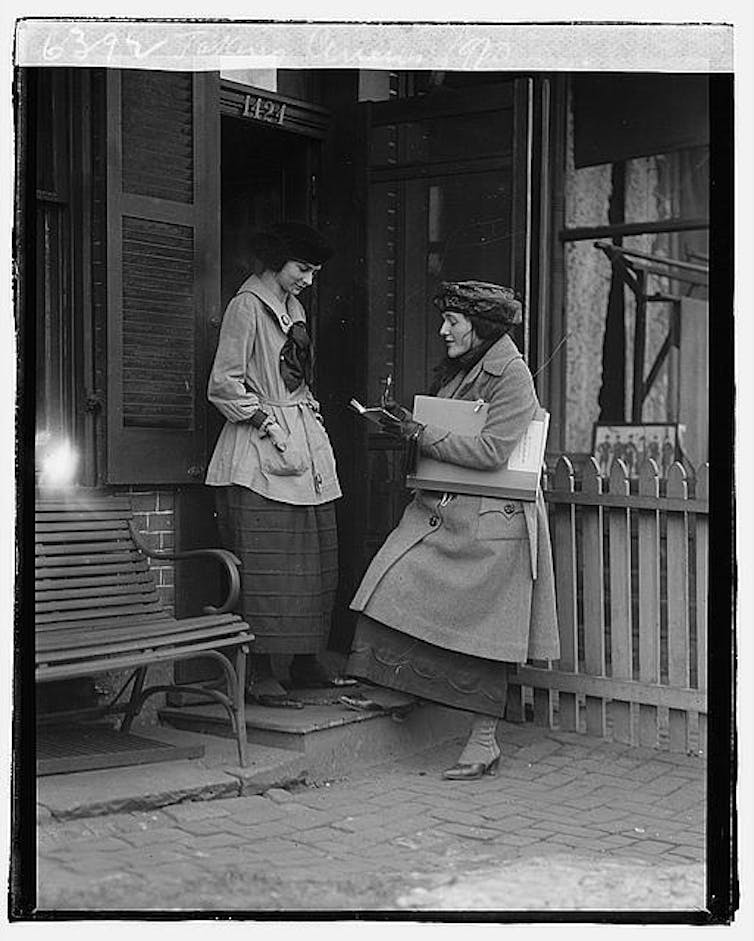
The 2020 Census asks just seven questions. Back in 1910, the census posed 32 questions, with an additional array of questions for farmers. One of those queries asked farmers the value of the products they sold during the previous year.
Since 1790, the official census start date had been either the first Monday of August or June 1. But, for the 1920 census, the Department of Agriculture presumed they would obtain more accurate information about the value of crops if the census were taken on Jan. 1. They feared farmers would forget financial details over the winter.
Congress approved the change without realizing the implications.
Immigration influx
Census 1920 results were released in December of that year, and they surprised the members of Congress.
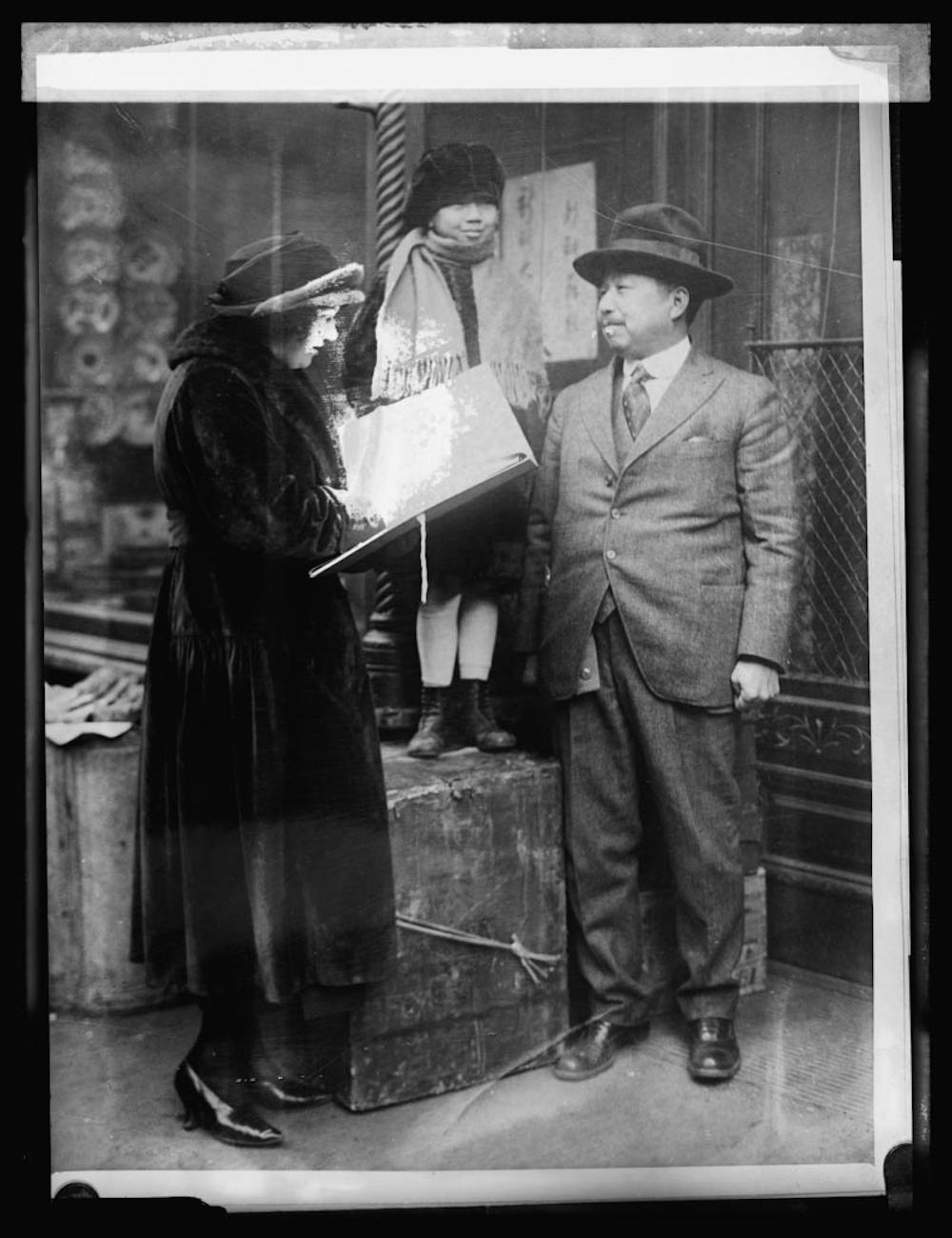
At that time, there was vibrant opposition to foreigners coming into the U.S. The nation had already banned immigration from Asia, but many of those arrived after 1880 were Catholics and Jews who came from southern and eastern Europe. Many Americans feared they would never assimilate.
The 1920 census results showed that the Northeastern and industrial Midwestern states had grown rapidly, thanks to immigration from Europe. After an interruption for World War I, immigration spiked to 800,000 in 1920.
In response to census results and the unexpected “flood” of immigrants, Congress, in 1921, enacted an Emergency Immigration Quota Act, restricting immigration.
The lost census
That was just the first step in a decadelong controversy involving key issues that shaped the nation. Would there be continued immigration from eastern and southern Europe? Would political power shift to the states with the biggest cities?
The 1920 results would have shifted political power away from the South and away from the agricultural states of the Midwest, to the northeastern states and those states Americans now call the Rust Belt.
Representatives of farm states contended that the new Jan. 1 census date meant that many men who spent most of the year working on farms were counted in cities where they spent just a few winter months.
Southerners in Congress argued that congressional seats should be allocated on the number of citizens only, since this would protect their representation.
Congressmen from growing states emphasized that the Constitution said nothing about citizens. They argued that a constitutional amendment was required to limit congressional apportionment to citizens only.
Northeastern members also pointed to an obscure clause from the 14th Amendment that permitted Congress to diminish a state’s representation if they determined that a state abridged the right of male citizens to vote. Southern states attempted to accomplish that with poll taxes, literacy tests, grandfather clauses and refusal to register African Americans.
There was also controversy about which mathematical method to use to allocate seats to states. Different methods assigned different numbers of seats to states.
From 1800 to 1910, Congress had increased its membership after censuses, to prevent states from losing a seat. Vibrant controversy raged about the size of Congress, since different numbers favored different states.
Late in the 1920s, it became clear that Congress was so riven they would never use Census 1920 data to reapportion Congress. In 1929, they enacted legislation specifying which method would be used to allocate seats on the basis of the 1930 count.
Census 1920 is unique, since it was the only one not used for reapportionment.
Echoes of the past
Is there any chance the census count of 2020 will be dismissed?
Just as in the 1920, there are conflicting views today about immigration and how much representation states should have in Congress and the Electoral College.
In the pending federal suits, plaintiffs contend that the administration’s lack of sufficient planning and funding will substantially undercount Americans, especially minority groups.
Should federal judges find in the plaintiff’s favor, members of Congress may be skeptical about data from Census 2020.
What’s more, at present, there are many individuals and several organizations arguing that congressional and Electoral College seats should be allocated according to the count of citizens or the count of voting age citizens, as opposed to all residents.
The state of Alabama has already filed suit contending that Alabama will likely lose a seat to Texas because aliens are included in the count used to apportion seats. If Congress were to apportion seats on the basis of citizens only, the Supreme Court may have to rule about what the framers of the Constitution meant when they defined the apportionment population.
Finally, the nation’s population is currently three times as large as in 1911, when Congress decided that 435 was the appropriate size of membership. On the basis of 2019 data, it seems likely that 10 states will lose a representative.
Some political analysts and advocates favor an expansion of Congress, since that would mean that members would represent fewer constituents. If Congress, next year, decided to increase its size to 460, no state would lose any of its current seats.
A new Congress will be elected this November and they will meet for the first time on Jan. 3, 2021. One of their first obligations will be reapportionment. Will this go smoothly – or will the controversies of the 1920s once again influence what use Congress makes of census counts?
[Like what you’ve read? Want more? Sign up for The Conversation’s daily newsletter.]
Walter Reynolds Farley, Professor Emeritus of Sociology, University of Michigan
This article is republished from The Conversation under a Creative Commons license. Read the original article.
It will be a dark winter’s night when Solar Orbiter launches from Florida on its journey to the source of all light on Earth, the sun.
The mission, a collaboration between the European Space Agency and NASA, is scheduled to begin Feb. 9, 2020, during a two-hour launch window that opens at 11:03 p.m. EST. The two-ton spacecraft launches from Cape Canaveral on a United Launch Alliance Atlas V rocket.
Seeking a view of the sun’s north and south poles, Solar Orbiter will journey out of the ecliptic plane — the belt of space, roughly aligned with the sun’s equator, through which the planets orbit.
Slinging past Earth and repeatedly around Venus, the spacecraft will draw near the sun and climb higher above the ecliptic until it has a bird’s eye view of the poles.
There, Solar Orbiter will try to answer basic questions about the sun, whose every burp and breeze holds sway over the solar system.
What drives the solar wind, the gust of charged particles constantly blowing from the sun? Or, what churning deep inside the sun generates its magnetic field? How does the sun’s magnetic field shape the heliosphere, the vast bubble of space dominated by our star?
“These questions are not new,” said Yannis Zouganelis, ESA deputy project scientist at the European Space Astronomy Centre in Madrid. “We still don’t understand fundamental things about our star.”
In solving these mysteries, scientists seek to better understand how the sun shapes space weather, the conditions in space that can impact astronauts, satellites, and everyday technology like radio and GPS.
Over the next seven years, Solar Orbiter will travel as close as 26 million miles to the sun — closing about two-thirds the distance from Earth to the star. It will climb 24 degrees above the ecliptic for a vista of the poles and the far side of the sun.
“We don’t know what we’re going to see,” said Teresa Nieves-Chinchilla, NASA deputy project scientist at NASA’s Goddard Space Flight Center in Greenbelt, Maryland. “Our view of the sun is going to change a lot in the next few years.”
Enabling its scorching voyage is a heat shield sporting a black coating of calcium phosphate, a charcoal-like powder similar to pigments used in cave paintings tens of thousands of years ago.
All but one of the spacecraft’s telescopes peer through holes in the heat shield. At closest approach, the front of the shield will near 1,000 degrees Fahrenheit, while the instruments tucked behind it will remain at a comfortable range – for them – between minus 4 F and 122 F above zero.
Because Earth orbits through the ecliptic plane, we don’t get a good view of the poles from afar. It’s a bit like trying to glimpse Mount Everest’s summit from the base of the mountain. Crucially, the poles are still missing from space weather models that scientists use to forecast solar activity.
Like Earth’s own North and South poles, the sun’s poles are extreme regions quite different from the rest of the sun. They’re covered in coronal holes, cooler stretches where the fast solar wind comes gushing from.
There, scientists hope to find the footprints of knotted magnetic fields underlying solar activity. Many think the poles hold the first clues to the intensity of the next solar cycle, which comes roughly every 11 years, as the sun swings from seasons of high to low activity.
With a powerful array of 10 instruments, Solar Orbiter is like a lab in orbit, designed to study the sun and its outbursts in great detail.
“What makes Solar Orbiter unique is this combination of really high-resolution imagers and in situ instruments, getting perspectives we haven’t seen yet,” said Daniel Müller, ESA project scientist at the European Space Research and Technology Centre in the Netherlands.
Ideally, Müller said, Solar Orbiter will image where solar wind bubbles on the surface and study the properties of that gust of wind as it flows from the sun and passes the spacecraft. For the first time, scientists will be able to map what comes out of the sun to precisely where it came from.
The instruments are also designed to work in concert, enhancing their observing power, said ESA payload manager Anne Pacros. When something fleeting like an X-ray solar flare blazes on the surface, the spacecraft’s X-ray instrument will see, and alert the others to pay attention.
“They enter burst mode, where they take more data, faster, responding to solar activity in real time,” Pacros said. “This promises much more science with what we have on board.”
Solar Orbiter’s destination is largely uncharted, a little-explored region of the heliosphere. Its unique vantage point is key to a complete understanding of the sun’s activity and cycles.
By offering regular views of the far side of the sun, and the first images of the solar poles, Solar Orbiter joins a team of NASA heliophysics missions seeking to understand how the sun affects the space around Earth and all the planets.
“We have all these amazing missions located in exactly the right place we want to study,” said Nicola Fox, director of the Heliophysics Division at NASA Headquarters in Washington. “They’re in places that allow us to do big system science, more science than you could do with just one mission alone.”
In particular, Solar Orbiter will work closely with NASA’s Parker Solar Probe. The two are natural teammates. Together, they’ll provide a never-before-seen global view of our star.
The duo makes new multi-point measurements possible; these are useful for tracking how flows from the sun develop and change. As Parker Solar Probe samples hot solar gases up close, Solar Orbiter can tell us more about the very space Parker flies through.
Or, they might simultaneously image the same structure in the corona, the solar atmosphere, sharing views from the poles and equator. At various points, the two missions will make coordinated observations.
“Parker Solar Probe and Solar Orbiter, in orbit together, is a big milestone,” Nieves-Chinchilla said. “This is something heliophysicists have been waiting on for decades. In the next decade, together, the two will be sure to change the field.”
After launch, the operations team will conduct three months of commissioning to ensure the instruments are operating properly. Once this check-out period is complete, the in situ instruments will turn on; the remote-sensing instruments will remain in cruising mode until Solar Orbiter’s first solar approach in November 2021.
Solar Orbiter is an international cooperative mission between ESA and NASA. ESA's European Space Research and Technology Centre in the Netherlands manages the development effort. The European Space Operations Center in Germany will operate Solar Orbiter after launch.
Solar Orbiter was built by Airbus Defence and Space, and contains 10 instruments: nine provided by ESA member states and ESA.
NASA provided one instrument, SoloHI and an additional sensor, the Heavy Ion Sensor, which is part of the Solar Wind Analyzer instrument suite.
For more information, please visit www.nasa.gov/solarorbiter .
Lina Tran works for NASA's Goddard Space Flight Center in Greenbelt, Maryland.
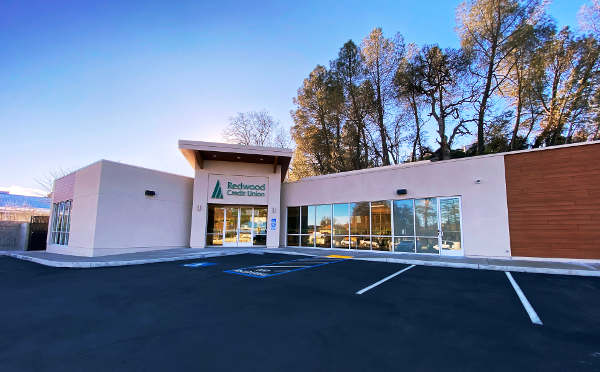
LOWER LAKE, Calif. – Redwood Credit Union this week announced the opening of its new, full-service branch in Lower Lake.
The branch is located at 16095 Main St., at the corner of Highway 53 and Highway 29.
It’s a major investment by the credit union in Lower Lake, which sustained major losses to its downtown in the August 2016 Clayton fire.
To better accommodate RCU’s growing membership in Lake County, the new branch offers the community competitive personal and business loans, free checking, high-yield deposit options, home and auto loans, and concierge auto-buying services.
Comfortable technology areas for members to bank online and quickly access information is also offered, with staff readily available to assist. There’s also a children’s activity area.
“Our new Lower Lake branch is designed to offer an experience that goes beyond everyday banking, though that’s offered too,” said Brett Martinez, RCU president and CEO. “It’s a comfortable environment where individuals and businesses can get financial service – from money management to home and auto loans, and long-term financial planning. We’re excited to offer this new location to serve the Lower Lake community.”
With branch hours Monday through Friday, 9 a.m. to 6 p.m. and Saturdays, 9 a.m. to 4 p.m., plus an easy-to-access location, this Lower Lake branch is set up to make banking easy for its local members
Founded in 1950, Redwood Credit Union is a full-service financial institution providing personal and business banking to consumers and businesses in the North Bay and San Francisco.
RCU has over $4.9 billion in assets and serves more than 355,000 members with full-service branches from San Francisco to Ukiah.
The National Weather Service has issued the wind advisory that will be in effect from 10 a.m. to 10 p.m. Sunday.
Forecasters said an area of low pressure will bring a period of gusty northerly and easterly winds to the region on Sunday.
The strongest winds are expected on the west side of the Sacramento Valley and into Lake County and on higher elevations of the Sierra. The forecast said winds will begin to weaken Sunday night into Monday morning.
The advisory notes that northerly and easterly winds from 20 to 30 miles per hour and valley gusts between 30 to 45 miles per hour are expected, while upper foothills and mountain gusts of between 30 and 60 miles per hour and stronger gusts possible for the higher elevations also in the forecast.
The Lake County forecast anticipates gusts above 35 miles per hour in areas such as Cobb.
Over the coming week, temperatures in Lake County are forecast to be warmer – into the mid-40s at night and upper 60s during the day – thanks to sunny and clear conditions.
Pacific Gas and Electric Co. said its meteorologists are forecasting strong winds Sunday and into Monday throughout much of Northern and Central California and it’s urging customers to take the necessary steps to be prepared and stay safe.
PG&E emphasized that, while it’s tracking the system, it is not planning to call a public safety power shutoff as fuel and soil moisture values remain high due to winter season precipitation.
The company said it has electric and vegetation crews on alert and in position to be able to respond should outages occur.
Email Elizabeth Larson at