 How to resolve AdBlock issue?
News
The red flag warning is in effect until 11 p.m. Monday.
A red flag warning means that critical fire weather conditions are either occurring now or will shortly.
The forecast warns of the potential fire starts due to “abundant lightning” that’s possible from Sunday night through early Tuesday morning.
The National Weather Service said a moist and unstable midlevel airmass is expected to spread north across the region on Sunday, with isolated thunderstorms possibly developing over Mendocino and Lake counties during the day.
“Additional thunderstorm development will be more likely Sunday night into Monday morning across much of Northwest California as the remnants of a tropical system move north across the area,” according to the forecast.
Forecasters warn of another round of storms that will be possible on Tuesday morning as a second upper disturbance moves eastward across the region.
“Lightning combined with dry fuels will increase the threat for fire starts during each episode of storm development,” the forecast said.
Other concerns cited in the National Weather Service’s long-term forecast include high temperatures close to the century mark through Monday before conditions cool slightly, dropping into the low to mid 90s through the weekend.
Smoke from the LNU Lightning Complex and other regional fires also is expected to continue to impact Lake County through at least Tuesday, the forecast said.
Email Elizabeth Larson at
The August Complex on the Mendocino National Forest’s Grindstone Ranger District burned 160,005 acres by Saturday night, with containment at 11 percent, the US Forest Service reported.
The complex, located 30 miles northeast of Willows, began burning last Sunday, in the wake of thunderstorms that passed over the region.
The Forest Service said it’s made up of 20 fires.
In a Saturday report, forest officials said the complex had so far destroyed 10 structures.
The largest of the fires include the Doe, 136,430 acres; the Glade, 13,088 acres; the Tatham, 7,667 acres; the Hopkins, 2,153 acres; and the Willow Basin, 601 acres.
The Forest Service said firefighters are working with Cal Fire to construct dozer lines along County Road 306 in Glenn County to provide protection to private homes and properties against the Tatham fire, which is four miles west of Paskenta.
Officials said fire crews are going direct on the west flank of the Glade fire and making good progress while continuing to protect property at risk on the east and southeast side of the fire.
The Hopkins fire is burning in an old fire scar in the Yolla Bolly wilderness and is staffed with smokejumpers, officials said.
The Forest Service said 397 firefighting personnel and 124 overhead personnel, 28 engines, three helicopters, seven bulldozers, four water tenders and seven crews are assigned to the complex.
Also in the Mendocino National Forest, the 2,000-acre Hull fire is burning five miles north of Lake Pillsbury on the Upper Lake Ranger District.
Officials said Saturday that the fire, caused by lightning, was discovered on Wednesday.
Email Elizabeth Larson at
Dogs available for adoption this week include mixes of American Staffordshire Terrier, chow chow, German Shepherd, Great Pyrenees, husky, Labrador Retriever and pit bull.
Dogs that are adopted from Lake County Animal Care and Control are either neutered or spayed, microchipped and, if old enough, given a rabies shot and county license before being released to their new owner. License fees do not apply to residents of the cities of Lakeport or Clearlake.
The following dogs at the Lake County Animal Care and Control shelter have been cleared for adoption (additional dogs on the animal control Web site not listed are still “on hold”).
Call Lake County Animal Care and Control at 707-263-0278 or visit the shelter online at http://www.co.lake.ca.us/Government/Directory/Animal_Care_And_Control.htm for information on visiting or adopting.

‘Pina’
“Pina” is a young female pit bull terrier with a short tan and brindle coat.
She is in kennel No. 26, ID No. 13842.

German Shepherd-pit bull mix
This male German Shepherd-pit bull mix has a black and brindle coat.
He is in kennel No. 27, ID No. 13841.

‘Turbo’
“Turbo” is a young male German Shepherd-husky mix.
He has a medium-length gray and black coat.
He is in kennel No. 28, ID No. 13903.

‘Raven’
“Raven” is a female black Labrador Retriever.
She has been spayed.
She is in kennel No. 29, ID No. 13902.

Great Pyrenees
This male Great Pyrenees has a long cream-colored coat.
He is in kennel No. 31, ID No. 13900.

Male chow chow
This male chow chow has a medium-length black coat.
He is in kennel No. 33, ID No. 13795.

‘Chopper’
“Chopper” is a male American Staffordshire Terrier with a tan and white coat.
He has been neutered.
He’s in kennel No. 34, ID No. 13886.
Email Elizabeth Larson at

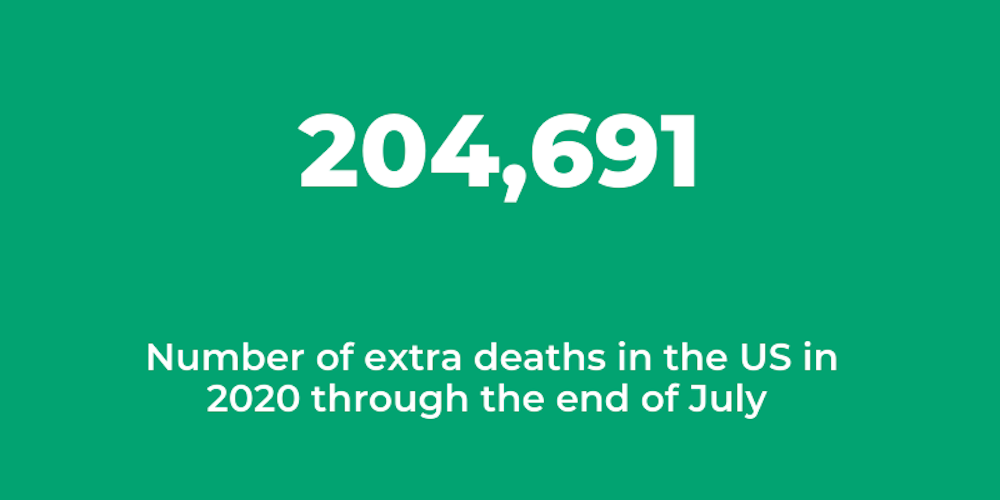
The number of deaths in the United States through July 2020 is 8% to 12% higher than it would have been if the coronavirus pandemic had never happened. That’s at least 164,937 deaths above the number expected for the first seven months of the year – 16,183 more than the number attributed to COVID-19 thus far for that period – and it could be as high as 204,691.
Tracking deaths
When someone dies, the death certificate records an immediate cause of death, along with up to three underlying conditions that “initiated the events resulting in death.” The certificate is filed with the local health department, and the details are reported to the National Center for Health Statistics.
As part of the National Vital Statistics System, the NCHS then uses this information in various ways, such as tabulating the leading causes of death in the United States – currently heart disease, followed by cancer. Sometime this fall, COVID-19 will likely become the third-largest cause of death for 2020.
Projecting from the past
To calculate excess deaths requires a comparison to what would have occurred if COVID-19 had not existed. Obviously, it’s not possible to observe what didn’t happen, but it is possible to estimate it using historical data. The Centers for Disease Control and Prevention does this using a statistical model, based on the previous three years of mortality data, incorporating seasonal trends as well as adjustments for data-reporting delays.
So, looking at what happened over the past three years, the CDC projects what might have been. By using a statistical model, they are also able to calculate the uncertainty in their estimates. That allows statisticians like me to assess whether the observed data look unusual compared to projections.
The number of excess deaths is the difference between the model’s projections and the actual observations. The Centers for Disease Control and Prevention also calculates an upper threshold for the estimated number of deaths – that helps determine when the observed number of deaths is unusually high compared to historical trends.
Clearly visible in a graph of this data is the spike in deaths beginning in mid-March 2020 and continuing to the present. You can also see another period of excess deaths from December 2017 to January 2018, attributable to an unusually virulent flu strain that year. The magnitude of the excess deaths in 2020 makes clear that COVID-19 is much worse than influenza, even when compared to a bad flu year like 2017-18, when an estimated 61,000 people in the U.S. died of the illness.
The large spike in deaths in April 2020 corresponds to the coronavirus outbreak in New York and the Northeast, after which the number of excess deaths decreased regularly and substantially until July, when it started to increase again. This current uptick in excess deaths is attributable to the outbreaks in the South and West that have occurred since June.
The data tell the story
It doesn’t take a sophisticated statistical model to see that the coronavirus pandemic is causing substantially more deaths than would have otherwise occurred.
The number of deaths the CDC officially attributed to COVID-19 in the United States exceeded 148,754 by Aug. 1. Some people who are skeptical about aspects of the coronavirus suggest these are deaths that would have occurred anyway, perhaps because COVID-19 is particularly deadly for the elderly. Others believe that, because the pandemic has changed life so drastically, the increase in COVID-19-related deaths is probably offset by decreases from other causes. But neither of these possibilities is true.
In fact, the number of excess deaths currently exceeds the number attributable to COVID-19 by more than 16,000 people in the U.S. What’s behind that discrepancy is not yet clear. COVID-19 deaths could be being undercounted, or the pandemic could also be causing increases in other types of death. It’s probably some of both.
Regardless of the reason, the COVID-19 pandemic has resulted in substantially more deaths than would have otherwise occurred … and it is not over yet.
Ronald D. Fricker Jr., Professor of Statistics and Associate Dean for Faculty Affairs and Administration, Virginia Tech
This article is republished from The Conversation under a Creative Commons license. Read the original article.

An SUV-size space rock flew past our planet last weekend and was detected by a NASA-funded asteroid survey as it departed.
Near Earth asteroids, or NEAs, pass by our home planet all the time. But an SUV-size asteroid set the record this past weekend for coming closer to Earth than any other known NEA: It passed 1,830 miles (2,950 kilometers) above the southern Indian Ocean on Sunday, Aug. 16 at 12:08 a.m. EDT (Saturday, Aug. 15 at 9:08 p.m. PDT).
At roughly 10 to 20 feet (3 to 6 meters) across, asteroid 2020 QG is very small by asteroid standards: If it had actually been on an impact trajectory, it would likely have become a fireball as it broke up in Earth's atmosphere, which happens several times a year.
By some estimates, there are hundreds of millions of small asteroids the size of 2020 QG, but they are extremely hard to discover until they get very close to Earth. The vast majority of NEAs pass by safely at much greater distances – usually much farther away than the Moon.
"It's really cool to see a small asteroid come by this close, because we can see the Earth's gravity dramatically bend its trajectory," said Paul Chodas, director of the Center for Near-Earth Object Studies (CNEOS) at NASA's Jet Propulsion Laboratory in Southern California. "Our calculations show that this asteroid got turned by 45 degrees or so as it swung by our planet."
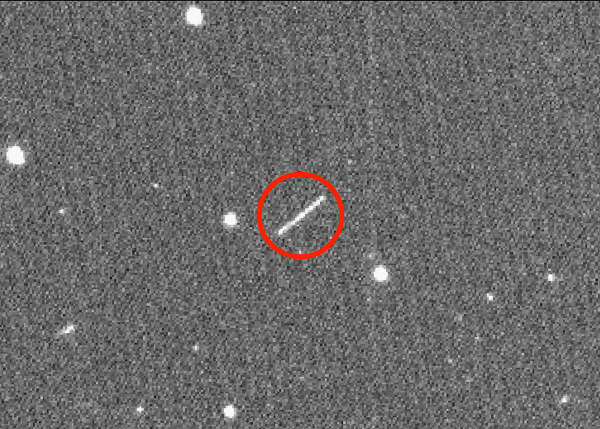
Zipping along at almost 8 miles per second (12.3 kilometers per second) – a little slower than average, Chodas noted – 2020 QG was first recorded as just a long streak in a wide-field camera image taken by the Zwicky Transient Facility.
The image was taken six hours after the closest point of approach as the asteroid was heading away from Earth. A sky-scanning survey telescope funded by the National Science Foundation and NASA, the Zwicky Transient Facility is based at Caltech's Palomar Observatory in San Diego County. NASA's Near-Earth Object Observations Program funds data processing for NEO detections.
Asteroid 2020 QG enters the record books as the closest known nonimpacting asteroid; many very small asteroids impact our planet every year, but only a few have actually been detected in space a few hours before impacting Earth. On average, an asteroid the size of 2020 QG passes this closely only a few times a year.
In 2005, Congress assigned NASA the goal of finding 90% of the near-Earth asteroids that are about 460 feet (140 meters) or larger in size. These larger asteroids pose a much greater threat if they were to impact, and they can be detected much farther away from Earth, because their rate of motion across the sky is typically much smaller at that distance.
"It's quite an accomplishment to find these tiny close-in asteroids in the first place, because they pass by so fast," Chodas said. "There's typically only a short window of a couple of days before or after close approach when this small of an asteroid is close enough to Earth to be bright enough but not so close that it moves too fast in the sky to be detected by a telescope."
A division of Caltech in Pasadena, JPL hosts CNEOS for NASA's Near-Earth Object Observations Program in NASA's Planetary Defense Coordination Office.
More information about CNEOS, asteroids and near-Earth objects can be found at https://cneos.jpl.nasa.gov.
For more information about NASA's Planetary Defense Coordination Office, visit https://www.nasa.gov/planetarydefense.
For asteroid and comet news and updates, follow @AsteroidWatch on Twitter at https://twitter.com/AsteroidWatch.
LAKE COUNTY, Calif. – Firefighters held the LNU Lightning Complex to a smaller amount of daytime growth on Saturday as more resources arrived to assist the effort.
The complex was up to 325,128 acres on Saturday night, a growth of just under 11,000 acres during the course of the day, with containment remaining at 15 percent.
On Thursday and Friday, the complex had grown 84,000 and 83,000 acres, respectively, as Lake County News has reported.
The Hennessey fire, the portion of the complex burning in Lake, Napa, Solano and Yolo counties, has so far burned 271,714 acres and is 17-percent contained, Cal Fire said.
On the Sonoma County side of the fire, the Walbridge fire west of Healdsburg is up to 51,069 acres and the Meyers fire north of Jenner is at 2,345 acres. Cal Fire said there is no containment on either of those fires.
On Saturday evening, Cal Fire said the number of structures destroyed increased to 845, with damaged structures numbering 231. Another 30,500 remain threatened.
Cal Fire Sonoma Lake Napa Unit Chief Shana Jones said in a Saturday morning briefing that the LNU Lightning Complex remains the No. 1 priority in the state for resources that become available.
“Within an incident this size and complexity, and with all the fire activity throughout the state, all of our resources remain stretched to a capacity that we have not seen in recent history,” Jones said.
More resources are coming in from out of state to help fight the fires around California, but Jones said, “We are not out of the woods.”
A few hundred more firefighters and dozens of additional engines joined the fight on Saturday. Cal Fire said assigned resources included 1,704 personnel, 233 engines, 33 water tenders, 11 helicopters, 15 hand crews and 37 dozers.
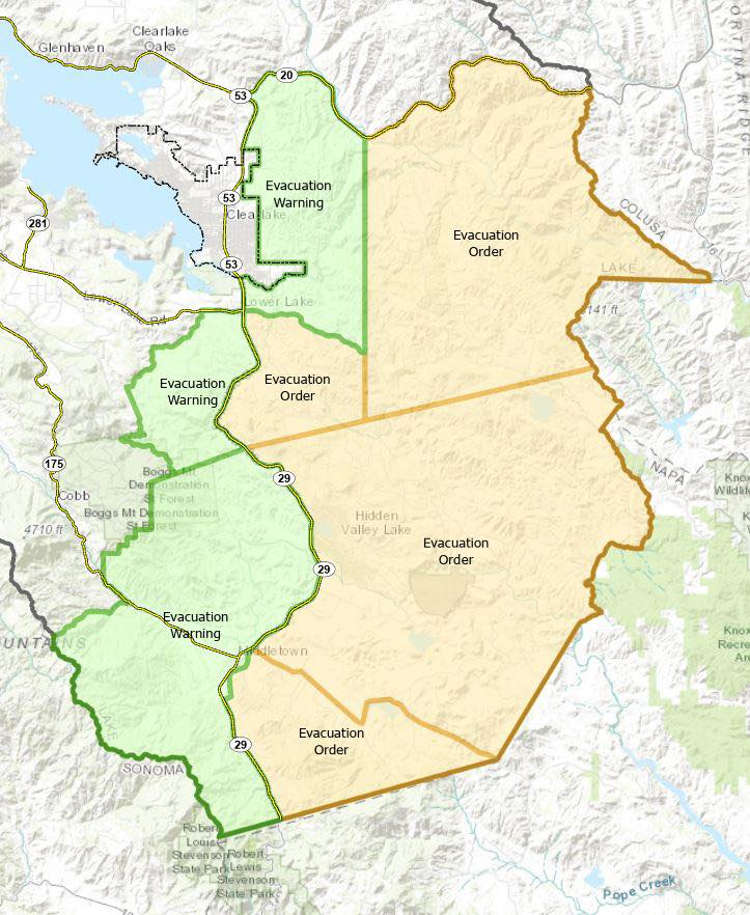
The fire’s continued growth led to the Lake County Sheriff’s Office issuing a new evacuation order for areas near Lower Lake and an evacuation warning for areas north of Lower Lake to Highway 20, excluding the city of Clearlake.
An evacuation order for the Hidden Valley Lake and Jerusalem Valley areas remains in effect, as does an evacuation warning for the greater Middletown area, including Middletown proper.
As predicted on Saturday, the wind shifted and caused Lake County’s air basin to fill with smoke, making visibility challenging for firefighting forces, according to radio reports.
Email Elizabeth Larson at