 How to resolve AdBlock issue?
News
LAKE COUNTY, Calif. – The Lake County Sheriff’s Office has issued a new evacuation warning after the LNU Lightning Complex made another advance, jumping Highway 16.
Just before 4:15 p.m. the Lake County Sheriff’s Office issued an evacuation warning for the areas east of Old Long Valley, New Long Valley Road and north of Highway 20 to the Lake County line due to the fire.
The warning area includes all residents living in Spring Valley, Long Valley and the Double Eagle subdivision.
Residents are asked to take preparations in the event that a mandatory evacuation order is issued.
Preparations should include gathering all medications, important documents, making plans for pets and notifying family members where you may be going. Those requiring additional time to evacuate or those with pets or livestock should leave the area as soon as possible.
“During a mandatory evacuation, it will be extremely hectic and traffic conditions will be very congested. By evacuating early, you do your part in keeping yourself, your neighbors, and our first responders safe,” officials said.
Should an evacuation order be issued and shelter is needed, evacuees will be directed to a temporary evacuation point.
Just before 4:15 p.m. the Lake County Sheriff’s Office issued an evacuation warning for the areas east of Old Long Valley, New Long Valley Road and north of Highway 20 to the Lake County line due to the fire.
The warning area includes all residents living in Spring Valley, Long Valley and the Double Eagle subdivision.
Residents are asked to take preparations in the event that a mandatory evacuation order is issued.
Preparations should include gathering all medications, important documents, making plans for pets and notifying family members where you may be going. Those requiring additional time to evacuate or those with pets or livestock should leave the area as soon as possible.
“During a mandatory evacuation, it will be extremely hectic and traffic conditions will be very congested. By evacuating early, you do your part in keeping yourself, your neighbors, and our first responders safe,” officials said.
Should an evacuation order be issued and shelter is needed, evacuees will be directed to a temporary evacuation point.
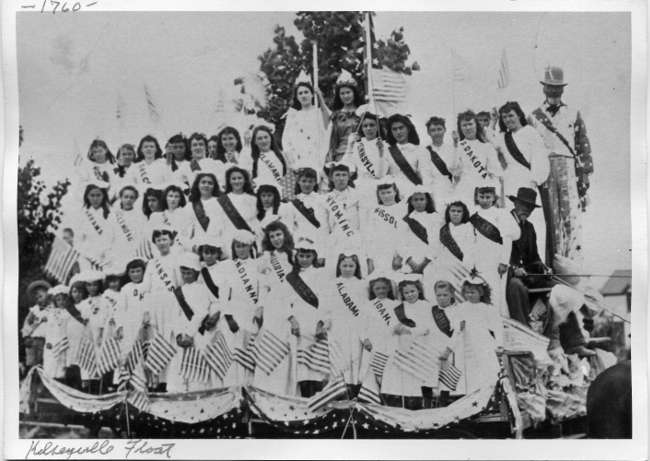
LAKE COUNTY, Calif. – As we celebrate the centennial of national woman suffrage, it’s good to reflect on what it took to reach that point, and to remember the Lake County people who did their parts to bring it about.
When Tennessee ratified the 19th Amendment in August 1920, making equal suffrage legal 72 years after Elizabeth Cady Stanton proposed the idea at the 1848 Women’s Rights Convention in Seneca Falls, New York, Lake County barely seemed to notice.
After all, California women had the vote since 1911.
Three generations of American suffragists had worked for this right, beginning with Stanton, Susan B. Anthony, Lucretia Mott and others whose work spanned the mid- to late 19th century. Coming up in the second generation were people like Anna Howard Shaw and Carrie Chapman Catt. Third generation suffragists like Alice Paul, Mabel Vernon, and Lucy Burns brought new tactics to the battle and helped carry the day.
During World War I female American citizens demonstrating for a national suffrage amendment in Washington DC were arrested on dubious charges and incarcerated. They picketed Woodrow Wilson, a war-time president, mocking his speeches about saving democracy in Europe, and were arrested on bogus charges. In prison some resorted to hunger strikes and authorities force –fed them.
Far from the centers of power, even Lake County had its suffragists who fought for equal suffrage during California’s contentious 1896 and 1911 campaigns. Another Lake County suffragist was arrested in Washington, DC in 1917.
The path to California’s suffrage
The equal suffrage movement in California traveled a long path to reach statewide suffrage nine years before the 19th Amendment was passed.
In 1875 California granted women the right to run for school offices, a right that didn’t include the ability to vote in those elections. Lake County women jumped at that opportunity and ran for the county superintendent of schools. From 1891 to World War II, women dominated that office in Lake County and got a taste of politics.
A massive woman suffrage campaign for California Amendment 6 in 1896 brought out pro-suffrage, pro-prohibition activists all across the state. Suffrage celebrities of the caliber of Susan B. Anthony and Anna Howard Shaw traversed California for months promoting the cause, visiting towns like Lakeport.
In Lake County members of the Women’s Christian Temperance Union, or WCTU, also joined the ranks of suffragists. Mrs. J.T. Alexander, Viola Boardman, Ada Clendenin, Jennie League, Marcia Mayfield, Mary Meddaugh, Amphelia Olsen, Evangeline Polk, Emma Ransdell, and Orrie Young were some Lake County WCTU members who also participated in suffrage activities. Some of them formed suffrage clubs in Upper Lake and Kelseyville, and some spoke at suffrage meetings.
A two-day Woman’s Congress in Lakeport in September, 1896, featured local speakers including artist Hannah Millard Coffin, newspaper editor Marcia Mayfield from the Clear Lake Press and Ida League, a young teacher. The Rev. H. W. Chapman and L. B. Scranton were among the male speakers on the program. Nationally-known suffragist Anna Howard Shaw, the star attraction and keynote speaker, spoke both days, charming her audience with her melodious voice and powerful wit.
An anonymous male writer who attended the Woman’s Congress in 1896 came away impressed with the speakers.
He recorded his impressions of Shaw in the Clear Lake Press:
“Miss Shaw is truly a wonderful woman. This has been said so often that it borders on a platitude; but what else will express it. Her voice is sometimes sharp when she hurls forth her sarcasm, and her sarcasm cuts—bless you it does—but how rounded her sentences, how sonorous her voice grew when she gave expression to her emotions of sentiment, of delight, of sympathy, of conviction of the righteousness of the cause to which she had given her life. And what man or woman with an unbiased mind is there who, after hearing Miss Shaw’s eloquent defense of that cause, does not believe in its righteousness?”
The liquor industry, anticipating that temperance-minded women with the vote would shut them down, mounted an anti-suffrage campaign that killed the measure. Lake County voters defeated the measure about 54 percent to 46 percent, nearly matching the statewide percentages.
The suffrage movement in California then entered a 15-year period called “The Doldrums” when little happened and suffragists readied themselves for the next campaign.
Some Lake County residents joined women’s clubs that took on other causes such as creating libraries, promoting education for Indian children, and protecting Lake County residents when the Yolo Water and Power Co. gained rights to Clear Lake’s water.
In 1911 California’s Proposition 4 granting equal suffrage came before the voters, and again suffragists mobilized, using what they had learned from the 1896 defeat.
In Lake County proponents for both sides went into action. Ministers and their wives played a big part in the discussion in Lake County.
Mrs. JP Hearst, president, Edith Dunbar, vice-president, and Mary Meddaugh, secretary, led a suffrage committee that promoted suffrage speakers. The Rev. JP Hearst spoke at one of the suffrage meetings.
In a lengthy newspaper debate, Nannie Kastner, another minister’s wife, and the Rev. James Woods made their cases, for and against equal suffrage.
Woods celebrated all the fine qualities he saw in women, and remarked, “Fifteen years ago the Lakeport lecture of the celebrated Anna Shaw was a strong weapon for the defeat of the suffrage amendment. A thousand local leaders such as I have known for a generation past may promote a like result. Many men will be slow to accept their tongue and mantle as sword and shield. I am confident that I speak for myriads of women whose silent voices protest from family, home and against this change and appeal to men as fathers, husbands, brothers and sons to protect and keep them in their womanly ways and graces.”
Kastner rebutted Woods’ notions in a long article, “‘Voting will make women unwomanly.’ The right of franchise is not calculated to make women less womanly and facts prove it does not in the states where the women vote. Why should voting be any more degrading than standing in a line with neighbors and strangers at the Post Office, paying taxes, purchasing railroad tickets, or the many other things which women do, and to which no men seem to object? How can she sacrifice her dignity by putting on her bonnet and walking down to the polling booth? The woman who thinks she is making herself unwomanly by voting is a silly creature.”
The Rev. Arthur Dewdney, a recent immigrant from New Zealand, spoke about his experience living in a nation that had had equal suffrage since 1893. He assured his audience that equal suffrage had proved to be a good thing. Judge Sayre, chairman of the event, found that Dewdney’s speech had converted him from a “straddle the fence” to a believer in the merits of the cause.
Ida Finney Mackrille, a leading San Francisco suffragist, and noted suffrage speaker Mary D. Fiske, both came to Lakeport to support the cause.
Lake County’s suffragists succeeded in their mission when the equal suffrage measure passed in Lake County by about 58 percent to 42 percent. Statewide, in a cliffhanger of a count, with votes trickling in over two days, it passed about 51 percent to 49 percent, making California the sixth state with universal suffrage.
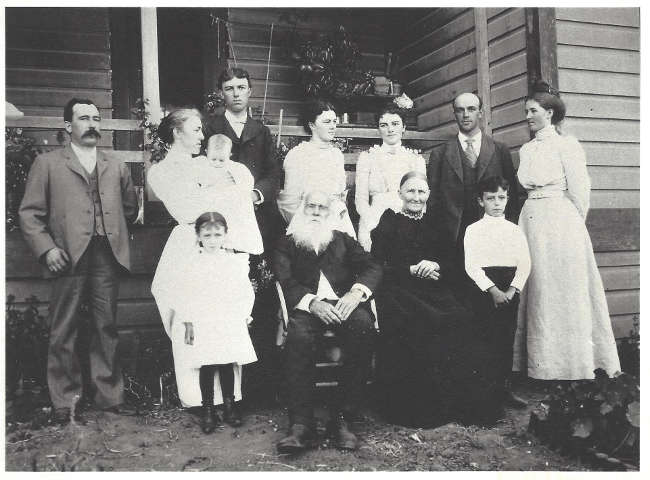
Lake County women register to vote
Limited voter registration took place soon after the election, and in November Lower Lake women had their first opportunity to vote in a “local option” election to decide if the town would be “wet” or “dry.”
California required all voters to re-register in even-numbered years, and women were asked to wait until the 1912 registration forms were ready before registering.
In January, county clerk Shafter Mathews went to Iley Lawson Hill’s home to register her, the first Lake County woman to register on the new form. At 103 she had waited a long time to register and was too frail to get out to the courthouse to register. Newspaper reports say that she registered as a Whig.
The 1912 voter’s registrations index lists the names of known Lake County suffragists like Evangeline Polk, Jennie League and Marcia Mayfield. Viola Boardman, Emma Ransdell and Hannah Millard Coffin had died before California women could vote.
In the new registration lists one can also find the names of other Lake County businesswomen and civic leaders who joined the ranks of new voters: Ida Dutcher, who owned a real estate and insurance business; Lavinia Noel, editor of the Lower Lake Bulletin; Hettie Irwin, superintendent of schools; Etta Kise Harrington a former superintendent, and Minerva Ferguson who would follow Irwin as superintendent; Harriet Lee Hammond, who donated the library building in Upper Lake; and Lottie Mendenhall and Amy Murdock who donated the land for the library.
Whether or not they were recognized as suffragists, they didn’t hesitate to register as soon as legally possible. These, and many other female voters made their marks on Lake County a century ago.
Pursuing a national suffrage constitutional amendment
Getting the vote in California was a big step forward, but passing statewide suffrage measures, as did California and a few other states, didn’t address the larger question of whether there should be a national amendment or if states should continue passing their own measures.
Suffragist organizations themselves were divided on this issue going into the 1910s. The National American Woman Suffrage Association favored the state-by-state plan. On the other hand, the National Woman’s Party, formed in 1916, posted Silent Sentinel pickets in front of the White House for two and a half years to petition for a national suffrage amendment.
Beatrice Reynolds Kinkead, born in Lake County, educated in the Bay Area, and living in New Jersey, was among a group of these Silent Sentinels arrested in July, 1917. Overall, about 2000 women joined this vigil and hundreds were arrested. In the end, it took suffragists on both sides of the question to convince legislators to bring the issue to fruition.
The Equal Suffrage Amendment finally made it to Congress where the House of Representatives and the Senate passed it in the spring of 1919. After that, thirty-six states would need to ratify it to make it part of the Constitution. California ratified the 19th Amendment in November, 1919, the eighteenth state to do so.
Again Lake County didn’t seem to notice. California women were already looking forward to their third presidential election.
State after state ratified the amendment in early 1920, but movement slowed during the spring and early summer. A month of intense politicking from pro- and anti-suffrage forces in Tennessee culminated in a close vote to ratify, making Tennessee the state that sealed the deal at long last.
An editorial in the Lake County Bee on Sept. 3, 1920: under the headline “Not All in a Day” commented that, “Woman with her vote should make haste slowly, lest in the end she makes haste not at all.
“Feminine suffrage was not achieved in a day, nor in a month, nor a year. It has required many years of ceaseless effort and countless disappointments to place her on a political equality with man.
“She cannot expect to revolutionize our political system in a day, nor in a year. To attempt such a sweeping overthrow of the customs of years would destroy her future prestige, and therefore her usefulness.
“The laudable ambition of womanhood is a better government and a more enlightened citizenry. This can be accomplished gradually, but it cannot be done with a stampede.
The tortoise travels slowly, but it gets there in the end.”
The women of Lake County didn’t make a big deal out of their new responsibility, they just got down to business.
Jan Cook is a technician for the Lake County Library who researches and writes about Lake County history.
LAKE COUNTY, Calif. – The Board of Supervisors on Tuesday unanimously approved a resolution ratifying Sheriff Brian Martin’s emergency declaration for the LNU Lightning Complex.
Martin issued the declaration on Aug. 20, when the fire – which began three days earlier – was 131,000 acres in size with no containment.
By Tuesday night, several hours after the declaration was ratified, the fire had reached 356,326 acres, with containment at 27 percent.
It has destroyed nearly 1,000 structures and killed five people, three in Napa County and two in Solano County, plus four civilian injuries, officials reported.
The sheriff said he declared the incident an emergency that also exceeded the county’s response capacity.
Martin said the fire resulted in mandatory evacuations for Jerusalem Valley, Jericho Valley and Hidden Valley Lake, with evacuation orders for other areas around Middletown and Lower Lake following later.
Altogether, Martin estimated that about 7,000 Lake County residents are impacted by the evacuation orders.
The county has opened an operations center for the fires that is running concurrently with one set up to address the COVID-19 pandemic, Martin explained. An evacuation location and temporary evacuation point also have been established.
The county requested mutual aid from out-of-county law enforcement agencies to patrol the evacuation area, and in addition to financial impacts there are air quality issues resulting from the complex, Martin said.
The supervisors approved the resolution ratifying the declaration with no additional discussion.
Separately, the board approved County Librarian Christopher Veach’s decision to close the Middletown Library on Aug. 20. It’s remained closed since then; he had asked the board if it supported that action and the supervisors said they did.
Declaration positions county for emergency funding
Emergency declarations like the one the board approved on Tuesday position the county to pursue disaster funding from state and federal officials.
It’s an action county officials have become very familiar with over the past five years, as they’ve declared numerous disasters due to previous major wildland fires, floods and the COVID-19 pandemic.
On Saturday, President Donald Trump approved Gov. Gavin Newsom’s request for a Presidential Major Disaster Declaration to bolster California’s emergency response to the wildfires burning in Lake, Napa, San Mateo, Santa Cruz, Solano, Sonoma and Yolo counties.
On the same day, members of Congress for the region including Mike Thompson and John Garamendi, who represent Lake County, announced that the Federal Emergency Management Agency had approved both Individual Assistance and Public Assistance funds for Lake, Napa, Solano, Sonoma and Yolo counties.
“This assistance will be critical to our efforts to rebuild and recover and I will continue to fight to ensure that we have all available federal resources,” Thompson said.
Garamendi said he would work with Thompson to make sure local communities get the resources they need to make “a swift and full recovery.”
FEMA approved Category B Public Assistance for Lake County, which provides assistance for “emergency work and the repair or replacement of disaster-damaged facilities.” The federal government covers 75 percent of the costs, and the state and local governments split the remaining 25 percent.
Also approved was Individual Assistance, which will be granted to individuals to help rebuild, repair and replace housing and assist with other disaster-related expenses.
To apply online visit www.disasterassistance.gov or call 1-800-621-3362. Those who have a speech disability or hearing loss and use TTY, should call 1-800-462-7585 directly; for those who use 711 or Video Relay Service (VRS), call 1-800-621-3362.
Email Elizabeth Larson atThis email address is being protected from spambots. You need JavaScript enabled to view it. . Follow her on Twitter, @ERLarson, or Lake County News, @LakeCoNews.
Martin issued the declaration on Aug. 20, when the fire – which began three days earlier – was 131,000 acres in size with no containment.
By Tuesday night, several hours after the declaration was ratified, the fire had reached 356,326 acres, with containment at 27 percent.
It has destroyed nearly 1,000 structures and killed five people, three in Napa County and two in Solano County, plus four civilian injuries, officials reported.
The sheriff said he declared the incident an emergency that also exceeded the county’s response capacity.
Martin said the fire resulted in mandatory evacuations for Jerusalem Valley, Jericho Valley and Hidden Valley Lake, with evacuation orders for other areas around Middletown and Lower Lake following later.
Altogether, Martin estimated that about 7,000 Lake County residents are impacted by the evacuation orders.
The county has opened an operations center for the fires that is running concurrently with one set up to address the COVID-19 pandemic, Martin explained. An evacuation location and temporary evacuation point also have been established.
The county requested mutual aid from out-of-county law enforcement agencies to patrol the evacuation area, and in addition to financial impacts there are air quality issues resulting from the complex, Martin said.
The supervisors approved the resolution ratifying the declaration with no additional discussion.
Separately, the board approved County Librarian Christopher Veach’s decision to close the Middletown Library on Aug. 20. It’s remained closed since then; he had asked the board if it supported that action and the supervisors said they did.
Declaration positions county for emergency funding
Emergency declarations like the one the board approved on Tuesday position the county to pursue disaster funding from state and federal officials.
It’s an action county officials have become very familiar with over the past five years, as they’ve declared numerous disasters due to previous major wildland fires, floods and the COVID-19 pandemic.
On Saturday, President Donald Trump approved Gov. Gavin Newsom’s request for a Presidential Major Disaster Declaration to bolster California’s emergency response to the wildfires burning in Lake, Napa, San Mateo, Santa Cruz, Solano, Sonoma and Yolo counties.
On the same day, members of Congress for the region including Mike Thompson and John Garamendi, who represent Lake County, announced that the Federal Emergency Management Agency had approved both Individual Assistance and Public Assistance funds for Lake, Napa, Solano, Sonoma and Yolo counties.
“This assistance will be critical to our efforts to rebuild and recover and I will continue to fight to ensure that we have all available federal resources,” Thompson said.
Garamendi said he would work with Thompson to make sure local communities get the resources they need to make “a swift and full recovery.”
FEMA approved Category B Public Assistance for Lake County, which provides assistance for “emergency work and the repair or replacement of disaster-damaged facilities.” The federal government covers 75 percent of the costs, and the state and local governments split the remaining 25 percent.
Also approved was Individual Assistance, which will be granted to individuals to help rebuild, repair and replace housing and assist with other disaster-related expenses.
To apply online visit www.disasterassistance.gov or call 1-800-621-3362. Those who have a speech disability or hearing loss and use TTY, should call 1-800-462-7585 directly; for those who use 711 or Video Relay Service (VRS), call 1-800-621-3362.
Email Elizabeth Larson at
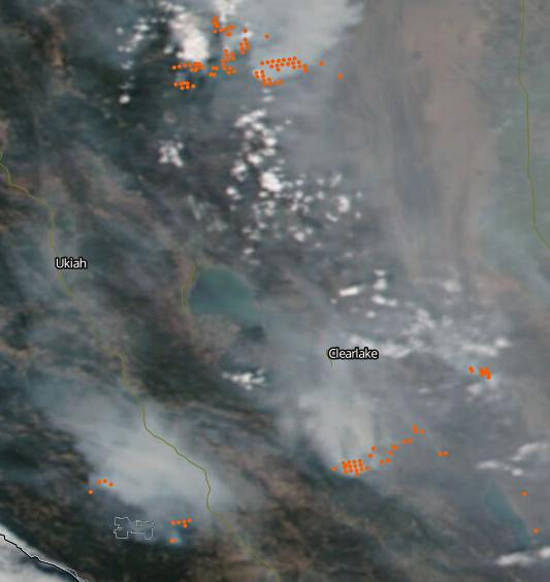
LAKE COUNTY, Calif. – An air quality alert issued by the Lake County Air Quality Management District will continue through Wednesday evening due to the impacts on the air basin from wildland fire smoke.
This week Lake County’s air basin has been heavily impacted by smoke not just from the LNU Lightning Complex – burning in southern Lake County, along with Napa, Solano, Sonoma and Yolo counties – but also from the August Complex of fires and the Hull fire in the Mendocino National Forest.
The Air Quality Management District said all areas of Lake County should be prepared for continuing periods of “unhealthy” to “hazardous” conditions through until 7 p.m. Wednesday when conditions are expected to begin to improve.
On Wednesday evening winds are expected to shift from the southwest to west-northwest, bringing cleaner air into the region. The slight change in regional wind patterns can significantly reduce the basin-wide smoke impacts, the air district said.
The district said smoke is still expected to intermittently impact the air basin until all of the regional fires are contained.
For more information on current Air Quality Index levels and particulate matter levels around the county visit the district website.
Email Elizabeth Larson at
NORTHERN CALIFORNIA – The US Forest Service reported that lightning-caused wildland fire incidents on the Upper Lake and Grindstone ranger districts in the Mendocino National Forest are now being managed together.
The August Complex has been burning since Aug. 16 on the forest’s Grindstone Ranger District in Glenn County.
The Hull fire was discovered on Aug. 19 four miles north of Lake Pillsbury on the Upper Lake Ranger District and has since prompted an evacuation warning for the Pillsbury Ranch community.
Officials said the Hull fire is now being managed as part of the August Complex.
As of Tuesday night, the fires had together burned 197,148 acres and were 17-percent contained, the Forest Service reported.
The Forest Service said the largest fire in the complex is the Doe, at 160,326 acres; followed by the Glade fire, 18,367 acres; the Tatham, 8,958 acres; and the Hull, 4,885 acres.
Forest officials said crews are continuing to utilize preexisting fuel breaks and roads to get around the southern edge of the Doe fire. Structure protection continues on the west side of the fire when fire behavior allows.
Crews working on the Hull fire are working in conjunction with crews on the Doe Fire to construct line on the southern portions of both fires, officials said.
The Forest Service said firefighters also are continuing to construct dozer lines on Tatham fire and are working with Cal Fire resources to contain the eastern flank.
On the Glade fire, crews will continue to go direct on the fires northern and western flanks, officials said.
Resources assigned to the incidents on Tuesday night included 476 firefighters and 152 overhead personnel, 37 engines, three helicopters, five bulldozers, 19 water tenders and eight crews, according to a Forest Service report.
The Forest Service said California Incident Management Team No. 15, which is overseeing the incident, will be transiting management of the August Complex to the Southern Incident Management Blue Team.
The incoming team will shadow California Incident Management Team No. 15 on Wednesday and will assume command at 7 a.m. Thursday, officials said.
Officials said light winds will cause smoke to linger over the complex the next several days. A slight chance of afternoon and evening thunderstorms along with above-normal temperatures and low relative humidity could result in increased fire behavior.
Area residents are told to expect slight improvements in air quality as the Air Quality Index remains in the range of unhealthy to unhealthy for sensitive groups.
Email Elizabeth Larson atThis email address is being protected from spambots. You need JavaScript enabled to view it. . Follow her on Twitter, @ERLarson, or Lake County News, @LakeCoNews.
The August Complex has been burning since Aug. 16 on the forest’s Grindstone Ranger District in Glenn County.
The Hull fire was discovered on Aug. 19 four miles north of Lake Pillsbury on the Upper Lake Ranger District and has since prompted an evacuation warning for the Pillsbury Ranch community.
Officials said the Hull fire is now being managed as part of the August Complex.
As of Tuesday night, the fires had together burned 197,148 acres and were 17-percent contained, the Forest Service reported.
The Forest Service said the largest fire in the complex is the Doe, at 160,326 acres; followed by the Glade fire, 18,367 acres; the Tatham, 8,958 acres; and the Hull, 4,885 acres.
Forest officials said crews are continuing to utilize preexisting fuel breaks and roads to get around the southern edge of the Doe fire. Structure protection continues on the west side of the fire when fire behavior allows.
Crews working on the Hull fire are working in conjunction with crews on the Doe Fire to construct line on the southern portions of both fires, officials said.
The Forest Service said firefighters also are continuing to construct dozer lines on Tatham fire and are working with Cal Fire resources to contain the eastern flank.
On the Glade fire, crews will continue to go direct on the fires northern and western flanks, officials said.
Resources assigned to the incidents on Tuesday night included 476 firefighters and 152 overhead personnel, 37 engines, three helicopters, five bulldozers, 19 water tenders and eight crews, according to a Forest Service report.
The Forest Service said California Incident Management Team No. 15, which is overseeing the incident, will be transiting management of the August Complex to the Southern Incident Management Blue Team.
The incoming team will shadow California Incident Management Team No. 15 on Wednesday and will assume command at 7 a.m. Thursday, officials said.
Officials said light winds will cause smoke to linger over the complex the next several days. A slight chance of afternoon and evening thunderstorms along with above-normal temperatures and low relative humidity could result in increased fire behavior.
Area residents are told to expect slight improvements in air quality as the Air Quality Index remains in the range of unhealthy to unhealthy for sensitive groups.
Email Elizabeth Larson at
LAKE COUNTY, Calif. – Firefighters were hard at work on Tuesday as the LNU Lightning Complex made runs across portions of southern Lake County.
The fire grew to 356,326 acres by Tuesday evening – increasing by approximately 3,413 acres during the course of the day – with containment remaining at 27 percent, according to Cal Fire’s report.
Cal Fire said the number of structures destroyed has risen to 978, with 256 damaged.
The Hennessey fire, on the east side of complex in Lake, Napa, Solano and Yolo counties, has burned 299,463 acres and is 29-percent contained, Cal Fire said.
On the Sonoma County side of the complex, the Walbridge fire west of Healdsburg has burned 54,503 acres and is 17-percent contained, while the Meyers fire north of Jenner remains at 2,360 acres and 97-percent containment.
The number of personnel increased by about a dozen during the day, for a total 2,207, while the number of engines decreased by nearly the same amount to 293. In addition, 66 water tenders, 11 helicopters, 18 hand crews and 56 dozers are assigned to the incident.
In recent days, the firefighting force assigned to the complex has held its growth to far smaller amounts than the tens of thousands of acres it scorched in its first days.
However, officials said the situation remains challenging.
Cal Fire said Tuesday evening that extreme fire behavior with short and long-range spotting are continuing to make firefighting efforts difficult.
On Tuesday afternoon, radio traffic indicated firefighters were busy in the Guenoc Ranch area, and Paul Duncan, a Cal Fire division chief from Cobb, reported on Facebook that the Hennessey fire had crossed a containment line in Guenoc Ranch and was moving west, with air and ground resources actively working it.
Duncan said to expect heavy ash and smoke in Hidden Valley Lake and the Ranchos.
He reported that the portion of the fire south of Middletown “is still presenting suppression challenges, moving to the north and east.”
With the fire remaining active and still continuing to grow, officials said evacuation orders and warnings for the south county remain in effect.
In his Facebook posts, Duncan said there is no estimated time yet for repopulation of the south county’s evacuated areas, adding that he understands the frustration and apologizes for the inconvenience, “but we can’t repopulate if the fireline is not secured.”
Email Elizabeth Larson at