 How to resolve AdBlock issue?
News
NORTHERN CALIFORNIA – Fires that began last week following major thunderstorms across the region continued to expand their acreage in the Mendocino National Forest on Sunday.
The August Complex on the forest’s Grindstone Ranger District in Glenn County and the Hull fire on the Upper Lake Ranger District had together burned more than 180,000 acres by Sunday night.
US Forest Service officials said the August Complex, which began 30 miles northwest of Willows on Aug. 17, originally was 37 different lightning-started fires that merged into about 20 larger fires.
It had grown by 17,745 acres to a total of 177,750 acres on Sunday, at which point it was 11 percent contained, the US Forest Service reported.
On Sunday night, the largest of those fires, the Doe, was up to 153,083 acres. The other major fires in the complex include the Glade fire, 13,888 acres; the Hopkins, 2,153 acres; the Tatham, 7,958 acres; and the Willow Basin, 601 acres.
To the west, the Hull fire grew by 500 acres to a total of 3,000 acres on Sunday evening, the Forest Service said. No containment has been reported.
Officials said the Hull fire continues to spread primarily to the southeast towards the Eel River and the 2018 Ranch fire footprint, and to the west.
The Hull fire is located five miles north of Lake Pillsbury on Hull Mountain, and it prompted the Lake County Sheriff’s Office to issue an evacuation warning for the Pillsbury Ranch community.
The Forest Service said 79 personnel are assigned to the incident.
Officials are concerned with the weather forecast for the coming days, with a red flag warning issued by the National Weather Service due to the potential for thunderstorms and high winds through Tuesday evening.
Email Elizabeth Larson atThis email address is being protected from spambots. You need JavaScript enabled to view it. . Follow her on Twitter, @ERLarson, or Lake County News, @LakeCoNews.
The August Complex on the forest’s Grindstone Ranger District in Glenn County and the Hull fire on the Upper Lake Ranger District had together burned more than 180,000 acres by Sunday night.
US Forest Service officials said the August Complex, which began 30 miles northwest of Willows on Aug. 17, originally was 37 different lightning-started fires that merged into about 20 larger fires.
It had grown by 17,745 acres to a total of 177,750 acres on Sunday, at which point it was 11 percent contained, the US Forest Service reported.
On Sunday night, the largest of those fires, the Doe, was up to 153,083 acres. The other major fires in the complex include the Glade fire, 13,888 acres; the Hopkins, 2,153 acres; the Tatham, 7,958 acres; and the Willow Basin, 601 acres.
To the west, the Hull fire grew by 500 acres to a total of 3,000 acres on Sunday evening, the Forest Service said. No containment has been reported.
Officials said the Hull fire continues to spread primarily to the southeast towards the Eel River and the 2018 Ranch fire footprint, and to the west.
The Hull fire is located five miles north of Lake Pillsbury on Hull Mountain, and it prompted the Lake County Sheriff’s Office to issue an evacuation warning for the Pillsbury Ranch community.
The Forest Service said 79 personnel are assigned to the incident.
Officials are concerned with the weather forecast for the coming days, with a red flag warning issued by the National Weather Service due to the potential for thunderstorms and high winds through Tuesday evening.
Email Elizabeth Larson at
LAKEPORT, Calif. – The recent high temperatures and unusual summer rain have created an opportunity for mosquitoes and West Nile virus to thrive.
This year, five samples of mosquitoes collected in Lake County tested positive for West Nile virus, according to the Lake County Vector Control District.
The WNV-positive mosquito samples were collected near Clearlake Oaks, Lower Lake, Middletown, and Upper Lake (2); all were Culex tarsalis (western encephalitis mosquito), Vector Control said.
“Both mosquito and West Nile virus activity increase when the overnight temperatures are 60°F or warmer,” said Jamesina Scott, Ph.D., district manager and research director of the Lake County Vector Control District. “With so many other things happening, like the fires and COVID-19, many people don’t think about mosquito-borne illnesses. Mosquitoes cannot transmit coronavirus, but they transmit West Nile virus. The best way to protect yourself is avoid mosquito bites. If you plan to be outside when mosquitoes are active, apply an effective repellent that contains Picaridin, IR3535, oil of lemon eucalyptus or DEET.”
Mosquitoes develop in water, so you can protect yourself and your family from mosquito bites and West Nile virus by dumping out standing water.
Now is a great time to take a walk around your yard and look for places that might hold water like buckets, toys, and boats and dump out any water you find.
If you have water that can’t be drained, like a pond, livestock watering trough, water feature, or an out-of-service (green) swimming pool, contact the district and staff can provide free mosquito-eating fish to prevent mosquitoes from growing there.
Lake County Vector Control District continues to provide mosquito control services to the community.
If residents need help with a mosquito problem, they are urged to call the district from 7:30 a.m. t 4 p.m. Monday through Friday, or request service online anytime at http://lcvcd.org/request-service/.
The district encourages residents to reduce their risk of contracting West Nile virus and other mosquito-borne diseases by:
– Dumping or draining standing water to prevent mosquitoes. Mosquitoes need water to complete their life cycle.
– Defending yourself. Use repellents containing DEET, Picaridin, IR3535, or Oil of Lemon Eucalyptus. Follow the label directions.
– Avoiding the outdoors when mosquitoes are present, typically dawn and dusk.
So far this year, West Nile virus activity has been detected in five mosquito samples in Lake County.
Statewide, 28 California counties have detected WNV this year, mainly in mosquitoes. As of Aug. 23, 27 human cases of West Nile virus illness have been reported in California residents this year.
Residents with questions or who would like help with a mosquito problem, including reporting a neglected pool or spa, or have an in-ground yellowjacket nest on their property that they want treated, should contact the Lake County Vector Control District at 707-263-4770 or visit their website at www.lcvcd.org.
For more information about West Nile virus, visit http://westnile.ca.gov/. Information about mosquito repellents can be found on the US Centers for Disease Control and Prevention website at http://www.cdc.gov/westnile/faq/repellent.html.
This year, five samples of mosquitoes collected in Lake County tested positive for West Nile virus, according to the Lake County Vector Control District.
The WNV-positive mosquito samples were collected near Clearlake Oaks, Lower Lake, Middletown, and Upper Lake (2); all were Culex tarsalis (western encephalitis mosquito), Vector Control said.
“Both mosquito and West Nile virus activity increase when the overnight temperatures are 60°F or warmer,” said Jamesina Scott, Ph.D., district manager and research director of the Lake County Vector Control District. “With so many other things happening, like the fires and COVID-19, many people don’t think about mosquito-borne illnesses. Mosquitoes cannot transmit coronavirus, but they transmit West Nile virus. The best way to protect yourself is avoid mosquito bites. If you plan to be outside when mosquitoes are active, apply an effective repellent that contains Picaridin, IR3535, oil of lemon eucalyptus or DEET.”
Mosquitoes develop in water, so you can protect yourself and your family from mosquito bites and West Nile virus by dumping out standing water.
Now is a great time to take a walk around your yard and look for places that might hold water like buckets, toys, and boats and dump out any water you find.
If you have water that can’t be drained, like a pond, livestock watering trough, water feature, or an out-of-service (green) swimming pool, contact the district and staff can provide free mosquito-eating fish to prevent mosquitoes from growing there.
Lake County Vector Control District continues to provide mosquito control services to the community.
If residents need help with a mosquito problem, they are urged to call the district from 7:30 a.m. t 4 p.m. Monday through Friday, or request service online anytime at http://lcvcd.org/request-service/.
The district encourages residents to reduce their risk of contracting West Nile virus and other mosquito-borne diseases by:
– Dumping or draining standing water to prevent mosquitoes. Mosquitoes need water to complete their life cycle.
– Defending yourself. Use repellents containing DEET, Picaridin, IR3535, or Oil of Lemon Eucalyptus. Follow the label directions.
– Avoiding the outdoors when mosquitoes are present, typically dawn and dusk.
So far this year, West Nile virus activity has been detected in five mosquito samples in Lake County.
Statewide, 28 California counties have detected WNV this year, mainly in mosquitoes. As of Aug. 23, 27 human cases of West Nile virus illness have been reported in California residents this year.
Residents with questions or who would like help with a mosquito problem, including reporting a neglected pool or spa, or have an in-ground yellowjacket nest on their property that they want treated, should contact the Lake County Vector Control District at 707-263-4770 or visit their website at www.lcvcd.org.
For more information about West Nile virus, visit http://westnile.ca.gov/. Information about mosquito repellents can be found on the US Centers for Disease Control and Prevention website at http://www.cdc.gov/westnile/faq/repellent.html.
LAKE COUNTY, Calif. – Cal Fire and the county of Lake will host a virtual community meeting to provide information on the LNU Lightning Complex on Monday, Aug. 24.
The meeting will begin at 6 p.m.
It will be broadcast live on Facebook and PEG TV Channel 8.
Those who wish to ask questions can participate via Zoom; meeting ID is 913 3863 4529, passcode is 094776. They also can call in with one tap mobile at +16699006833,,91338634529#,,,,,,0#,,094776#US.
Participants in the event are expected to include representatives from Cal Fire and the Lake County Sheriff’s Office, and also partnering agencies that have been crucial to Lake County’s response to this wildfire event, including representatives of the Red Cross, county health and social services agencies, Lake County Behavioral Health Services and more. They will be available to answer constituent questions. Local elected representatives will also be invited.
“This will be a virtual meeting, so we can have the very best people participate while allowing them to primarily focus on the firefighting and life-saving activities that matter most right now,” said Lake County Sheriff Brian Martin. “Our goal is to get you information you need to respond to this disaster, whether you are currently under evacuation, or concerned about how the fires may evolve in days to come.”
“We are grateful to Cal Fire and our other partners for understanding the importance of sharing information during an event like this,” said Martin. “People are facing the loss or potential loss of homes, loved ones and ways of life. That places a strain on entire communities. Our hope is this event will reach a lot of people that are connected to Lake County, and help them evaluate their next steps.”
The meeting will begin at 6 p.m.
It will be broadcast live on Facebook and PEG TV Channel 8.
Those who wish to ask questions can participate via Zoom; meeting ID is 913 3863 4529, passcode is 094776. They also can call in with one tap mobile at +16699006833,,91338634529#,,,,,,0#,,094776#US.
Participants in the event are expected to include representatives from Cal Fire and the Lake County Sheriff’s Office, and also partnering agencies that have been crucial to Lake County’s response to this wildfire event, including representatives of the Red Cross, county health and social services agencies, Lake County Behavioral Health Services and more. They will be available to answer constituent questions. Local elected representatives will also be invited.
“This will be a virtual meeting, so we can have the very best people participate while allowing them to primarily focus on the firefighting and life-saving activities that matter most right now,” said Lake County Sheriff Brian Martin. “Our goal is to get you information you need to respond to this disaster, whether you are currently under evacuation, or concerned about how the fires may evolve in days to come.”
“We are grateful to Cal Fire and our other partners for understanding the importance of sharing information during an event like this,” said Martin. “People are facing the loss or potential loss of homes, loved ones and ways of life. That places a strain on entire communities. Our hope is this event will reach a lot of people that are connected to Lake County, and help them evaluate their next steps.”
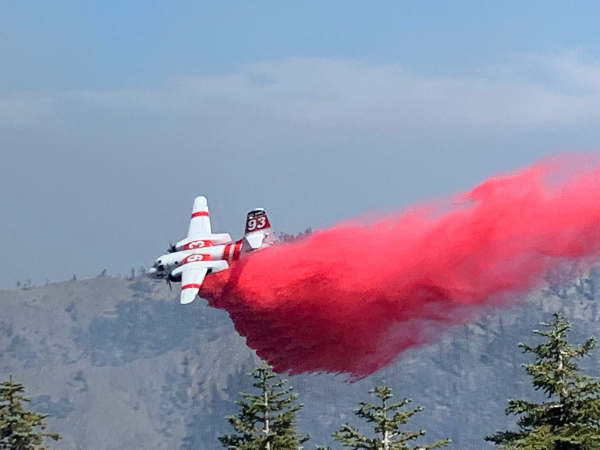
LAKE COUNTY, Calif. – A lightning-caused fire in the Mendocino National Forest has led to an evacuation warning for residents near Lake Pillsbury.
The Hull fire, located five miles north of Lake Pillsbury on the Upper Lake District of the Mendocino National Forest, is 2,500 acres and zero-percent contained, forest officials said Sunday.
The fire was detected on Wednesday after several rounds of thunderstorms occurred across the forest last week.
The Lake County Sheriff’s Office on Sunday issued an evacuation warning for Pillsbury Ranch due to the Hull fire.
The evacuation warning includes areas north of M-1, south of the Lake County line, west of Bloody Rock and east of the Lake County Line.
There are 49 personnel committed to the incident including seven engine crews, one hand crew and operations managers, the Forest Service said.
Officials said crews are challenged by steep, rugged terrain where the fire is rolling out and making uphill runs. On Saturday, air tankers assisted crews in containing a slopover on Road 38.
The fire is burning in timber on the north and east aspects of Hull Mountain and is active in Hull Creek, backing down into Rattlesnake Creek and spreading north along Panther Ridge, according to the Forest Service’s Sunday report.
The Forest Service said the fire is threatening cabins to the south and other private property may become threatened as the fire progresses northward.
Officials said smoke in the community of Potter Valley and the Pillsbury Subdivision has degraded air quality. A known sensitive air quality area is located east of the fire in the Snow Mountain Wilderness.
A red flag warning is in effect from 11 p.m. Sunday to 11 p.m. Monday in the fire area, where winds could gust as high as 40 miles per hour.
There is a road closure in effect on Forest Road M1 to Forest Road M6 on Road 18N016. In addition, the forest has an area closure in place due to the August Complex.
Closure information is available here.
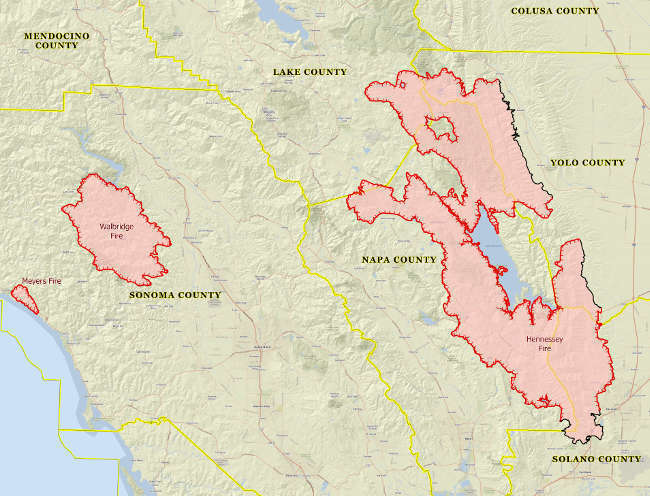
LAKE COUNTY, Calif. – Firefighters are being challenged by heat and smoky conditions as they battle the growing LNU Lightning Complex.
The fire added another 16,000 acres overnight, growing to 341,243 acres by Sunday morning. Containment edged up a few percentage points to 17 percent, Cal Fire reported.
The main fires in the incident are the Hennessey fire, burning in Lake, Napa, Solano and Yolo counties, and the Walbridge and Meyers fires in Sonoma County.
The Hennessey fire was up to 287,811 acres and 17-percent containment on Sunday morning, Cal Fire said.
Cal Fire’s Sunday mapping showed black containment line on the eastern side of the fire and the southern end that had burned into Solano County. All portions of the fire in Solano County now have containment lines around them.
The Walbridge, west of Healdsburg, has grown to 51,072 acres and the Meyers, north of Jenner, is at 2,360 acres. Cal Fires said firefighters have so far not been able to get containment on either of those fires.
The assessment of structures destroyed remained at 845 on Sunday morning, with another 231 damaged and 30,500 threatened, Cal Fire reported.
The evacuation orders and warnings for southern Lake County remain in effect because of the fire’s growing footprint to the southwest of Lower Lake and east of Hidden Valley Lake.
Shortly after 1 p.m. Sunday, radio reports on the incident indicated that heavy smoke was once again an issue, and that air operations were being suspended temporarily due to airports in the region being closed because of lack of visibility.
That’s challenging firefighters who are asking for air support in areas where there are flareups – including Berryessa Estates – and where the fire is threatening containment lines.
Resources assigned appear to have remained unchanged since Saturday evening, with 1,704 firefighters, 233 engines, 33 water tenders, 11 helicopters, 15 hand crews and 37 dozers working the incidents.
Cal Fire and local officials will hold a virtual community meeting for Lake County residents at 6 p.m. Monday, Aug. 24. The meeting will be available on Facebook, PEG TV Channel 8 and via Zoom. The meeting ID is 913 3863 4529, passcode is 094776.
Email Elizabeth Larson at
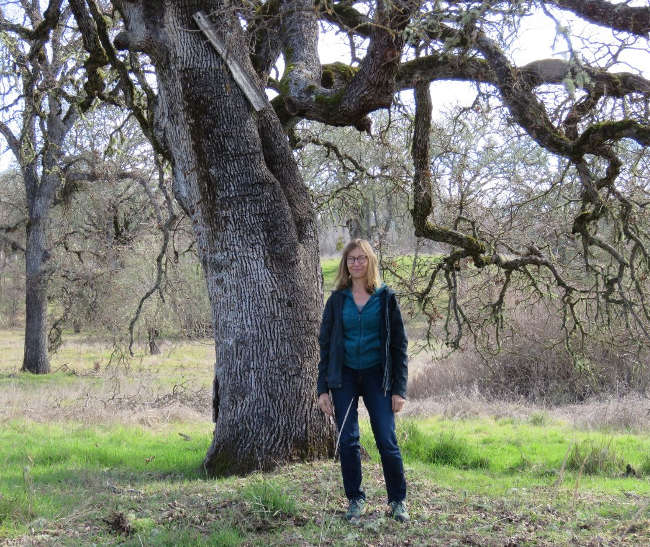
LAKE COUNTY, Calif. – Cathy Koehler doesn't allow any moss to grow under her feet, although she may have studied those plants.
She has worn many hats during her scientific endeavors: director of the McLaughlin Natural Reserve outside of Lower Lake, conducting research in both North American and International field stations, teacher of zoology and ecology, hosting public outreach events at McLaughlin Reserve, participating in K-12 science education programs and more.
According to the preface by Alexander N. Glazer in the book, “The Environmental Legacy of the UC Natural Reserve System,” University of California Press, “Because of the stewardship, dedication, and effectiveness of its staff, the reserve system has for close to half a century made it possible for students and faculty to advance public understanding of natural environments and their complex functioning."
He further states, “During the past 150 years, widespread disregard for the integrity of the natural world has resulted in a level of disruption with frightening implications for the future. In this situation, the value of the research and teaching that the Natural Reserve System (NRS) enables has become widely evident.”
The 41 reserves that are part of the UC Natural Reserve System, or NRS, system in California function as outdoor laboratories. By providing locations for research and teaching, they contribute to humanity's understanding of how the natural world works, which informs us about the needs of our species and how we humans are impacting our world.
The reserves provide the people living in nearby local communities with opportunities to engage with researchers and land stewards working to understand ecological and evolutionary principles as well as California's human histories.
Some of the nearby Northern California reserves include the Bodega Marine Reserve in Sonoma County, Hans Jenny Pygmy Forest Reserve in Mendocino County, Chickering American River Reserve in the Sierra Nevada mountains, Jepson Prairie Reserve near Davis, and the Donald and Sylvia McLaughlin Natural Reserve which straddles Lake, Napa and Yolo counties.
The McLaughlin Reserve, established in 1992 as 80 wildland acres on which scientists could conduct research within the land holdings of Homestake Mining Co.'s McLaughlin Project, expanded in 2002 to more than 7,000 acres when the mining effort ended.
The reserve is operated by the University of California, Davis, and is unique in many respects from the other reserves of the NRS in that its origins were in the vision of management team of Homestake Mining Co.'s McLaughlin Project, which operated a gold mine that employed around 200 people at the site from the 1980s to the 2000s.
Today it is producing world-class science because this is where scientists of all ilk come to study geology, ecology, archaeology and more.
Following is an interview with Cathy, via email.
Q. With all of the science that goes on at the Reserve, are there more plans for “citizen scientist” projects such as your Reserve hikes, collaborations with the community through the Middletown Art Center and the public lectures you have held out there? (Mary Ellen Hannibal's book, “Citizen Scientist – Searching for Heroes and Hope in an Age of Extinction” should have mentioned your work!)
A. I see a difference between outreach activities (to bring the science conducted at, and knowledge about, McLaughlin to the interested public) and citizen science activities. The outreach opportunities we offer continue in the form of some educational hikes and seasonal "wildflower walks," possibly lectures depending on researchers and their interest in presenting, and on occasion collaboration with other organizations like MAC.
However, citizen science opportunities would be different. Anyone interested in being a citizen scientist could attend our outreach events, but the events themselves are not offering the "science" opportunities.
Science is a process, it's "a way of knowing" (in the words of Dr. John Moore), a way of looking at and understanding the natural world." It's basically an action, which means that citizen scientists need to be engaged in activities that help us understand the natural world.
To that end, there are ways that interested folk can contribute to collecting and sorting the information that helps us understand our world, and they can participate in the activities that we engage in at the reserve to support science. So, if there are individuals out there who would like to commit to some simple or more involved activities, and become a part of advancing the scientific pursuits at the reserve, they are welcome to contact us and we'll help them identify how to become contributors in ways that are meaningful to them.
Of course, there are also ways of contributing to the reserve without committing to science … volunteers who are interested in becoming part of the function and fibre of the place in other ways are also welcome to work with us to craft a way that they can have a meaningful experience and contribution.
I have all sorts of ideas on how people can become involved with the feserve, and have meaningful input and contributions to science and conservation. It would be great to have a dedicated "volunteer" base of people who are willing to become trained contributors to the McLaughlin team and regularly come out here to do their citizen science task.
Alas, it's hard to find people who would like to be regular contributors instead of just lending a hand at one-time education or volunteer events. I'd be happy to create a real citizen science program, though, if there are individuals who are willing to invest the time and enthusiasm to be citizen scientists!
Q. Can you talk a bit about your experiences on becoming a scientist and what led to your career? For example, in the book "Lab Girl" by acclaimed scientist, Hope Jahren she discussed the mostly male scientists and the sometimes intolerant and dismissive attitudes she faced when starting her career.
A. It was fun reading "Lab Girl,” lots of things resonated with me and my experiences. But there were also differences.
For myself, coming out of high school I knew I wanted to pursue either art or biology. I chose biology, but that huge and encompassing word does not really provide much of a career framework other than outlining that you want to work with living things! I tended to want to work with animals, but not in a lab setting, so initially envisioned that vet school would be a way to have a career working with animals.
But in my third year of university, I had the good fortune to personally meet some bats which led to a fascination with them, and the opportunity to interact with them by working with a professor who studied bat ecology, and so I found myself with the opportunity to get involved in research in animal ecology.
I worked in bat research for my undergraduate thesis and my masters in science (at the University of Calgary), and thereafter started working in wildlife ecology. After a number of years working field jobs, I started a Ph.D. program. This was the first time I had a chance to formally teach science to undergraduate students as well as k-12 students and teachers.
I quickly realized that being an ambassador for science and helping people understand the ways that science allows us to understand our world was much more exciting to me than was being the person who is doing the extremely detailed experimental design and data collection that is the bedrock of science, and which is necessary in order for us to be confident in our understanding of the results of our inquiries.
So I aborted the Ph.D. pursuit and, in addition to continuing to work with other scientists on various projects, got involved in teaching science-content workshops for k-12 teachers and managing a public outreach program for a botanic garden while my husband finished his Ph.D.
We both wanted to continue working in wildlands, and having worked at research stations every year since I was 21, I could see that working in support of research at such a station would be a good use of my skills. When the opportunity to operate a research station arose, my husband and I co-applied and got the job at the McLaughlin Reserve.
You ask about a female scientist working amidst colleagues who are mostly male. Interestingly, I never felt marginalized or otherwise judged in my wanderings through the world of scientific inquiry. I was often the solo female, or one of only two or three females, in a group of mostly male colleagues (professors and graduate students), but did not reflect upon the gender distribution of these groups until it started to be pointed out to me.
I was invited to the nascent "Women in Science" outreach efforts that started to arise in the mid 1980s, but was never motivated to become involved in meetings or discussions, in part because I am not a person who gravitates toward clubs, support groups, or other gatherings based on a characteristic/distinction, and in part because I personally never felt disadvantaged or treated differently because of my gender.
I was also generally not aware of any academic inequality for females. However, I did encounter instances of male professors making sexual advances on female students, although apparently not in a quid-pro-quo way.
Alas, no sector of our modern societies seems to be immune to that, and maybe human civilization will see a slow shift away from patriarchal dominance in cultures in the next few centuries!
Q. Along with NASA scientists who have been out to the reserve studying our unique-to-this-part-of-the -world serpentinite, can you tell us about a couple of other unique studies that have taken place out there?
A. Well, I wouldn't say that serpentinite is unique to this part of the world. It is globally rare, and limited to continental edges where oceanic plates have subducted. Maine and Vermont, in fact, have serpentinites evidencing an ancient and long-defunct subduction zone on the east coast.
As for the work with the NASA scientists, Dawn Cardace moved on to a faculty position after her postdoc at NASA, and through collaborations driven by her and her NASA colleagues the work at McLaughlin has grown into a collaborative with investigators from numerous universities across the country.
What was unique about the location, here at McLaughlin, is that you had not only extensive and accessible serpentinites, but they were located within a research station.
The value of research stations to scientific inquiry is huge: it is very risky setting up experiments in areas that could be disturbed (incidentally or intentionally) by recreation or development, so what could be better than the availability of a location that is designated for research and teaching and has the attributes that are needed for your research?
All sorts of interesting studies have taken place here. Because the landscape in our region is very complex, with the jumble of geologic substrates supporting a jumble of different plant communities (and therefore our region comprises a globally notable area of high biodiversity), it lends itself well to scientific investigations that seek to understand about how plants adapt to challenging soil and climate conditions.
In the last decade there have also been several studies investigating how different plant communities might respond to climate change.
Because the reserve is also a location where land stewardship is maintaining native grassland and wildflower prairies, the year-round flowering of native plants (exemplified in the spring by tremendous wildflower blooms) support healthy populations of native pollinators, along with quite a few research projects that study those pollinators.
Q. What are you and other scientists studying at the reserve in relation to the effects climate change is having on our county and California?
A. Not a huge talking point for McLaughlin. McLaughlin is not a site that lends itself well to nailing down the effects of climate change. It is not on the coast, and it is not alpine (two ecosystems that are more likely to exhibit blatant manifestations of ecological responses to directional shifts in climate).
And the Mediterranean region of California is notable for how variable the climate is from year to year; it is normal for the Mediterranean region of California to have years of abundant rainfall, and years of very little rain, and everything in between.
Ecological studies on the effects of climate change produce clear results more-so in locations that are less variable because then the researcher can introduce variability (in temperature and precipitation) that exposes plants and animals to more unique conditions.
That's why we mostly hear about climate change research that is being conducted in coastal areas, in the Colorado mountains, in arctic regions.
That being said, the reserve has been host to research that sheds some light on ecological responses to climate change. A long-term data set, from research that initially intended to record shifts in plant species abundance and diversity in association with the normal year by year climatic variability, has revealed unanticipated shifts in plant community composition over a couple of decades in association with directional shifts in weather patterns associated with global warming.
Long-term data sets are rare .... so many research projects only last a few years which makes it hard to study the effects of variation in a highly variable environment! So it's great when a good long-term data set exists, and allows people to look back in time to pick out patterns that were not initially intended to be studied.
That data set has allowed for the development of meaningful experiments that can manipulate the plant community and the weather patterns to further investigate the plant community shifts that have been observed in the past couple of decades.
Q. As a former educator, what would you recommend that children, girls, in particular, study or get involved in to further their budding science interests?
A. We know children are naturally curious. I think most of them have budding science interests, which start by just watching the world around them. Let’s spend more time getting kids outdoors and interacting with nature.
Patient observation generates questions (why are those ants all on the branches of that shrub species, but not the other one? Why does this one kind of plant have small leaves here, but big leaves over there? Look at how hard it is for that bug to walk along a leaf that is hairy compared to a smooth leaf! Does that mean the smooth leaf is easier for bugs to eat? Why do I find mammal poop on top of rocks, and whose poop is it?).
And those questions become the building blocks of investigation and critical thinking. So, let's spend more time in the best classroom of all .... nature. And let's encourage kids who are energized by poking around and looking at nature to try to answer some of their questions.
And, if scientists are nearby, kids should be encouraged to hang out with them (and the scientists should be receptive to having kids hanging out!).
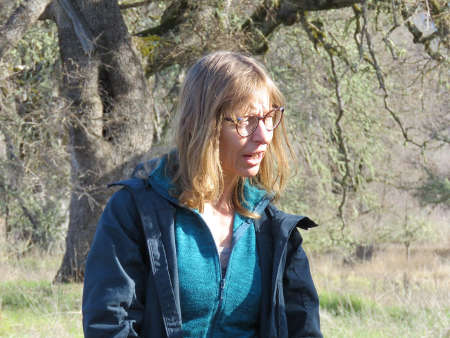
Q. Is the reserve still promoting and involved in science for our local schools? I am thinking in particular of the Science and History Day at Ely, the Lake County Geology tour, etc.
A. Not as much as when Paul and I first got here, but yes we still are. I have teachers contact me to craft a field trip for their classes, or to have me come to their classroom. Also, there is an annual program being implemented by UC Davis graduate students that brings locally-relevant ecology to students in Lower Lake Elementary school and culminates with a field trip to McLaughlin.
If you want to mention opportunities for k-12 education at McLaughlin, the best way to phrase it would probably be to tell teachers to reach out to me if they are interested in a field trip or having me come into their classroom.
Q. Since McLaughlin ended their mining operations and began restoring the lands, how is that going?
A. Homestake Mining Co. continues working on reclamation and remediation on the lands that were impacted by their mining operation (which is only about 10 percent of the lands of the McLaughlin Reserve).
It's a long-term job for them, and although I am aware of the challenges and their work, I'm not really the one to properly represent them. But the partnership of the reserve being operated in the natural lands alongside the continued reclamation work of Homestake in the mine-impacted areas is coming along fine.
Q. Does Paul Aigner, stewardship director, have similar duties to yours on the reserve?
A. Paul oversees land management and all the associated record-keeping and paperwork. I do a lot of the physical work of the land management alongside him, but I also oversee and coordinate all other aspects of the reserve (facilities maintenance, research and teaching use, finances, etc). So, no, he does not really have similar duties to myself.
We used to be co-directors, but a few years ago we worked with campus administrators to better delineate the needs of the reserve, and defined the Stewardship Director position to institutionalize the importance of land management work to supporting the research and teaching potential of the reserve.
Thank you very much, Cathy.
Kathleen Scavone, M.A., is a retired educator, potter, freelance writer and author of “Anderson Marsh State Historic Park: A Walking History, Prehistory, Flora, and Fauna Tour of a California State Park” and “Native Americans of Lake County.”