 How to resolve AdBlock issue?
News
Lara said the partnership includes the California Department of Insurance and Gov. Gavin Newsom’s administration, including the Governor’s Office of Emergency Services, the California Department of Forestry and Fire Protection, the Governor’s Office of Planning and Research and the California Public Utilities Commission.
“Hardening” refers to measures that prepare homes and communities to better survive a wildfire, such as building upgrades, defensible space and fire-resistant landscaping.
While California has existing wildfire building standards for new development as established by Cal Fire, this new partnership consisting of state wildfire, catastrophe and insurance experts will establish standards that are consistent, based in fire science, and apply to retrofits for older existing homes in order to help them seek and maintain insurance coverage, thus giving policyholders and insurance companies a shared strategy for reducing wildfire risks.
“With home and community hardening standards in place, Californians can hope to save lives and property through safer homes and increase insurance availability at the same time,” said Commissioner Lara. “Our insurance market is responding to higher wildfire risk, so safeguarding homes will assist consumers in finding and keeping their insurance. I look forward to working with Gov. Newsom and his administration on this critical mitigation effort to protect homes and communities from wildfire loss.”
“Climate change is a major contributor to the increased severity and frequency of California wildfires, and to the resulting unprecedented loss of life and property in recent years,” said Kate Gordon, director of the Governor’s Office of Planning and Research and the Governor’s Senior Policy Advisor on Climate. “Unless we take coordinated action now, these impacts will only worsen – especially in our most vulnerable communities. Identifying consistent statewide standards for home and community hardening is critical to California’s goal of reducing wildfire risk while increasing our overall resilience.”
“Development of a statewide retrofitting program that can reduce insurance loss is an important step in ensuring communities are hardened against the devastating effect of wildfire,” said State Fire Marshal Chief Mike Richwine. “Taking the necessary measures to prepare your home can help increase its chance of survival when wildfire strikes.”
“As our state continues to grapple with catastrophic wildfires, it is important that we take proactive steps to prepare and protect our communities,” said Mark Ghilarducci, director of the California Governor’s Office of Emergency Services. “We look forward to working with Commissioner Lara and our partners to collaboratively strengthen California’s preparedness and mitigation efforts.”
“The CPUC welcomes this collaboration with our sister agencies on this very important issue,” said CPUC President Marybel Batjer. “We each play an important and distinct role in wildfire mitigation, community resilience, and recovery, and our work together will help ensure that Californians are aware of efforts at the state level, the assistance that is available to them, and ways they can help reduce risk.”
This partnership is the latest step to enact regulatory and administrative actions that Commissioner Lara announced on Sept. 16, 2020, using his existing regulatory authority under voter-approved Proposition 103 to protect the state’s insurance market.
Commissioner Lara held hearings on Oct. 19 and Dec. 10, 2020, to gather public input into fire mitigation and other steps to address the availability and affordability of insurance due to wildfires. Watch video of those hearings and learn more at www.insurance.ca.gov.
Last year, Gov. Newsom signed legislation to increase consumer protections for wildfire survivors, including Senate Bill 872 authored by state Sen. Bill Dodd and sponsored by Commissioner Lara, among other measures.
In his signing message for SB 872 and Assembly Bill 3012, Gov. Newsom stated that “we must do more” and directed the Governor’s Office of Planning and Research, CalOES, and Cal Fire to “work with the Insurance Commissioner to evaluate and recommend ways that residents, communities and the insurance industry can work together to better mitigate wildfire risks. This work should inform the development of solutions for residents in wildfire-prone areas who continue to face the threat of policy non-renewal and rising premium costs for those policies that are available.”
This partnership is in furtherance of the governor’s signing message and to help protect residents from the increasing risk of wildfires and stabilize the insurance market.
Dodd – who formerly represented Lake County in the state Assembly and now serves all or portions of Napa, Solano, Yolo, Sonoma, Contra Costa and Sacramento counties in the California Senate – on Monday lauded the creation of the new statewide plan for home and community hardening.
“I want to thank Gov. Newsom and Commissioner Lara for following through for people who’ve endured tremendous hardship over the past several years of devastating wildfires,” Sen. Dodd said. “This has been a high priority for me and I appreciate their collaborative approach. We must deliver for Californians who deserve accessible and affordable insurance.”
The partnering agencies and departments will begin meeting this month.

Since December, the California Department of Fish and Wildlife and wildlife rehabilitation centers have been inundated with calls from residents who are finding sick or dead finches at bird feeders.
Most reports have come from locations on California’s Central Coast, the San Francisco Bay Area and Sierra Nevada communities.
CDFW’s Wildlife Investigations Laboratory has evaluated birds from several locations and determined the cause of illness to be salmonellosis, a disease caused by salmonella bacteria.
Pine siskins, a species of finch that winters in California, are the primary species affected by the outbreak. The disease has also been reported in smaller numbers of lesser goldfinches and American goldfinches.
“Salmonellosis occurs periodically in pine siskins in some winters throughout their range. When large numbers of pine siskins congregate, the disease can spread rapidly causing high mortality. Most birds die within 24 hours of infection,” said CDFW Senior Environmental Scientist Krysta Rogers, an avian disease specialist.
Birds become infected with salmonella when they ingest food, water or come into contact with objects – such as bird feeders, perches soil – contaminated with feces from an infected bird.
Sick birds often appear weak, have labored breathing, and may sit for prolonged periods with fluffed or ruffled feathers.
Salmonellosis is almost exclusively reported from locations with bird feeders where birds congregate.
Residents can help reduce disease transmission by removing bird feeders and bird baths. Allowing birds to feed on natural seeds rather than at bird feeders reduces contact between birds and helps slow spread of the disease.
Residents can report dead birds to CDFW’s Wildlife Investigations Laboratory using the mortality reporting form, which helps biologists monitor the outbreak.
Disposable gloves should be worn and hands should be thoroughly washed after disposing of dead birds, and handling of bird feeders and bird baths.
If sick birds are found, please contact your local wildlife rehabilitation center for advice.
The meeting will begin at 9 a.m. Tuesday, Feb. 9, and will be available to the public virtually only.
The meeting can be watched live on Channel 8, online at https://countyoflake.legistar.com/Calendar.aspx and on the county’s Facebook page. Accompanying board documents, the agenda and archived board meeting videos also are available at that link.
To participate in real-time, join the Zoom meeting by clicking this link at 9 a.m. The meeting ID is 968 6101 7739, password 659362. The meeting also can be accessed via on tap mobile at +16699006833,,96861017739#,,,,*659362# US (San Jose).
All interested members of the public that do not have internet access or a Mediacom cable subscription are encouraged to call 669-900-6833, and enter the Zoom meeting ID and passcode information above.
Chromebook devices are also available at the Lakeport and Clearlake Library branches, which will open early on Tuesday. Chromebooks can be checked out for three hours for use on the library premises and contactless pickup is available. The Lakeport Library Branch can be reached at 707-263-8817, and Clearlake at 707-994-5115.
WiFi is accessible in the parking lot of each County Library Branch, so residents can park at these locations to use WiFi on borrowed or personal devices, by connecting to the “Lake County Library” network (no password) anytime from 7a.m. to 8 p.m.
To submit a written comment on any agenda item please visit https://countyoflake.legistar.com/Calendar.aspx and click on the eComment feature linked to the meeting date. If a comment is submitted after the meeting begins, it may not be read during the meeting but will become a part of the record.
On Tuesday, the board will consider a resolution accepting a 620-acre bequest to the county from the John T. Klaus 1994 Trust for the creation of a park along East Highway 20 in Clearlake Oaks.
The proposal was first taken to the board in July, as Lake County News has reported.
The trust also includes dedicated financial resources. Public Services Director Lars Ewing’s July report to the board said the trustee had reported assets including bank accounts totaling approximately $1.5 million, appraisal values of properties owned by the trust and not yet sold amounting to approximately $650,000, and recurring annual lease income of approximately $127,000 from a property in Livermore that has been leased to an oil change business for more than 20 years.
Conditions on the donation include naming the park “John T. Klaus Park,” with one-third of the land on the rear of the property to be reserved as a refuge for wildlife and the rest of the park to be developed for sporting and athletic activities for youth.
In other business, the board will review a resolution from last month authorizing temporary reduction of in-person services to the public due to COVID-19 pandemic conditions and also will review its temporary closure of the Board of Supervisors chambers for in-person meetings.
Also on Tuesday, the board will get its weekly update from Public Health Officer Dr. Gary Pace at 9:06 a.m.
The full meeting follows.
CONSENT AGENDA
5.1: Approve letter of opposition to SB 55 and authorize the chair to sign.
5.2: Consideration of amendment to the County of Lake Covid-19 Public Health Emergency Worksite Protocol.
5.3: (a) Waive the formal bidding process, pursuant to Lake County Code Section 38.2, as it is not in the public interest due to the unique nature of goods or services; and (b) approve the agreement between the county of Lake and Redwood Community Services Inc. for the Lake County WRAP Program, Foster Care Program, and Intensive Services Foster Care Program for Specialty Mental Health Services for Fiscal Year 2020-21 for coverage of services provided during Fiscal Year 2019-20 for a contract maximum of $44,623.66 and authorize the board chair to sign the agreement.
5.4: Approve minutes of the Board of Supervisors meeting Jan. 5, 2021.
5.5: Approve the continuation of a local health emergency related to the 2019 Coronavirus (COVID-19) as proclaimed by the Lake County Public Health officer.
5.6: Approve the continuation of resolution ratifying the declaration of local health emergency and order prohibiting the endangerment of the community through the unsafe removal, transport, and disposal of fire debris for the LNU Complex wildfire.
5.7: Approve the continuation of a local emergency due to the Mendocino Complex Fire incident (River and Ranch fires)
5.8: Approve the continuation of a local emergency due to the Pawnee Fire incident.
5.9: Approve the continuation of a local emergency due to COVID-19.
5.10: Approve the continuation of a local emergency in Lake County in response to the LNU Lightning Complex wildfire event.
5.11: Approve an agreement between the county of Lake and Califa for the provision, installation and maintenance of advanced network (data) services, for the period from July 1, 2021, until June 30, 2022, for an amount not to exceed $50,000 annually; and authorize the chair to sign.
5.12: Approve contract between county of Lake and Lake County Office of Education for community based child abuse prevention services from July 1, 2020, to June 30, 2024, and authorize the chair to sign.
5.13: Approve contract between the county of Lake and Lake Family Resource Center for Cal-Learn services in the amount of $50,000 from July 1, 2020, to June 30, 2021, and authorize the chair to sign.
TIMED ITEMS
6.2, 9:06 a.m.: Consideration of update on COVID-19.
6.3, 10 a.m.: Consideration of (a) resolution amending Resolution No. 2020-133 to amend the FY 2020-21 Adopted Budget by Adjusting Reserves, Fund Balance Carry Over, Revenues, and Appropriations; and (b) Resolution Amending Resolution 2020-134 to Amend the Position Allocations for FY 2020-21 to conform to the mid-year budget adjustments.
UNTIMED ITEMS
7.2: Review of Resolution No. 2021-11 authorizing temporary reduction of in-person delivery of county services to the public due to COVID-19 pandemic conditions.
7.3: Reconsideration of temporary closure of the Board of Supervisors chambers for in-person meetings.
7.4: Consideration of the following advisory board appointments: Fish and Wildlife Advisory Committee.
7.5: Consideration of resolution accepting bequest of real property and funds from The John T. Klaus 1994 Trust to the county of Lake.
7.6: Consideration of an Ordinance Amending Chapter 25 – Floodplain Management of the Lake County Code.
7.7: Consideration of Change Order No. Two for Clayton Creek Road at Clayton Creek Bridge Replacement Project, Federal Project No. BRLO-5914(077); Bid No. 20-10.
7.8: Consideration of agreement between the county of Lake and the California State Franchise Tax Board for FY 2020-2023; and authorize the Treasurer-Tax Collector to sign.
CLOSED SESSION
8.1: Conference with legal counsel: Existing litigation pursuant to Gov. Code sec. 54956.9(d)(1): Center for Biological Diversity v. County of Lake, et al.
8.2: Conference with legal counsel: Existing Litigation pursuant to Gov. Code sec. 54956.9(d)(1): California Native Plant Society v. County of Lake, et al.
Email Elizabeth Larson at
The commission will meet via webinar beginning at 5:30 p.m. Wednesday, Feb. 10.
The agenda is available here.
To speak on an agenda item, access the meeting remotely here; the meeting ID is 986 6166 5155.
Comments can be submitted by email to
Please indicate in the email subject line "for public comment" and list the item number of the agenda item that is the topic of the comment. Comments that read to the council will be subject to the three minute time limitation (approximately 350 words). Written comments that are only to be provided to the council and not read at the meeting will be distributed to the council prior to the meeting.
On the agenda is a presentation to Ken Wicks Jr., who served for several years on the commission. His term ended in December.
Also on Tuesday, Community Development Director Jenni Byers will have a discussion with the commission regarding the Planning Department and planning commission’s goals and work program.
Planning division goals include update the housing element, the general plan’s safety and conservation elements, submittal of Community Development Block Grant applications, completion of the Citywide General Plan Amendment and Zone Change inconsistency mapping review started in 2017, implementation of the Lakeport Lakefront Revitalization Plan recommendations, completion of a general plan annual progress report and right-of-way improvements, among other items on a lengthy list in her report.
Email Elizabeth Larson at
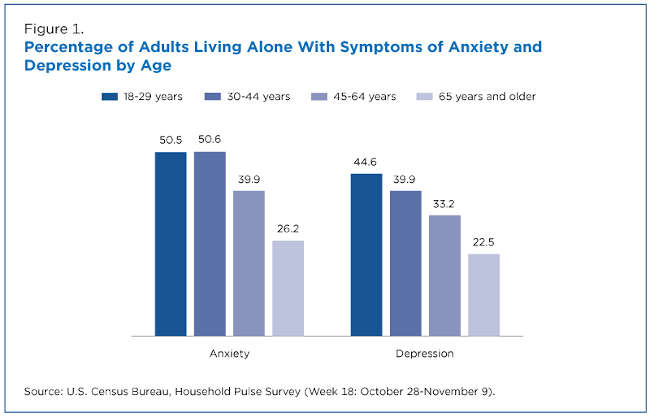
Younger adults living alone were more likely than older adults living alone to report symptoms of both anxiety and depression in recent weeks, according to new U.S. Census Bureau data.
The Household Pulse Survey provides insight into the mental health and well-being of adults living alone during the Coronavirus pandemic. The survey asks two questions related to symptoms of anxiety, and two questions about symptoms of depression.
Phase 3 of the survey collects data over two-week intervals, and this article relies on publicly available data collected from Oct. 28 through Nov. 9, a time period in which the Census Bureau sent invitations to 1,035,752 households and received a total of 58,729 responses.
Among adults living alone, respondents age 65 and over reported lower rates of anxiety and depression than those in other age groups (Figure 1).
Those between ages 18 and 29 and 30 and 44 reported higher rates of anxiety and depression. The age groups were not statistically different from each other on either measure.
Respondents in the 45-64 age group reported symptoms of both anxiety and depression at rates that fell between those of the youngest and oldest respondents.
Financial stress
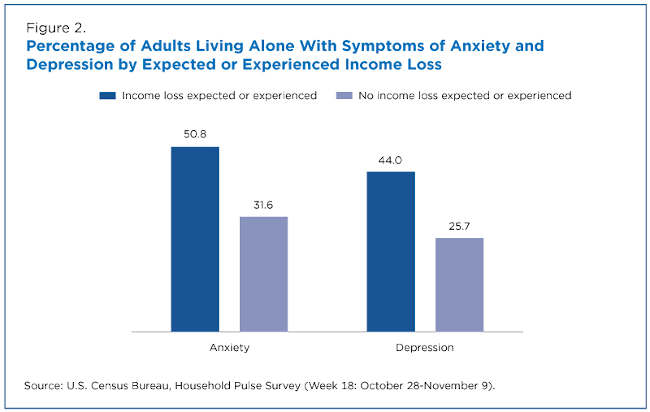
Economic disruptions such as a loss of income had an impact on the mental health of those living alone, as did the expectation of losing employment income in the next four weeks (Figure 2).
About half (51%) of individuals living alone who either lost or expected to lose employment income reported anxiety, compared with only about a third (32%) of those who had not experienced or expected the same type of economic disruption.
Similarly, about 44% of those who had experienced or expected lost income reported symptoms of depression, compared with about 26% of those who had not experienced or expected economic disruption.
Does health matter?
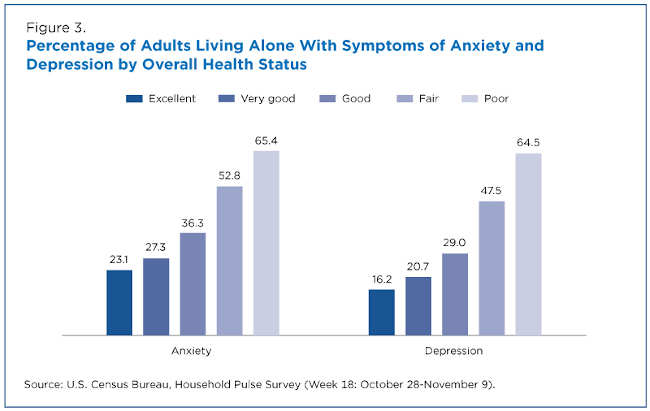
Adults living alone who reported excellent overall health had lower rates of both anxiety and depression: Only 23% reported symptoms of anxiety and 16% reported symptoms of depression (Figure 3).
On the other hand, among adults living alone who reported being in poor health, about two thirds reported symptoms of anxiety and depression (around 65% and not statistically different from each other on both measures).
It is important to emphasize that these questions and analysis do not capture causality. In other words, we do not know whether the mental health of those in good overall health was bolstered because of that good health, or whether poor mental health caused people to report lower levels of overall health.
It is likely that both are true: mental health influences overall health and vice versa.
Households with children
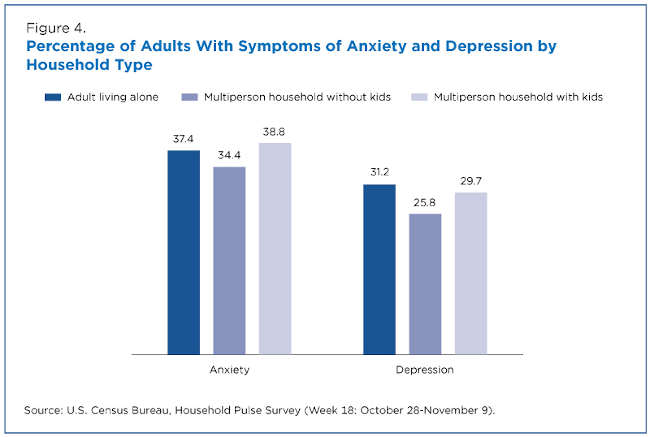
Overall, about 36% of all adults reported feeling anxiety in the previous week. Adults living alone and those in households with children were slightly more likely to report feeling anxious (about 38% each) than adults living in households without children (34%).
Meanwhile, about 28% of all households reported feeling depressed over the previous week.
When analyzed by specific household type, about 30% of those living alone and those in households with kids reported symptoms of depression, compared to about 26% of adults in households with other adults but without children (Figure 4).
We examined differences in mental health by racial and ethnic groups for those living alone but the results were generally inconclusive and are therefore not included here.
The Household Pulse Survey asks four questions about mental health over the previous seven days, two relating to symptoms of anxiety and two relating to symptoms of depression.
These questions are collected in partnership with the National Center for Health Statistics (NCHS). This analysis follows an approach outlined by NCHS, which categorizes individuals based on how frequently they reported feeling anxious or depressed, consistent with diagnoses of generalized anxiety disorder or major depressive disorder.
Household Pulse Survey data include Household Pulse Survey tables, Technical Documentation and Public Use File, or PUF, microdata.
Thom File is a sociologist in the Census Bureau’s Social, Economic, and Housing Statistics Division. Matthew Marlay is a sociologist and demographer in the Census Bureau’s Social, Economic, and Housing Statistics Division.

The SARS-CoV-2 virus mutates fast. That’s a concern because these more transmissible variants of SARS-CoV-2 are now present in the U.S., U.K. and South Africa and other countries, and many people are wondering whether the current vaccines will protect the recipients from the virus. Furthermore, many question whether we will we be able to keep ahead of future variants of SARS-CoV-2, which will certainly arise.
In my laboratory I study the molecular structure of RNA viruses – like the one that causes COVID-19 – and how they replicate and multiply in the host. As the virus infects more people and the pandemic spreads, SARS-CoV-2 continues to evolve. This process of evolution is constant and it allows the virus to sample its environment and select changes that make it grow more efficiently. Thus, it is important to monitor viruses for such new mutations that could make them more deadly, more transmissible or both.

RNA viruses evolve quickly
The genetic material of all viruses is encoded in either DNA or RNA; one interesting feature of RNA viruses is that they change much more rapidly than DNA viruses. Every time they make a copy of their genes they make one or a few mistakes. This is expected to occur many times within the body of an individual who is infected with COVID-19.
One might think that making a mistake in your genetic information is bad – after all, that’s the basis for genetic diseases in humans. For an RNA virus, a single change in its genome may render it “dead.” That’s not too bad if inside an infected human cell you’re making thousands of copies and a few are no longer useful.
However, some genomes may pick up a change that is beneficial for the survival of the virus: Maybe the change allows the virus to evade an antibody – a protein that the immune system produces to catch viruses – or an antiviral drug. Another beneficial change may allow the virus to infect a different type of cell or even a different species of animal. This is likely the pathway that allowed SARS-CoV-2 to move from bats into humans.
Any change that gives the virus’s descendants a competitive growth advantage will be favored – “selected” – and begin to outgrow the original parent virus. SARS-CoV-2 is demonstrating this feature now with new variants arising that have enhanced growth properties. Understanding the nature of these changes in the genome will provide scientists with guidance to develop countermeasures. This is the classic cat-and-mouse scenario.
In an infected patient there are hundreds of millions of individual virus particles. If you were to go in and pick out one virus at a time in this patient, you would find a range of mutations or variants in the mix. It’s a question of which ones have a growth advantage – that is, which ones can evolve because they are better than the original virus. Those are the ones that are going to become successful during the pandemic.
Of the mutations that have been detected, is one of particular concern?
Any single variant or change in the virus is probably not that problematic. A single change in the spike protein – which is the region of the virus that attaches to human cells – is probably not going to be a big threat as the medical community rolls out the vaccines.
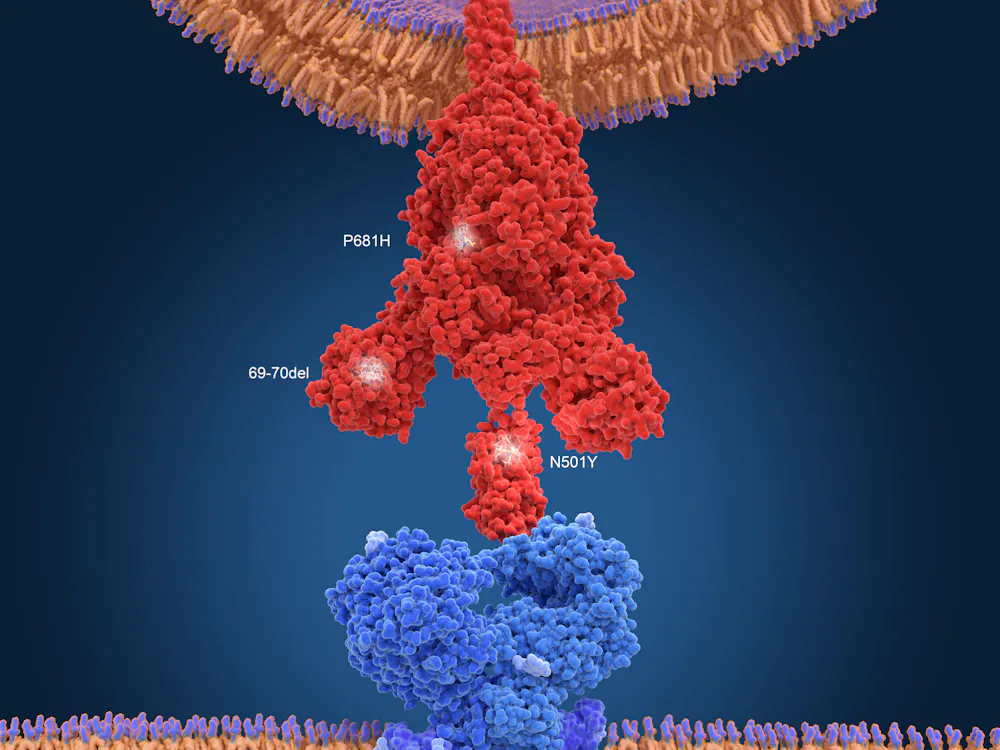
The current vaccines induce the immune system to produce antibodies that recognize and target the spike protein on the virus, which is essential for invading human cells. Scientists have observed the accumulation of multiple changes in the spike protein in the South African variant.
These changes allows SARS-CoV-2, for example, to attach more tightly to the ACE2 receptor and enter human cells more efficiently, according to preliminary unpublished studies. Those alterations could enable the virus to infect cells more easily and enhance its transmissibility. With multiple changes in the spike protein, the vaccines may no longer produce a strong immune response against these new variant viruses. That’s a double whammy: a less effective vaccine and a more robust virus.
Right now, the public doesn’t need to be concerned about the current vaccines. The leading vaccine manufacturers are monitoring how well their vaccines control these new variants and are ready to tweak the vaccine design to ensure that they will protect against these emerging variants. Moderna, for example, has stated that it will adjust the second or booster injection to more closely match the sequence of the South African variant. We’ll have to just wait and see, as more people receive vaccinations, whether the transmission rates will drop.
Why is lowering transmission key?
A drop in transmission rates means fewer infections. Less virus replication leads to fewer opportunities for the virus to evolve in humans. With less opportunity to mutate, the evolution of the virus slows and there is a lower risk of new variants.
The medical community needs to make a big push and get as many people vaccinated and thus protected as possible. If not, the virus will continue to grow in large numbers of people and produce new variants.
How the new variants are different
The U.K. variant, known as B.1.1.7., seems to bind more tightly to the protein receptor called ACE2, which is on the surface of human cells.
I don’t think we’ve seen clear evidence that these viruses are more pathogenic, which means more deadly. But they may be transmitted faster or more efficiently. That means that more people will be infected, which translates into more people who will be hospitalized.
[Deep knowledge, daily. Sign up for The Conversation’s newsletter.]
The South African variant, known as 501.V2, has multiple mutations in the gene that encodes the spike protein. These mutations help the virus evade an antibody response.
Antibodies have exquisite precision for their target, and if the target changes shape slightly, as with this variant – which virologists call an escape mutant – the antibody can no longer bind tightly, as it loses its power to protect.
Why do we need to monitor for mutations?
We want to make sure that the diagnostic tests are detecting all of the viruses. If there are mutations in the virus’s genetic material, an antibody or PCR test may not be able to detect it as efficiently or at all.
To be sure that the vaccine is going to be effective, researchers need to know if the virus is evolving and escaping the antibodies that were triggered via the vaccine.
Another reason that monitoring for new variants is important is that people who’ve been infected might be infected again if the virus has mutated and their immune system can’t recognize it and shut it down.
The best way to look for emerging variants in the population is to do random sequencing of the SARS-CoV-2 viruses from patient samples across diverse genetic backgrounds and geographical locations.
The more sequencing data researchers collect, the better vaccine developers will be able to respond in advance of major changes in the virus population. Many research centers around the U.S. and the world are ramping up their sequencing capabilities to accomplish this.
Richard Kuhn, Professor of Biological Sciences, Purdue University
This article is republished from The Conversation under a Creative Commons license. Read the original article.