 How to resolve AdBlock issue?
News

Although there are fewer cars on America’s roads since the pandemic began, the number of fatal car crashes has increased.
Early nationwide data supports this counterintuitive finding: Although daily trips from households fell by as much as 35% in 2020, preliminary traffic fatality count data for the first nine months of 2020 shows 28,190 people died in motor vehicle traffic crashes - a 4.6% increase compared with the same period in 2019. The same trend has been reported in countries outside the U.S., such as Australia, where less traffic has not produced fewer road deaths.
Curious about traffic crashes during the pandemic, we decided to use our skills as a social scientist and a research engineer who study vehicle crash data to see what we could learn about Connecticut’s traffic deaths when the stay-at-home orders first went into place last March.
A partnership between the Department of Transportation, local hospitals and the University of Connecticut discovered what many people intuitively knew: Traffic volume and multivehicle crashes fell significantly during the stay-at-home order. Statewide, daily vehicle traffic fell by 43% during the stay-at-home order compared to earlier in the year, while mean daily counts of multivehicle crashes decreased from 209 before the stay-at-home order to 80 during lockdown.
What was unexpected, however, was the significant increase in single-vehicle crashes, especially fatal ones. During the stay-at-home period, the incidence rate of fatal single-vehicle crashes increased 4.1 times, while the rate of total single-vehicle crashes was also up significantly.
Data about all crash types in the state, whether single- or multivehicle, tell a similar story. Although preliminary, police reports have placed the 2020 year-end total for traffic deaths at 308, a 24% increase from 2019.
It is unclear exactly why this is happening, but we are using data to investigate a few theories.
Data show that drivers are more likely to be speeding. Although traffic volume on Route 15 and Interstate 95 in Connecticut fell 52% in April 2020, the number of vehicles going more than 80 mph increased by 94%. Other states are seeing the same trends.
Drivers also appear to be very distracted. Data collected by Zendrive, a company that tracks smartphone data to predict drivers’ behavior, shows that in 57% of crashes nationwide in 2020, drivers were on their phones. From January (pre-lockdown) to March 2020, drivers in crashes spent 7% more time on their phones; when that data collection was extended to November, drivers checked their phones 17% more often. These trends are also holding up in other countries.
American drivers are also being riskier on the road: According to the National Highway Traffic Safety Administration, the percentage of injured road users – drivers, pedestrians, bicyclists – with alcohol, marijuana or opioids in their system all increased during the pandemic.
Any death during COVID-19 – whether it’s the direct result of the virus or its indirect effects on daily life – is a tragedy. Yet there are ways to keep drivers safe during this tumultuous period.
Check your speed
Fewer drivers does not make speeding less dangerous. In 2010, more than one-third of fatal crashes took place on local rural roads that tend to have relatively few cars – and nearly one-third of those crashes involved speeding.
In normal conditions, drivers often “go with the flow” of traffic, matching the speed of other cars. Without other cars around, it may be easy to unconsciously go much faster. Frequent speedometer checks can help combat this.
Setting cruise control to the speed limit – or, at most, five mph above – will lock in your speed and save you from having to check the speedometer.
Don’t drive angry
In addition, if you’re upset, try to avoid getting behind the wheel. The COVID-19 pandemic has left many feeling isolated, agitated or simply bored – but people who are feeling aggressive or angry are more likely to engage in unsafe driving. If you’re in a heightened emotional state, ask a friend or family member to drive, use public transit or ride-sharing services, take a walk, ride a bike or simply stay home.
Last, stay focused. With fewer vehicles on the road, it may also seem safer than usual to sneak a peek at your phone. That’s not the case, as the rise in phone use and fatal crashes during 2020 illustrates. To reduce the temptation of checking your phone, many free apps, such as Drivemode and Android Auto, simplify phone functions like GPS and music to minimize distractions.
This article was produced in collaboration with Knowable Magazine, a digital publication covering science and its emerging frontiers.
Eric Jackson, Associate Research Professor, Director, Connecticut Transportation Safety Research Center, University of Connecticut and Marisa Auguste, Behavioral Research Assistant, Connecticut Transportation Safety Research Center, University of Connecticut
This article is republished from The Conversation under a Creative Commons license. Read the original article.
The 90-foot American Challenger grounded early on the morning of March 6. It was being towed southward by the Tug Hunter from Puget Sound, Washington, when the Tug Hunter lost propulsion due to a rope entangling the propeller.
On Friday, Coast Guard Pacific Strike Team members conducted a drone overflight to assess the American Challenger. There were no new reports of sheening.
Environmental shoreline assessment teams continued to conduct surveys in the area with no reports of debris.
There have been no confirmed reports of oiled wildlife. If oiled wildlife is seen, the public is asked not to approach and contact the Oiled Wildlife Care Network at 1-877-823-6926.
The unified command is scheduled to host a virtual open house for the public Saturday from 2 p.m. to 4 p.m. at https://us02web.zoom.us/j/87996831064, where staff will present information on the current status and future plans of the response.
Additionally, the American Challenger Response public survey can be found at the following site: https://www.surveymonkey.com/r/AmericanChallengerResponsePublicSurvey.
For more information on this incident can be found at https://calspillwatch.wordpress.com/.
Zipping through space at close to the speed of light, solar energetic particles, or SEPs, are one of the main challenges for the future of human spaceflight.
Clouds of these tiny solar projectiles can make it to Earth – a 93 million-mile journey – in under an hour.
They can fry sensitive spacecraft electronics and pose serious risks to human astronauts. But their onset is extraordinarily hard to predict, in part because we still don’t know exactly where on the Sun they come from.
A new study tracing three SEP bursts back to the Sun has provided the first answer.
“We have for the first time been able to pinpoint the specific sources of these energetic particles,” said Stephanie Yardley, space physicist at the University College London and coauthor of the paper. “Understanding the source regions and physical processes that produce SEPs could lead to improved forecasting of these events.”
Study authors David Brooks, space physicist at George Mason University in Washington, D.C., and Yardley published their findings in Science Advances on March 3, 2021.
SEPs can shoot out from the Sun in any direction; catching one in the vastness of space is no small feat.
NASA’s Heliophysics System Observatory – a growing fleet of Sun-studying spacecraft, strategically placed throughout the solar system – was designed in part to increase the chances of those lucky encounters.
Scientists have divided SEP events into two major types: impulsive and gradual. Impulsive SEP events usually happen after solar flares, the bright flashes on the Sun produced by abrupt magnetic eruptions.
“There's this really sharp spike, and then an exponential decay with time,” said Lynn Wilson, project scientist for the Wind spacecraft at NASA’s Goddard Space Flight Center in Greenbelt, Maryland.
Gradual SEPs last longer, sometimes for days. They come in large swarms, making the blasts a bigger risk to astronauts and satellites.
Gradual SEPs are pushed along from behind by coronal mass ejections, or CMEs – large plumes of solar material that billow through space like a tidal wave. The SEPs act like surfers, caught by that wave and propelled to incredible speeds.
The greatest mystery about gradual SEPs is not what speeds them up, but where they come from in the first place.
For reasons still not fully understood, SEPs contain a different mix of particles than the other solar material streaming off the Sun in the solar wind – fewer carbon, sulfur, and phosphorous ions, for instance. Some scientists suspect they’re cut from an entirely different cloth, forming in a different feature or layer of the Sun than the rest of the solar wind.
To find out where SEPs come from, Brooks and Yardley traced gradual SEP events from January 2014 back to their origin on the Sun.
They started with NASA’s Wind spacecraft, which orbits at the L1 Lagrange point about 1 million miles closer to the Sun than we are. One of Wind’s eight instruments is the Energetic Particles: Acceleration, Composition, and Transport, or EPACT instrument, which specializes in detecting SEPs. EPACT captured three strong SEP blasts on January 4th, 6th and 8th.
Wind’s data showed that these SEP events indeed had a specific “fingerprint” – a different mix of particles than is typically found in the solar wind.
“There is often less sulfur in SEPs compared to the solar wind, sometimes a lot less” said Brooks, lead author of the paper. “This is a unique fingerprint of SEPs that allows us to search for places in the Sun's atmosphere where sulfur is also lacking.”
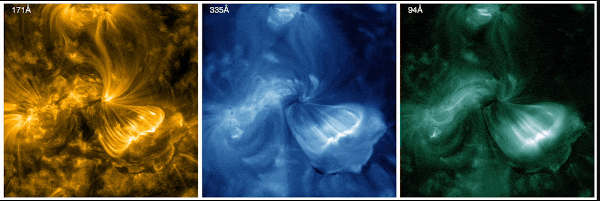
They turned to JAXA/NASA’s Sun-watching Hinode spacecraft, an observatory in which Brooks serves a critical operational role for NASA from Japan. Hinode was watching Active Region 11944, a bright area of strong magnetic field with a large dark sunspot visible from Earth. AR 11944 had produced several large flares and CMEs in early January that released and accelerated the SEPs Wind observed.
Hinode’s Extreme Ultraviolet Imaging Spectrometer, or EIS instrument, scanned the active region, breaking the light into spectral lines used to identify specific elements. They looked for places in the active region with a matching fingerprint, where the specific mix of elements agreed with what they saw in Wind’s data.

“This type of research is exactly what Hinode was designed to pursue,” said Sabrina Savage, the U.S. project scientist for Hinode. “Complex system science cannot be done in a bubble with only one mission.”
Hinode’s data revealed the source of the SEP events – but it wasn’t what either Brooks or Yardley expected.
As a rule, the solar wind can escape more easily by finding open magnetic field lines – field lines anchored to the Sun at one end but streaming out into space on the other.
“I really thought we were going to find it at the edges of the active region where the magnetic field is already open and material can escape directly,” Brooks said. “But the fingerprint matched only in regions where the magnetic field is still closed.”
The SEPs had somehow broken free from strong magnetic loops connected to the Sun at both ends. These loops trap material near the top of the chromosphere, one layer below where solar flares and coronal mass ejections erupt.
“People have already been thinking about ways it could get out from closed field – especially in the context of the solar wind,” Brooks said. “But I think the fact that the material was found in the core of the region, where the magnetic fields are very strong, makes it harder for those processes to work.”
The surprising result raises new questions about how SEPs escape the Sun, questions ripe for future work. Still, pinpointing one event’s source is a big step forward.
“Normally, you have to infer this kind of thing – you’d say, ‘look we saw an SEP and a solar flare, and the SEP probably came from the solar flare,’” said Wilson, who wasn’t involved in the study. “But this is direct evidence tying these two phenomena together.”
Brooks and Yardley also demonstrate one way to use NASA’s growing Heliophysics System Observatory, combining multi-spacecraft observations to do science that previously wasn’t possible.
“It's a way of thinking about all the spacecraft that are in flight that you can use to do a single study,” Wilson said. “It's like having a bunch of weather stations — you start to get a much better picture of what the weather is doing on a larger scale, and you can actively start to try to predict it.”
“These authors have done a remarkable job combining the right data sets and applying them to the right questions,” Savage said. “The search for the origins of potentially harmful energetic particles has been critically narrowed thanks to this effort.”
Miles Hatfield works for NASA.
The California Department of Public Health said Friday that two million doses of COVID-19 vaccine have been administered to Californians in some of the state’s hardest-hit communities, increasing immunity where the state's transmission rates and disease burden have been the highest during the pandemic.
With this equity metric met, and because vaccines slow the spread of disease and serious illness, the previously announced update to the Blueprint for a Safer Economy to account for progress with vaccine administration goes into effect.
After reassessment using new thresholds, 13 counties will move to a less restrictive tier, from purple (widespread) to red (substantial): Amador, Colusa, Contra Costa, Los Angeles, Mendocino, Mono, Orange, Placer, San Benito, San Bernardino, Siskiyou, Sonoma and Tuolumne.
Twenty-one counties will remain in the purple tier, 33 will be in the red (substantial) tier, three remain in the orange (moderate) tier and one remains in the yellow (minimal) tier. These changes will take effect on Sunday, March 14.
On Tuesday, CDPH said it also expects Sacramento, San Diego and 11 additional counties – Kings, Lake, Monterey, Riverside, San Joaquin, Santa Barbara, Sutter, Tehama, Tulare, Ventura and Yuba – to shift from purple to red based on current data and projections.
These tier adjustments will be assigned on Tuesday and take effect on Wednesday.
Lake County has been in the purple tier since the end of November.
There is potential for additional counties to move tiers next week based on next week’s blueprint tier assessment and assignment.
Going forward, the purple tier threshold is greater than 10 cases per 100,000 people.
“California is doubling down on its mission to keep equity a top priority as we continue to get COVID-19 doses into the arms of all Californians as safely and quickly as possible,” said Dr. Mark Ghaly, secretary of California’s Health and Human Services Agency. “Focusing on the individuals who have been hardest hit by this pandemic is the right thing to do and also ensures we are having the greatest impact in reducing transmission, protecting our health care delivery system and saving lives.”
On March 4, Gov. Gavin Newsom announced that the state had set aside 40 percent of vaccine doses for the hardest-hit communities and established an equity metric to increase vaccinations in those communities. Doing so recognizes that the pandemic did not affect California communities equally.
Forty percent of COVID cases and deaths have occurred in the lowest quartile of the Healthy Places Index, which provides overall scores and data that predict life expectancy and compares community conditions that shape health across the state.
Six of Lake County’s zip codes – Clearlake, Clearlake Oaks, Finley, Lucerne, Nice and Upper Lake – are in the lowest quartile on the Healthy Places Index.
“While we have reached a milestone today, we still have a lot of work ahead of us to help ensure we can put an end to this pandemic,” said Tomás Aragón, CDPH director and state Public Health officer. “We must all do our part by getting vaccinated as soon as it’s our turn and continue to wear masks and practice physical distancing to keep our communities safe.”
The blueprint will be updated again when four million doses have been administered in the vaccine equity quartile.
More information about the Blueprint for a Safer Economy is available here and additional details on the state's efforts to end the pandemic through equitable vaccine administration is available here.
“We are looking forward to transitioning back to more on-ground/face-to-face classes at all locations and plan to see our fall 2021 class schedule reflect that,” said Superintendent and President Tim Karas. “We are happy to report that with the help of Mendocino County, we have been able to provide all interested employees access to the COVID-19 vaccine so they feel comfortable coming back to campus and providing excellent student service as before the pandemic began.”
The college has a “Transition Group” which consists of classified staff, faculty and management leaders brainstorming ways to get more students back on campus in a timely and safe manner.
The college is also surveying students to gather input about how that might look. In the fall 2021 semester, the schedule will offer an expanded on ground/face-to-face course listing.
“We won’t be 100 percent back to normal by fall, but we will be increasing the number of classes at all of our locations,” says Debra Polak, vice president of instruction. “We will be introducing innovative instructional methods in the fall that will allow us to have fewer students in classrooms. We hope some of these new methods will help us reach students in our vast geographic area in post-pandemic times as well.”
“In the fall, the centers in Fort Bragg, Lakeport and Willits will have a heavier on-ground presence to support students who have had a difficult time accessing online education. We plan to offer close to the traditional variety of courses, just with reduced class enrollment caps, that align with current county safety guidelines,” says Dean of Centers Amanda Xu. “The center computer labs will also be open during regular business hours so that our rural students can more efficiently access online courses.”
Since the pandemic began, Mendocino College has continued to expand support and services geared toward student success, including free tutoring, books, tuition and more.
More than half the students who attend Mendocino College qualify for some form of financial aid, and many meet the guidelines that eliminate unit fees completely, regardless of their financial situation.
For more information, visit https://www.mendocino.edu/financial-aid.
“There will be numerous opportunities for students to access funds to pay for tuition and other educational expenses in the coming months,” says Karas. “We want students to know that we’re here to help break down any barriers that may be preventing them from returning to school. There is no better time than now to pursue your educational goals.”
Currently enrolled students can register for summer classes using MyMendo beginning April 24 and new students can apply now online at www.mendocino.edu.
The summer 2021 semester officially begins June 7. To make a counseling appointment, please email
The settlement agreement resolves allegations by the Attorney General’s Office, the United Food and Commercial Workers International Union and Employers Benefit Trust, or UEBT, and class action plaintiffs that Sutter’s anticompetitive practices led to higher health care costs for consumers in Northern California compared to other places in the state.
The nonprofit Sutter Health is the largest hospital system in Northern California. The Sutter network consists of some 24 acute care hospitals – including Sutter Lakeside Hospital in Lakeport – along with 36 ambulatory surgery centers and 16 cardiac and cancer centers. It also includes some 12,000 physicians and over 53,000 employees. In addition, Sutter negotiates contracts on behalf of the Palo Alto Medical Foundation and many affiliated physician groups.
The settlement “represents a huge step toward making health care more accessible and affordable for patients who need it, especially for Northern California patients served by Sutter,” said California Attorney General Xavier Becerra.
“This landmark settlement will require Sutter to stop practices that drive patients into more expensive health services and to operate with more transparency. The California Department of Justice will continue to work to keep the healthcare market competitive so that patients, families, and employers aren’t left holding the bag when big players dominate the market,” Becerra said.
Sutter Health said in a statement released to Lake County News that the ruling “enables the settlement approval process to continue moving toward final approval, which will ultimately help preserve our integrated network of care and is in the best interests of our patients and the communities we serve.”
The settlement requires Sutter to pay $575 million in compensation, prohibits anticompetitive conduct, and requires Sutter to follow certain practices to restore competition in California’s healthcare markets.
This settlement is the result of litigation that began in 2014 when the UEBT and numerous individual plaintiffs — later consolidated into a class action — filed their lawsuit challenging Sutter’s practices in rendering services and setting prices.
They sought compensation for what they alleged were unlawful, anticompetitive business practices, which caused them to pay more than necessary for health care services and products.
In March of 2018, Attorney General Becerra filed a similar lawsuit against Sutter on behalf of the people of California, principally seeking injunctive relief to compel Sutter to correct its anticompetitive business practices moving forward.
The separate lawsuits were combined by the court into one case.
In October of 2019, on the eve of trial, the parties reached an agreement to settle. The settlement was filed with the court on Dec. 19, 2019, together with an unopposed motion for its preliminary approval.
This week’s ruling grants preliminary approval and following the required class notice period, sets a hearing date for final approval.
With approval of the settlement, Sutter is required to:
– Pay $575 million to compensate employers, unions and others covered under the class action, and to cover costs and fees associated with the legal efforts.
– Limit what it charges patients for out-of-network services, helping ensure that patients visiting an out-of-network hospital do not face outsized, surprise medical bills.
– Increase transparency by permitting insurers, employers, and self-funded payers to provide plan members with access to pricing, quality, and cost information, which helps patients make better care decisions.
– Halt measures that deny patients access to lower-cost plans, thus allowing health insurers, employers, and self-funded payers to offer and direct patients to more affordable health plan options for networks or products.
– Stop all-or-nothing contracting deals, thus allowing insurers, employers, and self-funded payers to include some but not necessarily all of Sutter’s hospitals, clinics, or other commercial products in their plans’ network.
– Cease anticompetitive bundling of services and products which forced insurers, employers, and self-funded payers to purchase for their plan offerings more services or products from Sutter than were needed. Sutter must now offer a stand-alone price that must be lower than any bundled package price to give insurers, employers, and self-funded payers more choice.
– Cooperate with a court-approved compliance monitor to ensure that Sutter is following the terms of the settlement for at least 10 years. The monitor will receive and investigate complaints and may present evidence to the court.
– Clearly set definitions on clinical integration and patient access considerations. The settlement makes clear that for Sutter to claim it has clinically integrated a system, it must meet strict standards beyond regional similarities or the mere sharing of an electronic health record, and must be integrating care in a manner that takes into consideration the quality of care to the patient population. This is important because clinical integration can be used to mask market consolidation efforts by hospital systems, when in fact there is no true integration of a patient’s care. For example, saying that hospitals are regionally close or that hospitals are sharing electronic health records is not enough, there must be close coordination that will lead to less costly, higher quality care for local communities.
A number of studies have shown how overconsolidation drives up prices for consumers.
For example, a University of California Berkeley report found that outpatient cardiology procedures in Southern California cost nearly $18,000 compared to almost $29,000 in Northern California.
For inpatient hospital procedures, the cost in Southern California is nearly $132,000 compared to more than $223,000 in Northern California, a more than $90,000 difference.
A 2016 study found that a cesarean delivery in Sacramento, where Sutter is based, costs more than $27,000, nearly double what it costs in Los Angeles or New York, making Northern California one of the most expensive places in the country to have a baby.
A copy of the order granting preliminary approval is published below.
Order Granting Preliminary Approval Sutter 20210309[3] by LakeCoNews on Scribd