How to resolve AdBlock issue?
Refresh this page
How to resolve AdBlock issue?
Refresh this page
Lake County News,California
  • Home
    • Registration Form
  • News
    • Education
    • Veterans
    • Community
      • Obituaries
      • Letters
      • Commentary
    • Police Logs
    • Business
    • Recreation
    • Health
    • Religion
    • Legals
    • Arts & Life
    • Regional
  • Calendar
  • Contact us
    • FAQs
    • Phones, E-Mail
    • Subscribe
  • Advertise Here
  • Login

News

Clearlake Animal Control: ‘Ziggy’ and the dogs

“Ziggy.” Photo courtesy of Clearlake Animal Control.


CLEARLAKE, Calif. — Clearlake Animal Control has dozens of dogs waiting for their new homes.

The shelter has 48 adoptable dogs listed on its website.

This week’s dogs include “Ziggy,” an 8-month-old male border collie mix puppy. He has a black coat with white markings.

The shelter is located at 6820 Old Highway 53. It’s open from 9 a.m. to 6 p.m. Tuesday through Saturday. 

For more information, call the shelter at 707-762-6227, email This email address is being protected from spambots. You need JavaScript enabled to view it., visit Clearlake Animal Control on Facebook or on the city’s website.

This week’s adoptable dogs are featured below.

Email Elizabeth Larson at This email address is being protected from spambots. You need JavaScript enabled to view it.. Follow her on Twitter, @ERLarson, and on Bluesky, @erlarson.bsky.social. Find Lake County News on the following platforms: Facebook, @LakeCoNews; X, @LakeCoNews; Threads, @lakeconews, and on Bluesky, @lakeconews.bsky.social. 

Pediatricians’ association recommends COVID-19 vaccines for toddlers and some older children, breaking with CDC guidance

The AAP’s guidance on COVID-19 vaccines differs substantially from that of the CDC. Images By Tang Ming Tung/DigitalVision via Getty Images

For 30 years, vaccine recommendations from the Centers for Disease Control and Prevention have aligned closely with those from the American Academy of Pediatrics, or AAP. But on Aug. 19, 2025, the AAP published new vaccine recommendations that diverge from those of the CDC.

The pediatrician association’s move comes on the heels of unprecedented changes made earlier this year by Robert F. Kennedy Jr., as head of the Department of Health and Human Services, in how the government approves and issues guidance on vaccines.

The biggest difference is in the AAP’s guidance around COVID-19 vaccines for children. This new guidance comes as COVID-19 cases are once again rising across the U.S. and many parents and providers are confused by unclear guidance from federal health authorities about whether children should be vaccinated.

In a Q&A with The Conversation U.S., David Higgins, a pediatrician, preventive medicine physician and vaccine delivery researcher from the University of Colorado Anschutz Medical Campus, explains the new guidance and what it means for parents. Higgins is also a member of the American Academy of Pediatrics.

What are the AAP’s new vaccine recommendations?

The AAP recommends that all children 6 to 23 months old receive a complete COVID-19 vaccine series, consistent with recommendations for this age group in previous years.

For children and adolescents ages 2 to 18, the AAP now advises a single dose if they are at higher risk, a change from previous years, when vaccination was recommended for all in this age group. Children at higher risk include those who have certain chronic medical conditions, who live in long-term care or group settings, who have never been vaccinated, or who live with family members at high risk.

The AAP also recommends that COVID-19 vaccines remain available for any child or adolescent whose parent wants them to be protected, regardless of risk status. In all cases, the most updated version of the vaccine should be used.

How do these recommendations differ from CDC guidance?

The difference is substantial. The CDC currently advises what it calls “shared clinical decision-making” for children ages 6 months to 17 years who are not moderately or severely immunocompromised. This means the decision is left up to individual discussions between families and their health care providers, but the vaccine is not treated as a routine recommendation. These current guidelines were made after Kennedy bypassed the agency’s normal independent review process.

That framework can be confusing for families and difficult for providers to implement. By contrast, the AAP recommendations identify the ages and conditions where the risk is highest while also supporting vaccine availability for any families who want it.

Toddlers engaged in an activity at a wooden table in a classroom.
It’s not clear whether families will be able to access routine COVID-19 vaccines for children this fall. Pancake Pictures/Connect Images via Getty Images

Why are they diverging?

The AAP has been publishing vaccine guidance since the 1930s, long before the CDC or the Advisory Committee on Immunization Practices, an independent panel of experts that advises the CDC, existed.

Since 1995, the two groups have generally issued essentially identical vaccine guidance. But this year, the federal government dismissed the advisory committee’s panel of independent scientists and immunization experts, raising questions about the credibility of CDC guidance. At the same time, misinformation about vaccines continues to spread.

In response, the AAP decided to publish independent recommendations based on its own review of the latest evidence. That review showed that although the risks for healthy older children have declined compared with the early years of the pandemic, young children and those with specific conditions remain especially vulnerable. Additionally, a review of evidence by an independent expert group called the Vaccine Integrity Project, also released on Aug. 19, 2025, confirmed that there are no new safety concerns and no decline in the effectiveness of COVID-19 vaccines.

COVID-19 continues to cause hospitalizations and deaths in children and remains a leading cause of serious respiratory illness.

Will parents be able to follow these recommendations?

This is still unclear. The AAP recommendations do not automatically guarantee insurance coverage.

By law, insurance plans and the federal Vaccines for Children program, which provides vaccines for eligible children who might not otherwise be vaccinated due to cost or lack of insurance, are tied to Advisory Committee on Immunization Practices recommendations. Unless insurers and policymakers act to align with the AAP recommendations, there is a risk that parents would be forced to pay the costs out of pocket.

Vaccine supply may also be an issue. Currently, only two COVID-19 vaccines are available for children under 12. Moderna’s vaccine is approved only for children with at least one high-risk condition, while Pfizer’s authorization for younger children may not be renewed. If that happens, any remaining Pfizer doses for this age group may be unusable, leaving a shortfall in available vaccines for children.

Finally, implementation may differ depending on the type of provider. Some vaccine providers, such as pharmacists, operate under policies tied strictly to CDC recommendations, which may make it harder to follow AAP’s schedule unless rules are updated.

What happens next?

Parents and providers are likely to face continued confusion, just as COVID-19 cases rise as children return to school. Much will depend on whether the Advisory Committee on Immunization Practices updates its own recommendations at its upcoming meeting, expected in September, and whether pediatric COVID-19 vaccines remain available.

Until then, parents can speak with their pediatricians to understand the best protection for their children.The Conversation

David Higgins, Assistant Professor of Pediatrics, University of Colorado Anschutz Medical Campus

This article is republished from The Conversation under a Creative Commons license. Read the original article.
Preliminary hearing set for Clearlake Oaks man charged with kidnap, rape

LAKEPORT, Calif. — A Clearlake Oaks man arrested last week for a kidnap and rape case along with a separate case in which he committed an assault was back in court on Tuesday.

Clifford Merle Cutrell, 54, also known as “Cliff Hanger,” appeared before Judge J. David Markham in Lake County Superior Court’s Department 2 early Tuesday morning for the appearance of his legal counsel and plea entry.

Cutrell was arrested on Tuesday, Aug. 12, for a kidnap and rape authorities said he committed that day and a felony assault case from April 10, as Lake County News has reported.

He is a registered sex offender with a lengthy criminal record and a risk assessment score conducted by the state that puts him in the “high” category for reoffending.

During the brief Tuesday morning court appearance, Chief Deputy District Attorney Rich Watson submitted to the court an amended complaint that added a 10th felony charge — sexual battery — to the rape and kidnap case, and changed previous counts of sodomy and sexual penetration by force to oral copulation by force.

Cutrell is now facing charges of kidnapping to commit robbery or rape; assault with intent to commit a felony; four charges of oral copulation by force or fear of injury; rape by force, violence, duress or menace; burglary; threats to commit a crime resulting in death; and sexual battery.

He has pleaded not guilty to all of the charges, said his public defender, Farris Purviance. 

Deputy Public Defender Jennifer Ramon had reportedly filed a motion for bail review for Cutrell, but Purviance, the public defender who didn’t make the initial appearance as Cutrell's attorney but has since taken over handling the case, withdrew that bail review motion on Tuesday.

In order to protect the right to a speedy trial, in felony cases state law sets a 60 calendar day time limit between arraignment and the preliminary hearing unless the defendant waives that time limit. 

Markham asked Cutrell if he was willing to waive the time limit and he said yes.

The judge then set Cutrell’s preliminary hearing for both the rape and kidnap case and the April assault for Sept. 25 in Department 3.

While the bail review motion had been withdrawn, Watson asked that the bail matter be addressed. 

Cutrell’s bail initially was set at $1 million. Watson asked for it to be set at no bail. 

Markham agreed, with Cutrell to be held without bail in both cases pending a future bail hearing.

Email Elizabeth Larson at This email address is being protected from spambots. You need JavaScript enabled to view it.. Follow her on Twitter, @ERLarson, and on Bluesky, @erlarson.bsky.social. Find Lake County News on the following platforms: Facebook, @LakeCoNews; X, @LakeCoNews; Threads, @lakeconews, and on Bluesky, @lakeconews.bsky.social. 

Clearlake City Council to discuss future of animal control services

LAKE COUNTY, Calif. — Two weeks after it made the surprising decision to terminate its animal control contract, the Clearlake City Council is set to discuss next steps.

The council will meet at 6 p.m. Thursday, Aug. 21, in the council chambers at Clearlake City Hall, 14050 Olympic Drive.

The agenda can be found here.

The meeting will be broadcast live on the city's YouTube channel or the Lake County PEGTV YouTube Channel. 

Community members also can participate via Zoom. Register in advance for the meeting here; after registering, you will receive a confirmation email containing information about joining the webinar.

On Thursday, the council is scheduled to hold a discussion regarding “next steps” for animal care and control services in the city, with the recommended action being direction to staff, although exactly what action is yet to be determined.

On Aug. 7 the council agenda contained a vague and overly broad item of business regarding discussion and consideration of the contract with North Bay Animal Services.

In a surprise move, Mayor Russell Cremer and Councilmember Tara Downey were joined by Councilmember Jessica Hooten in voting to terminate the contract.

City Manager Alan Flora’s brief staff report for the item notes that he provided a notice of termination to North Bay Animal Services on Aug. 15.

Flora said that at the Aug. 7 meeting, the council directed him to add an item to a future agenda to discuss the next steps after the contract termination.

Also on Thursday, the council will hold a public hearing regarding fire mitigation fees, consider designating one voting delegate and up to two alternates for the League of California Cities Annual Conference in October, and receive presentations on August’s adoptable dogs and Future Farmers of America.

On the meeting’s consent agenda — items that are considered routine in nature and usually adopted on a single vote — are warrants; minutes; and the rescinding of the prior award of the contract for the Clearlake Senior Center painting project to Poso Brothers Painting due to
contractor withdrawal, authorization for the city manager to enter into a contract with Underdog Painting in the amount of $49,285, and authorization for the city manager to approve up to 10% for additional unforeseen contract amendments.

The council will hold a closed session to discuss negotiations with Alvarez Investments for city-owned property at 14180 and 14190 Division Ave., as well as to hold a conference with legal counsel regarding existing litigation, Mosqueda, Miguel v. City of Clearlake, p.s.i., administered by LWP Claims Solutions Inc.; and liability claims against the city filed by Anna Middling and Jeremy Nelson.

Email Elizabeth Larson at This email address is being protected from spambots. You need JavaScript enabled to view it.. Follow her on Twitter, @ERLarson, and on Bluesky, @erlarson.bsky.social. Find Lake County News on the following platforms: Facebook, @LakeCoNews; X, @LakeCoNews; Threads, @lakeconews, and on Bluesky, @lakeconews.bsky.social. 

IHSS workers ask supervisors to increase pay, address long-term care crisis in midst of contract negotiations

LAKEPORT, Calif. — On Tuesday, Lake County’s In-Home Supportive Services workers, now in contract negotiations with the county of Lake, returned to the Board of Supervisors meeting to urge elected officials to invest in long-term care. 

In-Home Supportive Services, or IHSS, workers in Lake County are represented by SEIU Local 2015, the largest union in California, representing more than half a million long-term care workers.

The county’s IHSS workers are currently negotiating a new contract with county officials, as their previous contract expired at the end of 2023.

More than 2,400 Lake County IHSS workers provide essential long-term care — including paramedical, personal care and household services — to seniors and people with disabilities. 

The IHSS program ensures people have the freedom to receive long-term care in the setting of their choice by enabling them to remain in their homes instead of moving to an institutional setting.

“The entire community benefits from having trained, compassionate, caring home care providers for these recipients,” said Lake IHSS worker Dianna Wilyard. “Our essential work keeps thousands of people safe at home and out of expensive care facilities.”

Despite this essential role, the union said Lake County is experiencing a caregiver shortage that will only worsen as the population ages. 

Last year, more than 385,000 authorized IHSS care hours went unused in Lake County, which SEIU Local 2015 said is nearly 10% of the total and more than double the percentage of unused authorized hours statewide. 

The union said these unfulfilled hours suggest individuals are not receiving the care they need and qualify for.

Additionally, union officials said wages and benefits that fail to meet the needs of families are driving IHSS workers out of the caregiving profession. The current Lake County IHSS wage is $17.15 an hour, only $0.65 above California’s minimum wage, and far below the MIT living wage threshold of $22.83 an hour for a single individual with no children.

“At various times, I’ve had to work two to three jobs to support my family,” said Ellie Hayes, a Lake County IHSS worker. “The IHSS wage is not enough to cover all my family’s costs.”

On top of all this, the population of older adults is growing in Lake and across California, increasing the demand for in-home care. 

The union said IHSS providers are especially critical in rural areas of Lake County, serving as vital links for the disability and senior community and offering essential care to those who do not have easy, affordable access to medical centers or specialized services.

“Lake County needs to start investing in care before more providers leave the industry which will worsen the current care crisis,” said SEIU Local 2015 President Arnulfo De La Cruz. “Care workers are essential and they need to be valued in order to safeguard the well-being of seniors and people with disabilities in Lake County.” 

The union’s bargaining team is encouraging the Board of Supervisors to collaborate to address these pressing issues and ensure that Lake’s long-term care system is prepared to support the county’s future.

San Francisco and other cities, following a Supreme Court ruling, are arresting more homeless people for living on the streets

A person walks past a homeless encampment in the Skid Row community in Los Angeles in June 2024. Mario Tama/Getty Images

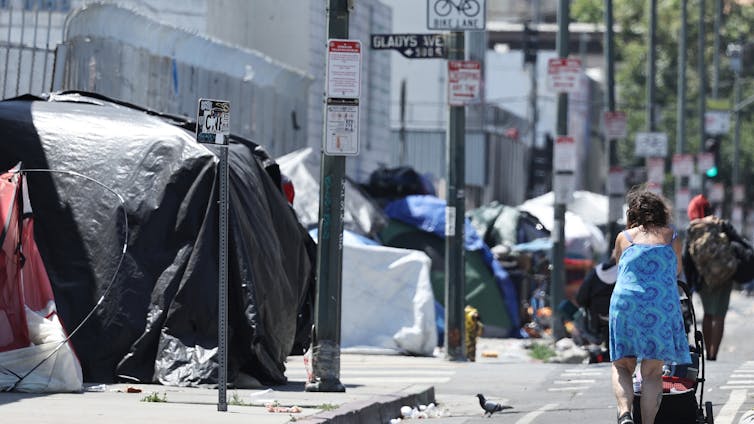
Homelessness is on the rise in the United States, and in some places, it is becoming more common for the police to arrest someone for sleeping or living in a public space.

In June 2024, the Supreme Court issued a ruling, Grants Pass v. Johnson, that determined it is constitutional to issue citations to or arrest homeless people, even when there is no available shelter.

The ruling reversed earlier federal appeals court rulings from 2019 and 2022 that determined cities cannot enforce anti-camping laws against homeless people if there are not enough shelter beds available for them.

The Supreme Court’s ruling also determined that the Eighth Amendment’s prohibition on cruel and unusual punishments does not protect homeless people from laws criminalizing resting in public places.

As someone who has spent more than a decade researching homelessness and speaking with unhoused communities, I have seen firsthand how enforcement of such laws imposes unavoidable hardships on homeless people and makes it harder for them to find a stable home.

A woman wearing a white pantsuit walks alongside a few people in a street that is littered in front of a few large buildings.
Los Angeles Mayor Karen Bass visits the site of a city-led sweep of a homeless encampment in Van Nuys, Calif., on July 31, 2025. David Pashaee/Middle East Images/AFP via Getty Images

A rise in punitive action against homelessness

In 2024, there were an estimated 771,480 people in the U.S. who experienced homelessness on a single night, the highest number ever recorded.

Since June 2024, almost 220 local measures have passed that restrict or ban acts like sleeping, sitting or panhandling in public in cities that include Phoenix; Gainesville, Florida, and Reno, Nevada.

The rate of unsheltered homelessness, meaning homeless people who are sleeping in places that are not meant for humans to rest in, like parks or cars, is the highest in California.

After the Supreme Court’s decision, California Gov. Gavin Newsom issued an executive order in July 2024 that directs state agencies and departments to adopt new policies that remove homeless encampments. Those are temporary outdoor living spaces used by homeless people, often on public or private property.

Following this executive order, more than two dozen California cities and towns adopted or considered adopting sweeping bans on homeless encampments.

Not every leader has embraced this approach of what some observers call criminalizing homelessness. Los Angeles Mayor Karen Bass, for example, rejected criminalizing homelessness as “backwards” in June 2024.

Nevertheless, many cities are enforcing existing and new bans on homeless encampments more aggressively than before the Supreme Court decision – despite evidence that such enforcement is not effective in dealing with the problem of homelessness.

The impacts of aggressive enforcement

Research shows that arresting someone without a home for sitting, resting or sleeping in a public place does not reduce homelessness.

Instead, encampment sweeps and camping bans typically displace people from one area to another, while discarding or destroying their personal belongings in the process, such as identification cards, medications and sleeping gear.

This approach also wastes public resources by paying groups to throw away people’s belongings instead of investing that money into actual housing solutions, like creating more affordable housing options.

Homeless encampment sweeps by police or other government officials are also shown to make people living in camps sicker, leading to increases in hospitalizations and even deaths among those dependent on drugs or alcohol.

A punitive shift in San Francisco

San Francisco is an example of an American city with a relatively large homeless population that has taken a more aggressive approach to enforcing bans on homeless encampments over the past year.

A few weeks after the Supreme Court decision, then-San Francisco Mayor London Breed promised to be “very aggressive” in removing homeless encampments. She also said that “building more housing” would not solve the homelessness crisis.

City data shows that in the 12 months since the Supreme Court ruling, San Francisco police had arrested more than 1,000 homeless people for living in a public space – a scale of enforcement rarely seen in the city’s past. In the year leading up to the ruling, 111 people were arrested for illegal lodging

San Francisco identified approximately 8,300 homeless city residents in 2024.

In June 2025, I conducted a survey of 150 homeless people in San Francisco. About 10% of those people who gave a reason for a recent arrest reported being jailed for lodging without permission. Another 6% said they were arrested for trespassing.

In the same survey, which is part of an ongoing project, 54% of homeless San Francisco residents reported being forced to move from a public space at least once.

Another 8% reported being cited for another reason related to trespassing.

A less aggressive path in Portland

Other western American cities with large homeless populations have taken slightly different approaches to removing homelessness encampments since June 2024.

Portland, Oregon, for example, began enforcing a new daytime camping ban in July 2024. But Portland police have only made 11 arrests of homeless people for camping-related violations over the past year.

Other homeless people in Portland have received police citations for other offenses, like trespassing.

As part of my June 2025 study, I surveyed 150 homeless Portland residents. About 49% of respondents reported having been arrested at some point in their lives. Though no respondents were arrested for camping in a prohibited place, 68% of people I spoke with reported that police or other government officers forced them to leave a public space at some point over the past year.

And 13% of those who gave a reason for being cited by police said it was for camping in a prohibited place. Another 11% of homeless people were cited for some other reason related to living without shelter.

As part of the study, I also interviewed residents who had been arrested while living on the street. One Portland resident I interviewed – who asked not to be named to preserve their anonymity – told me they lost the chance to rent an apartment because they were arrested in 2023 on a preexisting, unrelated warrant after a police officer checked their ID – just days before they were supposed to pick up their keys.

“Many unhoused people have warrants simply for failing to appear after being cited for sitting or resting in public space,” they said. “I was supposed to go get the keys and, bam, I got picked up. I was arrested and went to court. Just me being in jail for five, six or five days screwed it all. I didn’t show up to get the keys, and then (the landlord) couldn’t get ahold of me, and they had no idea what was going on.”

The weeklong jail stay not only pushed this person back onto the street, but it also put them back onto a waiting list for housing – where they remain in 2025.

A person wearing a dark sweatshirt and hat holds onto a wheelchair as a man crouches in front of a tent next to the wheelchair.
A volunteer helps a person into his tent after relocating him from one park to another in Grants Pass, Oregon, in March 2024. AP Photo/Jenny Kane

Looking ahead

The Supreme Court’s 2024 ruling did not mandate that cities criminalize homelessness. But it effectively gave cities the green light to do so without fear of violating people’s constitutional protections.

The effects of this ruling will be further felt with President Donald Trump’s July 24, 2025, executive order that ended federal support for approaches like Housing First, a policy that prioritizes providing homeless people with housing, before any other needed help. The order also calls for involuntarily committing homeless people with mental illness to mental health institutions.

As more cities consider tougher encampment ordinances, I think it is worth considering if more punitive measures really address homelessness. Decades of evidence suggest they won’t.

Instead, arresting homeless people often deepens their poverty, increases displacement and diverts public funding away from the real solution – stable, affordable housing.The Conversation

Stephen Przybylinski, Assistant Professor of Geography, Michigan State University

This article is republished from The Conversation under a Creative Commons license. Read the original article.

  • 123
  • 124
  • 125
  • 126
  • 127
  • 128
  • 129
  • 130
  • 131
  • 132

Community

  • Lake County Wine Alliance offers sponsor update; beneficiary applications open 

  • Mendocino National Forest announces seasonal hiring for upcoming field season

Public Safety

  • Lakeport Police logs: Thursday, Jan. 15

  • Lakeport Police logs: Wednesday, Jan. 14

Education

  • Woodland Community College receives maximum eight-year reaffirmation of accreditation from ACCJC

  • SNHU announces Fall 2025 President's List

Health

  • California ranks 24th in America’s Health Rankings Annual Report from United Health Foundation

  • Healthy blood donors especially vital during active flu season

Business

  • Two Lake County Mediacom employees earn company’s top service awards

  • Redwood Credit Union launches holiday gift and porch-to-pantry food drives

Obituaries

  • Rufino ‘Ray’ Pato

  • Patty Lee Smith

Opinion & Letters

  • The benefits of music for students

  • How to ease the burden of high electric bills

Veterans

  • CalVet and CSU Long Beach team up to improve data collection related to veteran suicides

  • A ‘Big Step Forward’ for Gulf War Veterans

Recreation

  • Wet weather trail closure in effect on Upper Lake Ranger District

  • Mendocino National Forest seeking public input on OHV grant applications

  • State Parks announces 2026 Anderson Marsh nature walk schedule 

  • BLM lifts seasonal fire restrictions in central California

Religion

  • Kelseyville Presbyterian to host Ash Wednesday service and Lenten dinner Feb. 18

  • Kelseyville Presbyterian Church to hold ‘Longest Night’ service Dec. 21

Arts & Life

  • Auditions announced for original musical ‘Even In Shadow’ set for March 21 and 28

  • ‘The Rip’ action heist; ‘Steal’ grounded in a crime thriller

Government & Politics

  • Lake County Democrats issue endorsements in local races for the June California Primary

  • County negotiates money-saving power purchase agreement

Legals

  • March 3 hearing on ordinance amending code for commercial cannabis uses

  • Feb. 12 public hearing on resolution to establish standards for agricultural roads

How to resolve AdBlock issue?
Refresh this page