How to resolve AdBlock issue?
Refresh this page
How to resolve AdBlock issue?
Refresh this page
Lake County News,California
  • Home
    • Registration Form
  • News
    • Education
    • Veterans
    • Community
      • Obituaries
      • Letters
      • Commentary
    • Police Logs
    • Business
    • Recreation
    • Health
    • Religion
    • Legals
    • Arts & Life
    • Regional
  • Calendar
  • Contact us
    • FAQs
    • Phones, E-Mail
    • Subscribe
  • Advertise Here
  • Login

News

Supervisors to discuss Guenoc resort project, biochar facility appeal

LAKE COUNTY, Calif. — The Board of Supervisors is set to discuss a major south county resort project and a community appeal of the Lake County Planning Commission’s approval of a biochar facility on county-owned property in Upper Lake.

The‌ ‌board will meet beginning ‌at‌ ‌9‌ ‌a.m. Tuesday, Aug. 26, in the board chambers on the first floor of the Lake County Courthouse, 255 N. Forbes St., Lakeport.

The‌ ‌meeting‌ ‌can‌ ‌be‌ ‌watched‌ ‌live‌ ‌on‌ ‌Channel‌ ‌8, ‌online‌ ‌at‌ ‌https://countyoflake.legistar.com/Calendar.aspx‌‌ and‌ ‌on‌ ‌the‌ ‌county’s‌ ‌Facebook‌ ‌page. ‌Accompanying‌ ‌board‌ ‌documents, ‌the‌ ‌agenda‌ ‌and‌ ‌archived‌ ‌board‌ ‌meeting‌ ‌videos‌ ‌also‌ ‌are‌ ‌available‌ ‌at‌ ‌that‌ ‌link. ‌ ‌

To‌ ‌participate‌ ‌in‌ ‌real-time, ‌join‌ ‌the‌ ‌Zoom‌ ‌meeting‌ ‌by‌ ‌clicking‌ ‌this‌ ‌link‌. ‌ ‌

The‌ ‌meeting‌ ‌ID‌ ‌is‌ 865 3354 4962, ‌pass code 726865.‌ ‌The meeting also can be accessed via one tap mobile at +16694449171,,86533544962#,,,,*726865#. The meeting can also be accessed via phone at 669 900 6833.

At 9:30 a.m., the board will hold a public hearing to consider Upper Lake resident Larry Kahn’s appeal of the Planning Commission’s approval of Scotts Valley Energy’s biochar facility on a county owned property at 755 East State Highway 20, Upper Lake.

The appeal has been held over from previously scheduled hearings on May 20 and June 17.

The county agreed to lease the company, owned by the Scotts Valley Pomo, the property for the forest wood processing bioenergy project.

Community members have raised numerous concerns about the project, from health impacts to its location close to the town, the project’s planning, as well as whether it can be located on property paid for by grants.

At 1 p.m., the board will consider the Planning Commission’s recommendation to approve the proposed development agreement, zoning ordinance amendment, general plan map amendment, general plan text amendment, rezones, general plan of development and consideration of a water supply assessment for the Guenoc Valley mixed-use planned development project.

The Guenoc Valley Mixed Use Planned Development Project is a luxury destination that at full buildout will include up to 400 hotel rooms, 450 resort residential units, 1,400 residential estates and 500 workforce co-housing units on a portion of the 16,000-acre, 82-parcel Guenoc property.

The full agenda follows.

CONSENT AGENDA

5.1: Approve the third amendment to the 2019 agreement between the city of Clearlake, city of Lakeport and the county of Lake for operation of a local public, educational, governmental (PEG) cable television channel, with amendments including extension of the term through June 30, 2030, and authorize the chair to sign.

5.2: Adopt resolution amending Resolution 2025-76 establishing position allocations for fiscal year 2025-26 to conform to the recommended budget and approve salary grade adjustments based on findings from the 2024 compensation study.

5.3: Adopt resolution amending Resolution 2025-72 establishing salaries and benefits for management employees for the period of July 1, 2025, to June 30, 2029.

5.4: Adopt resolution approving Agreement No. 24-0680-047-SF with the California Department of Food and Agriculture for the European Grapevine Moth Detection Program for $19,562 for the period of July 1, 2025, through June 30, 2026.

5.5: Adopt proclamation designating the month of September 2025 as National Recovery Month in Lake County.

5.6: Approve agreement between the county of Lake — Lake County Behavioral Health Services as lead agency for the Lake County Continuum of Care — and Adventist Health Clear Lake Hospital Inc. in the amount of $184,000 for the period of June 1, 2025, through Oct. 31, 2026, and authorize the chair to sign.

5.7: (a) Approve Amendment No. 2 to services contract between the county of Lake and Mitchell Hauptman for indigent defense services and authorize the board chair to sign; and (b) approve Amendment No. 2 to services contract between the county of Lake and William Conwell for indigent defense services and authorize the board chair to sign.

5.8: Approve first amendment to contract between the county of Lake and Chabot-Las Positas Community College District (CLPCCD) for Title IV-E training, in the amount of $1 million per fiscal year from July 1, 2024, to June 30, 2027, and authorize the chair to sign.

TIMED ITEMS

6.2, 9:03 a.m.: Pet of the Week.

6.3, 9:05 a.m.: Presentation of proclamation designating the month of September 2025 as National Recovery Month in Lake County.

6.4, 9:07 a.m.: Consideration of lighting the Lake County Superior Courthouse in purple in recognition and honor of International Overdose Awareness Day.

6.5, 9:15 a.m.: Public hearing, consideration of resolution approving Resolution No. 2025-5 submitted by Northshore Fire Protection District and making findings and requesting the county of Lake to implement fire mitigation fees with automatic inflation pursuant to the Lake County Fire Mitigation Fee Ordinance, fiscal year 2025-26 (continued from Aug. 5 and 19, 2025).

6.6, 9:30 a.m.: Public hearing, consideration of appeal (PL-25-22; AB 24-06) of the Planning Commission's approval of major use permit (UP 23-05) and initial study (IS 23-10) for the AG Forest Wood Processing Bioenergy Project, located at 755 East State Highway 20, Upper Lake (APN 004-010-04). Appellant: Larry Kahn (continued from May 20 and June 17, 2025).

6.7, 1 p.m.: Consideration of Planning Commission recommendations of proposed development agreement (DA 24-01), zoning ordinance amendment (AM 24-01), general plan map amendment (GPAP 24-01, Guenoc Valley site), general plan text amendment (GPAP 24-02), rezone (RZ 24-01, Santa Clara, Middletown housing site), general plan of development (GPD 24-01), rezone (RZ 24-02); and consideration of a water supply assessment for the Guenoc Valley mixed-use planned development project at multiple locations.

NON-TIMED ITEMS

7.2: Consideration of appointing qualified candidates in lieu of a general district election for the Scotts Valley Water Conservation District under Elections Code Section 10515.

7.3: Consideration of update regarding Public Guardian conservatee “BB.”

CLOSED SESSION

8.1: Public employee evaluation — Special Districts Administrator Robin Borre.

8.2: Closed session item: Conference with legal counsel, existing litigation pursuant to Gov. Code sec. 54956.9 (d)(1) — FERC Proceeding No. P-77, Potter Valley Hydroelectric Project.

Email Elizabeth Larson at This email address is being protected from spambots. You need JavaScript enabled to view it.. Follow her on Twitter, @ERLarson, and on Bluesky, @erlarson.bsky.social. Find Lake County News on the following platforms: Facebook, @LakeCoNews; X, @LakeCoNews; Threads, @lakeconews, and on Bluesky, @lakeconews.bsky.social. 

Wildfire disasters are increasingly in the news, yet less land is burning globally – here’s why

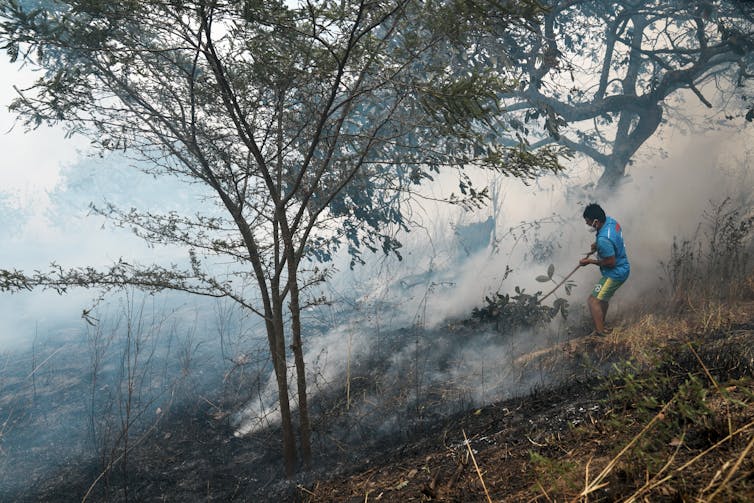
Residents try to put out flames as a wildfire threatens homes in Quito, Ecuador, in September 2024. AP Photo/Dolores Ochoa

Worldwide, an estimated 440 million people were exposed to a wildfire encroaching on their home at some point between 2002 and 2021, new research shows. That’s roughly equivalent to the entire population of the European Union, and the number has been steadily rising – up 40% over those two decades.

With intense, destructive fires often in the news, it can seem like more land is burning. And in parts of the world, including western North America, it is.

Globally, however, our team of fire researchers also found that the total area burned actually declined by 26% over those two decades.

How is that possible?

We found the driving reasons for those changes in Africa, which has the vast majority of all land burned, but the total burned area there has been falling. Agricultural activities in Africa are increasingly fragmenting wildland areas that are prone to burning. A cultivated farm field and roads can help stop a fire’s spread. But more farms and development in wildland areas also means more people can be exposed to wildfires.

Drawing on our expertise in climate and wildfire sciences and geospatial modeling, we analyzed global wildfire activity over the past two decades. The results highlight some common misperceptions and show how the fire risk to humans is changing.

Global burned area down, intense fires up

Wildfire is a natural process that has existed for as long as vegetation has covered the Earth. Occasional fires in a forest are healthy. They clear out dead wood and leaf and branch litter, leaving less fuel for future fires to burn. That helps to keep wildfires from becoming too intense.

However, intense fires can also pose serious threats to human lives, infrastructure and economies, particularly as more people move into fire-prone areas.

North and South America have both experienced a rise in intense wildfires over the past two decades. Some notable examples include the 2018 Camp Fire in California and the 2023 record-breaking Canadian wildfires, which generated widespread smoke that blanketed large parts of Canada and the eastern United States, and even reached Europe.

The increase in intense wildfires aligns with the intensification of fire weather around the world. Heat, low humidity and strong winds can make wildfires more likely to spread and harder to control. The number of days conducive to extreme fire behavior and new fire ignitions has increased by more than 50% over the past four decades globally, elevating the odds that the amount of land burned in a particular region sets a new record.

A high column of flames rises from a smoke-filled forest.
Flames rise amid the billowing smoke from a wildland fire burning along the ridges near the Ken Caryl Ranch development, southwest of Littleton, Colo., on,July 31, 2024. AP Photo/David Zalubowski

But fire weather is not the only influence on wildfire risk. The amount of dry vegetation, and whether it’s in a continuous stretch or broken up, influences fire risk. So do ignition sources, such as vehicles and power lines in wildland areas. Human activities can start fires and fuel climate change, which further dries out the land, amplifying wildfire activity. Fire suppression practices that don’t allow low-intensity fires to burn can lead to the accumulation of flammable vegetation, raising the risk of intense fires.

North America is a fraction of total burned area

In recent years, a growing number of wildfire disasters in North America, Europe and Australia have captured global attention. From the deadly 2025 Los Angeles fires to the devastating 2019-2020 Australian bushfires and the 2018 wildfire in Athens, Greece, flames have increasingly encroached upon human settlements, claiming lives and livelihoods.

However, wildfire exposure isn’t limited to these high-profile regions − we simply hear more about them.

The United States, Europe and Australia collectively account for less than 2.5% of global human exposure to wildfire. Human exposure to fire occurs when people’s homes fall directly within the area burned by a wildfire.

In stark contrast, Africa alone accounts for approximately 85% of all wildfire exposures and 65% of the global burned area.

Remarkably, just five central African countries – the Democratic Republic of Congo, South Sudan, Mozambique, Zambia and Angola – experience half of all global human exposure to wildfires, even though they account for less than 3% of the global population. These countries receive sufficient moisture to support plant growth, yet they are dry enough that trees and plants burn in frequent fires that in some places occur multiple times per year.

Regional trends and drivers of wildfire

We found that wildfire exposure increased across all continents except Europe and Oceania, but the underlying drivers of the increase varied by region.

In Africa, agricultural expansion has led to more people living in fire-prone areas.

In North America, particularly the United States, intensifying fire weather – the hot, dry, windy conditions conducive to spreading fires – has led to increasingly uncontrollable wildfires that threaten human settlements.

Two firefighters spray water on the smoking remains of a building surrunuded by burned trees.
Firefighters hose down hot spots on a fire-ravaged property while battling the Bridge Fire on Sept. 11, 2024, in Wrightwood, Calif. AP Photo/Eric Thayer

In South America, a combination of rising drought frequency and severity, intensifying heat waves and agricultural expansion has amplified wildfire intensity and increased the population in fire-prone regions.

In Asia, growing populations in fire-prone areas, combined with more days of fire-friendly weather, led to increased human exposure to wildfires.

In contrast, Europe and Oceania have seen declining wildfire exposures, largely due to more people moving to cities and fewer living in rural, fire-prone zones.

What to do about it

Communities can take steps to prevent destructive wildfires from spreading.

For example, vegetation management, such as prescribed fires, can avoid fueling intense fires. Public education, policy enforcement and engineering solutions – such as vegetation reduction and clearance along roads and power lines – can help reduce human-caused ignitions.

As climate change intensifies fire weather and people continue to move into fire-prone zones, proactive mitigation will be increasingly critical.The Conversation

Mojtaba Sadegh, Associate Professor of Civil Engineering; Senior Fellow at the United Nations University Institute for Water, Environment and Health, Boise State University; John Abatzoglou, Professor of Engineering, University of California, Merced, and Seyd Teymoor Seydi, Researcher in Remote Sensing, Boise State University

This article is republished from The Conversation under a Creative Commons license. Read the original article.

California and Denmark sign new partnership on climate, technology efforts

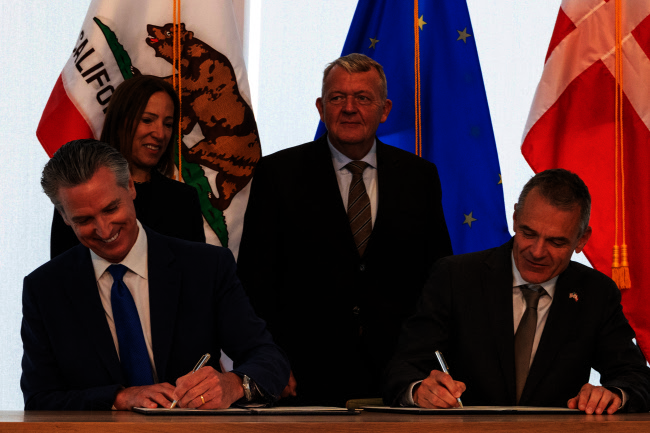
Gov. Gavin Newsom and Denmark’s Minister for Foreign Affairs Lars Løkke Rasmussen signed a climate and technology partnership on Friday, Aug. 22, 2025. Photo courtesy of the Governor’s Office.


Gov. Gavin Newsom has signed a memorandum of understanding, or MOU, between California and Denmark supporting cooperation on green economy resilience, technology and innovation. 

Home to Silicon Valley and the world’s fourth largest economy, California is uniquely positioned to lead the international conversation and help guide the world in the responsible implementation and use of emerging technology. 

The governor and California’s delegation met with Denmark’s delegation led by Minister for Foreign Affairs Lars Løkke Rasmussen and Ambassador of Denmark to the U.S. Jesper Møller Sørensen. California and Denmark signed the MOU at a ceremony in San Francisco.

“California continues to step up to the world stage. We are partnering with Denmark to further our commitment to building affordable clean energy, bolstering our low-carbon, green growth economies, fostering innovation, and accelerating safe and secure technologies. Our message to the rest of the world is clear: California is a stable, reliable partner,” said Gov. Newsom.

“Denmark is committed to expanding our partnerships around the world – also with federal states like California,” said Danish Foreign Minister Lars Løkke Rasmussen. “We are both frontrunners within green energy, innovation, and sustainability. If we combine our efforts, we can really push forward - not only for our own economies and societies, but also by inspiring others to pursue a green transition that creates jobs and growth at the same time.” 

The partnership, signed Friday, does the following:

Boosts the green economy and accelerates climate resilience by achieving carbon neutrality by 2045 through shared leadership.

Enhances digital and cyber resilience through technology and policy collaboration.

Strengthens innovation ecosystems by supporting public-private collaboration, research exchange, development projects, and aligning investment in future-oriented sectors, including emerging technologies and sustainability.

Facilitates the exchange of knowledge, best practices, and policy insights through dialogues, delegations, trade promotions, projects, and partnerships.

California and Danish officials meet on Friday, Aug. 22, 2025. Photo courtesy of the Governor’s Office.

Worldwide partnerships

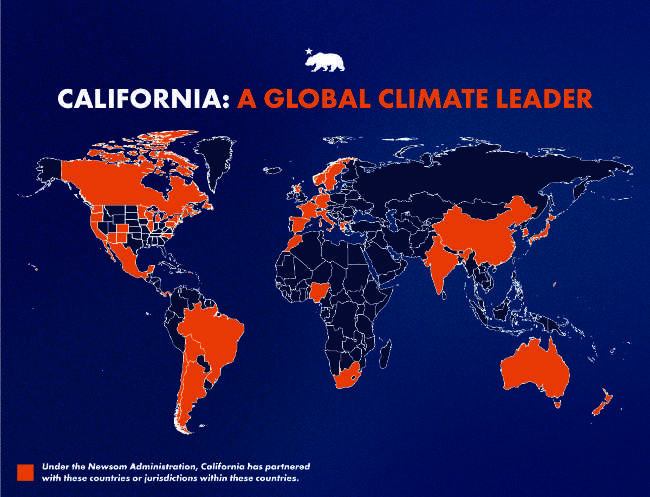
The Newsom administration has partnered with jurisdictions in 27 countries, touching more than a quarter of the world’s population and a combined GDP in the tens of trillions of dollars.

In March, Gov. Newsom welcomed a delegation from the Mexican state of Sonora and signed a partnership advancing the development of clean energy, supply chain resilience, and expanding regional access to renewables.

In February, California and a consortium of 21 Brazilian states partnered together to combat pollution and foster sustainable economic growth. 

Last year, Gov. Newsom signed an MOU with Emilia-Romagna during a visit to Italy for the Vatican’s Climate Summit, and another MOU in May with Gyeonggi Province, South Korea — the center of the country’s economy and high-tech industry. 

Gov. Newsom also welcomed delegations from Sweden and Norway and renewed climate partnerships with the two governments.

In 2023, Gov. Newsom led a California delegation to China, where California signed five MOUs — with China’s National Development and Reform Commission, the provinces of Guangdong and Jiangsu, and the municipalities of Beijing, and Shanghai. The trip also resulted in a first-of-its-kind declaration by China and California to cooperate on climate action like aggressively cutting greenhouse gas emissions, transitioning away from fossil fuels, and developing clean energy. California also launched the Mediterranean Climate Action Partnership at COP 28, working to support members in quickly adapting to climate impacts and emergencies. 

Also in 2023, California signed a MOU with the Chinese province of Hainan, as well as with Australia.

In 2022 alone, California signed Memorandums of Cooperation with Canada, New Zealand and Japan, as well as Memorandums of Understanding with China and the Netherlands, to tackle the climate crisis. The Governor also joined with Washington, Oregon, and British Columbia to recommit the region to climate action.

California’s climate leadership

Pollution is down and the economy is up. Greenhouse gas emissions in California are down 20% since 2000 — even as the state’s GDP increased 78% in that same time period. 

The state also continues to set clean energy records. California was powered by two-thirds clean energy in 2023, the latest year for which data is available — the largest economy in the world to achieve this level of clean energy. The state has run on 100% clean electricity for some part of the day almost every day this year.

Since the beginning of the Newsom Administration, battery storage is up to over 15,000 megawatts — a 1,900%+ increase, and over 25,000 megawatts of new resources have been added to the electric grid. 

Leading in technology 

AI is already changing the world, and California will play a pivotal role in defining that future. 

As the fourth-largest economy in the world and the birthplace of the tech industry, California continues to dominate this sector as the leader in AI. The state is home to 32 of the 50 top AI companies worldwide. 

In addition to championing responsible use of this emerging industry, California is harnessing its potential to increase efficiency and support state operations.   

California has launched efforts to help the state take advantage of this emerging technology, while also creating responsible policy guardrails to protect Californians. 

In 2023, Gov. Newsom signed an executive order laying out California’s measured approach to state GenAI procurement. That EO has shaped the future of ethical, transparent, and trustworthy GenAI deployment, all while California remains the world’s GenAI leader. 

Within the state government, projects are already underway to utilize GenAI to reduce highway congestion, improve roadway safety, and enhance customer service in a state call center, among other new initiatives. 

And this year, a group of world-leading AI academics and experts, convened at the request of Governor Newsom,  finalized a new empirical, science-based analysis of the capabilities and attendant risks of frontier models — which will help pave the way for the use of AI for the benefit of all Californians, and the world. 

Last year, Gov. Newsom also signed a series of bills to crack down on sexually explicit deepfakes and require AI watermarking, ban AI-generated child pornography, protect consumers by preventing scams from AI-generated robocalls, protect performers’ digital likenesses, and combat deepfake election content.

New Lake County Fair CEO brings new ideas, energy to annual event

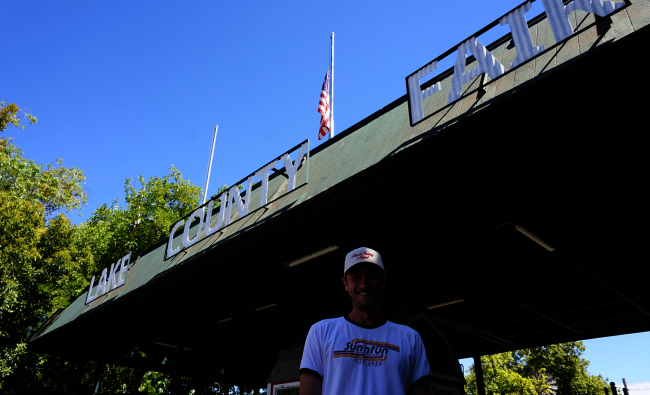
Lake County Fair Chief Executive Officer Drew Jacoby took over the job in February 2025. He has a background in event planning. Photo by Elizabeth Larson/Lake County News.

LAKEPORT, Calif. — While the theme for the 2025 Lake County Fair is “Blast from the Past,” the fair is something new for its recently hired chief executive officer.

Drew Jacoby has been on the job officially since February, calling Lake County, “the best kept secret of the Bay Area.” 

Previously a resident of Atlanta, he said he’s happy to be here and loves the small town feel and kind people. 

Jacoby enjoys his lunches at Howling Dog Cafe and dinners at recently opened Lakshmi Cuisine of India. 

Jacoby and his team are busy making final preparations to the fairgrounds at 401 Martin St.

This year, the fair will take place from Thursday, Aug. 28, through Sunday, Aug. 31.

On Thursday, Aug. 28, a traditional parade in downtown Lakeport will kick off the event with Congressman Mike Thompson as the grand marshal. 

With Lake County’s small town feel, the fair is something to look forward to every year. 

The fair will be keeping many traditions. Rides will be available with a cost of $33 for an unlimited pass. The typical fair food of corn dogs, cotton candy, and funnel cakes will be for sale — as well as some Mexican food stands, Thai food from Lakeport, and even fried bread tacos. 

The grandstand, the main stage of the fairgrounds, will have events Thursday to Sunday. 

On Thursday it will be the Junior Bull Riders Tour with mini bulls and more. On Friday, the Moto Xtreme Thrill Show will offer a blend of BMX events, freestyle motocross or FMX, and lots of fun performances for thrill seekers.

To keep with Lake County tradition, Saturday will include the highly anticipated boat races.

To end the fair on Sunday, the grandstand will host the Jaripeo, a Mexican rodeo.

It's a fair staff’s hope that everyone can find something to enjoy.

Lake County Fair Chief Executive Officer Drew Jacoby. Photo by Elizabeth Larson/Lake County News.


To keep with the “Blast from the Blast” theme, the fair will be doing something brand new this year. 

Back in 1999, the Upper Lake 4-H Club buried a time capsule to commemorate their lived experience in one of the barns at the fairgrounds.

To celebrate the capsule’s 25th anniversary, on Friday the capsule will be opened for the first time. Many alumni from the club will be in attendance to see what all was in there.

A new capsule is being created as well. Upper Lake 4-H Club members from 1999 to present will provide memorabilia for the new capsule’s contents.

Jacoby noted his excitement for the Junior Livestock Auction, most notably the tradition behind it. 

“While working with the committee, I noticed how far back the auction goes. We even have competitors whose families have been competing for three generations,” he said.

With the consistency of the fair giving people this opportunity to raise animals, there are approximately 200 students participating this year. 

Last year, over $750,000 was raised during the sale. Funds also were raised for the Lake County Fair Foundation from the auction. Jacoby is hopeful of making more money this year and for years to come. 

Another big draw of the fair is the flowers, plants, preserved foods and baked goods. Over 100 flowers have been submitted this year from gardens all over the county. 

The flowers are grown by the exhibitor and follow some guidelines such as nothing rotting and need to be grown in suitable containers. The different categories are arrangements, containers, beta fish gardens, cut flowers and even a filled 4-wheel wagon. 

While most of the floral competitions are looks alone, there are also ones that are judged on scent only. The plants are mainly judged on appearance and weight.

Lake County locals will be recognized for their homemade creations. The preserved foods and baked goods are judged on taste, flavor, aroma and appearance. Cakes, breads, various types of cookies, and muffins will all be on display. 

Additionally, jams, jellies, butter, honey, canned fruit, and various sauces will be judged. Dried food like jerky, fruits, and vegetables can also receive ribbons. 

While reflecting on the planning of the fair, Jacoby is full of nothing but gratitude. He’s happy to know the board of the fair “hired this city boy.” 

He’ll be spending the days of the fair walking around, introducing himself to the community and helping out vendors in any way he can. 

“The fairgrounds belong to this community. I’m just lucky to be the one organizing everything,” Jacoby said. 

He and his staff invite the community to come by the fair for some great food, laughs and fun for the whole family.

Prices on presale online and at some retailers at $9 for adults and $4 for children and senior citizens. On the day of, tickets are $12 for adults and $8 for children and senior citizens.

To buy tickets ahead of time, visit the fair’s ticket website.

Editor’s note: A previous version of this article incorrectly stated that the 1999 time capsule came from the Upper Lake High School senior class. In fact, it came from the Upper Lake 4-H Club. The article has been corrected.

Jordan O’Halloran writes feature stories for Lake County News.

An antique fire truck is part of the “Blast from the Past” theme and part of a display in Fritch Hall on the Lake County Fairgrounds in Lakeport, California. Photo by Elizabeth Larson/Lake County News.


Barry ‘The Fish’ Melton joins all-star cast at Blue Wing Blues Festival Labor Day Concert

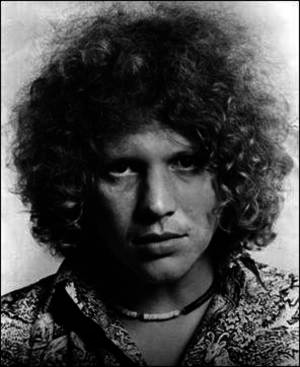
Music legend Barry Melton. Courtesy photo.


UPPER LAKE, Calif. — A musical legend is joining the line up for a Labor Day weekend music festival in Upper Lake.

The Blue Wing Blues Festival is a three-day annual event taking place over the Labor Day weekend starting at 6 p.m. each day in the shaded garden between the Tallman Hotel and Blue Wing Restaurant.

As a treat just added to the program, Barry “the Fish” Melton will be making a guest appearance with the veteran luminaries of The Blues Project Band as the grand finale to this year’s Festival on Labor Day Monday, Sept. 1.

Melton celebrated his 20th birthday in June 1967 during the “Summer of Love” in San Francisco.  

A few days later, he and his band, “Country Joe and the Fish,” were rocketed onto the world stage at the Monterey Pop Festival with such luminaries as the Jefferson Airplane, the Mamas and Papas, Otis Redding, Ravi Shankar, Simon and Garfunkel, the Who and a relatively unknown guitarist named Jimi Hendrix. 

And 50 years ago, in 1969, Melton appeared at the historic festival in Woodstock New York and is immortalized in the movie bearing the same name.

“These are my guys,” said Melton. “The Blues Project is a great band and I’m really looking forward to re-uniting with many of my old musical buddies and having a lot of fun at the Blue Wing Festival.”

The original Blues Project sold out venues from Greenwich Village to Bill Graham’s Fillmore Auditorium in the 1960s and 1970s.

Led by percussionist Roy Blumenfeld, the group includes guitarists David Aguilar and Mark Newman with Ken Clark on keys and Tim Eschliman on bass.

The admission price of $75 plus tax includes a barbecue dinner and an opening band (on Monday it will be San Francisco based Lucky Losers) plus a full barbeque dinner.

Tickets can be purchased online at eventbrite.com or by calling the Tallman Hotel at 707-275-2244.

Music legend Barry Melton. Courtesy photo.

Why America still needs public schools

While the White House’s fight with elite universities such as Columbia and Harvard has recently dominated the headlines, the feud overshadows the broader and more far-reaching assault on K-12 public education by the Trump administration and many states.

The Trump administration has gutted the Department of Education, imperiling efforts to protect students’ civil rights, and proposed billions in public education cuts for fiscal year 2026. Meanwhile, the administration is diverting billions of taxpayer funds into K-12 private schools. These moves build upon similar efforts by conservative states to rein in public education going back decades.

But the consequences of withdrawing from public education could be dire for the U.S. In our 2024 book, “How Government Built America,” we explore the history of public education, from Horace Mann’s “common school movement” in the early 19th century to the GI Bill in the 20th that helped millions of veterans go to college and become homeowners after World War II.

We found that public education has been essential for not only creating an educated workforce but for inculcating the United States’ fundamental values of liberty, equality, fairness and the common good.

In the public good

Opponents of public education often refer to public schools as “government schools,” a pejorative that seems intended to associate public education with “big government” – seemingly at odds with the small government preference of many Americans.

But, as we have previously explored, government has always been a significant partner with the private market system in achieving the country’s fundamental political values. Public education has been an important part of that partnership.

Education is what economists call a public good, which means it not only benefits students but the country as well.

Mann, an education reformer often dubbed the father of the American public school system, argued that universal, publicly funded, nonsectarian public schools would help sustain American political institutions, expand the economy and fend off social disorder.

an old greenish stamp has the face of a man in the center, with the words united states postage, 1 cent and Horace Mann
Horace Mann was a pioneer of free public schools and Massachusetts’ first secretary of education. traveler1116/iStock via Getty Images

In researching Mann’s common schools and other educational history for our book, two lessons stood out to us.

One is that the U.S. investment in public education over the past 150 years has created a well-educated workforce that has fueled innovation and unparalleled prosperity.

As our book documents, for example, in the late 18th and early 19th centuries the states expanded public education to include high school to meet the increasing demand for a more educated citizenry as a result of the Industrial Revolution. And the GI Bill made it possible for returning veterans to earn college degrees or train for vocations, support young families and buy homes, farms or businesses, and it encouraged them to become more engaged citizens, making “U.S. democracy more vibrant in the middle of the twentieth century.”

The other, equally significant lesson is that the democratic and republican principals that propelled Mann’s vision of the common school have colored many Americans’ assumptions about public schooling ever since. Mann’s goal was a “virtuous republican citizenry” – that is, a citizenry educated in “good citizenship, democratic participation and societal well-being.”

Mann believed there was nothing more important than “the proper training of the rising generation,” calling it the country’s “highest earthly duty.”

Attacking public education

Today, Mann’s vision and all that’s been accomplished by public education is under threat.

Trump’s second term has supercharged efforts by conservatives over the past 75 years to control what is taught in the public schools and to replace public education with private schools.

Most notably, Trump has begun dismantling the Department of Education to devolve more policymaking to the state level. The department is responsible for, among other things, distributing federal funds to public schools, protecting students’ civil rights and supporting high-quality educational research. It has also been responsible for managing over a trillion dollars in student loans – a function that the administration is moving to the Small Business Administration, which has no experience in loan management.

The president’s March 2025 executive order has slashed the department’s staff in half, with especially deep cuts to the Office for Civil Rights, which, as noted, protects student from illegal discrimination.

Trump’s efforts to slash education funding has so far hit roadblocks with Congress and the public. The administration is aiming to cut education funding by US$12 billion for fiscal year 2026, which Congress is currently negotiating.

And contradicting its stance on ceding more control to states and local communities, the administration has also been mandating what can’t and must be taught in public schools. For example, it’s threatened funding for school districts that recognize transgender identities or teach about structural racism, white privilege and similar concepts. On the other hand, the White House is pushing the use of “patriotic” education that depicts the founding of the U.S. as “unifying, inspiring and ennobling.”

A young female teacher monitors students working on a writing lesson.
The Trump administration has been increasingly mandating what teachers can and cannot teach in their classrooms. adamkaz/E+ via Getty Images

Promoting private education

As Trump and states have cut funding and resources to public education, they’ve been shifting more money to K-12 private schools.

Most recently, the budget bill passed by Congress in July 2025 gives taxpayers a tax credit for donations to organizations that fund private school scholarships. The credit, which unlike a deduction counts directly against how much tax someone owes, is $1,700 for individuals and double for married couples. The total cost could run into the billions, since it’s unclear how many taxpayers will take advantage.

Meanwhile, 33 states direct public money toward private schools by providing vouchers, tax credits or another form of financial assistance to parents. All together, states allocated $8.2 billion to support private school education in 2024.

Government funding of private schools diverts money away from public education and makes it more difficult for public schools to provide the quality of education that would most benefit students and the public at large. In Arizona, for example, many public schools are closing their doors permanently as a result of the state’s support for charter schools, homeschooling and private school vouchers.

That’s because public schools are funded based on how many students they have. As more students switch to private schools, there’s less money to cover teacher salaries and fixed costs such as building maintenance. Ultimately, that means fewer resources to educate the students who remain in the public school system.

Living up to aspirations

We believe the harm to the country of promoting private schools while rolling back support for public education is about more than dollars and cents.

It would mean abandoning the principle of universal, nonsectarian education for America’s children. And in so doing, Mann’s “virtuous citizenry” will be much harder to build and maintain.

America’s private market system, in which individuals are free to contract with each other with minimal government interference, has been important to building prosperity and opportunity in the U.S., as our book documents. But, as we also establish, relying on private markets to educate America’s youth makes it harder to create equal opportunity for children to learn and be economically successful, leaving the country less prosperous and more divided.The Conversation

Sidney Shapiro, Professor of Law, Wake Forest University and Joseph P. Tomain, Professor of Law, University of Cincinnati

This article is republished from The Conversation under a Creative Commons license. Read the original article.
  • 120
  • 121
  • 122
  • 123
  • 124
  • 125
  • 126
  • 127
  • 128
  • 129

Community

  • Lake County Wine Alliance offers sponsor update; beneficiary applications open 

  • Mendocino National Forest announces seasonal hiring for upcoming field season

Public Safety

  • Lakeport Police logs: Thursday, Jan. 15

  • Lakeport Police logs: Wednesday, Jan. 14

Education

  • Woodland Community College receives maximum eight-year reaffirmation of accreditation from ACCJC

  • SNHU announces Fall 2025 President's List

Health

  • California ranks 24th in America’s Health Rankings Annual Report from United Health Foundation

  • Healthy blood donors especially vital during active flu season

Business

  • Two Lake County Mediacom employees earn company’s top service awards

  • Redwood Credit Union launches holiday gift and porch-to-pantry food drives

Obituaries

  • Rufino ‘Ray’ Pato

  • Patty Lee Smith

Opinion & Letters

  • The benefits of music for students

  • How to ease the burden of high electric bills

Veterans

  • CalVet and CSU Long Beach team up to improve data collection related to veteran suicides

  • A ‘Big Step Forward’ for Gulf War Veterans

Recreation

  • Wet weather trail closure in effect on Upper Lake Ranger District

  • Mendocino National Forest seeking public input on OHV grant applications

  • State Parks announces 2026 Anderson Marsh nature walk schedule 

  • BLM lifts seasonal fire restrictions in central California

Religion

  • Kelseyville Presbyterian to host Ash Wednesday service and Lenten dinner Feb. 18

  • Kelseyville Presbyterian Church to hold ‘Longest Night’ service Dec. 21

Arts & Life

  • Auditions announced for original musical ‘Even In Shadow’ set for March 21 and 28

  • ‘The Rip’ action heist; ‘Steal’ grounded in a crime thriller

Government & Politics

  • Lake County Democrats issue endorsements in local races for the June California Primary

  • County negotiates money-saving power purchase agreement

Legals

  • March 3 hearing on ordinance amending code for commercial cannabis uses

  • Feb. 12 public hearing on resolution to establish standards for agricultural roads

How to resolve AdBlock issue?
Refresh this page