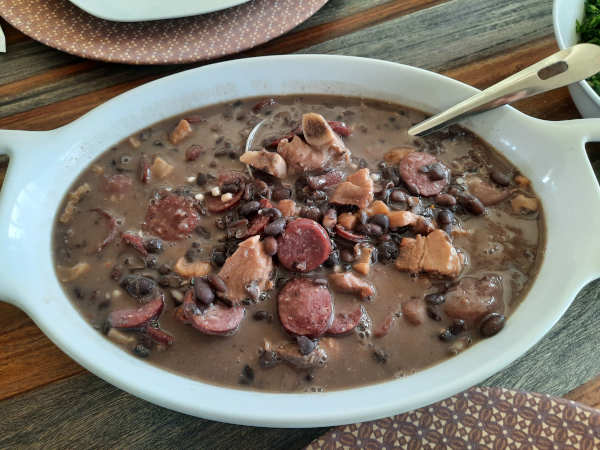
Feijoada, a stew made with black beans and pork, is sometimes called the national dish of Brazil. Photo by Esther Oertel.
LAKEPORT, Calif. — I was transported to Brazil on Thursday, though I didn’t have to travel far — just the 30 or so miles from Middletown to Lakeport.
I was connected by a colleague of mine to Euni Barbosa Sloan, a local Brazilian woman who is delightfully enthusiastic about dishes from her native land.
I was invited to join the two of them to sample feijoada (pronounced fay-jwa-da), a quintessential Brazilian stew and a specialty of Sloan’s, to whose home I had trekked.
The day was hot — near 100 in Lakeport — but it didn’t rival the warm welcome I received when I reached my destination and knocked on the door.
Brazilians are known for their friendliness (hospitality is characteristic of Brazil), and my host unquestionably embodied this trait. After being greeted with a hug I was ushered into the kitchen, where the components of our lunch were ready and laid out.
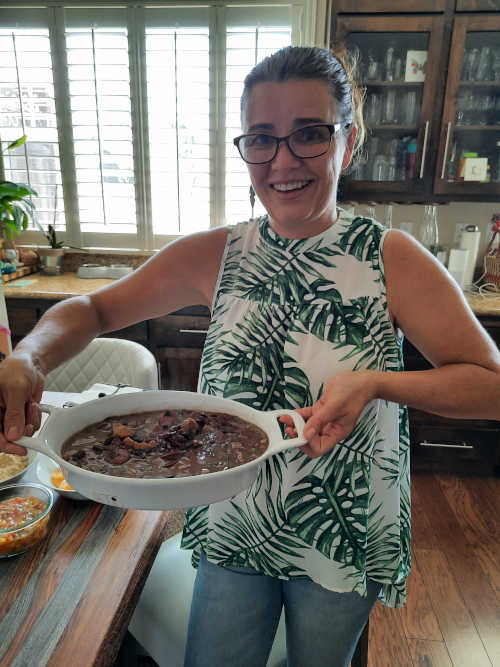
Euni Barbosa Sloan of Lakeport, California, hails from Brazil and enjoys making dishes from her homeland, such as this feijoada. Photo by Esther Oertel. Arrayed in front of me were bowls of traditional accompaniments to feijoada: succulent slices of orange, toasted cassava flour with bacon (known as farofa in Brazil), and a juicy salsa of sorts, made joyfully colorful by a rainbow of bell peppers.
Sloan piled white rice fresh from the stove into a bowl and ladled fragrant stew into a tureen. A mound of finely shredded deep green kale was put in a skillet to sauté, something done last minute to ensure its freshness.
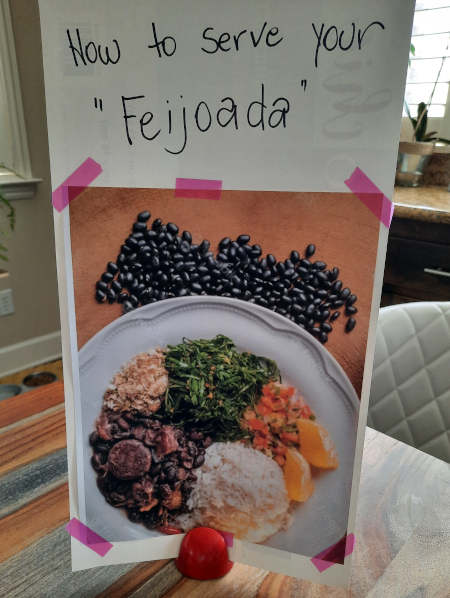
Since there are so many components to this dish, Sloan had printed a picture showing how to assemble one’s plate, something this novice appreciated.
Once our plates were full and we were ready to eat, talk turned to Sloan’s homeland. I learned a bit about its history and gained greater knowledge of its food.
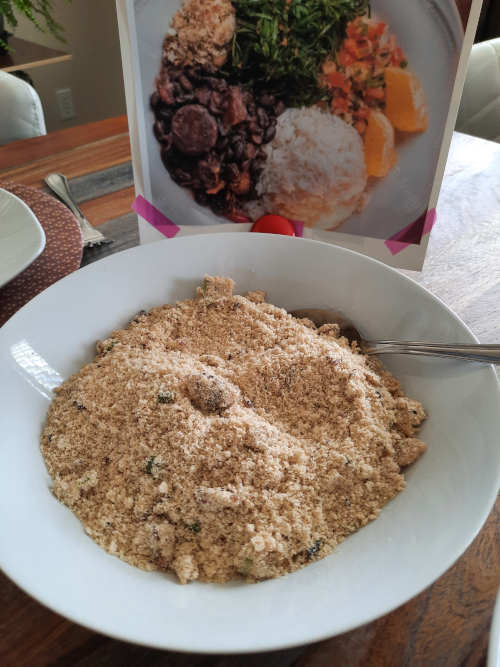
Farofa, a dish of toasted cassava flour with bacon, is a traditional accompaniment to feijoada, Brazilian black bean and pork stew. Photo by Esther Oertel. Brazilian cuisine is influenced by a mixture of European, Indigenous, and African ingredients and traditions.
Feijoada, a stew of black beans and pork, is sometimes called the national dish of Brazil. It likely originated with African slaves who worked on Brazil’s coffee, cotton and sugar cane plantations.
Its name stems from feijão, the word for black beans in Portuguese, the language of Brazil.
After the plantation owners had feasted on pork, slaves would use the leftovers, typically the “undesirable” parts such as the ears, tails and feet, to make a stew with black beans.
These days many eliminate the original parts used by slaves and substitute ribs, bacon and sausage; however, Sloan offers a nod to the initial configuration by adding a pig’s foot to the more modern version.
Her stew was rife with deep flavor, rich and smoky, and I found myself reaching for the tureen to replenish my plate. The juices of the black beans and pork mixed well with the graininess of the farofa, and the oranges, kale, and salsa provided balance by adding bright notes to the dish.
Dishes that traditionally accompany feijoada, Brazilian black bean stew, include kale, white rice, fresh oranges, salsa, and farofa, toasted cassava flour with bacon. Photo by Esther Oertel. It was a truly sublime experience, and I find myself thinking of the flavor even now, though I eat mostly plant-based foods.
Sloan enjoys cooking the dishes she grew up with in Brazil and strives to make them as authentic as possible, though it can be a challenge to find true Brazilian ingredients.
For example, in Brazil she makes feijoada with calabrese, a sausage that originated in Italy’s Calabria region, a reflection of the Italian influence in some of Brazil’s cuisine, particularly in the south.
In the U.S. she subs more available linguica or kielbasa, smoked sausages hailing from Portugal and Poland, respectively.
She often has luck finding ingredients at Bruno’s Shop Smart in Lakeport, but if all else fails, she orders what ingredients she can online.
Sloan refers to the cassava flour I mentioned as yuca flour (not to be confused with yucca, another plant with edible parts). Other names for the root from which this flour is made include manioc, mandioca, casabe and, as we may more commonly know it, tapioca.
In Portuguese, cassava flour is known as farinha de mandioca.
As to what food Sloan misses most, she longs for pão francés, a sourdough French bread warm from the bakery and spread with butter. I could almost taste it through her description. She’s been unable to find it here.
This is the traditional presentation of feijoada, Brazilian black bean and pork stew. Shown are accompaniments farofa (a toasted cassava flour dish with bacon), kale, salsa, fresh oranges and white rice. Photo by Esther Oertel. I learned of pastel, a thin crust savory or sweet Brazilian pastry filled with cheese, meat, or bananas and cinnamon, and coxinha, a Brazilian chicken croquette, which is a popular street food there.
I also learned that the custom in Brazil is to eat a heavy meal midday and a snack in the evening. Sloan has convinced her American husband to embrace this custom. Luckily he works nearby and can come home for lunch to enjoy his wife’s lavish cooking.
Our meal was finished with coffee and bolo de laranja, a rich Brazilian cake flavored with a whole orange, rind and all, that manages to be both dense and delicate.
Brazil is known for its passionate love of meats, and there are some Brazilian steakhouses and barbecue restaurants within driving distance, though not in Lake County. Napa, Sacramento, San Jose and San Francisco were mentioned by Sloan, and Brazilian food may also be available in nearby Sonoma County.
Sloan prepared feijoada for her husband’s birthday celebration less than two weeks prior to my visit, and I’m grateful she made it a second time for me. I deeply appreciate her valuable contributions to today’s column, as well as her warm Brazilian hospitality.
I also extend my sincerest thanks to Teresa Marks, a fellow literacy tutor and Lake County Literacy Coalition board member, for suggesting the subject and introducing me to Sloan.
Brazil, which occupies half of South America’s land mass, was ranked by Condé Nast Travel editors as the most beautiful country in the world. (This is no small task, to be sure.) As Condé Nast reports, with its many and delightful natural wonders, Brazil has “no shortage of grandeur.”
While I’ve never traveled to Brazil (I hope to someday), my visit to the Sloan residence, what I now think of as a local Brazilian outpost, was both grand and delightful.
Today’s recipes are generously shared by Sloan and are for her feijoada and Brazilian orange cake.
Feijoada (Brazilian black bean and pork stew)
1 pound dried black beans (soaked at least four hours or overnight), drained and rinsed 4 ounces slab bacon, rind removed, diced 1 pound pork ribs, cut into individual ribs 2 smoked sausages, such as linguica or kielbasa, sliced 4 ounces pork meat, cut into small pieces 1 pork foot, cut into small pieces 4 cloves garlic, minced 3 or 4 bay leaves Water, about 8 cups Oil for pot Salt to taste
Add oil to a large, heavy-bottomed soup pot. Add bacon and cook over medium heat until crisp. Transfer to a plate and set aside.
In the same pot, brown ribs and sausages in batches. Transfer to a plate and set aside.
If needed, add more oil to the pot and sauté garlic over medium heat until soft and fragrant, being careful not to burn, about a minute or less.
Add the beans, bacon, sausages, ribs, pork meat, pork foot, salt, and bay leaves to the pan. Cover with water, about 8 cups.
Bring the mixture to a boil and reduce the heat to low. Cover and let it cook for 2 to 2 ½ hours, or until the beans are soft.
If the stew has too much liquid, uncover the pot and continue cooking to allow some of the liquid to evaporate.
Bola de laranja is a dense yet delicate Brazilian orange cake flavored with a whole orange, including the rind. Photo by Esther Oertel. Bolo de Laranja (Brazilian orange cake)
1 whole orange with skin, cut into pieces with white pith removed 1 cup neutral oil (Sloan uses avocado oil) 4 eggs 2 cups sugar 2 cups wheat flour 1 tablespoon baking powder Powdered sugar for decoration
Grease and flour a tube pan.
In a blender or food processor, puree orange, oil, eggs and sugar. Set aside.
Mix flour and baking powder in a large bowl.
Add blended orange mixture to the bowl and incorporate well.
Pour into a greased and floured tube pan and bake at 360 degrees F for 30 minutes.
When cool, remove from the pan.
Lightly sprinkle powdered sugar over the cake to decorate.
Recipes by Euni Sloan.
Esther Oertel is a writer and passionate home cook from a family of chefs. She grew up in a restaurant, where she began creating recipes from a young age. She’s taught culinary classes in a variety of venues in Lake County and previously wrote “The Veggie Girl” column for Lake County News. Most recently she’s taught culinary classes at Sur La Table in Santa Rosa. She lives in Middletown, California.
LAKE COUNTY, Calif. — Authorities said two separate crashes in different parts of Lake County on Saturday resulted in fatalities.
The wrecks occurred near Middletown Saturday morning and Blue Lakes in the afternoon.
The first crash was reported at 8:40 a.m. on Highway 29 at Mirabel Road, south of Middletown.
Reports from the scene stated that the crash involved a large box truck carrying mail and a pickup.
There were two patients, one with moderate injuries and one with major injuries, with extrication needed, according to radio reports.
Shortly after 9 a.m., an air ambulance requested to the scene was canceled.
The California Highway Patrol confirmed the crash resulted in a fatality.
The CHP said the roadway wasn’t fully reopened until just before 1 p.m.
Shortly before 3 p.m., Northshore Fire and Cal Fire were dispatched to a head-on crash on Highway 20 just west of Blue Lakes Road that blocked the roadway.
Incident command reported that two vehicles were involved with a total of three patients, two with major injuries, one with moderate injuries. Two air ambulances were requested to respond.
The CHP also confirmed that the crash resulted in a fatality but additional information was not immediately available on Saturday.
The roadway was not fully reopened until shortly after 4:45 p.m., the CHP reported.
Additional information on the wrecks will be published when it becomes available.
LAKE COUNTY, Calif. — Lake County Animal Care and Control has more new dogs available to new families this week.
Dogs available for adoption this week include mixes of Australian cattle dog, basset, boxer, bulldog, husky, Labrador Retriever, pit bull, Rhodesian Ridgeback, Rottweiler, shepherd and terrier.
Dogs that are adopted from Lake County Animal Care and Control are either neutered or spayed, microchipped and, if old enough, given a rabies shot and county license before being released to their new owner. License fees do not apply to residents of the cities of Lakeport or Clearlake.
The following dogs at the Lake County Animal Care and Control shelter have been cleared for adoption (additional dogs on the animal control website not listed are still “on hold”).
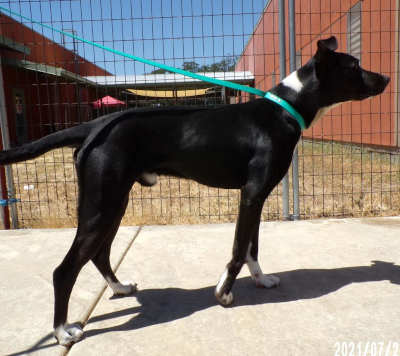
This 2-year-old male Labrador Retriever is in kennel No. 19, ID No. LCAC-A-1349. Photo courtesy of Lake County Animal Care and Control. Male Labrador Retriever
This 2-year-old male Labrador Retriever has a short black coat with white markings.
He is in kennel No. 19, ID No. LCAC-A-1349.
This 2-year-old female basset-husky-hound is in kennel No. 21, ID No. LCAC-A-1331. Photo courtesy of Lake County Animal Care and Control. Basset-husky-hound mix
This 2-year-old female basset-husky-hound has a short black and tan coat.
She is in kennel No. 21, ID No. LCAC-A-1331.
“Dusty” is a 2-year-old female pit bull terrier mix in kennel No. 22, ID No. LCAC-A-611. Photo courtesy of Lake County Animal Care and Control. ‘Dusty’
“Dusty” is a 2-year-old female pit bull terrier mix with a short gray coat.
She is in kennel No. 22, ID No. LCAC-A-611.
“Jim” is a 2-year-old pit bull terrier mix in kennel No. 23, ID No. LCAC-A-810. Photo courtesy of Lake County Animal Care and Control. ‘Jim’
“Jim” is a 2-year-old pit bull terrier mix with a short black and white coat.
He is in kennel No. 23, ID No. LCAC-A-810.
This 6-year-old male terrier is in kennel No. 24, ID No. LCAC-A-1149. Photo courtesy of Lake County Animal Care and Control. Male terrier
This 6-year-old male terrier has a short black coat.
He is in kennel No. 24, ID No. LCAC-A-1149.
“Rosco” is 3-year-old a male Rhodesian Ridgeback-Shepherd mix in kennel No. 25, ID No. LCAC-A-1205. Photo courtesy of Lake County Animal Care and Control. ‘Rosco’
“Rosco” is 3-year-old a male Rhodesian Ridgeback-Shepherd mix with a short tan coat.
He is in kennel No. 25, ID No. LCAC-A-1205.
This female Rottweiler-pit bull mix is in kennel No. 27, ID No. LCAC-A-731. Photo courtesy of Lake County Animal Care and Control. Rottweiler-pit bull mix
This 1-year-old female Rottweiler-pit bull mix has a short black coat.
She has been spayed.
She is in kennel No. 27, ID No. LCAC-A-731.
“Canelo” is a young male Australian cattle dog in kennel No. 28, ID No. LCAC-A-1348. Photo courtesy of Lake County Animal Care and Control. ‘Canelo’
“Canelo” is a young male Australian cattle dog with a short red and white coat.
He is in kennel No. 28, ID No. LCAC-A-1348.
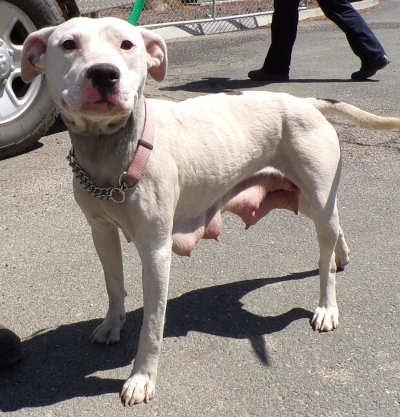
This 4-year-old female pit bull terrier mix is in kennel No. 29, ID No. LCAC-A-812. Photo courtesy of Lake County Animal Care and Control. Female pit bull terrier
This 4-year-old female pit bull terrier mix has a short white coat.
She is in kennel No. 29, ID No. LCAC-A-812.
“Bubba” is a male pit bull terrier mix in kennel No. 30, ID No. LCAC-A-1306. Photo courtesy of Lake County Animal Care and Control. ‘Bubba’
“Bubba” is a male pit bull terrier mix with a short black coat.
He is in kennel No. 30, ID No. LCAC-A-1306.
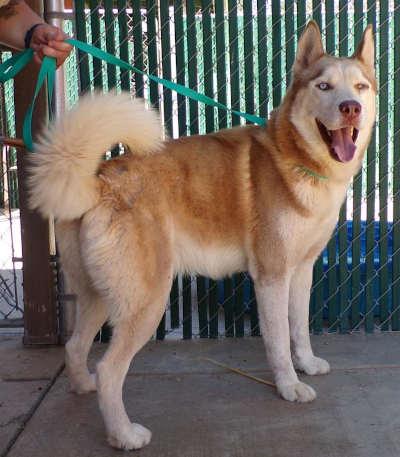
This 2-year-old male husky is in kennel No. 32, ID No. LCAC-A-1024. Photo courtesy of Lake County Animal Care and Control. Male husky
This 2-year-old male husky has a medium-length red and white coat.
He is in kennel No. 32, ID No. LCAC-A-1024.
“Dee” is a 1-year-old male shepherd mix in kennel No. 33, ID No. LCAC-A-1347. Photo courtesy of Lake County Animal Care and Control. ‘Dee’
“Dee” is a 1-year-old male shepherd mix with a black coat.
He’s in kennel No. 33, ID No. LCAC-A-1347.
“Ghost” is a 2-year-old female husky in kennel No. 34, ID No. LCAC-A-1167. Photo courtesy of Lake County Animal Care and Control. ‘Ghost’
“Ghost” is a 2-year-old female husky with an all-white coat and blue eyes.
She is in kennel No. 34, ID No. LCAC-A-1167.
Email Elizabeth Larson at This email address is being protected from spambots. You need JavaScript enabled to view it.. Follow her on Twitter, @ERLarson, or Lake County News, @LakeCoNews.
Team USA has sent 613 athletes from 46 states to this summer’s 2020 Olympic Games in Tokyo, which were postponed a year due to the pandemic.
California, the most populous state, is sending the most (126) but Colorado is sending more per capita (5.9 per million).
The full roster of the 2020 U.S. Olympic Team shows athletes by state, including their name, sport, hometown and event(s).
Competition (some baseball and soccer games) began on July 21, before the opening ceremony on July 23. The closing ceremony is Aug. 8.
These Olympics are featuring 339 medal events in 33 sports. Four sports are new this year: karate, skateboarding, sport climbing and surfing. Baseball and softball are returning for the first time since 2008.
Team USA athletes from 46 states
— California’s 126 athletes make up 20.5% of the U.S. team. Next are Florida (51), Colorado (34), Texas (31) and New York (27). On a per capita basis, Colorado (5.9 athletes per million population), Hawaii (5.7), and the District of Columbia (5.6) beat out all other states, including California (3.2).
— The nine states with populations over 10 million contributed 322 athletes (California, Texas, Florida, New York, Pennsylvania, Illinois, Ohio, Georgia and North Carolina). The seven states with populations under 1 million sent 10 (Delaware, South Dakota, North Dakota, Alaska, District of Columbia, Vermont and Wyoming).
— Aside from the 50 states, the District of Columbia is home to four athletes (men’s basketball, fencing, tennis and triathlon) and Puerto Rico to one (baseball). There’s even one Italian on Team USA (men’s water polo).
More U.S. sports facts
— In 2019, there were 39,297 fitness and recreational sports centers establishments in the United States. They employed 777,590 people with a $12 billion annual payroll.
— The United States had about 140,000 athletes, coaches and umpires out of a workforce of 114 million in 2019. That’s about 1,228 per million population.
A brief history about the Olympics and Japan
— The modern Olympics began in 1896 in Athens, Greece.
— The United States has hosted more Olympics than any other country: four Summer Games (1904, 1932, 1984, 1996) and four Winter Games (1932, 1960, 1980, 2002).
— Japan has hosted four Olympics, tied for third with Italy: two Summer Games (1964 and 2020 held this year) and two Winter Games (1972 and 1998).
— During these Olympics, Japan is expected to host 11,238+ athletes from 206 countries. The official Games motto: United by Emotion.
— Tokyo is the largest metropolitan area in the world with a population of 38.14 million in 2016.
— Japan is ranked 11th with a 2021 population of 124.7 million.
The next three Summer Games are set to be held in 2024 in Paris, 2028 in Los Angeles and 2032 in Brisbane, Australia.
India, the second most populous country in the world, has never hosted the Olympics. Neither has any country on the continent of Africa.
Derick C. Moore is a senior communications specialist in the Census Bureau's Communications Directorate.
This mini-panorama combines two photographs taken by Apollo 15 lunar module pilot Jim Irwin, from the Apollo Lunar Surface Experiments Package (ALSEP) site, at the end of the second Apollo 15 moonwalk on August 1, 1971. Scott is leaning to his right and is putting down the Apollo Lunar Surface drill used to take core samples and set up a heat flow experiment. The Solar Wind Spectrometer is in the right foreground. The min-pan of photographs AS15-11845 and 11847 was combined by Erik van Meijgaarden, volunteer contributor to the Apollo Lunar Surface Journal site. Credits: Erik van Meijgaarden. Fifty years ago, Apollo 15 lifted off from Kennedy Space Center, sending Commander David R. Scott, Command Module Pilot Alfred M. Worden, and Lunar Module Pilot James B. Irwin on the first of three Apollo “J” missions.
These missions gave astronauts the opportunity to explore the Moon for longer periods using upgraded and more plentiful scientific instruments than ever before. Apollo 15 was the first mission where astronauts used the Apollo Lunar Surface Drill, or ALSD, and the Lunar Roving Vehicle, or LRV.
Scott and Irwin would land on the Moon and use the ALSD at the site where they set up several scientific instruments during the nearly 67 hours they were on the surface of the Moon.
The tool was a rotary-percussive drill that used a combined motion that hammered a rotating drill bit into the surface to make a hole.
The overall purpose of gathering core samples was part of NASA’s lunar geology studies to learn more about the composition of the Moon and discover more about its history by looking at different kinds of rocks, including some from below the surface.
Now, NASA is going back to the Moon as part of the agency’s Artemis missions and has a new drill headed to the lunar surface as a commercially delivered payload via the Commercial Lunar Payload Services initiative.
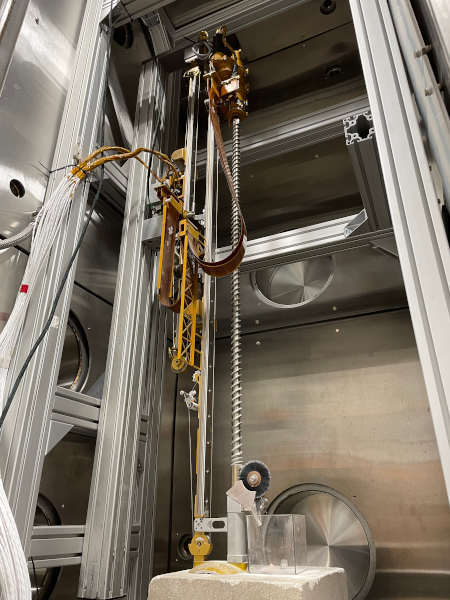
The Regolith and Ice Drill for Exploring New Terrain, or TRIDENT, is key to locating ice and other resources on the Moon.
“Honeybee Robotics designed the TRIDENT drill for NASA to sample lunar regolith,” said Amy Eichenbaum, the Polar Resources Ice Mining Experiment-1, or PRIME-1, deputy project manager. “TRIDENT will help understand the physical properties of the lunar regolith while also allowing analysis of the resources present in samples taken from various depths.”
TRIDENT is also a rotary-percussive drill, but one major difference between it and its Apollo counterpart is that TRIDENT does not need astronauts to operate it manually.
Honeybee Robotics originally partnered with NASA through the Small Business Innovation Research program, a highly competitive program that encourages small businesses to engage in federal research.
The Regolith and Ice Drill for Exploring New Terrain (TRIDENT) Engineering Development Unit performs recent testing at Honeybee Robotics. TRIDENT is a drill on the Polar Resources Ice Mining Experiment-1 (PRIME-1), the first in-situ resource utilization demonstration on the Moon, scheduled to take flight in late 2022. Credits: Honeybee Robotics. PRIME-1 will be the first in-situ resource utilization demonstration on the Moon. For the first time, NASA will robotically sample and analyze for ice from below the surface.
PRIME-1 will use TRIDENT to drill in a single location at a site with a high likelihood of having water – whether in liquid or ice form.
It will drill down about 3 feet below the surface, each time bringing up samples that NASA will analyze with a scientific instrument — the Mass Spectrometer observing lunar operations, or MSolo.
“MSolo will measure water ice and other volatiles released from the sample brought to the surface by the TRIDENT drill,” said Dr. Janine Captain, the principal investigator for MSolo. “These measurements will help us start to understand the distribution of resources on the lunar surface, a key to enabling a long-term presence on the Moon.”
Apollo 15 landed near the Hadley Rille, a long, deep channel-like gorge in the Moon’s surface, which was at the base of the Apennines Mountains to the north of the Moon’s equator.
PRIME-1’s destination is the Moon’s South Pole — new territory far from all the Apollo landing sites — a location very interesting because NASA has previously detected water there from space.
However, gathering more accurate data requires PRIME-1, like ALSD, to land and drill into the surface to examine what is there.
What PRIME-1 discovers will help to update resource models for where explorers are most likely to find water on the Moon.
About a year after the PRIME-1 mission, NASA will send an exploratory rover — Volatiles Investigating Polar Exploration Rover, or VIPER — to the surface.
VIPER is NASA’s first mobile robotic mission to the Moon, and will carry a TRIDENT drill and scientific instruments that enable it to directly analyze water ice on the surface and subsurface of the Moon at varying depths and temperature conditions. VIPER will explore multiple sites on the lunar South Pole for about 100 days.
PRIME-1 and VIPER will build upon the legacy of Apollo 15 by using drills and rovers, allowing NASA the chance to look below the surface and detect what is there.
Much like Apollo 15, NASA is preparing to send new capabilities to the Moon that will enable people to stay there for longer than ever before, because learning how to find and use water is a key to living and working on the Moon and other deep space destinations.
“The Apollo missions first introduced the concept of drilling to provide subsurface understanding of a foreign world,” said Dan Andrews, VIPER Project Manager. “PRIME-1 and VIPER will expand the state of the art as we look to a future of sustainable exploration and learning how to live off the land.”
Leejay Lockhart works for NASA's Kennedy Space Center.
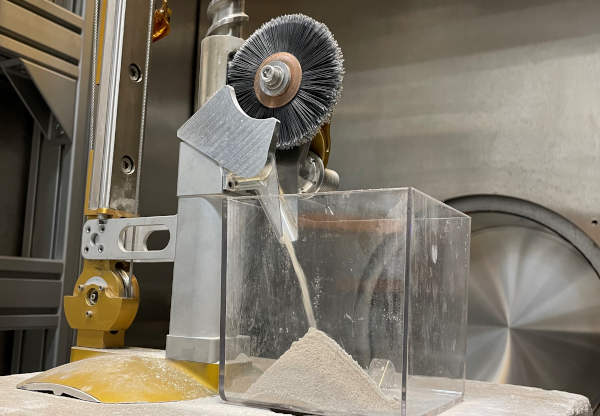
The brush assembly for The Regolith and Ice Drill for Exploring New Terrain (TRIDENT) Engineering Development Unit shown in close up during recent testing at Honeybee Robotics. TRIDENT is a drill on both the Polar Resources Ice Mining Experiment-1 (PRIME-1) the first in-situ resource utilization demonstration on the Moon and Volatiles Investigating Polar Exploration Rover, or VIPER, NASA’s first mobile robotic mission to the Moon. Credits: Honeybee Robotics.
LAKE COUNTY, Calif. — Health officials said Lake County’s COVID-19 caseload has reached such critically high levels that the emergency departments at Sutter Lakeside Hospital in Lakeport and Adventist Health in Clearlake have now been significantly stretched for more than a week.
The Lake County Health Services Department has received reports that some people with mild symptoms that can be associated with COVID-19 have continued to utilize local emergency rooms for COVID testing. Others have sought vaccination at our hospitals.
“As a small, rural county, we have limited intensive care and emergency medicine resources. They must be reserved for those in medical distress; those in need of immediate care. Overutilization of these resources extends wait times, and delays care for those in the greatest need,” said Charlie Evans, MD, Lake County’s acting Public Health officer.
“At this time, we ask people with mild symptoms to please contact their medical providers and nursing advice lines, rather than going straight to the emergency room,” said Evans. “If you are in need of immediate medical care, go to the ER. However, if you are mildly ill, use alternative resources.”
OptumServe at Lower Lake Town Hall, 16195 Main St.: Mondays and Thursdays, 7 to 11 a.m. and noon to 4 p.m. Appointments are highly recommended, limited on-site registration is available.
Lake County Tribal Health offers testing by appointment to established patients with or without symptoms. For appointments, call 707-263-8382.
Clearlake VA Clinic is offering COVID-19 tests to veterans experiencing symptoms or prior to procedures. Please call the TLC line at 800-733-0502 for information.
Quest Diagnostics offers home testing by mail. Visit https://questdirect.questdiagnostics.com/ for information and to see if you're eligible for $0 out-of-pocket-testing. (Quest Diagnostics in Lakeport is not offering in-lab testing for active COVID-19.)
Sutter Health (outpatient clinics) are offering testing to existing patients, if ordered by your provider. Please contact your provider's office for details.
Adventist Health is offering testing to existing pediatric patients (children) in limited circumstances. Please contact your provider's office for details.
Lake County Public Health will test by appointment on Tuesdays and Wednesdays from 8:30 to 11:30 a.m. Call 707-263-8174 to schedule or for information.
 How to resolve AdBlock issue?