How to resolve AdBlock issue?
News
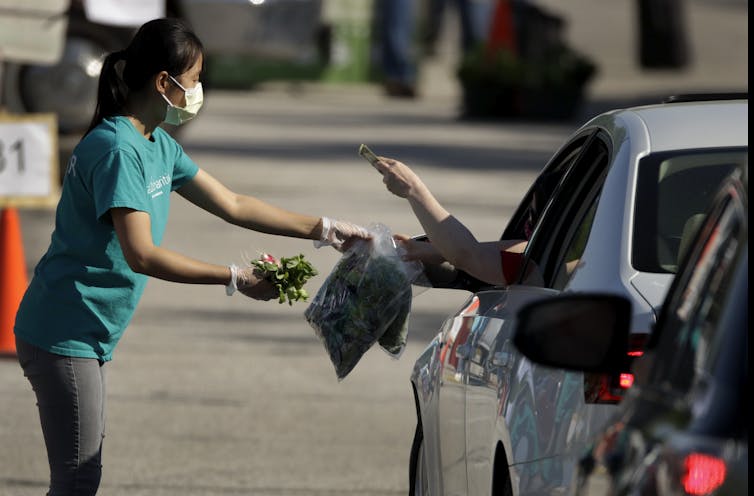
For many Americans, buying fresh local food at one of the estimated 9,000 farmers markets across the U.S. is one of summer’s pleasures. But farmers markets aren’t just nice amenities. Over the past 18 months, many have filled food supply gaps caused by COVID-19 shutdowns.
While numerous farmers markets shut down at the start of the pandemic, many soon reopened under state or local guidelines that mandated masks, social distancing and other precautions.
When grocery store supply chains were disrupted, consumer interest in local foods spiked, along with concerns about exposure to the coronavirus while shopping. Farmers market managers adapted swiftly, experimenting with options like prepackaged goods and drive-thru pickup.
In fact, many farmers markets enjoyed their strongest-ever sales in 2020. Affluent shoppers became more interested in buying local food, while lower-income buyers were able to use federal benefits like the Supplemental Nutrition Assistance Program. Stepping into this expanded role was no mean feat – but we know from our research in city planning and urban food systems that with adequate support, marketplaces respond vigorously to crises and opportunities.
The fall and rise of urban farmers markets
Farmers have been selling their goods at public markets in the U.S. for centuries. Many U.S. cities evicted or sidelined street vendors in the mid-20th century to make room for large-scale retail stores. But in the 1970s and ‘80s, farmers markets started reappearing in middle-class communities and suburbs.
This resurgence, which reflected the rise of the environmental movement, was most evident in university towns like Berkeley, California, and Madison, Wisconsin. In these communities, restaurants, farmers markets and educated consumers converged around the idea of eating locally produced food. Consumers wanted to taste flavors they remembered from childhood, and a new generation of growers were learning and practicing ecologically friendly farming methods.
At the same time, the U.S. Department of Agriculture became interested in the related phenomena of organic products and local foods sold directly to consumers. In the 1990s, the agency began to document the number of U.S. farmers markets.
Cities like Des Moines, Iowa, and San Antonio began to promote “placemaking” initiatives around markets, using them to help create quality public spaces. By the 2000s multifunctional markets became common, often serving racially and economically diverse populations.
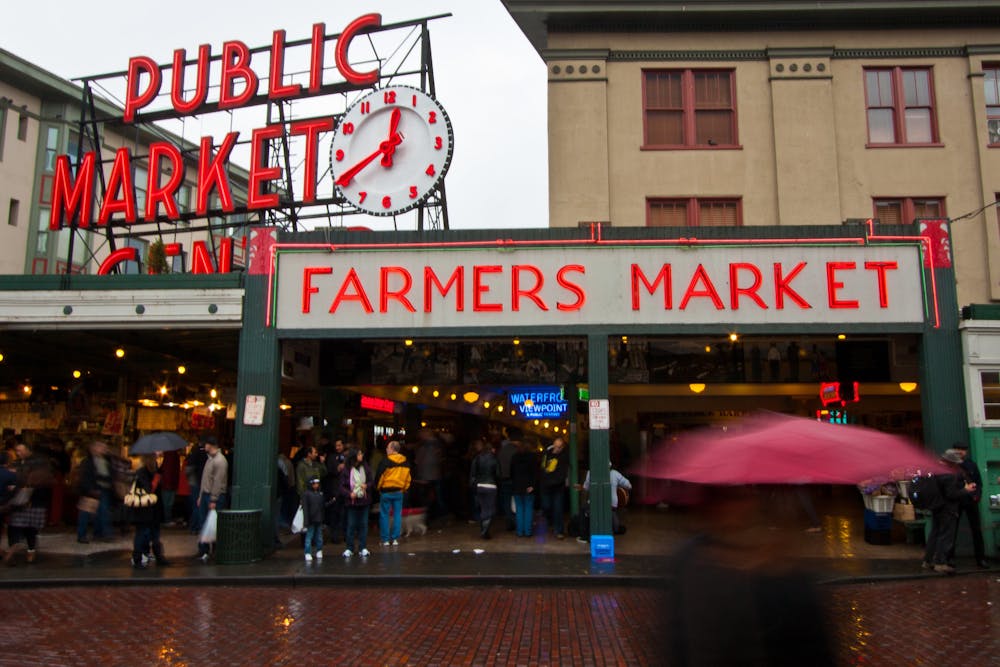
For example, by 2019 Chicago had 27 outdoor farmers markets across the city, offering goods such as clothing and furniture along with food. Some cities repurposed sites such as fairgrounds and drive-in theaters to house outdoor markets.
Governments began to view markets as policy tools for promoting food security, fostering new farmers and supporting place-based community development. Advocacy organizations supporting farmers markets also emerged to help markets attract public and private support. In 2008 the Farmers Market Coalition, a California-based nonprofit, was launched to represent markets around the country.
Filling COVID gaps
The pandemic worsened food insecurity in the U.S., where it already was a serious concern. A lack of reliable access to healthy food contributes to many long-term health issues, and has severe implications for child development.
According to the nonprofit organization Feeding America, food insecurity in the U.S. rose dramatically because of the pandemic. In 2020, 45 million people – including 15 million children – experiencing food insecurity, up from 35 million in 2019.
Farmers markets have become important tools for reducing food insecurity over the past 15 years. Most studies that measure food access focus on two factors: households’ proximity to food sources and access to transportation. Food sources can include supermarkets, discount stores, convenience stores, farmers markets and food pantries. Among these options, consumers purchase healthy food mostly at supermarkets and farmers markets.
Federal funding distributed through the U.S. Department of Agriculture transformed food security during the COVID-19 pandemic. The Coronavirus Food Assistance Program took a variety of steps to move locally and regionally produced food into schools, food banks and farmers markets.
About US$19 billion went to these various outlets. Farmers markets helped to expand access to food, with most states declaring them to be essential services.
While there are no uniform national statistics, surveys and media reports show that many food-insecure people shopped at farmers markets during the pandemic. A survey by the Farmers Market Coalition found that in the summer of 2020, purchases using SNAP benefits – the largest federal food assistance program – increased over 2019 levels at nearly 40% of markets that responded. From central Texas to western North Carolina to Connecticut, farmers markets reported dramatic increases in customers using SNAP and Pandemic Electronic Benefits Transfer cards.
Farmers markets for the 21st century
As the pandemic showed, farmers markets make communities more resilient during catastrophic events. We are working to help markets become more effective and efficient so that they can play even larger roles in their communities.
We have developed a toolkit called Farm 2 Facts for market managers to help them collect and analyze economic, ecological and other data to address a wide range of questions. For example, markets have used the program to track visitor counts and demographic trends, conduct outreach to low-income and minority shoppers and estimate the markets’ local economic impacts.
We also are developing ecosystem metrics to help farmers and markets educate consumers about farmers markets’ important ecological benefits. This tool will enable farmers to measure how their products promote environmental goals such as biodiversity and soil health.
[Over 100,000 readers rely on The Conversation’s newsletter to understand the world. Sign up today.]
Technology investments are helping farmers markets to grow. One priority is having the capability to process electronic benefits transactions so that the markets can serve customers at all income levels. And decision-support software like Farm 2 Facts can help them document how farmers markets promote health, equality and sustainability.
The next time you visit a farmers market, look past the corn and cucumbers. You’ll see an organization that’s promoting health and wellness, contributing to the local economy and bringing people together.
Edna Ledesma, Assistant Professor of Planning and Landscape Architecture, University of Wisconsin-Madison and Alfonso Morales, Vilas Distinguished Achievement Professor of Planning and Landscape Architecture, University of Wisconsin-Madison
This article is republished from The Conversation under a Creative Commons license. Read the original article.
Brittany Marie Turner, 31, was identified as the crash victim, said Lt. Corey Paulich of the Lake County Sheriff’s Office.
In its Wednesday report on the crash, the CHP’s Clear Lake Area office said the crash occurred at 2:50 p.m. Saturday on Highway 20 west of Blue Lakes Road.
Brittany Turner was driving a 1997 Mazda Protege sedan eastbound with 34-year-old Patrick Turner of Ukiah riding as her passenger, the CHP said.
Driving westbound and approaching the Mazda was 18-year-old Robert Fetzer of Redwood Valley in a 2001 Volkswagen Jetta, with passenger Taylor Travis, 19, of Ukiah, the CHP said.
The CHP said that for reasons still under investigation, Brittany Turner’s Mazda sedan crossed over the solid double yellow lines and collided head-on into Fetzer’s Volkswagen.
Both vehicles became disabled within the westbound lane, the CHP said.
The CHP said Brittany Turner was extricated from the vehicle but, after life saving measures, she succumbed to her injuries on scene.
Neither alcohol nor drugs are suspected with the parties involved in the crash, the CHP said.
The CHP said Patrick Turner, who was not using his safety equipment, suffered major injuries. Fetzer had minor injuries, as did Travis.
The crash at Blue Lakes was the second fatal automobile wreck in Lake County on Saturday. Earlier in the day, a Hidden Valley Lake man died after his pickup was hit by a box truck near Middletown, as Lake County News has reported.
Email Elizabeth Larson at
William James Wight, 51, was identified as the man who died in the wreck, said Lt. Corey Paulich of the Lake County Sheriff’s Office.
The California Highway Patrol’s Clear Lake Area office said in a Wednesday report that the crash happened at 8:37 a.m. Saturday on Highway 29 south of Mirabel Road.
Frederick Gibson II, 34, of Roseville was traveling north on Highway 29 in a 2016 International truck, the CHP said. Reports from firefighters at the scene said the vehicle was a large box truck carrying mail.
At the same time, Wight was driving a 2020 Ford pickup truck southbound, the CHP said.
The CHP said that for an undetermined reason, Gibson allowed his truck to travel off the east road edge.
When Gibson reentered the road, the truck traveled out of control across both lanes of traffic, broadsiding Wight’s pickup on the west shoulder, the CHP report said.
The report said Wight had attempted to avoid the crash by moving his pickup onto the west shoulder.
The CHP said Wight died of his injuries at the scene.
Gibson suffered minor injuries in the crash, according to the report.
Alcohol and drugs were not factors in the crash, the CHP said.
The crash was the first of two fatal wrecks reported in Lake County on Saturday. Later in the day, a Ukiah woman would die in a head-on wreck on Highway 20 at Blue Lakes.
Email Elizabeth Larson at
Supervisor Jessica Pyska, who last month presented a resolution urging Lake County residents to mask in indoor public settings as the case rate started to rise, brought the urgency ordinance requiring masking in county-run facilities, regardless of vaccination status.
Pyska, the newest member of the board, also helped start the meeting by asking the community to contemplate how to work through fears, anxieties and anger and come together to fight the COVID-19 battle on a united front as a prelude to the board’s moment of silence.
Before taking up the urgency ordinance, the supervisors got a COVID-19 situational update from Dr. Gary Pace, formerly the county Public Health officer, and epidemiologist Sarah Marikos.
Pace, who left his position with the county in the spring, is now back in clinical practice. He gave the update as Dr. Charlie Evans, the acting county Public Health officer, traveled to Kenya this week to work at a clinic he helped found there.
Pace, now sporting a full white beard, said the situation in Lake County right now is “very concerning.”
The state COVID-19 case statistics dashboard on Tuesday showed Lake County continued to lead California for its cases per 100,000. For a seven-day average, the county is now at 57 cases per 100,000. That rate has tripled over the last three weeks.
It was also reported on Tuesday that both hospital intensive care units were full, with the Sutter emergency room having more COVID-19 patients than ER beds.
The concerns were further explained in Mariko’s report, which noted that Lake County has had its 66th death over the past week, the third in the past month. She said Lake County also had the highest COVID-19 case rate statewide for all of July.
As of July 31, there were 13 Lake County residents hospitalized for COVID-19, numbers that Marikos said are reaching the county’s winter surge. Those numbers, she added, don’t cover patients transported out of the county.
At the same time, she said only about 53% of eligible Lake County residents are vaccinated.
However, Marikos noted some good news — indications are that vaccinations are increasing across Lake County and California as a whole.
Pace said the situation is worrisome, with a lot of vulnerable, unvaccinated people.
“The most important thing to remember is that the vaccine continues to be very protective against serious illness and death. This is really a blessing,” said Pace.
He said the situation has become more confusing for the public because some vaccinated people are getting the virus.
Pace said the data is very clear that 90% of people in hospitals are unvaccinated and tend to be younger, ranging from those in their 20s to 40s. At the same time, the Delta variant appears to be much more contagious than originally believed, so vaccinated people can get and spread it.
Masking discussions are the result, with Pace saying that vaccination is not adequate to stop the spread. He suggested that had the county not had the vaccination push over the last several months, the hospitals would probably be overwhelmed.
Pace said many Bay Area health departments are making indoor masking mandatory now, with businesses responsible for enforcing the mandates. He added he thinks indoor masking is only common sense.
Looking ahead to September and October, Pace said it should be expected to get worse.
He said new things are being learned everyday about the virus. “This virus is changing, the guidance is evolving and we’re probably not going to be reaching herd immunity anytime soon.”
As such, Pace said we’ll be dealing with COVID-19 for awhile, and eventually our immune systems will get used to it, like flu or the common cold. “Right now our immune systems have not seen this thing before and we’re struggling to keep up with it.”
Pace encouraged everyone to take the situation very seriously, noting the community is now in a new phase and things are becoming more complicated.
Supervisor Tina Scott asked about putting back up barriers. Pace said he thinks barriers help, however, they primarily prevent droplet spread. That doesn’t address the aerosol component, the tiny particles that stay in the air and circulate. “The mask is preferable. The mask is better.”
“We’re clearly in a dangerous place right now,” said Pyska, noting her worries for people and the economy.
Three people have died this month. “That is real,” she said, and she said connecting those statistics to faces might convince people that the pandemic is a reality.
“Ultimately we have to come together and we have to work through this as a community,” and that’s difficult when so much disinformation swirling around us, said Pyska.
Board discusses urgency ordinance, workplace rules
In introducing the urgency ordinance, which was added as an extra item to the Tuesday agenda, Pyska said it was time for the board to make the difficult position to return to masking in county facilities, just like the Superior Court had done on the courthouse’s fourth floor.
She said the county is having outbreaks within its ranks, with staff out and quarantining or recovering, and they can’t risk productivity.
“This is a temporary Band-Aid fix until more of our county can become vaccinated and we can begin to move out of this pandemic together. We’ve done this before and we can do this again,” said Pyska.
County Administrative Officer Carol Huchingson said she polled more than 20 department heads on the urgency ordinance and got 18 responses. Of those, 17 supported the masking proposal and one said they would uphold it if the board passed it. The president of the county’s largest employee union also offered her support.
Board Chair Bruno Sabatier said he wanted a trigger for when masking would no longer be necessary.
Huchingson said the ordinance language had a trigger — that masking must be observed while the present COVID-19 State of Emergency continues to exist, or until otherwise ordered by the Board of Supervisors. However, Sabatier wanted something more specific, like a case number threshold, pointing out that the county has been in an emergency for 18 months.
Sheriff Brian Martin said he also supported it, but like Sabatier he wanted a trigger.
County Counsel Anita Grant said some care should be taken to determine a trigger, explaining that another set of circumstances could arise that could make it a good idea to continue the urgency ordinance.
County Librarian Christopher Veach told the board he agreed with requiring everyone to mask.
Veach explained that the honor system with regard to requiring unvaccinated visitors to mask isn’t working. He said many people are entering the libraries unmasked who are likely unvaccinated, such as children.
As a result, Veach said he’s heard from library patrons or staff who are concerned about CVOID-19 and who feel that the library is not a safe place.
Pyska offered the urgency ordinance, which the board approved 5-0. It went into effect immediately and will remain in effect for 45 days unless the board decides to end it earlier or extend it.
Also on Tuesday, Human Resources Director Pam Samac presented an updated county COVID-19 workplace protocol that, in anticipation of the masking urgency ordinance’s approval, required staff and the public entering the building to immediately begin masking.
The board voted unanimously to add that item as an extra item as Huchingson said it was necessary to keep the protocol in line with the urgency ordinance.
Sabatier raised his concerns about exceptions in the updated protocol, such as allowing staff to drink and eat together unmasked in break rooms.
Sheriff Martin also raised questions about exceptions, noting challenges his dispatchers had with masking.
Huchingson said county staff had managed masking for months, and questioned why it couldn't now be managed.
To help clarify the situation, and to ensure the protocol was properly in line with the ordinance, at Grant’s suggestion the board voted to reopen the urgency ordinance discussion, adding a line that said the board directed the Count Administrative Office to prepare protocols to carry out the mandate in a manner reasonable for county employees, subject to board approval.
The board approved the urgency ordinance with those changes and then returned to the workplace protocol discussion, approving it unanimously.
Email Elizabeth Larson at
The council will meet in closed session at 5 p.m. Thursday, Aug. 5, to discuss potential litigation as well as a lawsuit against the county treasurer-tax collector and an opioid lawsuit against Amerisourcebergen Drug Corp. and hold negotiations with Burbank Housing Corp. for property at 6885 Old Highway 53, before the public portion of the meeting begins at 6 p.m. in the council chambers at Clearlake City Hall, 14050 Olympic Drive.
The meeting will be broadcast live on the city's YouTube channel or the Lake County PEGTV YouTube Channel. Community members also can participate via Zoom or can attend in person.
The agenda can be found here.
Comments and questions can be submitted in writing for City Council consideration by sending them to City Clerk Melissa Swanson at
To give the council adequate time to review your questions and comments, please submit your written comments before 4 p.m. on Thursday, Aug. 5.
Each public comment emailed to the city clerk will be read aloud by the mayor or a member of staff for up to three minutes or will be displayed on a screen. Public comment emails and town hall public comment submissions that are received after the beginning of the meeting will not be included in the record.
The council on Thursday will present a proclamation promoting tolerance, respect, equity and inclusion, and get an update on the progress of the city’s 2021 Chip Seal Project.
Under council business, the council will be asked to approve the sale of its franchise waste hauler, Clearlake Waste Solutions, to Waste Connections.
City Manager Alan Flora’s report to the council notes that the city entered into a franchise agreement with Clearlake Waste Solutions in 2011 for waste services.
“The franchise agreement requires that the City approve any sale of stock outside of the three primary stockholders. The owners have negotiated a sale to Waste Connections in July and are asking for the City’s approval of the sale,” Flora said.
He said city representatives have met with both the owners of Clearlake Waste Solutions and representatives of Waste Connections.
After the sale Waste Connections will be hiring Bruce McCracken, the vice president of Clearlake Waste Solutions, to run the company locally, and the name and other operations of Clearlake Waste Solutions will remain the same.
“Staff believe that with the retention of Mr. McCracken and the process of allowing continued local control of the operations, the positive partnership the City has enjoyed with Clearlake Waste solutions will remain in place,” Flora wrote.
In a letter written to Flora dated July 14, McCracken and David Carroll, Clearlake Waste Solutions’ president, wrote that due to factors including increasing costs and the ever-changing regulatory environment, they had been considering a “stronger partner.”
Ultimately, they chose the Texas-based Waste Connections US Inc., whose subsidiaries serve 25 other California communities.
“Why WCI? We chose WCI as our suitor because of their proven commitment to staying local,” McCracken and Carroll wrote.
They added, “WCI ownership provides everything necessary to ensure the continued strength and success of both CWS and the CIty of Clearlake.”
Also on Thursday, staff also will update the council regarding the status of ongoing Code Enforcement cases at 14541 and 14525 Lakeshore Drive and consider rejecting bids for the Sulphur Fire Roadway Disaster Repair Project.
In other business, the council will consider authorizing the city manager to prepare and submit two program income only applications for $420,000 through the California Housing and Community Development CDBG Program for the Senior Community Center Rehabilitation Project and Red Bud Park Facilities Improvement and Safety Enhancement Project; consider a resolution certifying the appointment of David Deakins as Building Inspector II; hold the first reading of Ordinance No. 256-2021, an amendment to Chapter 17 of the Clearlake Municipal Code repealing and replacing floodplain management regulations, and consider joining the Joint Powers Authority of the Lake County Community Risk Reduction Authority.
On the meeting's consent agenda — items that are not considered controversial and are usually adopted on a single vote — are warrants, minutes of the June 9 Lake County Vector Control District Board meeting, continuation of the declaration of local emergency issued on March 14, 2020, and ratified by council action on March 19, 2020, for COVID-19, and continuation of the declaration of local emergency issued on Oct. 9, 2017, and ratified by council action Oct. 12, 2017, for the Sulphur fire.
Email Elizabeth Larson at

LAKEPORT, Calif. — Some of the best grillers in Lake County will fire up their barbecues and pit their skills against one another Saturday, Aug. 7, in one of the hottest contests this summer, and the public is invited to help choose the winners.
Attendees will enjoy samples and cast votes for their favorite grillers while supporting improvements at Westside Community Park at this year’s “Grillin’ on the Green,” returning after the COVID-19 pandemic canceled the 2020 event.
Barbecue amateurs and experts will vie for bragging rights during the family fun event at the park, 1401 Charlie Jolin Way, between 5 and 7:30 p.m.
Additionally, the popular barbecue competition will feature plenty of food, drink, and entertainment for all ages.
Presented by the Westside Community Park Committee, the event is an annual fundraiser for development of the park, which is home to soccer fields, a dog park, baseball and softball diamonds, horseshoe pits, and a bicycle pump track.
The committee is also working to establish a horse park on a separate site located off State Highway 175, west of Lakeport.
Local organizations, individuals and professionals go head-to-head in the Grillin’ on the Green cook-off, preparing their best barbecue recipes for attendees who then cast People’s Choice votes for their favorites.
A group of celebrity judges will select their favorites as well, with Celebrity Choice and Rookie Griller awards to be presented. Honoring area first responders, this year’s celebrity judges are Lake County Sheriff Brian Martin, Lakeport Police Chief Brad Rasmussen and Lakeport Fire Protection District Chief Jeffrey Thomas.
Event attendees will enjoy a variety of barbecued dishes, accompanied by side dishes and beverages, and entertainment including live music by the LC Diamonds, children’s water activities and a car show featuring vintage vehicles from local car clubs. An award for People’s Choice Favorite Vehicle will be presented.
Tickets purchased in advance of the event are $25 per adult, $10 per child between the ages of 5 and 12, and no charge for children 4 years old or younger.
Adult tickets purchased at the event will cost $30 per adult. All proceeds benefit the Westside Community Park development. Call Cindy Ustrud, 707-349-0718, or Dennis Rollins, 707-349-0969, for more information.
Advance tickets for “Grillin’ on the Green” may be purchased at the Lake County Chamber of Commerce in Lakeport and at Polestar Computers in Kelseyville.
“Grillin’ on the Green gets better every year with incredible barbecue dishes created by our participating teams and lots of fun, family entertainment,” said event chair Ustrud. “Attendees call the fare the best barbecue around, and what a great way to raise funds for continuing improvements to our community park. We hope to see you there.”
This year’s grill competitors include several teams who have competed in previous years. Teams confirmed for the event include the Kiwanis Club of Lakeport, Rotary Club of Lakeport, City of Lakeport, Adam Bruch, Jessie Richardson, Aaron Ustrud-Rollins, Alfred Silva, Jared Brownscombe and Andy Williams.
Side dishes will be available to attendees. Beer and wine will be available for purchase.
“We thank the many sponsors helping us to present this year’s event and support the development of our park,” said Rollins.
Major sponsors include Lake County News, KNTI, the Keeling-Barnes Family Foundation, Susan King, the Ustrud-Rollins Family, Community First Credit Union, Sutter Lakeside Hospital, James and Alice Holmes, the Lake County Tribal Health Consortium, and Tomkins Tax Consultants.
Rollins also expressed gratitude for the in-kind contributions from Lake Event Design, Steele Wines, O'Meara Brothers Brewing, and Disney Trophies & Awards.
Information about the event can be found on the park’s website, www.westsidecommunitypark.org, or on Westside Community Park’s Facebook page.
Westside Community Park is a regional recreational facility that is operated by the City of Lakeport and the Westside Community Park Committee. It has been in development for 19 years.
The nonprofit Park Committee is developing the park in conjunction with the city of Lakeport, volunteers, and numerous contributions by individuals and businesses dedicated to constructing a recreational facility for the youth and adults of Lake County.