 How to resolve AdBlock issue?
News
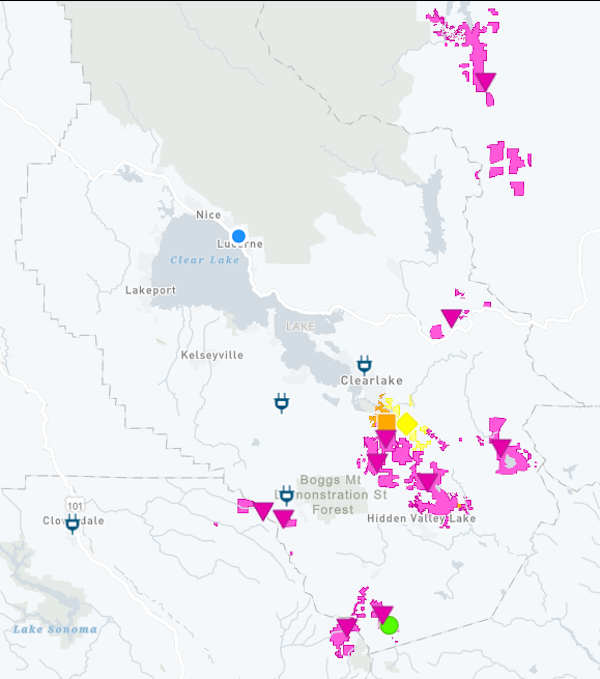
LAKE COUNTY, Calif. — Pacific Gas and Electric Co. said its crews began conducting patrols on Wednesday after the high winds that prompted a public safety power shutoff the previous night had subsided.
The company said its meteorologists began issuing the weather “all clear” Wednesday morning for portions of affected areas impacted by the public safety power shutoff, or PSPS.
As of 10 p.m. Wednesday, PG&E said it had restored power to 55% — or 27,000 — of the impacted customers.
The remaining customers are expected to have their power restored by late Thursday afternoon or early Thursday evening, PG&E said.
PG&E had been planning to turn off the power to 51,000 counties across 18 counties on Tuesday night.
However, on Wednesday, the company said it removed five counties — Alameda, Contra Costa, Sierra, Trinity and Yuba — from the shutoff scope.
That left 48,000 customers in portions of Lake and 12 counties: Butte, Colusa, Glenn, Lassen, Mendocino, Napa, Plumas, Shasta, Solano, Sonoma, Tehama and Yolo.
In Lake County, the number of impacted customers in the first PSPS of the year was 4,563, including 353 in the Medical Baseline program, PG&E said.
During the shutoff, PG&E said it recorded wind gusts of 56 miles per hour at Jarbo Gap in Butte County, 48 miles per hour at Wilson Hill Road in Shasta County and 55 miles per hour at Thomes Creek in Tehama County.
Once the windstorm had passed, PG&E said its crews had to begin patrolling more than 3,289 miles of transmission and distribution lines to ensure that no damage or hazards existed before reenergizing the lines to restore power to customers.
PG&E said 1,302 ground patrol units and 33 helicopters were involved in the patrol work.
By Wednesday afternoon, power restoration had begun in some areas where PG&E said it was safe to do so.
There were reports in some parts of Lake County that power was being turned on Wednesday afternoon.
At the same time, due to the Cache fire in Clearlake, transmission lines through the fire area had been temporarily deenergized, according to radio reports.
A PG&E map of the PSPS area showed a large portion of Lake County’s impacted customers remained without power early Thursday morning, with restoration expected by 2 p.m. Thursday in most of those outage areas.
Three community resource centers remain open in Lake County until the outage is fully resolved. They are open 8 a.m. to 10 p.m. daily. They are:
— Clearlake Senior Community Center, 3245 Bowers Ave., Clearlake.
— Mountain Lions Club (also known as Little Red Schoolhouse), 15780 Bottle Rock Road, Cobb.
— Scotts Valley Band of Pomo Indians Red Hills property, 7130 Red Hills Road, Kelseyville.
The centers offer charging for medical equipment and electronic devices, information on the outage, and water, snacks and other essential items.
For more information visit the PSPS website.
Email Elizabeth Larson at
The election is set for Sept. 14, and Registrar of Voters Maria Valadez reported that all registered voters will be mailed a vote-by-mail ballot to ensure a safe and accessible voting option during the COVID-19 pandemic.
Mailing of vote-by-mail ballots began no later than Monday, Aug. 16, Valadez said. Supplemental mailings will follow for newly registered or re-registered voters.
Valadez said her office will begin processing the returned vote-by-mail ballots on Monday, Aug. 23, with the processing of the vote-by-mail voter ballots will continue through Election Day as well as during the official canvass. Results won’t be released until after polls close on Sept. 14.
To ensure there are no delays in receiving your ballot in the mail, verify that the Registrar of Voters has your most up-to-date voter information. Visit https://voterstatus.sos.ca.gov/ or call 707-263-2372 or toll-free at 888-235-6730 to verify both your residential and mailing address.
Is everything correct? If not, you can update your registration by re-registering to vote at http://registertovote.ca.gov or by calling 707-263-2372 and requesting a voter registration form be mailed to you.
Return your vote by mail ballot
The Registrar of Voters Office encourages you to vote safely at home, and return your vote-by-mail ballot in one of the following ways:
— Mail your ballot on or before Election Day; no postage is required.
— At any official ballot drop box location. Visit the following website at https//caearlyvoting.sos.ca.gov/ or call 707-263-2372 for locations.
— At the Lake County Registrar of Voters Office or at any polling place location within the state of California.
Track your vote-by-mail ballot
Receive your personalized text message, emails or voicemails letting you know when your ballot is mailed, received, and counted by the Registrar of Voters Office by subscribing to https://wheresMyBallot.sos.ca.gov.
In-person voting
There will be 22 polling place locations on Election Day. Polling place locations will be staffed for voters to drop off voted ballots or to be issued a replacement ballot from 7 a.m. to 8 p.m.
To vote in-person at your assigned polling place site on Election Day (please call the Registrar of Voters Office for instructions). You will be required to vote a provisional ballot if you are unable to surrender your vote by mail ballot and envelope.
For additional information call the Registrar of Voters Office at 707-263-2372 or 888-235-6730.
Student loans are among the largest contributors to household debt. The U.S. Department of Education estimates that in 2017 the total amount owed in federal student loans was $1.37 trillion.
Experiences prior to and during the pandemic provide insight into what we can expect going forward.
In 2017, 15% of adults (33 million) who had completed at least a high school degree had student loan debt, according to the Census Bureau’s Survey of Income and Program Participation (SIPP), which provides detailed info about debt holders in the years preceding the pandemic (all subsequent SIPP estimates are limited to those with at least a high school degree).
But the number was higher for certain groups: 21% of non-Hispanic Black adults; 23% of never-married adults; and 29% of adults ages 25 to 34.
Education and debt go hand in hand
Student debt was tied to educational attainment or the highest degree someone has received.
About 1 in 4 adults with advanced degrees, meaning those with more than a bachelor’s degree, had at least some student debt, compared to fewer than 1 in 5 adults with an associate or two-year degree.
Those with only a high school diploma were the least likely to carry student debt. But even this group accrued debt if they started but did not complete college courses or took vocational training, such as trade certifications or licensing.
Although those with advanced degrees were the most likely to hold and have higher student debt, those with some college but no degree were in a particularly difficult double bind: They accumulated debt during college but were yet to benefit from the greater earnings that come with a college degree.
In 2017, median annual earnings of those with some college but no degree was significantly less than among those with a bachelor’s or higher degree, making it more challenging for them to pay off their student debt. And while some may eventually complete a college degree, many will not.

Who is most likely to have student loans?
Racial differences in student debt holding are stark.
Non-Hispanic Black adults were particularly likely to have student debt.
In 2017, for example, rates for some non-Hispanic Black groups were twice as large as for non-Hispanic White adults and Black adults were more likely than White adults at every educational attainment level to have student loans.
Women overall were 28% more likely than men to have student debt.
In 2017, non-Hispanic Black women were the most likely of any gender group to have student loans. About 1 in 4 non-Hispanic Black women had student debt, compared to 1 in 8 non-Hispanic White men.
Younger adults, particularly those in their late 20s and early 30s, held a disproportionate amount of debt and clear racial and ethnic differences existed in this age group as well.
Among adults ages 25 to 44, Hispanic adults were the least likely to have student debt, partly a reflection of the lower likelihood of college attendance among the Hispanic population.
Roughly a third of non-Hispanic Black and White adults ages 25 to 34 held student debt.
However, older Black adults were significantly more likely than White adults to still have debt.
Differences by educational attainment and race were so large that non-Hispanic Black adults who had attended college but not earned a degree were about as likely as non-Hispanic White adults who had completed advanced degrees (21% and 22%, respectively) to carry student debt.
How much student debt do people owe?
Median student debt in December 2017 was similar for non-Hispanic Black women and non-Hispanic White women, with each group each carrying roughly $20,000.
Non-Hispanic White women, who made up the largest percentage of college graduates, carried as a group an estimated $398 billion in student loans in 2017.
Non-Hispanic White men, the second-largest student debt group, owed $278 billion in student loans. Non-Hispanic Black women carried $110 billion and Hispanic women an estimated $54 billion in student debt.
According to SIPP, adults with at least a bachelor’s degree had student debt totaling $756 billion.
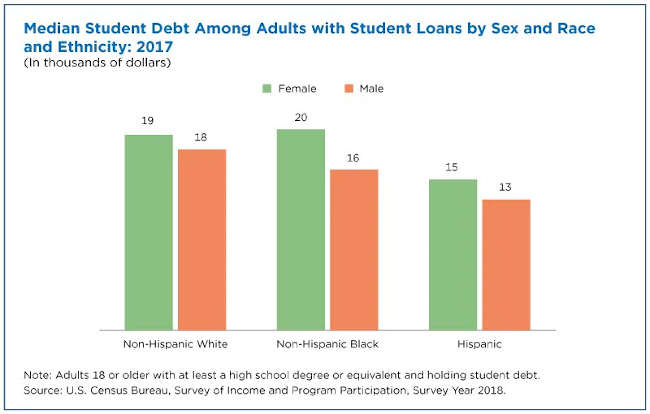
Student loan debt associated with more debt overall
Many adults with student loans also faced other debt burdens. Of those with student loans, about 23 million (69%) had at least one additional type of debt like credit card, vehicle or medical.
Among those with student loans, credit card debt was the most common additional debt (52% of those with student debt also had credit card debt), followed by vehicle loans (33%), and medical debt (18%).
Those with debt on top of their student loans also often owed more in student loans.
For instance, the median student debt of those with no credit card debt was $16,000 in 2017. However, those with both student and credit card debt owed a median amount of $20,000 in student loans.
COVID-19 adds layers of economic hardship
Since 2017, federal student loans have increased an additional $190 billion, totaling $1.57 trillion in 2020. The onset of the COVID-19 pandemic has piled on additional layers of economic challenges on top of existing loan burdens.
Responses to the Census Bureau’s experimental Household Pulse Survey highlight how some groups for whom student debt may present particular challenges have also been hardest hit by the pandemic.
For example, those with some college but no degree were more likely to have experienced a loss of employment income within their household since the start of the pandemic. They were also more likely to report having a somewhat or very difficult time paying their usual expenses in the prior week than those with at least a bachelor’s degree.
In an effort to reduce the burden of student debt during the pandemic, the government has frozen payments for federal student loans and interest rates have been set to zero.
However, these policies are only temporary. Even with high national unemployment and without a current need to pay down this debt, recent stimulus money has been used to reduce debt burden.
Although the stimulus payments received in January were not more than $600 per person, more than three quarters of the people who received them spent them immediately and about half reported spending it to pay down credit card, student loan or other debt.
The populations most likely to carry student debt were even more likely to use the January stimulus payment to pay down debt.
For example, women were more likely than men to use the stimulus to narrow debt. Similarly, more than 60% of both non-Hispanic Black respondents and Hispanic respondents also used that money to shrink debt compared to less than 50% of non-Hispanic White respondents.
These results suggest that despite the freeze on payments student loan debt is still a heavy burden for many households during the pandemic.
About the data
SIPP is the nation’s premier source of information for income and program participation. It collects data and measures change in Americans’ economic well-being, family dynamics, education, assets, health insurance, child care and food security. Information on the methodology and reliability of these estimates can be found in the source and accuracy statements for each SIPP data release.
HPS is designed to provide near real-time data on how people’s lives have been impacted by the coronavirus pandemic. Information on the methodology and reliability of these estimates can be found in the source and accuracy statements for each HPS data release.
Michael D. King and Lindsay M. Monte are survey statisticians in the Census Bureau’s Program Participation and Income Transfers Branch. Neil Bennett is an economist in the Census Bureau’s Labor Force Statistics Branch.
LAKE COUNTY, Calif. — Firefighters are trying to stop a wildland fire burning in Clearlake.
The Cache fire was dispatched at about 12:30 p.m. Wednesday in the area of Sixth Avenue and Cache Creek in Clearlake.
Units arriving on scene reported finding RVs on fire as well as several acres of wildland, with a rapid rate of spread.
Incident command began requesting evacuations on the north side of Dam Road, adding the south side of Dam Road minutes later.
Radio reports stated that California Highway Patrol and Lake County Sheriff’s Office units were asked to respond to assist the Clearlake Police Department with evacuations.
Incident command also requested strike teams from in-county and out-of-county fire agencies for help with structure protection, but initial reports indicated challenges getting those additional resources.
Copter 104 from Boggs Mountain arrived on the scene just before 12:50 p.m. and reported over the air that the fire was between 25 and 30 acres and was soon to impact structures.
In addition to Copter 104, there are three helicopters and three tankers assigned, according to radio reports.
Authorities are going door to door along Dam Road to evacuate people, based on radio reports.
At 1:09 p.m., the Clearlake Police Department issued an evacuation order for the area from Cache Creek Apartments east to Betz Lane, with additional evacuations for south of Dam Road to Tish A Tang.
At 1:13 p.m., it was reported that 15 to 20 structures were involved, with several hundred threatened.
At 1:20 p.m., the Lake County Sheriff’s Office issued an evacuation order for zones LOW-E159, located north of Morgan Valley Road and south of Cache Creek, east of Bonham Road and southwest of Staehle Lane; and LOW-E160, which includes Lower Lake, north of Main Street and Morgan Valley Road, south of Cache Creek, east of Bonham Road and west of Highway 53.
The schools were advised to begin evacuating children, and at 1:25 p.m. it was reported that school children were being evacuated from Lower Lake to Haverty Field at Austin Park.
Just before 1:30 p.m., incident command requested two more copters and five additional strike teams.
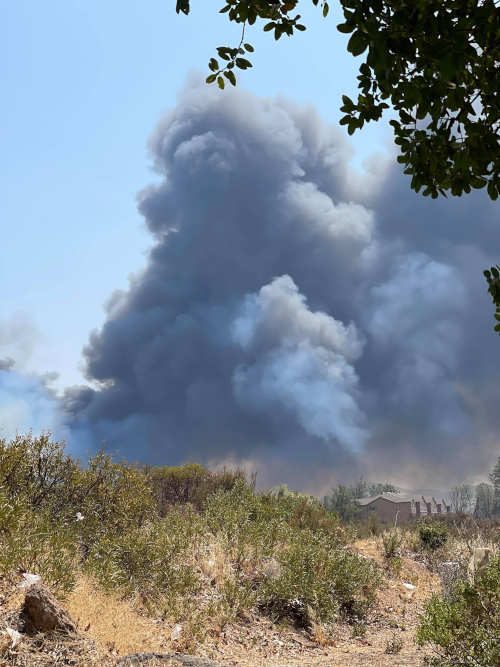
By 1:40 p.m., the fire was estimated to be up to 40 acres. Minutes later, an update said two dozen structures were involved.
The Lake County Sheriff’s Office said at 1:40 p.m. that an evacuation shelter has been established at Kelseyville High School.
Incident command called at 1:46 p.m. for an ambulance to respond to Cache Creek Mobile Home Park and an air ambulance to Adventist Health Clear Lake for an elderly burn victim. However, the air ambulance request could not be filled so a ground ambulance was requested. Later, it was reported an air ambulance would respond.
Just after 1:50 p.m. a grass fire was reported to be near Lower Lake Elementary School and the Lower Lake Cemetery, with a firefighter trying to access it.
Help from CHP was requested at Highways 29 and 53 shortly before 2 p.m. in order to get traffic going, as cars were backing up.
At 2 p.m., it was reported that Lower Lake Elementary’s evacuation had been completed, with children moved out by bus.
Minutes later, as many as three spot fires were reported around Lake Street.
At 2:07 p.m., an evacuation order was issued for south of 10th and East of Cache Creek apartments to the city limits.
At the same time, heavy traffic was reported on Highway 29, and at 2:10 p.m. radio traffic indicated a hard road closure was needed for northbound traffic at Highway 29 and Highway 53.
The fire was estimated to be 50 acres as of 2:12 p.m., with numerous structures involved and a moderate rate of spread.
At that point, incident command asked for four more dozers, two more crews and additional water tenders, with plans to update evacuation orders.
At 2:39 p.m., incident command reported the fire was up to 100 acres, with no updated estimate on structures. They asked for Animal Control and the Lake Evacuation and Animal Protection, or LEAP, team to respond to Dam Road for numerous burned pets and livestock.
Evacuation areas have continued to expand. A rundown of zones and descriptions and their evacuation status is below.
There were separate reports over the air of forward progress being stopped, at 3:21 p.m. and again at 4:48 p.m.
Tankers began to be released shortly before 3:30 p.m. while work continued on a stop fire near the school.
At 4:36 p.m., there were plans to begin reenergizing major transmission lines that go through the fire area.
At 4:50 p.m., the sheriff’s office released a Nixle alert reporting that road closures are in place at the following locations: Dam Road at Jack in the Box, Main Street in Lower Lake at Highways 53 and 29, and Jessie Street at Highway 53 All other road closures were removed by that point.
At 6:55 p.m., incident command reported the fire was 80 acres and 20% contained, with two helicopters — of them Copter 104 — released.
At 7:51 p.m., the Lake County Sheriff’s Office said evacuation orders for zones LOW-E159 and LOW- E169 were no longer in effect and residents could return home, but they were asked to be alert as fire and law enforcement personnel are still in the area.
The evacuation warning for zones LOW-E161, LOW-E167, LOW-E170 and LOW-E176 also were reported to have been lifted at that time.
However, the sheriff’s office said evacuation orders for zones LOW-E160 and CLE-E157A remain in effect.
The Clearlake Police Department reported just before 8:30 p.m. that the mandatory evacuation order for Cache Creek Apartments has been lifted and residents could return home, but the LOW-E160 and CLE-E157A evacuations orders were still active.
Additional information will be posted as it becomes available.
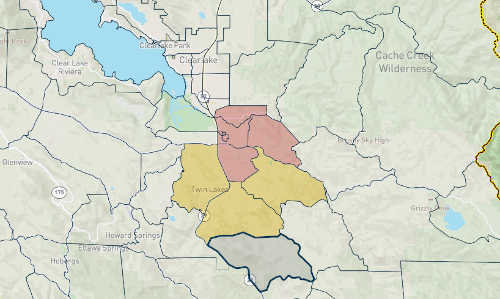
ZONES IMPACTED BY THE CACHE FIRE
Evacuation orders remaining in effect as of 8 p.m.:
CLE-E157-A: Everything in the city of Clearlake to the south of 18th Avenue and east of Highway 53 except for Adventist Health Clear Lake Hospital.
LOW-E160: Lower Lake. North of Main Street and Morgan Valley Road. South of Cache Creek. East of Bonham Road and west of Highway 53. This area excludes school district campuses.
LOW-E163: Richard H. Lewis School campuses.
LOW-E164: Includes Lower Lake, north of Main Street and Morgan Valley Road, south of Cache Creek, east of Bonham Road and west of Highway 53.
LOW-E166: Lower Lake High School and William C. Carle Continuation High School campuses.
Evacuation orders lifted as of 8 p.m.:
LOW-E159: Located north of Morgan Valley Road and south of Cache Creek, east of Bonham Road and southwest of Staehle Lane.
LOW-E169: North boundary extends south of Main Street and Morgan Valley Road. West boundary extends to the east of Highway 29. South boundary extends north of Spruce Grove Road North.
Evacuation warnings lifted as of 8 p.m.:
LOW-E161: West of Highway 53, north of Highway 29, northeast of Point Lakeview Road.
LOW-E167: Twin Lakes, west of Highway 29. North and east of Perini Road. East of Big Canyon Road and Seigler Canyon Road. Seigler Canyon Road passing through the outer part of the northwest boundary. Highway 29 passes through the outer part of the north boundary.
LOW-E170: South of E-169 and E-159, no boundary description offered, but northern boundary is Morgan Valley Road.
LOW-E176: Southwest of Spruce Grove Road and Old Spruce Grove Road. Southeast of Highway 29. North and northwest of Henderson Ranch Road.
Email Elizabeth Larson at
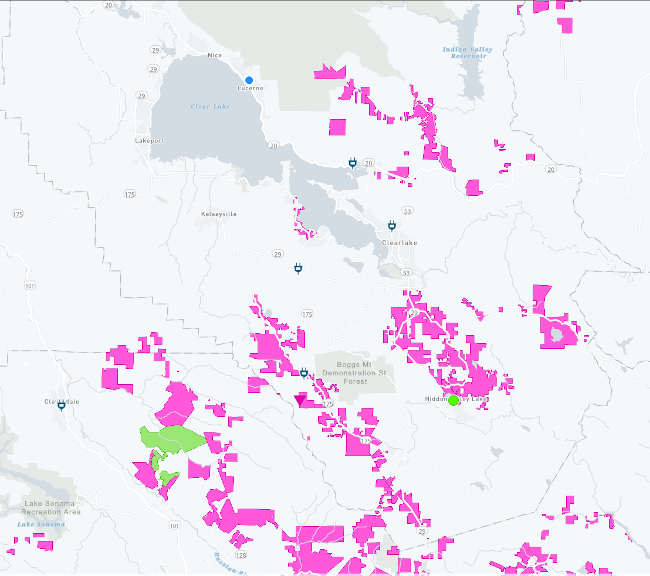
LAKE COUNTY, Calif. — On Tuesday evening, as a red flag warning was going into effect across parts of Northern California, Pacific Gas and Electric Co. moved forward with shutting off power to 51,000 of its customers across portions of 18 counties, including Lake.
In Lake County, approximately 4,563 customers — including 353 in the Medical Baseline program — had their power turned off starting between 5 and 7 p.m., the company reported.
PG&E spokeswoman Deanna Contreras said the shutoff was expected to impact areas in or near Clearlake Oaks, Kelseyville, Cobb, Lower Lake, Riviera, Clearlake Highlands, Morgan Valley, Spring Valley and Hidden Valley Lake.
The number of Lake County customers to be included in the shutoff doubled earlier in the day, according to PG&E.
The last time a public safety power shutoff took place in Lake County was in December, when only about two dozen customers were impacted.
PG&E said it took the action due to concerns about the incoming weather system, which could bring gusts of up to 40 miles per hour, which could increase fire danger significantly when combined with dry vegetation and low humidity.
The company said it expects the “all clear” will occur on Wednesday afternoon, but Contreras said power restoration is expected to occur on Thursday afternoon.
That’s because, once the windstorm has subsided, PG&E said it will patrol the de-energized lines to ensure they were not damaged and, if necessary, make repairs before restoring power as quickly as possible.
“It is very possible that customers may be affected by a power shutoff even though they are not experiencing extreme weather conditions in their specific location. This is because the electric system relies on power lines working together to provide electricity across cities, counties and regions,” Contreras said.
Due to the smoke from wildland fires around Northern California, the inspection process could be hampered by reduced visibility, the company said.
PG&E is opening 36 community resource centers — 16 outdoor sites and 20 indoor sites — in 17 counties to support customers affected by this event.
The centers initially opened from 5 to 10 p.m. Tuesday and will be open 8 a.m. to 10 p.m. daily for the remainder of the shutoff.
In Lake County, four community resource centers are being opened at the following locations:
— Clearlake Senior Community Center, 3245 Bowers Ave., Clearlake.
— Live Oaks Senior Center, 12502 Foothill Blvd., Clearlake Oaks.
— Mountain Lions Club (also known as Little Red Schoolhouse), 15780 Bottle Rock Road, Cobb.
— Scotts Valley Band of Pomo Indians Red Hills property, 7130 Red Hills Road, Kelseyville.
At the community resource centers, community members can charge medical equipment and electronic devices, get water, snacks and other essential items, and also receive updates on the PSPS. All resource centers will have COVID-19 health guidelines in place.
For updates, visit PG&E’s PSPS website.
Email Elizabeth Larson at
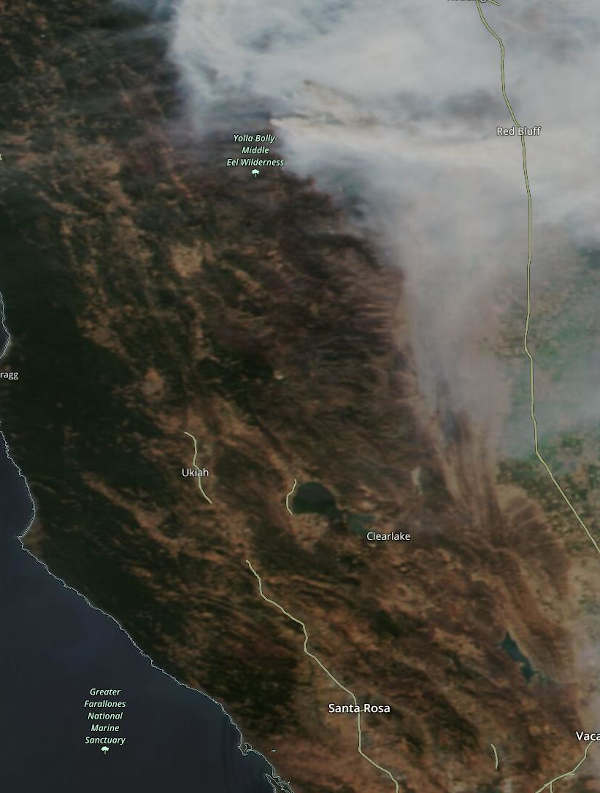
LAKE COUNTY, Calif. — As major wildland fires continue to burn across Northern California, the Lake County Air Quality Management District said more smoke and haze are expected in the air basin this week.
Air Pollution Control Officer Doug Gearhart said fires including the Dixie, McFarland and Monument are creating the regional smoke impacts throughout Lake County and California.
The new Caldor fire in El Dorado County also will contribute to smoke impact in Lake County over the next several days, Gearhart said.
Gearhart said all of Lake County has experienced intermittent air quality impacts from moderate to hazardous over the past few weeks.
He said the air quality forecast through Friday will range from “moderate,” or 51 to 100 on the Air Quality Index, to “unhealthy for sensitive groups” (AQI of 101 to 150) with a heightened potential for “unhealthy for all” (AQI of 151 to 200) conditions as the anticipated north winds may bring smoke from the Northern California fires into Lake County.
This forecast is based on the latest weather, monitoring and fire activity information, Gearhart said.
The National Weather Service, which also has included information about hazy conditions on Wednesday in its forecast, has issued a red flag warning for Lake County until 8 p.m. Wednesday due to high winds in the forecast, with those winds also prompting Pacific Gas and Electric to conduct a public safety power shutoff impacting parts of Lake County.
Gearhart said the district continues to actively monitor the smoke impacts throughout the County.
Information also is available at the Lake County Air Quality Management District website; follow the quick links for air monitoring for current smoke and air quality conditions.
Current particulate levels in Lake County range from “good” to “moderate.” Gearhart said those values were forecast to degrade overnight to “unhealthy for sensitive groups” or worse as smoke is pushed into the county.
Gearhart said concentrations of smoke may vary depending upon location, weather and elevation.
Smoke from wildfires and structure fires contain harmful chemicals that can affect your health. Smoke and high winds can cause eye and throat irritation, coughing, and difficulty breathing. People who are at greatest risk of experiencing symptoms due to smoke include those with respiratory disease (such as asthma), those with heart disease, young children and older adults.