 How to resolve AdBlock issue?
News
Dogs available for adoption this week include mixes of American bulldog, Australian shepherd, border collie, cattle dog, Chihuahua, German shepherd, husky, Labrador retriever, pit bull, Rhodesian ridgeback, Rottweiler, shepherd and terrier.
Dogs that are adopted from Lake County Animal Care and Control are either neutered or spayed, microchipped and, if old enough, given a rabies shot and county license before being released to their new owner. License fees do not apply to residents of the cities of Lakeport or Clearlake.
The following dogs at the Lake County Animal Care and Control shelter have been cleared for adoption (additional dogs on the animal control website not listed are still “on hold”).
Call Lake County Animal Care and Control at 707-263-0278 or visit the shelter online at http://www.co.lake.ca.us/Government/Directory/Animal_Care_And_Control.htm for information on visiting or adopting.

Border collie mix
This 4-year-old male border collie mix has a short liver and white coat.
He is in kennel No. 5, ID No. LCAC-A-1611.

‘George’
“George” is a 1-year-old male American bulldog mix with a short gray coat.
He’s in kennel No. 6, ID No. LCAC-A-1430.

Male pit bull terrier mix
This 1-year-old male pit bull terrier mix has a short gray coat.
He’s in kennel No. 8, ID No. LCAC-A-1617.

‘Milo’
“Milo” is a 3-year-old male American bulldog-pit bull mix with a short white coat.
He is in kennel No. 9, ID No. LCAC-A-1657.

‘Cookie’
“Cookie” is a 1-year-old female husky mix with a long red and white coat.
She is in kennel No. 10, ID No. LCAC-A-1682.

‘Dozer’
‘Dozer’ is a 5-year-old American pit bull terrier mix with a short brindle coat.
He is in kennel No. 12, ID No. LCAC-A-1483.

Male pit bull mix
This 3-year-old male pit bull mix has a short brindle coat.
He is in kennel No. 13, ID No. LCAC-A-1604.
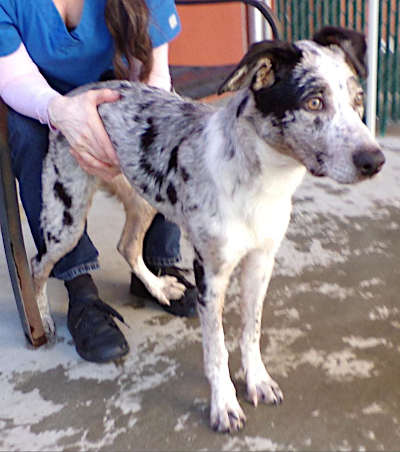
Female Australian shepherd
This young female Australian shepherd mix has a blue merle coat.
She is in kennel No. 14, ID No. LCAC-A-1672.

‘Groover’
“Groover” is a 1-year-old male German shepherd-cattle dog mix with a short black and tan coat.
He’s in kennel No. 15, ID No. LCAC-A-1659.

‘Topolina’
“Topolina” is a 10-year-old male Chihuahua mix with a short black coat with white markings.
He is in kennel No. 16, ID No. LCAC-A-1663.

Female German shepherd
This 1-year-old female German shepherd has a short black and tan coat.
She is in kennel No. 18, ID No. LCAC-A-1673.

Male Labrador retriever
This 2-year-old male Labrador retriever has a short black coat with white markings.
He is in kennel No. 19, ID No. LCAC-A-1349.

Male pit bull terrier mix
This 2-year-old male pit bull terrier mix has a short black coat with white markings.
He is in kennel No. 24, ID No. LCAC-A-1625.

‘Rosco’
“Rosco” is 3-year-old a male Rhodesian Ridgeback-Shepherd mix with a short tan coat.
He is in kennel No. 25, ID No. LCAC-A-1205.

‘LuLu’
“LuLu” is a 1-year-old female Rottweiler with a short black and tan coat.
She is in kennel No. 27, ID No. LCAC-A-1658.

‘Raina’
“Raina” is a 5-year-old female Rottweiler with a short black and tan coat.
She is in kennel No. 28, ID No. LCAC-A-1480.

Male pit bull
This young male pit bull has a short brindle coat.
He is in kennel No. 30, ID No. LCAC-A-1591.

Male husky
This 2-year-old male husky has a red and cream coat.
He is in kennel No. 32, ID No. LCAC-A-1024.

Male pit bull mix
This 2-year-old male pit bull terrier mix has a short brindle coat.
He is in kennel No. 33, ID No. LCAC-A-1528.
Email Elizabeth Larson at


It seems like every week, another rocket is launched into space carrying rovers to Mars, tourists or, most commonly, satellites. The idea that “space is getting crowded” has been around for a few years now, but just how crowded is it? And how crowded is it going to get?
I am a professor of physics and director of the Center for Space Science and Technology at the University of Massachusetts, Lowell. Many satellites that were put into orbit have gone dead and burned up in the atmosphere, but thousands remain. Groups that track satellite launches don’t always report the same exact numbers, but the overall trend is clear – and astounding.
Since the Soviet Union launched Sputnik – the first human-made satellite – in 1957, humanity has steadily been putting more and more objects into orbit every year. Over the the second half of the 20th century, there was a slow but steady growth, with roughly 60 to 100 satellites launched yearly until the early 2010s.
But since then, the pace has been increasing dramatically.
By 2020, 114 launches carried around 1,300 satellites to space, surpassing the 1,000 new satellites per year mark for the first time. But no year in the past compares to 2021. As of Sept. 16, roughly 1,400 new satellites have already begun circling the Earth, and that will only increase as the year goes on. Just this week, SpaceX deployed another 51 Starlink satellites into orbit.

Small satellites, easy access to orbit
There are two main reasons for this exponential growth. First, it has never been easier to get a satellite into space. For example, on Aug. 29, 2021, a SpaceX rocket carried several satellites – including one built by my students – to the International Space Station. On Oct. 11, 2021, these satellites will deploy into orbit, and the number of satellites will increase again.
The second reason is that rockets can carry more satellites more easily – and cheaply – than ever before. This increase isn’t due to rockets getting more powerful. Rather, satellites have gotten smaller thanks to the electronics revolution. The vast majority – 94% – of all spacecraft launched in 2020 were smallsats – satellites that weigh less than around 1,320 pounds (600 kilograms).
The majority of these satellites are used for observing Earth or for communications and internet. With a goal of bringing the internet to underserved areas of the globe, two private companies, Starlink by SpaceX and OneWeb together launched almost 1,000 smallsats in 2020 alone. They are each planning to launch more than 40,000 satellites in the coming years to create what are called “mega-constellations” in low-Earth orbit.
Several other companies are eyeing this US$1 trillion market, most notably Amazon with its Project Kuiper .
A crowded sky
With the huge growth in satellites, fears of a crowded sky are starting to come true. A day after SpaceX launched its first 60 Starlink satellites, astronomers began to see them blocking out the stars. While the impact on visible astronomy is easy to understand, radio astronomers fear they may lose 70% sensitivity in certain frequencies due to interference from satellite megaconstellations like Starlink.
Experts have been studying and discussing the potential problems posed by these constellations and ways the satellite companies could address them . These include reducing the number and brightness of satellites, sharing their location and supporting better image-processing software.
As low-Earth orbit gets crowded, concern about space debris increases, as does a real possibility of collisions.
Future trends
Less than 10 years ago, the democratization of space was a goal yet to be realized. Now, with student projects on the Space Station and more than 105 countries having at least one satellite in space, one could argue that that goal is within reach.
Every disruptive technological advancement requires updates to the rules – or the creation of new ones. SpaceX has tested ways to lower the impact of Starlink constellations, and Amazon has disclosed plans to de-orbit their satellites within 355 days after mission completion. These and other actions by different stakeholders make me hopeful that commerce, science and human endeavors will find sustainable solutions to this potential crisis.
[The Conversation’s science, health and technology editors pick their favorite stories. Weekly on Wednesdays.]
Supriya Chakrabarti, Professor of Physics, University of Massachusetts Lowell
This article is republished from The Conversation under a Creative Commons license. Read the original article.

LAKE COUNTY, Calif. — A Clearlake man has been convicted of arson and sentenced to state prison.
Charles William Cartwright, 54, was convicted of and sentenced for committing felony arson on Monday, Sept. 13, said Chief Deputy District Attorney Richard Hinchcliff.
Cal Fire Arson Investigator Joe Baldwin and other Cal Fire personnel responded to a vegetation fire that occurred on July 23 at 7:30 p.m. in the area of Ogulin Canyon Road near the City of Clearlake, according to investigation reports by Cal Fire.
The fire was limited to less than a half acre of grass and oak trees as a result of successful fire suppression efforts by Cal Fire, including the use of a helicopter.
Because the fire was in a wooded grassy area between Clearlake and the Landrum Ranch area of Highway 20, it had the potential to become a serious wildland fire, officials said.
Upon arrival, Cal Fire firefighters found a dehydrated “hiker” in the area, and assisted him medically. Investigator Baldwin initially interviewed Cartwright, who stated he did not start the fire and had nothing with which to start a fire.
Baldwin then interviewed other fire personnel who were initially on the scene to gather further information.
The helicopter pilot and another fire captain advised Baldwin that when they arrived, Cartwright was lying in the grass next to the fire.
Other fire personnel reported that when they rendered assistance to Cartwright, he admitted he started the fire.
Cartwright stated that he had become lost after hiking all day and did not have water, and was afraid he could not make it back to town.
He told authorities he set the fire to signal for help so he could get back to town. Cartwright advised that he lived in the homeless encampment behind Foods, Etc.
Cartwright was charged with arson of forest land for intentionally starting the fire, and with recklessly starting a fire of forest land, Hinchcliff said.
Hinchcliff said that on Aug. 16, Cartwright pleaded no contest to arson for intentionally starting the fire.
On Monday, Judge David J. Markham sentenced Cartwright to six years in state prison, Hinchcliff said.
Hinchcliff said the conviction also qualifies as a “strike” if Cartwright commits any felonies in the future.
Cartwright will also be required to register as an arson offender for his lifetime, Hinchcliff reported.
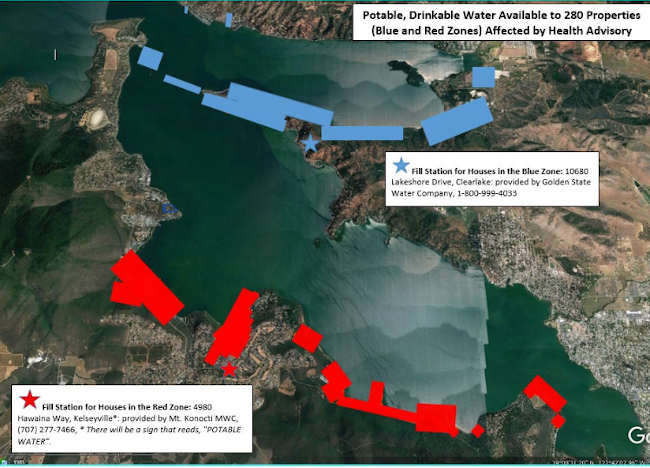
LAKE COUNTY, Calif. — Two water companies are supporting local and state officials in assisting Lake County residents who are being affected by a health advisory related to their private drinking water intakes.
On Wednesday evening, approximately 280 properties in the Oaks and Lower Arms of Clear Lake that use a personal, private intake to draw their household water directly from the lake were advised by Public Health officials not to consume their tap water, due to high cyanotoxin levels.
Thanks to the swift and collaborative efforts of local officials, local water systems such as Golden State Water and Mt. Konocti Mutual Water Co., and the State Water Resources Control Board, alternative filling stations have been established to provide potable, drinkable water to the affected property owners:
• Fill station for houses in the blue zone: 10680 Lakeshore Drive, Clearlake: provided by Golden State Water Co., 1-800-999-4033;
• Fill station for houses in the red zone: 4980 Hawaina Way, Kelseyville: provided by Mt. Konocti Mutual Water Co., 707-277-7466. There will be a sign that reads, "Potable Water.”
Water availability begins Saturday at noon and is strictly limited to property owners affected by the health advisory.
This water is intended to meet very basic household needs (e.g., drinking, cooking), please limit to 25 gallons per week per household.
The treatment process and testing are designed to ensure that the water delivered to our customers meets all water quality standards. The finished water has been tested and meets health guidelines for cyanotoxins.
Once the water leaves the point of connection, the Water Systems can no longer guarantee that the water continues to be free of contamination. Individuals should bring their own clean containers that are meant for food or beverage storage.

LAKEPORT, Calif. — The Lakeport Police Department is asking the community’s assistance in locating a man wanted for child abuse.
James Ryan Anson, 33, is wanted on a felony warrant charging the willful infliction of corporal punishment resulting in a traumatic condition and under conditions likely to produce great bodily harm, and infliction of unjustifiable physical pain on a 3-year-old child.
Police said Anson is aware of this investigation and is avoiding law enforcement.
He lives in Lakeport but was last known to be in the Santa Rosa area. He is believed to be driving a gray 2014 Toyota Tundra pickup truck with California license plate number 8R63596.
Anson has prior encounters with police involving evading in a vehicle, resisting arrest, terrorist threats, robbery, burglary and domestic violence.
Police said they have information that he could have recently been in possession of a handgun.
Anson is described as a white male adult, with blond hair and blue eyes. He’s 6 feet 1 inch tall and 200 pounds.
He should be considered dangerous and police ask the public not to approach or contact him but to immediately notify their local law enforcement agency.
Anyone with information related to this investigation or the whereabouts of Anson can contact Officer Melissa Bedford at 707-263-5491 or by email at
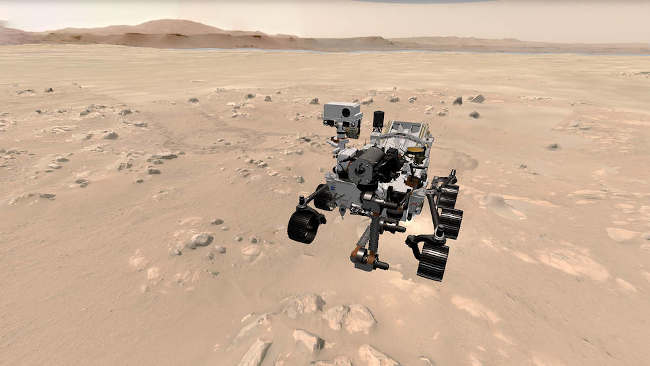
It’s the next best thing to being on Mars: Two online interactive experiences let you check out Jezero Crater — the landing site and exploration locale for NASA’s Perseverance rover — without leaving our planet.
One new experience, called “Explore with Perseverance,” allows you to follow along with the rover as though you were standing on the surface of Mars. Another interactive — “Where Is Perseverance?” — shows the current location of the rover and Ingenuity Mars Helicopter as they explore the Red Planet.
It’s updated after every drive and flight and allows you to track the progress of Perseverance and Ingenuity, in their journeys on and above the Red Planet.
Explore with Perseverance is made mostly with images taken by the rover from various vantage points, with additional images from the High Resolution Imaging Experiment, or HiRISE, camera aboard NASA’s Mars Reconnaissance Orbiter overhead.
“It’s the best reconstruction available of what Mars looks like,” said Parker Abercrombie, a senior software engineer who is leading the software development at NASA’s Jet Propulsion Laboratory in Southern California.
The agency’s Mars Public Engagement team recruited Abercrombie and his colleagues, who work on similar tools for the mission team, to develop a public-friendly experience by stitching together and reconstructing the Perseverance and HiRISE images.
The team plans to update the site regularly with new views from the spacecraft and the rover and some new points of interest, as they are found. For example, said Abercrombie, “we can highlight scientifically interesting rocks and other features, or the Ingenuity helicopter flight locations.”
Abercrombie believes the site will help people understand the perspective as if they were on Mars. “It’s sometimes hard for people to grasp location and distance from Mars images. It’s not like here on Earth, where you can get your bearings by looking at trees and buildings. With the Martian terrain, it can be really hard to wrap your head around what you’re seeing.”
The dashboard makes it easy for parents and teachers to share the 3D views with kids, bringing them along as Perseverance explores.
The 3D tool is based on the Advanced Science Targeting Tool for Robotic Operations, or ASTTRO, that the rover’s science team uses to select interesting targets for the rover to study — but has been modified to make it more user-friendly.
“It’s a unique challenge to set things up so people can browse in a way they’ll understand, since users have varying experiences in using 3D environments,” Abercrombie said. “This is a great opportunity for the public to follow along with the mission, using the same type of visualization tools as the mission scientists.”
The Curiosity mission has a similar experience built by the same team.
A Mars map of the rover and helicopter journeys
“The Where Is Perseverance? map allows you to see more of what we’re doing and where we’re going,” said JPL Mapping Specialist Fred Calef.
It, too, is based on ASTTRO, and Calef notes that you’ll get the data almost as fast as the engineers and scientists do. Plus, you’re using practically the same software the team uses, “so everyone can explore the way we explore in almost the same way,” Calef said, zooming in, zooming out, and panning around.
The map shows the rover’s route and its stopping points with markers indicating the Martian day, or sol, and you’ll get the overview of where Perseverance and Ingenuity might head next. Terrain maps like this one allow scientists to spot interesting places to look for possible evidence of ancient life, and you’ll be able to share in the journey.
When Ingenuity flies, it’s usually a burst of activity and then a lull for a couple of weeks. The rover, said Calef, “drives more often, though not as far, traveling around 130 meters [142 yards] on its longest drive (sol) to date. When we find a geologically interesting spot, we’ll stop for a week or so to check it out.”
More about the mission
You can get more news about the activities of Curiosity on Mars at the Mars Science Laboratory/Curiosity website, and follow the latest about Perseverance at the Mars 2020/Perseverance website.
A key objective for Perseverance’s mission on Mars is astrobiology, including the search for signs of ancient microbial life. The rover will characterize the planet’s geology and past climate, pave the way for human exploration of the Red Planet, and be the first mission to collect and cache Martian rock and regolith (broken rock and dust).
Subsequent NASA missions, in cooperation with ESA (European Space Agency), would send spacecraft to Mars to collect these sealed samples from the surface and return them to Earth for in-depth analysis.
The Mars 2020 Perseverance mission is part of NASA’s Moon to Mars exploration approach, which includes Artemis missions to the Moon that will help prepare for human exploration of the Red Planet.
JPL, which is managed for NASA by Caltech in Pasadena, California, built and manages operations of the Perseverance rover.
For more about Perseverance visit www.mars.nasa.gov/mars2020/ and www.nasa.gov/perseverance.