LAKE COUNTY, Calif. — Lake County Animal Care and Control has many new adoptable dogs waiting for homes this week.
Dogs available for adoption this week include mixes of American bulldog, cattle dog, Chihuahua, German shepherd, husky, pit bull, Rottweiler, shepherd and terrier.
Dogs that are adopted from Lake County Animal Care and Control are either neutered or spayed, microchipped and, if old enough, given a rabies shot and county license before being released to their new owner. License fees do not apply to residents of the cities of Lakeport or Clearlake.
The following dogs at the Lake County Animal Care and Control shelter have been cleared for adoption (additional dogs on the animal control website not listed are still “on hold”).
“CoCoBean” is a young female pit bull terrier mix in kennel No. 18, ID No. LCAC-A-1705. Photo courtesy of Lake County Animal Care and Control. ‘CoCoBean’
“CoCoBean” is a young female pit bull terrier mix with a short brown coat.
She is in kennel No. 18, ID No. LCAC-A-1705.
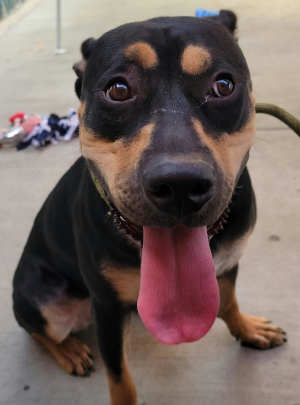
This 2-year-old female German shepherd mix is in kennel No. 20, ID No. LCAC-A-1660. Photo courtesy of Lake County Animal Care and Control. Female German shepherd mix
This 2-year-old female German shepherd mix has a short black and tan coat.
She’s in kennel No. 20, ID No. LCAC-A-1660.
“George” is a 1-year-old male American bulldog mix in kennel No. 23, ID No. LCAC-A-1430. Photo courtesy of Lake County Animal Care and Control. ‘George’
“George” is a 1-year-old male American bulldog mix with a short gray coat.
He’s in kennel No. 23, ID No. LCAC-A-1430.
“Groover” is a 1-year-old male German shepherd-cattle dog mix in kennel No. 25, ID No. LCAC-A-1659. Photo courtesy of Lake County Animal Care and Control. ‘Groover’
“Groover” is a 1-year-old male German shepherd-cattle dog mix with a short black and tan coat.
He’s in kennel No. 25, ID No. LCAC-A-1659.
“LuLu” is a 1-year-old female Rottweiler in kennel No. 27, ID No. LCAC-A-1658. Photo courtesy of Lake County Animal Care and Control. ‘LuLu’
“LuLu” is a 1-year-old female Rottweiler with a short black and tan coat.
She is in kennel No. 27, ID No. LCAC-A-1658.
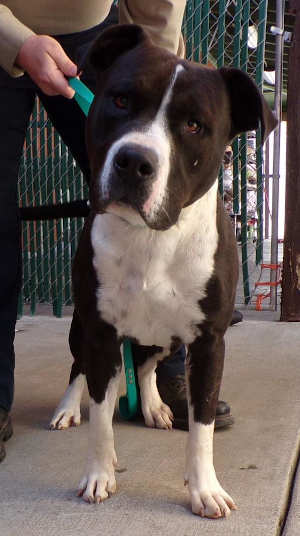
This young male pit bull is in kennel No. 29, ID No. LCAC-A-1699. Photo courtesy of Lake County Animal Care and Control. Male pit bull
This young male pit bull has a short black and white coat.
He is in kennel No. 29, ID No. LCAC-A-1699.
This young male pit bull terrier is in kennel No. 30, ID No. LCAC-A-1591. Photo courtesy of Lake County Animal Care and Control. Male pit bull terrier
This young male pit bull terrier has a short brown coat with white markings.
He is in kennel No. 30, ID No. LCAC-A-1591.
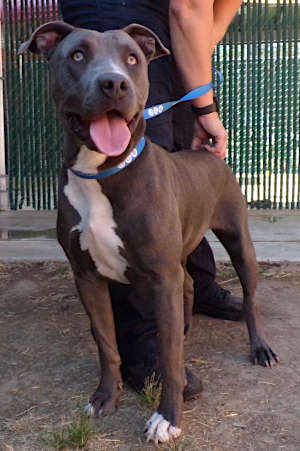
This 1-year-old female pit bull mix is in kennel No. 31, ID No. LCAC-A-1683. Photo courtesy of Lake County Animal Care and Control. Female pit bull
This 1-year-old female pit bull mix has a short gray coat with white markings.
She is in kennel No. 31, ID No. LCAC-A-1683.
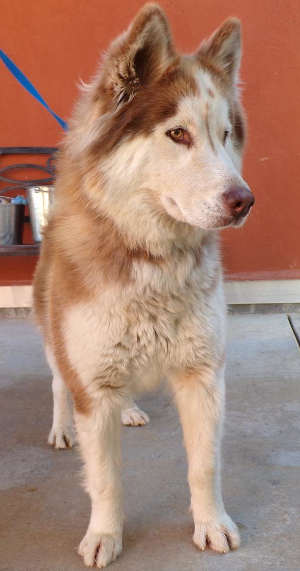
“Cookie” is a 1-year-old female husky mix in kennel No. 32, ID No. LCAC-A-1682. Photo courtesy of Lake County Animal Care and Control. ‘Cookie’
“Cookie” is a 1-year-old female husky mix with a long red and white coat.
She is in kennel No. 32, ID No. LCAC-A-1682.
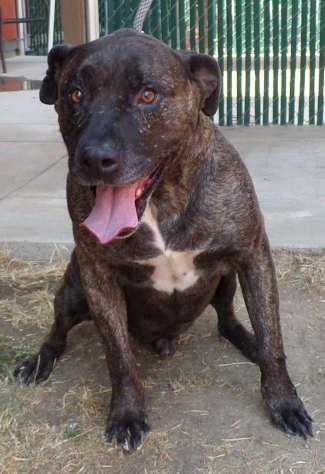
“Dozer” is a 5-year-old American pit bull terrier mix in kennel No. 33, ID No. LCAC-A-1483. Photo courtesy of Lake County Animal Care and Control. ‘Dozer’
‘Dozer’ is a 5-year-old American pit bull terrier mix with a short brindle coat.
He is in kennel No. 33, ID No. LCAC-A-1483.
“Milo” is a 3-year-old male American bulldog-pit bull mix in kennel No. 34, ID No. LCAC-A-1657. Photo courtesy of Lake County Animal Care and Control. ‘Milo’
“Milo” is a 3-year-old male American bulldog-pit bull mix with a short white coat.
He is in kennel No. 34, ID No. LCAC-A-1657.
Email Elizabeth Larson at This email address is being protected from spambots. You need JavaScript enabled to view it.. Follow her on Twitter, @ERLarson, or Lake County News, @LakeCoNews.
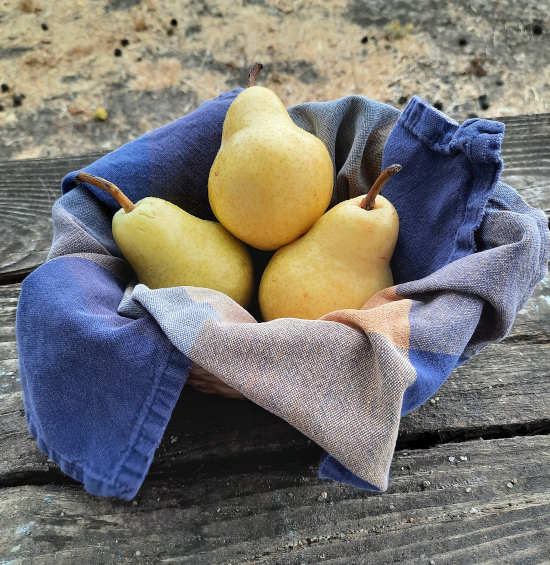
Lake County has a long history with the Bartlett pear and remains one of the biggest producers of premium pears in the nation. These pears are in season now and can be found almost everywhere, including at local farmers' markets. Photo by Esther Oertel. LAKE COUNTY, Calif. — You might say that pears are Lake County’s gold.
There’s no time when that’s more apparent than in September, when Lake County Bartletts show up almost everywhere and (in non-pandemic years) there’s a festival in the county to celebrate the crop. My heart swells just a bit when I see ads from out-of-county markets that tout the wonders of Lake County pears.
In other words, as fall approaches, it’s sweet pear-adise in Lake County.
Many varieties of pears are grown here (among others, the buttery, sweet Comice and the popular dessert pear, Bosc) but it’s the Bartlett that’s helped us achieve pear growing fame.
The histories of our county and this pear have been interwoven over the last century and more, with the result of this synergy a mutually beneficial agricultural tapestry that lives on today.
While there are fewer pear orchards here now than there were some decades ago, Lake County still produces a respectable crop as one of the largest suppliers of premium pears in the U.S.
Most farmers in the county were growing grain in the late 1800s and early 1900s when a few farmers planted pear orchards. Over time, pears became the crop of choice because of the higher profit margin they provided.
Lake County apples and pears — and most especially the Bartlett pear — attracted a lot of attention at the 1885 New Orleans World Fair, leading to the birth of an industry.
Dried Bartlett pears from Lake County, reputed to be the finest in the world, were referred to as “slabs of gold” and were extremely popular in Europe. Most were exported there until the market collapsed in the early 1920s.
Growers then began packing pears for the fresh market, and by the late 1920s, the industry was booming. Since then the market for pears has waxed and waned, with the destruction and replanting of orchards based on the need for the crop.
A high of almost 8,000 acres was reached in 1976, but since that time Lake County has lost roughly 50% of that acreage to other agricultural uses, as well as the majority of its packing houses.
The industry survives, however, and pears are still very much part of our identity. “Mountain Pears,” as Lake County pears are called, are especially prized because of the taste produced by hot days and relatively cool nights before harvest.
Thousands have thronged to the Kelseyville Pear Festival in past years, many from outside the county, to celebrate this golden harvest.
Though, like last year, the festival was canceled due to pandemic-related concerns, some celebratory activities still took place in Kelseyville last week (dubbed Pear Week), including a farm to fork dinner and street dance on Friday evening and the Pear Parade on Saturday morning. For creative cooks, the contest for the most stunning original pear dessert was still on.
Pears, along with their relatives apple and quince, are members of the rose family. Considering their delicately fragrant and slightly floral taste, this isn’t surprising.
One of the earliest written records of pears comes from Homer, who called them “gifts of the gods.”
While apples are homey and familiar, their near relatives pears are sophisticated. Truly, recipes with pears at their centerpiece are especially elegant, even those that are purposely rustic, like some pear tarts and pear-centric soups.
A diversity of flavor and texture among the different pear varieties makes for an endless (and delicious) array of pairings with wines and cheeses. Finding complementary matches is a delicious art — like pear poetry, if you will.
They were a popular fruit in the ancient world, particularly prized by the Persians, Chinese, Greeks and Romans.
Wild pears have grown in Europe and Asia since prehistoric times, and their cultivation in these places can be traced back at least 3,000 years. Now thousands of pear varieties exist worldwide, with some experts estimating the number as high as 5,000.
None are native to America, however. Like the apple, the first American pears were raised from seed (which were brought from England to Massachusetts in 1629), so they didn’t breed true to variety. Hence, American pears have become more diverse than their European ancestors.
Pears are high in vitamin C, have a healthy dose of vitamin K and lots of fiber. The vitamins are close to the skin, so pears are more nutritionally beneficial when eaten with the skin intact. The vitamins are at their peak when pears are fully ripe.
Pears may be ripened at room temperature or in a paper bag to hasten the process. Once ripe, enjoy their delicious flavor immediately or store in the refrigerator. They need plenty of air flow to prevent them from degrading quickly there, so storing them in plastic bags or in restrictive spaces isn’t recommended.
Today’s recipe is for chutney, a perhaps unusual but uniquely tasty way to use the pears that are in abundance now.
The secret to chutney is to create a balance of flavors, a perfect blend of sweet, spicy and tangy, with none predominant. Despite the long list of ingredients needed to achieve this, chutney is fairly simple to make.
This chutney can be served in a variety of ways — over goat cheese on crackers as an appetizer, with chicken, pork or smoked meats (try it in a sandwich!), or with hearty grains like bulgur wheat or brown rice.
The recipe calls for nutmeg used in my favorite way, the whole nut grated as needed. Ground nutmeg in a jar can be substituted, of course — use ¼ teaspoon at first and add more (sparingly) as needed to add a warm spicy note.
Pear chutney
2 pears, peeled and diced into ½ inch chunks (about 2 to 2 ½ cups) 1 medium shallot, peeled and finely diced ½ inch piece fresh ginger, peeled and finely minced 1 clove garlic, peeled and minced 2 tablespoons extra-virgin olive oil ½ cup diced dried pineapple 1 tablespoon lemon zest (from about 1 ½ lemons) ¼ cup fresh lemon juice (from about 1 ½ lemons) ¼ teaspoon dried chili flakes (more or less to taste) 1 tablespoon apple cider vinegar 1 tablespoon light brown sugar ¼ cup finely chopped scallions, green and white parts (about 1 to 2 scallions) 2 tablespoons chopped fresh cilantro (leaves from about 20 sprigs) Freshly grated nutmeg, about ½ nut ½ teaspoon salt
Heat olive oil in a large skillet over medium heat. Saute shallots, ginger and garlic until tender and fragrant, about three to five minutes.
Add remaining ingredients and bring to a boil. Reduce heat to low and continue cooking for about 20 minutes, until pears are tender but not mushy.
Allow to cool to room temperature if using immediately or transfer to a glass jar for storage in the refrigerator.
Chutney can be made one to two days in advance and refrigerated. It should be brought to room temperature before using.
This recipe makes about 1 ½ cups.
Recipe by Esther Oertel.
Esther Oertel is a writer and passionate home cook from a family of chefs. She grew up in a restaurant, where she began creating recipes from a young age. She’s taught culinary classes in a variety of venues in Lake County and previously wrote “The Veggie Girl” column for Lake County News. Most recently she’s taught culinary classes at Sur La Table in Santa Rosa. She lives in Middletown, California.
The Dia de los Muertos altar during the Pumpkin & Dia de los Muertos Festival in Lakeport, California. Courtesy photo. LAKEPORT, Calif. — The Lakeport Main Street Business Association will host the second annual Pumpkin & Dia de los Muertos Festival in downtown Lakeport on Saturday, Oct. 2.
The event will be held from 11 a.m. to 8 p.m. on Main Street between First and Fourth streets.
The association held the inaugural festival in October 2019 and is excited to be able to “finally” have the second annual event next month.
The festival celebrates October and everything that fall has to offer, including pumpkins and Dia de los Muertos, the Day of the Dead.
This year's festival will include a car show offering people’s choice awards for the best festival-themed decoration.
The master of ceremonies will be Lakeport’s favorite local Fabian “Looch” Moreno from La Mexicana Taqueria with all-day awesome music spinning provided by DJ 800$MONEY.
During the festival, everyone will have a chance to guess the weight of the “Great Pumpkin.”
Make sure the kids don’t miss out on the Haunted House put on by Haunted Lake County. There will be other fun stuff for the children including crafts, face painting and lawn games.
There is still time to enter the scarecrow contest and you can go to the association’s Facebook page and website for more info.
The Clearlake Club will be hosting a corn hole tournament for the adults and, besides a few other libations, O’Meara Bros. is brewing up some special beer for the festival.
There will be fun and entertainment for the whole family to enjoy to celebrate October and the fall season. Of course, a must have at a Dia de los Muertos celebration is an altar to celebrate and honor those who have passed and you will be able to add the name of your loved one to the altar during the event.
The association urges community members to visit the downtown businesses during the festival that will be offering festival specials. Watch the association’s social media pages to find out what they will offer. There will also be crafts, goods and food vendors for you to visit during the day as well.
Other highlights will include native Pomo dancers, singer Irma Lopez, the Si Señor Mexican dance group from Lower Lake, the Lake County Clickers, line dancing and some singalong and dance-along fun during the day. A schedule of events will be posted on the association’s social media pages before and at the event.
From 5 to 8 p.m., there will be a street dance featuring the music of “Beats Werkin.”
LAKE COUNTY, Calif. — The Yuba Community College District Governing Board is moving forward with a partnership with Pacific Gas and Electric Co. to provide a microgrid power station at the district’s Lake County Campus.
The wildfire season in the Lake County area has been very active during the past several years.
When wildfires occur near electrical power lines, PG&E turns off power to impacted power lines as part of its public safety power shut-off, or PSPS, events.
Electricity power has historically been turned off to a significant area of Lake County during wildfire incidents and can remain off for several days or even weeks at a time.
To maintain emergency services to the Lower Clear Lake area, Woodland Community College, Lake County Campus — part of the Yuba Community College District — has partnered with PG&E to install a temporary microgrid power station at the front of the campus during fall 2021.
A permanent microgrid power station is planned to be installed on the east side of the campus during winter 2021.
The YCCD Governing Board approved resolutions at its April 8 and May 13 regular meetings conveying easements of land to PG&E in support of the microgrid power station project.
A third resolution, declaring intent to convey a second easement of land to PG&E, was approved at the Sept. 9 regular board meeting.
“The partnership between PG&E and YCCD is an excellent example of the public/private collaborations that are needed to better serve our community,” said interim Chancellor Dr. James Houpis. “The microgrid power station, in the Clear Lake area, will allow critical public functions to continue during general power outages.”
The temporary and permanent microgrid power stations will provide power to a one-to-two-mile radius ensuring that during PSPS events power will be maintained at the local hospital, fire station, grocery store and local shopping areas, the transportation corridor, residential areas, the Konocti School District Middle School and the Woodland Community College Lake County Campus.
“The Yuba Community College District Board of Trustees is thrilled to support these forward-thinking measures that will aid in protecting and safeguarding our communities,” Board President Susan Alves said.
The Lake County Campus has historically been utilized by firefighters and emergency responders during natural emergency events such as wildfires.
Yuba Community College District officials said the district is committed to supporting the needs of the Lake County community through its partnership with PG&E.
An EMT taking a stretcher into an emergency room. Courtesy photo. An increasing percentage of emergency visits and hospitalizations in the United States before the pandemic involved patients with alcohol and other substance use disorders, according to a study by UC San Francisco researchers. The authors say hospitals need to develop better ways to identify and treat those patients.
The study, led by Leslie Suen, MD, MAS, of the UCSF Department of Medicine, found that from 2014 to 2018, emergency department, or ED, visits made by adults with alcohol and substance use disorders increased by 30 percent. Hospitalizations among patients with those disorders increased by 57 percent.
The authors found that during the study period, one out of 11 ED visits and one out of nine hospitalizations each year involved an individual with an alcohol or another substance use disorder.
“These statistics are comparable to common conditions like heart failure, but hospitals and EDs are rarely as equipped to treat addiction as they are to treat cardiovascular diseases,” said Suen, a fellow in the National Clinician Scholars Program at the UCSF Philip R. Lee Institute of Health Policy Studies.
“These data suggest that there is an urgent need for hospitals to develop systems of hospital-based interventions to provide addiction treatment for those accessing emergency and inpatient care. Models providing hospital-based addiction services already exist, including UCSF’s Addiction Care Team at San Francisco General Hospital.”
The study was published on Sept. 13 in the Journal of General Internal Medicine.
The researchers found that patients with alcohol and other substance use disorders who came into the emergency department were more likely to have Medicaid health insurance, have depression, be experiencing homelessness, have received mental health treatment and present with injury and trauma.
“Illness and death from complications of alcohol and other substance use are increasing nationally,” noted Suen. “Hospitals are one place where we can begin to reverse that trend, but we must be prepared to identify and treat these patients while they are in the hospital and continue following and treating them after they are discharged, as well.”
For the study, the researchers analyzed data from the National Hospital Ambulatory Medical Care Survey, an annual survey administered by the National Center for Health Statistics. Alcohol use disorder and other substance use disorders were identified based on patients’ medical charts.
“Our estimate of alcohol and substance use disorders among ED visits is higher than in some other recent studies,” said Suen. “This is possibly because our study is the first to use comprehensive medical chart reviews, which are more likely to reflect true prevalence of these disorders, rather than relying solely on billing diagnosis codes.”
UCSF co-authors are Leslie Suen, MD, MAS; Anil N. Makam, MD, MAS; Hannah R. Snyder, MD; Daniel Repplinger, MD; Margot B. Kushel, MD; Marlene Martin, MD; and Oanh Kieu Nguyen, MD, MAS. The study was supported by the National Heart, Lung and Blood Institute. The authors declare no conflicts of interest.
Elizabeth Fernandez writes for the University of California, San Francisco.
This animation portrays the complementary nature of imaging and spectroscopy to understand galaxies. It begins with a portion of the Hubble GOODS-South field, a region of the sky containing hundreds of visible galaxies. Then rainbow-colored lines called spectra are added next to selected galaxies; in reality, every star and galaxy has its light spread out. The underlying image later fades away to highlight the galaxies’ spectra, which contain a wealth of information including distances (redshifts). The image and spectra were obtained by Hubble and illustrate what will be done with Roman, but over a vastly larger number of galaxies. Credits: NASA, ESA, and J. DePasquale (STScI)
When NASA’s Nancy Grace Roman Space Telescope launches in the mid-2020s, it will revolutionize astronomy by providing a panoramic field of view at least 100 times greater than Hubble's at similar image sharpness, or resolution.
The Roman Space Telescope will survey the sky up to thousands of times faster than can be done with Hubble.
This combination of wide field, high resolution, and an efficient survey approach promises new understandings in many areas, particularly in how galaxies form and evolve over cosmic time.
How did the largest structures in the universe assemble? How did our Milky Way galaxy come to be in its current form? These are among the questions that Roman will help answer.
Galaxies are conglomerations of stars, gas, dust, and dark matter. The largest can span hundreds of thousands of light-years. Many gather together in clusters containing hundreds of galaxies, while others are relatively isolated.
How galaxies change over time depends on many factors: for example, their history of star formation, how rapidly they formed stars over time, and how each generation of stars influenced the next through supernova explosions and stellar winds. To tease out these details, astronomers need to study large numbers of galaxies.
“Roman will give us the ability to see faint objects and view galaxies over long intervals of cosmic time. That will allow us to study how galaxies assembled and transformed,” said Swara Ravindranath, an astronomer at the Space Telescope Science Institute (STScI) in Baltimore, Maryland.
While wide-field imaging will be important for galaxy studies, just as important are Roman’s spectroscopic capabilities.
A spectrograph takes light from an object and spreads it into a rainbow of colors known as a spectrum. From this range of colors, astronomers can glean many details otherwise unavailable, like an object’s distance or composition.
Roman’s ability to provide a spectrum of every object within the field of view, combined with Roman imaging, will enable astronomers to learn more about the universe than from either imaging or spectroscopy alone.
Revealing when and where stars were born
Galaxies don’t form stars at a constant rate. They speed up and slow down — forming more or fewer stars — under the influence of a variety of factors, from collisions and mergers to supernova shock waves and galaxy-scale winds powered by supermassive black holes.
By studying a galaxy’s spectrum in detail, astronomers can explore the history of star formation. “Using Roman we can estimate how fast galaxies are making stars and find the most prolific galaxies that are producing stars at an enormous rate. More importantly, we can find out not only what’s happening in a galaxy at the moment we observe it, but what its history has been,” stated Lee Armus, an astronomer at IPAC/Caltech in Pasadena, California.
Some precocious galaxies birthed stars very rapidly for a short time, only to cease forming stars surprisingly early in the universe’s history, undergoing a rapid transition from lively to “dead.”
“We know galaxies shut off star formation, but we don’t know why. With Roman’s wide field of view, we stand a better chance of catching these galaxies in the act,” said Kate Whitaker, an astronomer at the University of Massachusetts in Amherst.
Growing the cosmic web
Even as galaxies themselves have grown over time, they also have gathered together in groups to form intricate structures billions of light-years across. Galaxies tend to collect into bubbles, sheets, and filaments, creating a vast cosmic web.
By combining high-resolution imaging, which yields a galaxy’s position on the sky, with spectroscopy, which provides a distance, astronomers can map this web in three dimensions and learn about the universe’s large-scale structure.
The expansion of the universe stretches light from distant galaxies to longer, redder wavelengths — a phenomenon called redshift. The more distant a galaxy is, the greater its redshift.
Roman’s infrared detectors are ideal for capturing light from those galaxies. More distant galaxies are also fainter and harder to spot.
Combining this with the fact that some galaxy types are rare, you have to search a larger area of the sky with a more sensitive observatory to find the objects that often have the most interesting stories to tell.
“Right now, with telescopes like Hubble we can sample tens of high-redshift galaxies. With Roman, we’ll be able to sample thousands,” explained Russell Ryan, an astronomer at STScI.
Seeking the unknown
While astronomers can anticipate many of the discoveries of the Roman Space Telescope, perhaps most exciting is the possibility of finding things that no one could have predicted. Typical high-resolution observations from space-based observatories, like Hubble, target specific objects for detailed investigation. Roman’s survey approach will cast a wide net, thereby opening up a new “discovery space.”
“Roman will excel in unknown unknowns. It will certainly find rare, exotic things that we don’t expect,” said Ryan.
“Roman’s combined imaging and spectroscopy surveys will gather the ‘gold nuggets’ that we never would have mined otherwise,” added Ravindranath.
The Nancy Grace Roman Space Telescope is managed at NASA’s Goddard Space Flight Center in Greenbelt, Maryland, with participation by NASA's Jet Propulsion Laboratory and Caltech/IPAC in Southern California, the Space Telescope Science Institute in Baltimore, and a science team comprising scientists from various research institutions. The primary industrial partners are Ball Aerospace and Technologies Corporation in Boulder, Colorado; L3Harris Technologies in Melbourne, Florida; and Teledyne Scientific & Imaging in Thousand Oaks, California.
Christine Pulliam works for the Space Telescope Science Institute in Baltimore, Maryland.
 How to resolve AdBlock issue?