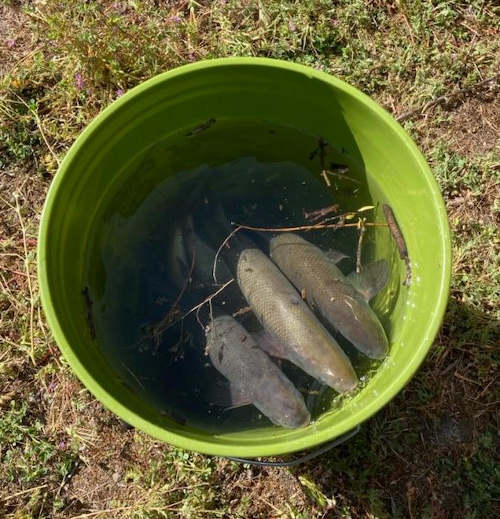
A bucket filled with Clear Lake hitch rescued from an isolated pool in Adobe Creek near Soda Bay in Lakeport, California, on Thursday, April 28, 2022. Photo courtesy of Lake County Water Resources. LAKE COUNTY, Calif. — Lake County’s drought conditions led this week to the need to rescue hundreds of threatened native fish.
Lake County Water Resources staff and the California Department of Fish and Wildlife, working alongside of Robinson Rancheria and Habematolel Pomo tribal members, leapt to the rescue on Thursday when it was reported that there were Clear Lake hitch in an isolated pool in Adobe Creek near Soda Bay in Lakeport.
The hitch, a large minnow found only in Clear Lake and its tributaries, has been a culturally important fish for the Pomo tribes, which considered it a staple food.
However, in recent decades it has significantly declined in numbers.
In 2014, the hitch was listed as a threatened species under the California Endangered Species Act.
A federal endangered species listing was denied for the hitch in December 2020 but is now the basis of a lawsuit filed in August by the Center for Biological Diversity, which submitted both the state and federal listing petitions for the hitch in an effort to save it.
Lake County Water Resources reported that the low water levels, warm weather and groundwater use can cause streams to dry up more quickly than usual at this time of year.
That’s a problem for hitch and other fish that are swimming up streams to spawn.
“This sometimes leaves isolated, non-connected pools or runs in streams around Clear Lake. Any fish caught in these isolated pools can't access the Lake and sometimes, they can die when the pool dries up later in spring or summer,” Lake County Water Resources reported on its Facebook page.
Lake County Water Resources said Friday that, in all, 240 hitch were rescued.
The agency credited the successful rescue of the fish to a fast and coordinated effort between its staff, the state Department of Fish and Wildlife and the tribal partners.
The team of rescuers was able to move the hitch, one by one, using backpack electroshockers — which stun the fish without harming them — buckets and nets.
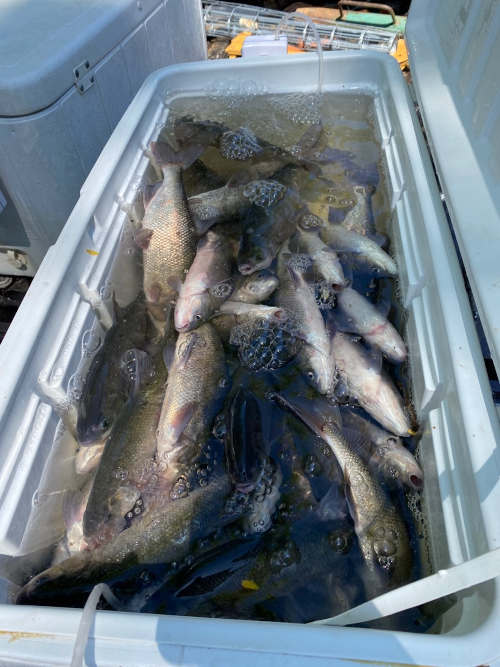
They put the fish into aerated coolers and drove them to a site near Konocti Vista Casino and Resort Marina in Lakeport where the fish were released into Clear Lake.
Water Resources said no fish died during the rescue, and all reports on the released hitch were positive.
Community members who see stranded fish in isolated pools or disconnected creeks are asked to contact Water Resources to help the fish.
That’s because officials emphasized that only permitted fisheries professionals from the state Department of Fish and Wildlife are allowed to conduct and supervise hitch rescues at this time. Any other type of hitch handling in streams is illegal.
Water Resources staffer Angela DePalma-Dow, who also writes the twice-monthly “Lady of the Lake” column for Lake County News, said they are encouraging reporting of strandings in the hope of saving more fish.
She said they also want to discourage illegal dumping in streams and creeks. “We see a lot of trash out there.”
If you see any stranded fish in creeks, call Water Resources at 707-263-2344 or message them on Facebook and they will investigate to see if a rescue is needed.
Email Elizabeth Larson at This email address is being protected from spambots. You need JavaScript enabled to view it.. Follow her on Twitter, @ERLarson, or Lake County News, @LakeCoNews.
Clear Lake hitch rescued from an isolated pool in Adobe Creek near Soda Bay in Lakeport, California, on Thursday, April 28, 2022, were placed in aerated coolers and transported to Clear Lake for a safe release.
CLEARLAKE, Calif. — Clearlake Animal Control has two more new dogs this week that are waiting for homes.
The City of Clearlake Animal Association also is seeking fosters for the animals waiting to be adopted.
Call the Clearlake Animal Control shelter at 707-273-9440, or email This email address is being protected from spambots. You need JavaScript enabled to view it. to inquire about adoptions and schedule a visit to the shelter.
Visit Clearlake Animal Control on Facebook or on the city’s website.
The following dogs are available for adoption.
“Captain.” Photo courtesy of Clearlake Animal Control. ‘Captain’
“Captain” is a male border collie mix with a black, white and blue coat.
He is dog No. 49623709.
“Big Phil.” Photo courtesy of Clearlake Animal Control. ‘Big Phil’
“Big Phil” is a 13-year-old male American pit bull terrier mix with a blue coat.
He is dog No. 49951647.
“Andy.” Photo courtesy of Clearlake Animal Control. ‘Andy’
“Andy” is a male American pit bull mix with a short gray and white coat.
He is dog No. 48995415.
“Bear.” Photo courtesy of Clearlake Animal Control. ‘Bear’
“Bear” is a male Labrador retriever-American pit bull mix with a short charcoal and fawn coat.
He has been neutered.
“Chai.” Photo courtesy of Clearlake Animal Control. ‘Chai’
“Chai” is a female Alaskan husky mix with a gray and white coat.
She has been spayed.
She is dog No. 49279552.
“Colt.” Photo courtesy of Clearlake Animal Control. ‘Colt’
“Colt” is a male Rhodesian Ridgeback mix with a short rust and black coat.
He has been neutered.
He is dog No. 49812106.
“Fritz.” Photo courtesy of Clearlake Animal Control. ‘Fritz’
“Fritz” is a male Australian shepherd mix with a black and white coat.
He is dog No. 49278179.
“Snowball.” Photo courtesy of Clearlake Animal Control. ‘Snowball’
“Snowball” is a male American Staffordshire mix terrier with a white coat.
He has been neutered.
He is dog No. 49159168.
“Terry.” Photo courtesy of Clearlake Animal Control. ‘Terry’
“Terry” is a male shepherd mix with a short brindle coat.
He is dog No. 48443693.
Email Elizabeth Larson at This email address is being protected from spambots. You need JavaScript enabled to view it.. Follow her on Twitter, @ERLarson, or Lake County News, @LakeCoNews.
Starting on May 1, Medi-Cal, California’s health coverage program for low-income individuals and families, is extending eligibility for full coverage to more than 185,000 individuals who are 50 years of age or older, regardless of immigration status.
“We’re delivering concrete results for Californians, continuing to fulfill the promise of a Healthy California for All, and I encourage all those eligible to take advantage of these essential health services,” said Gov. Newsom. “This is an investment in our people, our economy, and our future. But we’re not stopping there. California is on the path to expand Medi-Cal to all eligible Californians regardless of age or immigration status, providing the most comprehensive health coverage in the entire country.”
Gov. Newsom last year signed legislation making California the first state in the nation to expand full-scope Medi-Cal eligibility to low-income adults 50 years of age or older, regardless of immigration status.
Subject to legislative approval, Gov. Newsom has this year proposed expanding Medi-Cal to all eligible residents, regardless of age or immigration status.
The expansion population includes individuals 50 years of age or older who are eligible for Medi-Cal, who do not have satisfactory immigration status or are unable to establish satisfactory immigration status for full-scope Medi-Cal and are not yet enrolled in Medi-Cal. It also includes individuals 50 years of age or older who are currently enrolled in restricted scope Medi-Cal.
Individuals ages 50 and over, regardless of their immigration status, who have not applied for Medi-Cal can apply here starting May 1, 2022.
“This expansion of Medi-Cal supports the Newsom Administration’s vision of a Healthy California for All by addressing health coverage disparities that disproportionately impact disadvantaged communities. We’re committed to advancing diversity, equity, and inclusion on behalf of all Californians,” said Michelle Baass, Director of the Department of Health Care Services, or DHCS. “This action reflects our fundamental conviction that all Californians deserve quality health care.”
Many of these individuals and their communities have been disproportionately impacted by the COVID-19 pandemic and have had limited access to care. This expansion will improve access to preventive and routine care, improve financial security for those who enroll, and strengthen California’s efforts to address health disparities and inequities, especially among populations of color.
The state has worked for the last several years to extend health coverage to more Californians.
In May 2016, children under 19 years of age became eligible for full-scope Medi-Cal benefits, and in January 2020, full-scope Medi-Cal was extended to young adults ages 19 through 25, regardless of immigration status.
Previously, these individuals only qualified for limited Medi-Cal services, such as emergency, prenatal, and long-term care. Now they can access the full range of benefits available to Medi-Cal beneficiaries, including no-cost/low-cost quality health, behavioral health, substance use disorder services, and dental services through the various delivery systems under the Medi-Cal program.
“These Californians now have a place where they can coordinate all of their medical, dental, mental, and substance use disorder needs, and a primary care physician to better manage their health conditions,” said Jacey Cooper, State Medicaid Director. “Everyone benefits from ensuring access for all Californians, and many of us know someone who depends on Medi-Cal for vital health coverage.”
The next step in California’s coverage expansion, subject to legislative approval, is outlined in the Governor’s 2022-23 budget, which proposes to expand Medi-Cal coverage to an estimated 700,000-plus adults ages 26 through 49 without satisfactory immigration status, effective no sooner than Jan. 1, 2024.
Extending Medi-Cal to hundreds of thousands more is an important step to help close health equity gaps in the state and get California closer to universal coverage, the Governor’s Office reported.
The expansion to individuals aged 50 and over was included in Assembly Bill 133 (Chapter 143, Statutes of 2021), which amended Welfare and Institutions Code section 14007.8. For nearly a year, DHCS held monthly advocate and county work group meetings to implement this expansion.
The U.S. Department of Homeland Security and U.S. Citizenship and Immigration Services do not consider health, food and housing services as part of the public charge determination. Therefore, using Medi-Cal benefits (except for nursing home or mental health institution care) will not hurt an individual’s immigration status.
When someone applies for state-funded benefits, their information is only used to determine if they qualify. State laws protect the privacy of their information.
The California Governor’s Office of Emergency Services, or Cal OES, announced the deployment of firefighting resources to New Mexico in response to ongoing statewide wildfires.
One Type 3 Cal OES strike team is departing on Saturday and expected to arrive in Santa Fe, New Mexico on Sunday.
The strike team consists of five engines — one each from the departments of Ontario, Victorville, Chino Valley, Apple Valley and Rancho Cucamonga — and a Cal OES assistant chief.
Strong winds and dry conditions are contributing to massive wildfires burning throughout New Mexico. As of Friday, three wildfires have burned more than 63,000 acres combined.
The largest of those fires, the Cooks Peak Fire, has burned 55,978 acres and is 54% contained.
The Cerra Pelado Fire has consumed 7,258 acres and is 15% contained, while the newly-started Water Fire in the Gila National Forest burned 700 acres in less than two hours and has no containment.
Cal OES continues to monitor operations in New Mexico and requests for additional Emergency Management Assistance Compact, or EMAC, assistance.
EMAC — which includes the participation of all 50 states, the District of Columbia, Puerto Rico, Guam and the U.S. Virgin Islands — is a nationally recognized mutual-aid system that provides the foundation for states to request and send resources across their borders when impacted by a disaster.
The solar system. Image Credit: NASA/JPL-Caltech. Following a thorough evaluation, NASA has extended the planetary science missions of eight of its spacecraft due to their scientific productivity and potential to deepen our knowledge and understanding of the solar system and beyond.
The missions — Mars Odyssey, Mars Reconnaissance Orbiter, MAVEN, Mars Science Laboratory (Curiosity rover), InSight lander, Lunar Reconnaissance Orbiter, OSIRIS-REx, and New Horizons — have been selected for continuation, assuming their spacecraft remain healthy. Most of the missions will be extended for three years; however, OSIRIS-REx will be continued for nine years in order to reach a new destination, and InSight will be continued until the end of 2022, unless the spacecraft’s electrical power allows for longer operations.
Each extended mission proposal was reviewed by a panel of independent experts drawn from academia, industry, and NASA. In total, more than 50 reviewers evaluated the scientific return of the respective proposals. Two independent review chairs oversaw the process and, based on the panel evaluations, validated that these eight science missions hold substantial potential to continue bringing new discoveries and addressing compelling new science questions.
Beyond providing important programmatic benefit to NASA, several of these missions promise multi-divisional science benefits across NASA’s entire Science Mission Directorate (SMD), including their use as data relays for Mars surface landers and rovers, as well as to support other NASA initiatives such as the Commercial Lunar Payload Services (CLPS).
“Extended missions provide us with the opportunity to leverage NASA’s large investments in exploration, allowing continued science operations at a cost far lower than developing a new mission,” said Lori Glaze, director of the Planetary Science Division at NASA’s Headquarters in Washington. “Maximizing taxpayer dollars in this way allows missions to obtain valuable new science data, and in some cases, allows NASA to explore new targets with totally new science goals.”
Two of the extended missions, MAVEN and OSIRIS-REx, welcome new principal investigators (PIs).
OSIRIS-APEX (Principal Investigator: Dr. Daniella DellaGiustina, University of Arizona): The Origins, Spectral Interpretation, Resource Identification, Security-Regolith Explorer (OSIRIS-REx) mission is currently on its way back to Earth to deliver the samples of asteroid Bennu that it collected in 2020. Dante Lauretta, OSIRIS-REx PI, will remain in place for the primary mission, while DellaGiustina begins her role as the newly named PI for OSIRIS-APophis EXplorer (OSIRIS-APEX). With a new name to reflect the extended mission’s new goals, the OSIRIS-APEX team will redirect the spacecraft to encounter Apophis, an asteroid roughly 1,200 feet (roughly 370 meters) in diameter that will come within 20,000 miles (32,000 kilometers) of Earth in 2029. OSIRIS-APEX will enter orbit around Apophis soon after the asteroid’s Earth flyby, providing an unprecedented close-up look at this S-type asteroid. It plans to study changes in the asteroid caused by its close flyby of Earth and use the spacecraft’s gas thrusters to attempt to dislodge and study the dust and small rocks on and below Apophis’ surface.
MAVEN (Principal Investigator: Dr. Shannon Curry, University of California, Berkeley): The Mars Atmosphere and Volatile Evolution (MAVEN) mission plans to study the interaction between Mars’ atmosphere and magnetic field during the upcoming solar maximum. MAVEN’s observations as the Sun’s activity level increases toward the maximum of its 11-year cycle will deepen our understanding of how Mars’ upper atmosphere and magnetic field interact with the Sun.
InSight (Principal Investigator: Dr. Bruce Banerdt, JPL): Since landing on Mars in 2018, the Interior Exploration using Seismic Investigations, Geodesy and Heat Transport (InSight) mission has operated the only active seismic station beyond Earth. Its seismic monitoring of “marsquakes” has provided constraints on Mars’ interior, formation, and current activity. The extended mission will continue InSight’s seismic and weather monitoring if the spacecraft remains healthy. However, due to dust accumulation on its solar panels, InSight’s electrical power production is low, and the mission is unlikely to continue operations for the duration of its current extended mission unless its solar panels are cleared by a passing ‘dust devil’ in Mars’ atmosphere.
Lunar Reconnaissance Orbiter (LRO) (Project Scientist: Dr. Noah Petro, GSFC): LRO will continue to study the surface and geology of the Moon. The evolution of LRO’s orbit will allow it to study new regions away from the poles in unprecedented detail, including the Permanently Shadowed Regions (PSRs) near the poles where water ice may be found. LRO will also provide important programmatic support for NASA’s efforts to return to the Moon.
Mars Science Laboratory (MSL) (Project Scientist: Dr. Ashwin Vasavada, JPL): The Mars Science Laboratory and its Curiosity rover have driven more than 16 miles (27 km) on the surface of Mars, exploring the history of habitability in Gale Crater. In its fourth extended mission, MSL will climb to higher elevations, exploring the critical sulfate-bearing layers which give unique insights into the history of water on Mars.
New Horizons (Principal Investigator: Dr. Alan Stern, SwRI): New Horizons flew past Pluto in 2015 and the Kuiper belt object (KBO) Arrokoth in 2019. In its second extended mission, New Horizons will continue to explore the distant solar system out to 63 astronomical units (AU) from Earth. The New Horizons spacecraft can potentially conduct multidisciplinary observations of relevance to the solar system and NASA’s Heliophysics and Astrophysics Divisions. Additional details regarding New Horizons’ science plan will be provided at a later date.
Mars Odyssey (Project Scientist: Dr. Jeffrey Plaut, JPL): Mars Odyssey’s extended mission will perform new thermal studies of rocks and ice below Mars’ surface, monitor the radiation environment, and continue its long-running climate monitoring campaign. The Odyssey orbiter also continues to provide unique support for real-time data relay from other Mars spacecraft. The length of Odyssey’s extended mission may be limited by the amount of propellant remaining aboard the spacecraft.
Mars Reconnaissance Orbiter (MRO) (Project Scientist: Dr. Rich Zurek, JPL): MRO has provided a wealth of data regarding the processes on Mars’ surface. In its sixth extended mission, MRO will study the evolution of Mars’ surface, ices, active geology, and atmosphere and climate. In addition, MRO will continue to provide important data relay service to other Mars missions. MRO’s CRISM instrument will be shut down entirely, after the loss of its cryocooler has ended the use of one of its two spectrometers.
NASA’s Planetary Science Division currently operates 14 spacecraft across the solar system, has 12 missions in formulation and implementation, and partners with international space agencies on seven others.
The detailed reports from the 2022 Planetary Science Senior Review may be found here.
LAKE COUNTY, Calif. — The state of California has introduced a new program that gives community members a way to use their library cards to access state parks in an effort to advance safe and equitable outdoor access to all Californians.
California State Parks and the California State Library have announced a three-year pilot program that introduces the California State Library Parks Pass.
As part of the effort, which kicked off earlier this month during National Library Week, California State Parks is distributing the California State Library Parks Pass to public libraries across the state for checkout by library patrons.
“Spending time in nature is crucial to our mental health and well-being,” said First Partner Jennifer Siebel Newsom. “With the California State Library Parks Pass, anyone with a library card will be able to unlock the benefits and beauty of our majestic state parks.”
The new pass will allow free vehicle day use entry at more than 200 participating state park units.
That includes Clear Lake State Park in Kelseyville and Anderson Marsh State Historic Park in Lower Lake, and Robert Louis Stevenson State Park, which straddles the Lake and Napa County border, south of Middletown.
“Libraries are trusted community hubs where Californians know they can find what they need to work, play, and thrive,” said California State Librarian Greg Lucas. “This partnership with State Parks now allows Californians to ‘check out’ California’s great outdoors at their community library.”
State officials said the goal of the program is to bring together the largest state park system in the nation with California’s public libraries to reduce barriers to park access and help more Californians explore the outdoors and generate positive impacts in the area of health, natural resource stewardship, and historical and cultural connections.
“Parks and libraries have the potential to be powerful symbols and agents for California’s open spaces,” said California State Parks Director Armando Quintero.
Starting this month, each library jurisdiction will receive at least three California State Library Parks Pass hangtags per branch for checkout by library patrons, including mobile libraries.
Park passes will enter circulation on a rolling basis throughout April and May for checkout by library patrons; library users can contact their local library for more information. Library-card holders will be able to check out the pass for the allotted number of days allowed by the local library, then return the pass to the library for others to use.
The pass is valid for entry of one passenger vehicle with capacity of nine people or less or one highway licensed motorcycle at participating state park units.
Lake County Librarian Christopher Veach said it’s an exciting new program for the state.
“We have received three passes from the state so far and are working to make them available to Lake County Library card holders only since there are so few,” Veach said.
He said the passes will be assigned one each to Lakeport, Middletown and Redbud Library.
“According to an email from the state, we expect to receive at least 11 more by the end of the month which will be distributed between all four branches. The state library decided how many to send to each Library system by population,” Veach added.
State officials said libraries are already an important part of Californians’ lives.
There are 1,184 public library buildings in California, and more than 23 million Californians have library cards.
In 2019-2020, California’s libraries circulated over 97 million items free of charge, such as books, technology, Wi-Fi hotspots, videos, music, instruments, tools, telescopes and more.
Additionally, California’s libraries hosted over 300,000 programs in 2019-2020, with almost 7.5 million people attending.
The Lake County Library’s facilities include those in Lakeport, Middletown and Redbud Library, and in Upper Lake.
Veach has worked hard to expand the offerings of the Lake County Library system, providing resources, programs and online training, and staying connected with the community despite the pandemic.
Veach said there are 26,640 active Lake County library cards registered. The county’s overall population is around 65,000.
Lake County Library card holders can view and request the California State Library Parks Pass on the library catalog here.
The California State Library will be providing grant funding to libraries for outdoor-related items for checkout, programs that teach natural resource stewardship and outdoor skills, or to encourage their library patrons to enjoy the outdoors and make historical and cultural connections to parks.
The 2021-22 State Budget included initiatives to advance equitable access to state parks and open spaces for all Californians.
A $9.1 million one-time General Fund investment was included in the budget to launch a state parks pilot to expand parks pass distribution, especially for youth in disadvantaged communities.
The pilot includes the California State Park Adventure Pass program that provides free day-use passes for fourth graders and their families, the revamped Golden Bear Pass Program and the California State Library Parks Pass.
Email Elizabeth Larson at This email address is being protected from spambots. You need JavaScript enabled to view it.. Follow her on Twitter, @ERLarson, or Lake County News, @LakeCoNews.
 How to resolve AdBlock issue?