 How to resolve AdBlock issue?
News
PG&E said it is continuing to evolve its wildfire safety program to reduce the risk of catastrophic wildfires.
As part of these efforts, PG&E is hosting the wildfire safety webinar for Napa, Lake and Colusa County residents on Wednesday, April 27, from 5:30 to 7 p.m. to share its wildfire prevention plans for 2022 and listen to customer feedback.
PG&E experts will provide a brief presentation, after which participants will have the opportunity to ask questions.
The event can be accessed through the link or dial-in below or through PG&E’s website, pge.com/firesafetywebinars.
Click this link to join: bit.ly/362LL9X.
Attendee dial-in is 800-369-2098; the conference ID is 1371852.
During the webinar event, the PG&E team will discuss its wildfire prevention efforts; resources to help customers and communities before, during and after wildfire safety outages; and improvements and updates to PG&E’s safety technology and tools.
Closed captioning will be available in English, Spanish and Chinese and dial-in numbers will be available for those who aren’t able to join online.
For the full webinar events schedule, additional information on how to join, recordings and presentation materials from past events, and to learn more about PG&E’s Community Wildfire Safety Program, visit www.pge.com/wildfiresafety.
More information and resources to help you and your family prepare for and stay safe in the event of an emergency can be found at https://www.safetyactioncenter.pge.com/.

On Monday, Gov. Gavin Newsom convened the coalition in support of CARE Court, which will provide individuals with severe mental health and substance use disorders the care and services they need to get healthy.
SB 1338, CARE Court legislation authored by Senator Thomas Umberg (D-Santa Ana) and Senator Susan Talamantes Eggman (D-Stockton), will be heard on Tuesday in its first committee, Senate Judiciary.
“Support for CARE Court is broad and diverse because Californians are tired of the status quo,” said Gov. Newsom. “We must act with urgency and accountability to address this crisis which currently leaves thousands of individuals living on our streets without the help they need.”
The coalition includes members of California’s Big City Mayors, the National Alliance on Mental Illness, California Professional Firefighters, the California Medical Association and the California Hospital Association, among others.
“As leaders at the local level, we are on the frontlines of this crisis, and we see CARE Court as a critical priority for the Big City Mayors of California. It’s time that our golden state stops walking by our greatest moral shame and faces it head on with clarity and compassion,” said Oakland Mayor Libby Schaaf.
“Our members see people at their point of greatest need, responding to 911 calls for those in serious mental health crisis. This leads to using scarce fire and EMS resources to pick up the same folks over and over again. Governor Newsom knows we need a different approach, and CARE Court will help us break this cycle and truly get people the help they need,” said California Professional Firefighters President Brian K. Rice.
CARE Court would allow courts to order CARE plans, which would require counties to provide comprehensive treatment to the most severely impaired and untreated Californians and hold patients accountable to following their treatment plans.
It will provide an opportunity for a range of people, including family members, first responders, intervention teams, and mental health service providers, among others, to refer individuals suffering from schizophrenia spectrum or psychotic disorders, many of them unhoused, and get them into community-based services.
These include short-term stabilization medications, wellness and recovery supports, and connection to social services, including a housing plan.
The governor has called upon the Legislature to move quickly to enact CARE Court to allow local partners to begin implementation of this critical program.
CARE Court builds on Gov. Newsom’s $14 billion multi-year investment to provide new housing units and treatment slots and nearly $10 billion annually in community behavioral health services.
The governor’s approach focuses on quickly rehousing unsheltered individuals with behavioral health issues, all while new units come online, while also transforming Medi-Cal to provide more behavioral health services to people struggling the most.
For more information, visit https://www.chhs.ca.gov/care-court/.
America’s electric power system is undergoing radical change as it transitions from fossil fuels to renewable energy. While the first decade of the 2000s saw huge growth in natural gas generation, and the 2010s were the decade of wind and solar, early signs suggest the innovation of the 2020s may be a boom in “hybrid” power plants.
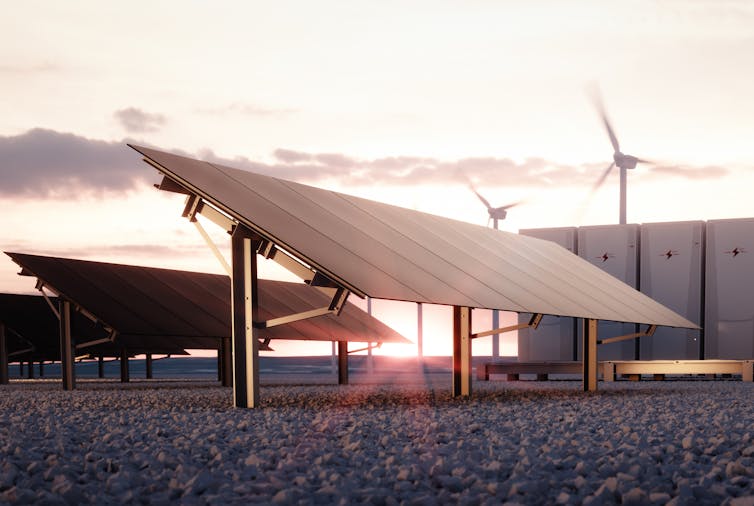
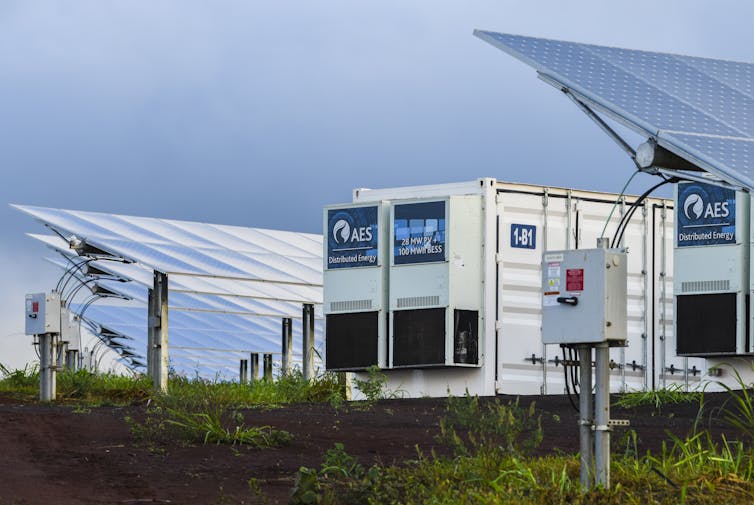
A typical hybrid power plant combines electricity generation with battery storage at the same location. That often means a solar or wind farm paired with large-scale batteries. Working together, solar panels and battery storage can generate renewable power when solar energy is at its peak during the day and then release it as needed after the sun goes down.
A look at the power and storage projects in the development pipeline offers a glimpse of hybrid power’s future.
Our team at Lawrence Berkeley National Laboratory found that a staggering 1,400 gigawatts of proposed generation and storage projects have applied to connect to the grid – more than all existing U.S. power plants combined. The largest group is now solar projects, and over a third of those projects involve hybrid solar plus battery storage.
While these power plants of the future offer many benefits, they also raise questions about how the electric grid should best be operated.
Why hybrids are hot
As wind and solar grow, they are starting to have big impacts on the grid.
Solar power already exceeds 25% of annual power generation in California and is spreading rapidly in other states such as Texas, Florida and Georgia. The “wind belt” states, from the Dakotas to Texas, have seen massive deployment of wind turbines, with Iowa now getting a majority of its power from the wind.
This high percentage of renewable power raises a question: How do we integrate renewable sources that produce large but varying amounts of power throughout the day?
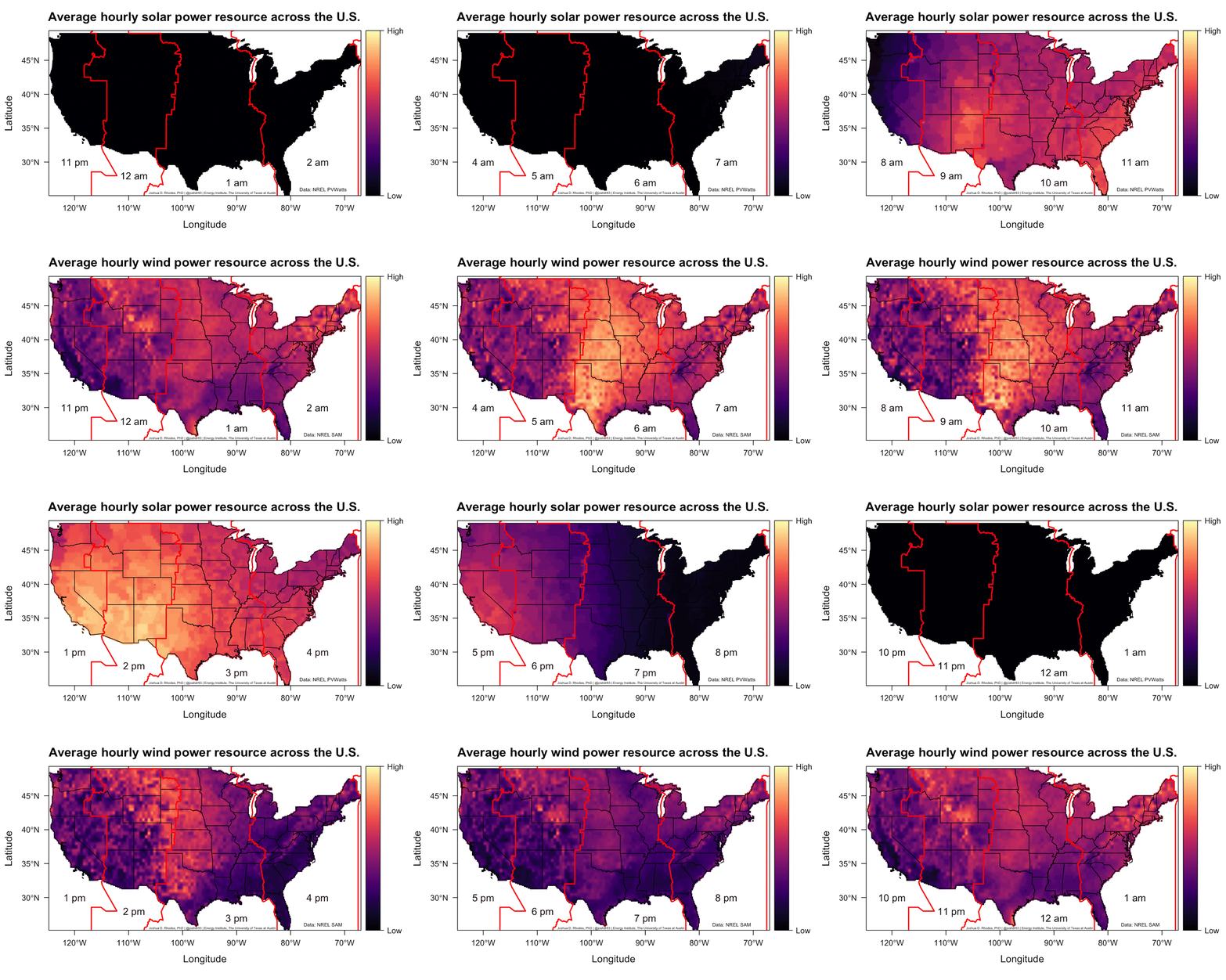
That’s where storage comes in. Lithium-ion battery prices have rapidly fallen as production has scaled up for the electric vehicle market in recent years. While there are concerns about future supply chain challenges, battery design is also likely to evolve.
The combination of solar and batteries allows hybrid plant operators to provide power through the most valuable hours when demand is strongest, such as summer afternoons and evenings when air conditioners are running on high. Batteries also help smooth out production from wind and solar power, store excess power that would otherwise be curtailed, and reduce congestion on the grid.
Hybrids dominate the project pipeline
At the end of 2020, there were 73 solar and 16 wind hybrid projects operating in the U.S., amounting to 2.5 gigawatts of generation and 0.45 gigawatts of storage.
Today, solar and hybrids dominate the development pipeline. By the end of 2021, more than 675 gigawatts of proposed solar plants had applied for grid connection approval, with over a third of them paired with storage. Another 247 gigawatts of wind farms were in line, with 19 gigawatts, or about 8% of those, as hybrids.
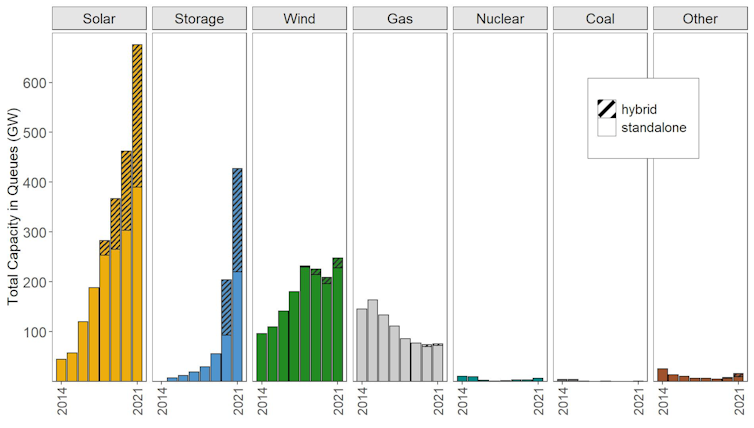
Of course, applying for a connection is only one step in developing a power plant. A developer also needs land and community agreements, a sales contract, financing and permits. Only about one in four new plants proposed between 2010 and 2016 made it to commercial operation. But the depth of interest in hybrid plants portends strong growth.
In markets like California, batteries are essentially obligatory for new solar developers. Since solar often accounts for the majority of power in the daytime market, building more adds little value. Currently 95% of all proposed large-scale solar capacity in the California queue comes with batteries.
5 lessons on hybrids and questions for the future
The opportunity for growth in renewable hybrids is clearly large, but it raises some questions that our group at Berkeley Lab has been investigating.
Here are some of our top findings:
-
The investment pays off in many regions. We found that while adding batteries to a solar power plant increases the price, it also increases the value of the power. Putting generation and storage in the same location can capture benefits from tax credits, construction cost savings and operational flexibility. Looking at the revenue potential over recent years, and with the help of federal tax credits, the added value appears to justify the higher price.
-
Co-location also means tradeoffs. Wind and solar perform best where the wind and solar resources are strongest, but batteries provide the most value where they can deliver the greatest grid benefits, like relieving congestion. That means there are trade-offs when determining the best location with the highest value. Federal tax credits that can be earned only when batteries are co-located with solar may be encouraging suboptimal decisions in some cases.
-
There is no one best combination. The value of a hybrid plant is determined in part by the configuration of the equipment. For example, the size of the battery relative to a solar generator can determine how late into the evening the plant can deliver power. But the value of nighttime power depends on local market conditions, which change throughout the year.
-
Power market rules need to evolve. Hybrids can participate in the power market as a single unit or as separate entities, with the solar and storage bidding independently. Hybrids can also be either sellers or buyers of power, or both. That can get complicated. Market participation rules for hybrids are still evolving, leaving plant operators to experiment with how they sell their services.
-
Small hybrids create new opportunities: Hybrid power plants can also be small, such as solar and batteries in a home or business. Such hybrids have become standard in Hawaii as solar power saturates the grid. In California, customers who are subject to power shutoffs to prevent wildfires are increasingly adding storage to their solar systems. These “behind-the-meter” hybrids raise questions about how they should be valued, and how they can contribute to grid operations.
Hybrids are just beginning, but a lot more are on the way. More research is needed on the technologies, market designs and regulations to ensure the grid and grid pricing evolve with them.
While questions remain, it’s clear that hybrids are redefining power plants. And they may remake the U.S. power system in the process.
Joachim Seel, Senior Scientific Engineering Associate, Lawrence Berkeley National Laboratory; Bentham Paulos, Affiliate, Electricity Markets & Policy Group, Lawrence Berkeley National Laboratory, and Will Gorman, Graduate Student Researcher in Electricity Markets and Policy, Lawrence Berkeley National Laboratory
This article is republished from The Conversation under a Creative Commons license. Read the original article.
The board will meet beginning at 9 a.m. Tuesday, April 26, in the board chambers on the first floor of the Lake County Courthouse, 255 N. Forbes St., Lakeport.
The meeting can be watched live on Channel 8, online at https://countyoflake.legistar.com/Calendar.aspx and on the county’s Facebook page. Accompanying board documents, the agenda and archived board meeting videos also are available at that link.
To participate in real-time, join the Zoom meeting by clicking this link.
The meeting ID is 956 8784 9396, pass code 132379. The meeting also can be accessed via one tap mobile at +16699006833,,95687849396#,,,,*132379#.
All interested members of the public that do not have internet access or a Mediacom cable subscription are encouraged to call 669-900-6833, and enter the Zoom meeting ID and pass code information above.
To submit a written comment on any agenda item visit https://countyoflake.legistar.com/Calendar.aspx and click on the eComment feature linked to the meeting date. If a comment is submitted after the meeting begins, it may not be read during the meeting but will become a part of the record.
In an untimed item, the board will consider a report from County Administrative Officer Carol Huchingson regarding supervisorial salaries in 12 comparison counties.
In 2020 and 2021, the board approved raises for county employees totaling $21 million, but at that time did not raise supervisorial salaries.
However, the Tuesday discussion to be presented by Huchingson — who is retiring as of April 29 — appears to be setting the stage for the board to get raises totaling nearly 35%.
Huchingson’s report said supervisorial salaries in Lake County had been set at 60% of the average of the elected department head salaries since 2001.
She said that the board’s actions in October 2020, when it gave out the first $5 million in raises, froze the supervisorial salaries at $63,714 per year, with the chair getting an additional $2,400.
Human Resources has gathered data from the original 12 comparison counties used in the classification and compensation the county used for giving the employee raises over the past two years. “Staff requests an opportunity to review the findings with your Board,” Huchingson wrote.
She said if the board reverted back to the 60% methodology, the new salary rate for supervisors would be $85,855 per year, plus the $2,400 for the chair.
Her report showed that among the comparison counties, some base supervisorial salaries on a percentage of the salaries paid for Superior Court judges, which currently are set at $225,074 annually. Those range from 33%, or $74,274 per year in Colusa County, to 47%, or $105,785 annually, in Napa County and 75%, or $168,805, in Sonoma County.
In another untimed item, Supervisor Bruno Sabatier is asking the board to consider reestablishing Human Resources as a stand-alone department.
In 2018, at Huchingson’s request, the board placed Human Resources under the County Administrative Officer’s control.
However, historically, over the past four decades, it had mostly been a stand-alone department, Sabatier said.
“In 2018, there were some needs to enhance Human Resources, especially in its goal to quickly fly positions for recruitment and to tackle the issue of pay and vacancy rates. These changes have been successful. Now, Human Resources is able to fly those positions fairly quickly upon request by a hiring department and salaries and benefits have received the scrutiny it required in order to pro-actively deal with our vacancy rates,” Sabatier wrote.
“Human Resources has grown a lot as well over the years. It develops policy on recruitment strategies to effectively recruit qualified personnel, ensure training opportunities for our employees, administers health and other work-related benefits, and appropriately responds to state and federal regulatory mandates,” he said.
Sabatier said it’s “absolutely important that the Board of Supervisors have a direct connection with the Human Resources Director as we continue the work to reduce our vacancy rates. It is also important, as the Board goes through the process of hiring a new County Administrative Officer, to ensure that they come into the position with the ability to seamlessly transition and to continue towards the Board’s goal and objectives. By re-establishing Human Resources as a stand-alone department, it will allow Board members to continue to oversee the work being accomplished by Human Resources while also alleviating some of the workload of the CAO to better focus on the Administrative Office’s role in taking our county into the future.”
Sabatier’s report does not directly address concerns about transparency and conflict of interest with Human Resources remaining under the County Administrative Office’s control, at least in the short-term.
Specifically, those issues are arising because Susan Parker, Huchingson’s assistant county administrative officer, has been tapped by the board to fill the position on an interim basis. Parker has acknowledged she intends to see the job on a permanent basis.
That raises questions about what influence she may exert in the recruitment process for the job that she also is seeking.
A discussion the county had announced would take place on April 26 regarding how to fill Supervisor Tina Scott’s seat due to her resignation, effective in July, is not on the agenda.
The full agenda follows.
CONSENT AGENDA
5.1: Adopt proclamation commending County Administrative Officer Carol J. Huchingson for her 29 years of service to the county of Lake.
5.2: a) Rescind the wireless-communications devices policies; and b) approve the smartphone stipend policy.
5.3: Approve public defender contract amendment No. 7 between the county of Lake and Lake Indigent Defense LLP for the purpose of removing Mitchell Hauptman as partner and authorize chair to sign.
5.4: Approve Board of Supervisors meeting minutes April 5, 2022.
5.5: Adopt proclamation designating the week of April 24 to 30, 2022, as National Crime Victims' Rights Week.
5.6: Adopt resolution authorizing the Lake County Health Services Department to accept funding from the California Department of Public Health's Oral Health Program for fiscal years 2022 through 2027.
5.7: Approve the purchase of professional services from CivicPlus in the amount of $62,853.29 for website redesign, migration, and hosting, and authorize the board chair to sign the statement of work.
5.8: a) Approve agreement for Federal Apportionment Exchange Program and State Match Program for California Department of Transportation — Non MPO County, Agreement No. X22-5914(124); and b) adopt resolution authorizing and directing the chair of the Board of Supervisors to execute the agreements for Federal Apportionment Exchange Program and State Match Program for California Department of Transportation – Non MPO County, Agreement No. X22-5914(124), and authorize the chair to sign the resolution and agreement.
5.9: Approve the submission of an electronic grant application to the state of California Department of Boating and Waterways in the amount of $125,000 for the purchase of a new law enforcement patrol boat and trailer.
TIMED ITEMS
9:05 a.m.: Pet of the Week.
6.3, 9:07 a.m.: Presentation of proclamation commending County Administrative Officer Carol J. Huchingson for her 29 years of service to the county of Lake.
6.4, 9:08 a.m.: Presentation of Proclamation Designating the week of April 24-30, 2022 as National Crime Victims' Rights Week.
6.5, 9:30 a.m.: Public hearing on account and proposed assessment for 6329 10th Ave, Lucerne.
6.6, 10:15 a.m.: a) Consideration of presentation on the Organized Delivery System 1115 Demonstration and 1915(b) waiver for substance use disorder treatment services; and b) approve joining the Organized Delivery System.
6.7, 10:45 a.m.: a) Consideration of update by the Public Works director on the status of the 5-Year Pavement Rehabilitation Plan; and b) direction to staff for next steps in completing the plan.
6.8, 11:30 a.m.: Discussion of potential transient occupancy tax ordinance revision and voluntary collection agreements.
6.9, 12 p.m.: Consideration of a 5 year agreement by and between the county of Lake and ECS Imaging Inc. for document management software and scanning, indexing, conversion and destruction services, year one in the amount $191,950.50, year two in the amount of $67,500, year three in the amount of $67,500, year four in the amount of $67,500 and year five in the amount of $67,500.00 for a total of $461,950.50, and authorize the chair to sign.
UNTIMED ITEMS
7.2: Consideration of Board of Supervisor salaries in 12 comparison counties.
7.3: Consideration of the following advisory board appointments: Maternal, Child and Adolescent Health, Lower Lake Waterworks District.
7.4: Consideration of Clearlake Oaks Road Map Task Force Community-Driven Revitalization Action Plan.
7.5: Consideration of use of Pacific Gas and Electric Co. settlement funds for various road projects and authorize the Public Works Department to include appropriations in the fiscal year 2022-23 budget.
7.6: a) Presentation and discussion on proposed routes to ensure compliance with Senate Bill 552; and b) identify and authorize the most-viable route as recommended for Lake County’s Compliance with Senate Bill 552.
7.7, ADDENDUM: Consideration of resolution re-establishing the human resources department as a stand-alone department.
CLOSED SESSION
8.1: Public employee evaluation: County Librarian Christopher Veach.
8.2: Public employee evaluation: Public Services Director Lars Ewing.
Email Elizabeth Larson at
The commission will meet beginning at 6 p.m. Tuesday, April 26, in the council chambers at Clearlake City Hall, 14050 Olympic Drive.
The agenda can be found here.
Submit comments and questions in writing for commission consideration by sending them to Administrative Services Director/City Clerk Melissa Swanson at
Community members also can participate via Zoom.
To give the planning commission adequate time to review your questions and comments, please submit written comments before 4 p.m. Tuesday, April 26.
The meeting will be broadcast live on the YouTube channels for the city of Clearlake or Lake County PEG TV.
On the agenda is a public hearing for the commission to consider conditional use permit application and a corresponding environmental assessment, and a categorical exemption to develop and operate a gas station with convenience store with on-site sales of alcohol, office space, fast food restaurant, and a drive through car wash to be located at 15895 Dam Road.
The new business would be located in the Clearlake Shopping Center, located at Highway 53 and Dam Road.
The property is owned by Jatinder Sign. The applicant, Jeanette Verdugo, anticipates starting construction in September, with the work to be completed in six months.
On the meeting's consent agenda — items that are considered routine in nature and usually adopted on a single vote — are planning commission minutes fo Nov. 3, 2020, May 17, 2021, June 22, 2021, Aug. 24, 2021, Nov. 9, 2021, Jan. 11, 2022, and January 25, 2022; general plan consistency determination, GPCD 2022-01, Categorical Exemption, CE 2022-07, APN: 042-362-100-000; PC Resolution No. 2022-09; and general plan consistency determination, GPCD 2022-02, Categorical Exemption, CE 2022-08, road abandonment, portion of Spruce Avenue and Armijo Avenue, Resolution PC 2022-10.
Email Elizabeth Larson at
The event will be held in the front lobby entrance of the police station at 2025 S. Main St., Lakeport.
Items that will be accepted include all over the counter or prescription medications in pill, tablet, liquid, cream or capsule form including schedule II-V controlled and non-controlled substances.
Pills need to be emptied out of their containers and placed in a zip lock plastic bag (not paper; they need to verify the contents to make sure there is nothing in the bag they can't take).
They will collect vape pens or other e-cigarette devices from individual consumers only after the batteries are removed from the devices. It is important to stress that we will not be responsible for removing the batteries from the devices.
Items they will not accept include illegal drugs, needles, inhalers or aerosol cans.
Since the LPD started participating with the prescription Take Back Program in January of 2019, the agency has collected more than 838 pounds of prescription drugs, many of which were dangerous narcotics including opioids.
Collecting these prescription drugs protects the community by keeping them from being diverted to illegal use and keeps them out of our environment and water.
For more information about the event, visit https://www.dea.gov/takebackday. Contact the Lakeport Police Department with questions, 707-263-5401.