 How to resolve AdBlock issue?
News

Winter solstice brings the shortest day and longest night of the year in the Northern Hemisphere. It’s a great night to spend reading.
I’ve taught English and creative writing in snowy Binghamton, New York, for more than 40 years – reading, writing, reviewing and judging books all the while – so it’s never hard for me to find something to read. Only to choose.
To save you the same indecision, I’ve picked five books for the darkest time of the year.
1. Henry David Thoreau, “Walden Pond” (1854)
Thoreau’s “Walden Pond” is America’s most celebrated nature book, filled with the author’s observations of the woods near Walden Pond in Concord, Massachusetts. “Walden” begins in July, but Thoreau welcomes winter in some of the book’s most beautiful passages.
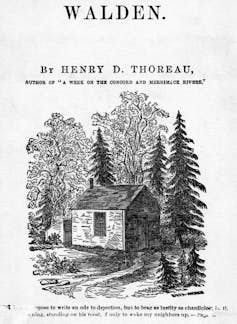
“The north wind had already begun to cool the pond,” Thoreau writes, when he “went into winter quarters.” Not that he stayed indoors much.
Most of us won’t stretch out face down “on ice only an inch thick,” as Thoreau reports doing, but we can read about him doing it while staying warm. Thoreau noticed frozen bubbles, stacked “like a string of beads” or “silvery coins poured from a bag.” He catalogs – how he loves cataloging! – the colors of the pond, from “transparent” to dark green to “opaque and whitish or gray.” In winter he burned pine, decaying stumps, hickory, dry leaves and logs he’d dragged home while skating across the pond. Fuel provided him warmth, cooked food and company. “You can always see a face in the fire,” Thoreau wrote.
In winter he welcomed rare humans, such as fellow writer Louisa May Alcott’s father, Bronson. But mostly he encountered foxes, squirrels, chickadees, jays and a barred owl that he described as the “winged brother of the cat.” Thoreau delights in the sound of the ice booming in a thaw and describes moonlit rescues of hikers he escorted back to the edge of civilization.
The five chilly chapters of “Walden” comprise a winter sampler for those who haven’t read this mighty book — and for those returning to it.
2. Robert Frost, “The Poetry of Robert Frost”
No poet sang of winter like poet laureate and New Englander Robert Frost. In his great “Stopping by Woods on a Snowy Evening” he pays homage to winter’s solitude:
“Between the woods and frozen lake/The darkest evening of the year.”
“The Poetry of Robert Frost” weighs in at more than 600 pages. “You Come Too,” a beautifully curated edition of poems for the young, is less than 100.
Both books contain popular midwinter favorites. Even their titles suggest the poet’s strong connection to winter: “Looking for a Sunset Bird in Winter”; “A Hillside Thaw” (“Ten million silver lizards out of snow!”); “Good-by and Keep Cold”; “A Patch of Old Snow.”
In “Birches,” Frost writes of branches that turn raindrops into ice crystals melted by sunlight.
Shattering and avalanching on the snow-crust –
Such heaps of broken glass to sweep away
You’d think the inner dome of heaven has fallen.
Frost’s poems are easily memorized and lovely to read aloud over any blustering gales.
3. Dylan Thomas, “A Child’s Christmas in Wales” (1952)
As Frost wrote for all ages, so did Dylan Thomas in “A Child’s Christmas in Wales” – available in its original Tiffany blue New Directions paperback edition, decorated exquisitely with illustrations by Ellen Raskin – a winter’s poem made to be sung. We can even hear the poet chanting it aloud on his 1952 recording.
One need not be Welsh to love Thomas’ seaside childhood. One need not even celebrate Christmas.
“One Christmas was so much like another,” the poem opens, “that I can never remember whether it snowed/for six days and six nights when I was 12/or whether it snowed for 12 days and/12 nights when I was six.”
4. Italo Calvino, “If on a Winter’s Night a Traveler” (1979)
Italo Calvino bundles magic, metafiction, philosophy, danger and love into “If on a Winter’s Night a Traveler.” It’s Calvino’s most mystifying work, challenging readers’ assumptions about reading and storytelling.
Not exactly a novel, it comprises the first chapter of 10 invented novels by 10 imaginary authors. Is it still winter? a reader may wonder. Was it ever winter?
As Calvino admits, “The only truth I can write is that of the instant I am living.”
5. James Fenton, “A Garden from a Hundred Packets of Seeds” (2002)
Some gardeners spend all winter dreaming. Others spend it busily planning.
“A Garden from a Hundred Packets of Seeds” proposes a radically old-fashioned approach – to grow a garden simply sprung from seed. Author James Fenton explains, “[S]imple-mindedness was a part of what I was after: buy a packet of nasturtium seeds and plant them, grow some very tall sunflowers – this is what gardening should be all about.”
A garden doesn’t need expensive starter plants or even a plan. The great question in life, as well as with gardens, is: What do I want to grow?
Winter unearths simplicity – the stark black-and-white vista it presents, the bare-boned landscape. It encourages readers to follow suit by ridding themselves of the extraneous and making room for life. As the celebrated saying goes, “If you choose not to find joy in the snow, you will have less joy in your life but the same amount of snow.”
Besides, as December ends, we turn the corner toward light. 

Liz Rosenberg, Professor of English, General Literature and Rhetoric, Binghamton University, State University of New York
This article is republished from The Conversation under a Creative Commons license. Read the original article.

A space telescope designed to search for the hardest-to-find asteroids and comets that stray into Earth’s orbital neighborhood, NASA’s Near-Earth Object Surveyor, or NEO Surveyor, recently passed a rigorous technical and programmatic review.
Now the mission is transitioning into the final design-and-fabrication phase and establishing its technical, cost, and schedule baseline.
The mission supports the objectives of NASA’s Planetary Defense Coordination Office, or PDCO, at NASA Headquarters in Washington.
The NASA Authorization Act of 2005 directed NASA to discover and characterize at least 90% of the near-Earth objects more than 460 feet across that come within 30 million miles of our planet’s orbit.
Objects of this size are capable of causing significant regional damage, or worse, should they impact the Earth.
“NEO Surveyor represents the next generation for NASA’s ability to quickly detect, track, and characterize potentially hazardous near-Earth objects,” said Lindley Johnson, NASA’s Planetary Defense Officer at PDCO. “Ground-based telescopes remain essential for us to continually watch the skies, but a space-based infrared observatory is the ultimate high ground that will enable NASA’s planetary defense strategy.”
Find them first
Managed by NASA’s Jet Propulsion Laboratory in Southern California, NEO Surveyor will journey a million miles to a region of gravitational stability — called the L1 Lagrange point — between Earth and the Sun, where the spacecraft will orbit during its five-year primary mission.
From this location, the NEO Surveyor will view the solar system in infrared wavelengths — light that is invisible to the human eye.
Because those wavelengths are mostly blocked by Earth’s atmosphere, larger ground-based observatories may miss near-Earth objects that this space telescope will be able to spot by using its modest light-collecting aperture of nearly 20 inches.
NEO Surveyor’s cutting-edge detectors are designed to observe two heat-sensitive infrared bands that were chosen specifically so the spacecraft can track the most challenging-to-find near-Earth objects, such as dark asteroids and comets that don’t reflect much visible light.
In the infrared wavelengths to which NEO Surveyor is sensitive, these objects glow because they are heated by sunlight.
In addition, NEO Surveyor will be able to find asteroids that approach Earth from the direction of the Sun, as well as those that lead and trail our planet’s orbit, where they are typically obscured by the glare of sunlight — objects known as Earth Trojans.
“For the first time in our planet’s history, Earth’s inhabitants are developing methods to protect Earth by deflecting hazardous asteroids,” said Amy Mainzer, the mission’s survey director at the University of Arizona in Tucson. “But before we can deflect them, we first need to find them. NEO Surveyor will be a game-changer in that effort.”
The mission will also help to characterize the composition, shape, rotation, and orbit of near-Earth objects. While the mission’s primary focus is on planetary defense, this information can be used to better understand the origins and evolution of asteroids and comets, which formed the ancient building blocks of our solar system.
When it launches, NEO Surveyor will build upon the successes of its predecessor, the Near-Earth Object Wide-field Infrared Survey Explorer, or NEOWISE.
Repurposed from the WISE space telescope after that mission ended in 2011, NEOWISE proved highly effective at detecting and characterizing near-Earth objects, but NEO Surveyor is the first space mission built specifically to find large numbers of these hazardous asteroids and comets.
Already in the works
After the mission passed this milestone on Nov. 29, key instrument development got under way. For instance, the large radiators that will allow the system to be passively cooled are being fabricated.
To detect the faint infrared glow of asteroids and comets, the instrument’s infrared detectors need to be much cooler than the spacecraft’s electronics. The radiators will perform that important task, eliminating the need for complex active cooling systems.
Additionally, construction of the composite struts that will separate the telescope’s instrumentation from the spacecraft has begun.
Designed to be poor heat conductors, the struts will isolate the cold instrument from the warm spacecraft and sunshield, the latter of which will block sunlight that might otherwise obscure the telescope’s view of near-Earth objects and heat up the instrument.
Progress has also been made developing the instrument’s infrared detectors, beam splitters, filters, electronics, and enclosure. And work has begun on the space telescope’s mirror, which will be formed from a solid block of aluminum and shaped by a custom-built diamond-turning machine.
“The project team, including all of our institutional and industrial collaborators, is already very busy designing and fabricating components that will ultimately become flight hardware,” said Tom Hoffman, NEO Surveyor project manager at JPL. “As the mission enters this new phase, we’re excited to be working on this unique space telescope and are already looking forward to our launch and the start of our important mission.”
More about the mission
The mission is tasked by NASA’s Planetary Science Division within the Science Mission Directorate; program oversight is provided by the PDCO, which was established in 2016 to manage the agency’s ongoing efforts in planetary defense.
NASA’s Planetary Missions Program Office at Marshall Space Flight Center provides program management for NEO Surveyor.
The project is being developed by JPL and is led by survey director Amy Mainzer at the University of Arizona. Established aerospace and engineering companies have been contracted to build the spacecraft and its instrumentation, including Ball Aerospace, Space Dynamics Laboratory, and Teledyne.
The Laboratory for Atmospheric and Space Physics at the University of Colorado, Boulder will support operations, and IPAC-Caltech in Pasadena, California, is responsible for processing survey data and producing the mission’s data products. Caltech manages JPL for NASA.
More information about NEO Surveyor is available at https://solarsystem.nasa.gov/missions/neo-surveyor.
The vote came toward the end of a two-hour meeting held in Lucerne Elementary School’s multipurpose room.
The town hall also voted to direct Chair Kurt McKelvey to send the letter to county, state and federal leaders.
The town hall moved its meeting location to Lucerne Elementary after the Lucerne Hotel’s owner, Andrew Beath, refused to allow them to meet if they were going to discuss the sale to the Scotts Valley Band.
District 3 Supervisor EJ Crandell then sent out a cancellation notice setting the next meeting in January, which the group’s bylaws don’t give him the authority to do.
Concerned about reports that escrow was set to close by the end of December, McKelvey called the special meeting for Wednesday night in an attempt to give the community a chance to comment.
Even in the midst of the busy holiday season, three dozen people showed up to discuss the matter in person — with about 20 more on Zoom at one point as well as others who watched the livestream on Facebook. They voted to approve the resolution, concerned about matters including the impacts on the community and the lack of transparency.
Crandell was not present at the meeting.
The resolution, which can be seen in its final version below, raises issues about community impacts, highest and best use for the building — which the county had owned but sold to Beath in 2019 over community objections — and suggests that the former juvenile hall, which has served as a shelter and is available for purchase for significantly less than the 94-year-old hotel, would be the better site.
The resolution ends by saying, “Lucerne will not be a sacrifice zone.”
At one point the document has used the word “colonialism” to describe the situation. A small number of meeting participants objected to that word and the group agreed to remove it.
In November, the tribe received the $5.2 million Tribal Homeless Housing Assistance and Prevention Program grant from the California Business, Consumer Services and Housing Agency. The single grant consumed a quarter of the funding made available in this round to the state’s 110 federally recognized tribes.
The intent is that the hotel would house up to 60 individuals ages 16 to 24, including some families. The target group would be both tribal and nontribal, and from Lake and Mendocino counties.
The grant was written in 10 days in June by Tribal Administrator Tom Jordan, who is not a tribal member, and Ana Santana, who oversees the Lake County Office of Education’s Healthy Start Program.
It lists the Lake County Office of Education as the “primary partner,” and nearly 40 local organizations as “secondary” partners.
However, Superintendent of Schools Brock Falkenberg said his agency had no idea about the project, and so far Lake County News has not been able to confirm that any of the secondary partners knew about it, either.
Falkenberg also said that based on his understanding of the grant documents and after discussions with Santana and Jordan, it was revealed that the intent was for the Lake County Office of Education to run the homeless housing facility.
Falkenberg said that while the agency supports the goals of the project, it has no intent to be the primary partner and won’t operate the facility, as that is outside of its scope.
Nevertheless, the state has decided to go forward with granting the funds, claiming the grant application is accurate despite the claims about nonexistent partnerships.
McKelvey had invited Jordan to last week’s town hall meeting to discuss the project with the community, but he declined, asking instead to come in January.
When McKelvey asked him to come to the special Wednesday meeting, Jordan told him he couldn’t clear his schedule.
That’s because while the town hall was gathering, Jordan was at a special meeting of the Lake County Board of Education, which wanted to know more about the grant and how it had bypassed the Lake County Office of Education’s processes, as Falkenberg acknowledged it had.
Getting answers about the grant and process
At the Board of Education meeting, Falkenberg emphasized that the project proposal aligns with the Office of Education’s core values, which focus on the needs of children and putting children first.
The agenda he’s shared with his staff includes that the Office of Education, or LCOE, will be a support center for school districts, they will foster partnerships to support all Lake County students and build an internal culture based on best practices.
He also raised the issue of respect, and said that if the project was going to move forward, “that bridge of respect has to be addressed and rebuilt.”
Board of Education members questioned Jordan and Santana on how the grant got through without the administration knowing, resulting in board members and agency leadership being surprised.
Jordan and Santana described to the board the hurried process, and Santana admitted she had not formally asked the partners for support.
They acknowledged they do not have firm funding past renovation and the first year of operation. Santana said there are state and federal funding sources, and Jordan said the tribe intended to seek its third state Homekey grant which would give them a five-year operating subsidy.
Santana said it is not a homeless shelter. “It's homeless youth housing.”
She also said she was surprised by the community response, had no idea others were trying to buy the building — the tribe has locked up the building in a purchase agreement for months — and that although she lives in Lucerne, she had no idea there was a town hall.
Falkenberg said a neutral third party has been asked to review the Office of Education’s grant process and see if there are areas where they can improve so this doesn’t happen again.
Board Chair Denise Loustalot said the board, which hadn’t known about the grant beforehand, now had to ask how the project is supposed to work.
Jordan said Scotts Valley is the lead in the grant. “It's their responsibility to figure all of that out,” he said, adding that it is expected to take place over the next three to six months.
It also was explained by Jordan during the discussion that there was not yet a confirmed closing date. He said the state is transferring the money to the tribe, which has to handle other issues with the property owner, Beath. Those are likely to include hundreds of thousands of dollars in property tax that Beath is disputing with the county.
“This is a community issue and it’s a controversial one also so it’s hard not to have an opinion on the whole process,” said Board of Education member Anna Ravenwoode.
Ravenwoode said Lake County needs a homeless youth center. “That’s a given.” However, it also needs the economic development that the Lucerne Hotel can provide.
She asked if there was another facility that could house the facility Jordan and Santana proposed, “and leave the Lucerne Hotel for economic development.”
“I want both,” Ravenwoode said.
“I think we all do,” said Loustalot.
Santana said in her 17-plus years with LCOE, her focus has always been on unrepresented youth. She said homelessness and lack of stable housing for communities has been an ongoing issue. So when the grant came available and the hotel was put up for sale, it seemed like a perfect opportunity.
She said they created a list of partners who have supported other grant opportunities, and because LCOE was not supposed to be the financial sponsor, she didn’t let Falkenberg know. She said she realizes now that was a mistake.
Santana said she never imagined the grant would create the “harsh” amount of emotion, and apologized to the community for any hard feelings and to the agencies named as partners that were not contacted.
Board member Dr. Mark Cooper said he was bothered by the statement in the grant that LCOE was the primary partner. “What led you to believe that the LCOE would be the primary partner? Was there something that went on during that time?”
Jordan said it was the belief that LCOE would be able to provide those services. When writing a grant, he said, he anticipates what the granter is looking for. “They were looking for partners, we used the term ‘partner.’”
Jordan also apologized to the board for the discomfort he and Santana had created in the process, adding that collaboration is important.
He made a point of reporting that for the past year the tribe has been in the process of transitioning his position from tribal administrator to a lesser, part-time position in economic development.
As a result, starting in mid-January, he anticipates he will no longer be tribal chair.
“It's time for me to take a lesser role,” he said, emphasizing the transition had been ongoing and had nothing to do with the grant situation.
Jordan did not name who his successor would be or if they were familiar with the next steps in the process.
Email Elizabeth Larson at
LATH Resolution A0004 — Signed 12-21-2022 (1) by LakeCoNews on Scribd
LAKE COUNTY, Calif. — The Lake County Superior Court reported that an interim chief probation officer has been named to succeed Rob Howe, appointed this week by the Board of Supervisors to be sheriff.
Presiding Judge J. David Markham has appointed Wendy Mondfrans as interim chief probation officer, while a recruitment process for a permanent replacement can be conducted.
Mondfrans said she’s excited for the opportunity to lead the Probation Department.
“The Department is filled with dedicated staff and probation officers who have a strong commitment to community safety and helping those involved with the justice system to change their lives,” she said in an email to Lake County News. “Working with them every day is an honor and a privilege!”
She said she plans to pursue the job on a permanent basis.
Howe’s appointment to succeed Sheriff Brian Martin, who is retiring, will take effect on Jan. 2, at which point Mondrans will take over the Probation Department.
Howe had served as chief probation officer since March 2012, following 19 years with the sheriff’s office.
“The Court would like to thank Chief Howe for his leadership over the last 10 years. He has
successfully led the Probation Department through many significant changes in the law,” the court said in a written statement issued on Thursday afternoon.
Mondfrans has worked for Probation since 2010. She has held several positions including deputy probation officer, senior, chief deputy probation officer and, most recently, assistant chief probation officer since January 2018.
Before her work with Probation, Mondfrans was a practicing attorney.
The Probation Department says on its website that its mission “is to continually improve the quality of community life by enhancing public safety, by assisting victims with restoration and by offering the hope of a more productive lifestyle for offenders.”
Email Elizabeth Larson at
“With anticipated high volumes of traffic, and impending winter storms, the CHP wants you to slow down, buckle up, and never drive impaired,” said CHP Commissioner Amanda Ray. “Give yourself some extra time to get to your destinations, make sure your vehicles are fueled up and properly equipped for your travels, and most of all, always designate a sober driver.”
According to data from the CHP’s Statewide Integrated Traffic Records System, 28 people were killed in California crashes throughout the Christmas Maximum Enforcement Period, or MEP, last year.
During that 54 -hour MEP, CHP officers made 341 arrests for driving under the influence. Additionally, the CHP issued 1,151 citations for speeding violations and 16 citations for occupants not being properly restrained.
The CHP will begin the MEP at 6:01 p.m. on Friday, Dec. 23, and continue through 11:59 p.m. on Sunday, Dec. 25.
During that time, all available officers will be on the road for enhanced enforcement and to assist any motorists or pedestrians in Need.
During the MEP, the CHP will deploy all available officers to patrol the highways looking
to remove impaired drivers.
Additional focus will be placed on speeding, which is one of the primary causes of crashes in California.
Sen. Bill Dodd, D-Napa, introduced Senate Bill 61 on Thursday.
“Although the university system is required to return these items to tribes, it has not always done so in a consistent and timely manner,” Sen. Dodd said. “My bill would help restore dignity to generations of Indigenous Californians by ensuring campuses allocate the necessary funding to complete the repatriation process and by holding them accountable to get it done.”
Historically, University of California campuses have possessed hundreds of thousands of Native American artifacts unearthed across the state.
Many Native Americans believe the spiritual journeys of their ancestors have been disrupted by the exhumation of their remains and hope to rebury them once they are returned.
Government agencies and museums — including universities — are required to return the items under both the federal Native American Graves Protection and Repatriation Act and state’s version of the law, CalNAGPRA.
However, an audit released in November showed compliance with repatriation laws by the University of California has been inconsistent.
Campuses at Berkeley, Riverside, San Diego and Santa Barbara have not reviewed all Native American remains and cultural items in their possession, the audit said.
Also, the Office of the President has provided neither the necessary guidance nor the funding for repatriation activities, the audit showed.
Only UC Davis and UCLA have repatriated the majority of their Native American collections, the audit found.
SB 61 would implement the auditor’s recommendations to address university shortcomings, ensuring campuses have the resources to return remains and other items in a consistent and timely manner, and report on their progress.
“Tribes are committed to do right by our people, past present and future,” said Robert Smith, chairman of the Pala Band of Mission Indians since 1990. “We appreciate Sen. Dodd and the state Legislature pressing the University of California to do what’s right. It’s confounding it requires a state law to do that.”
“We have met our obligations to honorably lay our people to rest,” said Jesus Tarango, chairman of the Wilton Rancheria. “The UC campuses need to meet their obligation to return our ancestors and cultural items to their rightful resting places.”
Dodd represents the Third Senate District, which includes all or portions of Napa, Solano, Yolo, Sonoma, Contra Costa, and Sacramento counties.