How to resolve AdBlock issue?
Refresh this page
How to resolve AdBlock issue?
Refresh this page
Lake County News,California
  • Home
    • Registration Form
  • News
    • Education
    • Veterans
    • Community
      • Obituaries
      • Letters
      • Commentary
    • Police Logs
    • Business
    • Recreation
    • Health
    • Religion
    • Legals
    • Arts & Life
    • Regional
  • Calendar
  • Contact us
    • FAQs
    • Phones, E-Mail
    • Subscribe
  • Advertise Here
  • Login

News

Space News: Solar storms have influenced our history – an environmental historian explains how they could also threaten our future

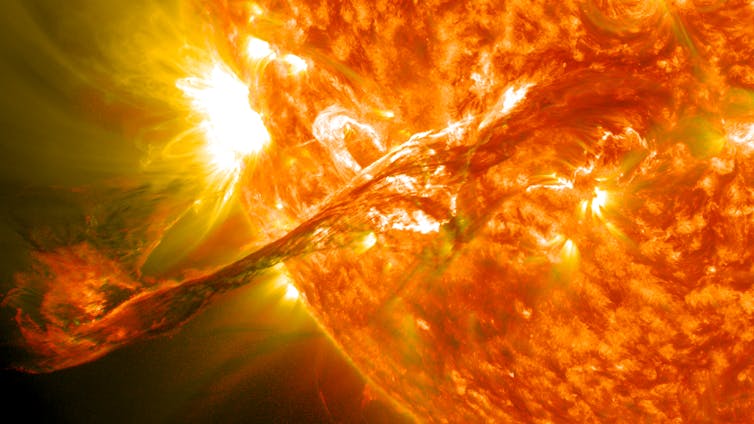
Coronal mass ejections from the Sun can cause geomagnetic storms that may damage technology on Earth. NASA/GSFC/SDO

In May 2024, part of the Sun exploded.

The Sun is an immense ball of superheated gas called plasma. Because the plasma is conductive, magnetic fields loop out of the solar surface. Since different parts of the surface rotate at different speeds, the fields get tangled. Eventually, like rubber bands pulled too tight, they can snap – and that is what they did last year.

These titanic plasma explosions, also known as solar flares, each unleashed the energy of a million hydrogen bombs. Parts of the Sun’s magnetic field also broke free as magnetic bubbles loaded with billions of tons of plasma.

These bubbles, called coronal mass ejections, or CMEs, crashed through space at around 6,000 times the speed of a commercial jetliner. After a few days, they smashed one after another into the magnetic field that envelops Earth. The plasma in each CME surged toward us, creating brilliant auroras and powerful electrical currents that rippled through Earth’s crust.

A coronal mass ejection erupting from the Sun.

You might not have noticed. Just like the opposite poles of fridge magnets have to align for them to snap together, the poles of the magnetic field of Earth and the incoming CMEs have to line up just right for the plasma in the CMEs to reach Earth. This time they didn’t, so most of the plasma sailed off into deep space.

Humans have not always been so lucky. I’m an environmental historian and author of the new book “Ripples on the Cosmic Ocean: An Environmental History of Our Place in the Solar System.”

While writing the book, I learned that a series of technological breakthroughs – from telegraphs to satellites – have left modern societies increasingly vulnerable to the influence of solar storms, meaning flares and CMEs.

Since the 19th century, these storms have repeatedly upended life on Earth. Today, there are hints that they threaten the very survival of civilization as we know it.

The telegraph: A first warning

On the morning of Sept. 1, 1859, two young astronomers, Richard Carrington and Richard Hodgson, became the first humans to see a solar flare. To their astonishment, it was so powerful that, for two minutes, it far outshone the rest of the Sun.

About 18 hours later, brilliant, blood-red auroras flickered across the night sky as far south as the equator, while newly built telegraph lines shorted out across Europe and the Americas.

The Carrington Event, as it was later called, revealed that the Sun’s environment could violently change. It also suggested that emerging technologies, such as the electrical telegraph, were beginning to link modern life to the extraordinary violence of the Sun’s most explosive changes.

For more than a century, these connections amounted to little more than inconveniences, like occasional telegraph outages, partly because no solar storm rivaled the power of the Carrington Event. But another part of the reason was that the world’s economies and militaries were only gradually coming to rely more and more on technologies that turned out to be profoundly vulnerable to the Sun’s changes.

A brush with Armageddon

Then came May 1967.

Soviet and American warships collided in the Sea of Japan, American troops crossed into North Vietnam and the Middle East teetered on the brink of the Six-Day War.

It was only a frightening combination of new technologies that kept the United States and Soviet Union from all-out war; nuclear missiles could now destroy a country within minutes, but radar could detect their approach in time for retaliation. A direct attack on either superpower would be suicidal.

Several buildings on an icy plain, with green lights in the sky above.
An aurora – an event created by a solar storm – over Pituffik Space Base, formerly Thule Air Base, in Greenland in 2017. In 1967, nuclear-armed bombers prepared to take off from this base. Air Force Space Command

Suddenly, on May 23, a series of violent solar flares blasted the Earth with powerful radio waves, knocking out American radar stations in Alaska, Greenland and England.

Forecasters had warned officers at the North American Air Defense Command, or NORAD, to expect a solar storm. But the scale of the radar blackout convinced Air Force officers that the Soviets were responsible. It was exactly the sort of thing the USSR would do before launching a nuclear attack.

American bombers, loaded with nuclear weapons, prepared to retaliate. The solar storm had so scrambled their wireless communications that it might have been impossible to call them back once they took off. In the nick of time, forecasters used observations of the Sun to convince NORAD officers that a solar storm had jammed their radar. We may be alive today because they succeeded.

Blackouts, transformers and collapse

With that brush with nuclear war, solar storms had become a source of existential risk, meaning a potential threat to humanity’s existence. Yet the magnitude of that risk only came into focus in March 1989, when 11 powerful flares preceded the arrival of back-to-back coronal mass ejections.

For more than two decades, North American utility companies had constructed a sprawling transmission system that relayed electricity from power plants to consumers. In 1989, this system turned out to be vulnerable to the currents that coronal mass ejections channeled through Earth’s crust.

Several large pieces of metal machinery lined up in an underground facility.
An engineer performs tests on a substation transformer. Ptrump16/Wikimedia Commons, CC BY-SA

In Quebec, crystalline bedrock under the city does not easily conduct electricity. Rather than flow through the rock, currents instead surged into the world’s biggest hydroelectric transmission system. It collapsed, leaving millions without power in subzero weather.

Repairs revealed something disturbing: The currents had damaged multiple transformers, which are enormous customized devices that transfer electricity between circuits.

Transformers can take many months to replace. Had the 1989 storm been as powerful as the Carrington Event, hundreds of transformers might have been destroyed. It could have taken years to restore electricity across North America.

Solar storms: An existential risk

But was the Carrington Event really the worst storm that the Sun can unleash?

Scientists assumed that it was until, in 2012, a team of Japanese scientists found evidence of an extraordinary burst of high-energy particles in the growth rings of trees dated to the eighth century CE. The leading explanation for them: huge solar storms dwarfing the Carrington Event. Scientists now estimate that these “Miyake Events” happen once every few centuries.

Astronomers have also discovered that, every century, Sun-like stars can explode in super flares up to 10,000 times more powerful than the strongest solar flares ever observed. Because the Sun is older and rotates more slowly than many of these stars, its super flares may be much rarer, occurring perhaps once every 3,000 years.

Nevertheless, the implications are alarming. Powerful solar storms once influenced humanity only by creating brilliant auroras. Today, civilization depends on electrical networks that allow commodities, information and people to move across our world, from sewer systems to satellite constellations.

What would happen if these systems suddenly collapsed on a continental scale for months, even years? Would millions die? And could a single solar storm bring that about?

Researchers are working on answering these questions. For now, one thing is certain: to protect these networks, scientists must monitor the Sun in real time. That way, operators can reduce or reroute the electricity flowing through grids when a CME approaches. A little preparation may prevent a collapse.

Fortunately, satellites and telescopes on Earth today keep the Sun under constant observation. Yet in the United States, recent efforts to reduce NASA’s science budget have cast doubt on plans to replace aging Sun-monitoring satellites. Even the Daniel K. Inouye Solar Telescope, the world’s premier solar observatory, may soon shut down.

These potential cuts are a reminder of our tendency to discount existential risks – until it’s too late.The Conversation

Dagomar Degroot, Associate Professor of Environmental History, Georgetown University

This article is republished from The Conversation under a Creative Commons license. Read the original article.

Judge upholds Interior’s ability to reevaluate Scotts Valley Vallejo casino plan, allows tribe to continue pursuing project

LAKE COUNTY, Calif. — On Thursday, a federal court handed down a decision in the ongoing legal battle over a Lake County tribe’s attempt to establish a casino in Vallejo, with both proponents and opponents of the project claiming victory in the ruling.

The United States District Court for the District of Columbia handed down the opinion in the Lakeport-based Scotts Valley Band of Pomo Indians’ lawsuit against U.S. Department of Interior Secretary Doug Burgum.

Judge Trevor McFadden allowed for Scotts Valley to continue pursuing the project while upholding the Department of Interior’s ability to reevaluate it.

The decision keeps alive the tribe’s plan for a massive casino project that is anticipated to generate hundreds of millions of dollars a year. However, the 35-page decision emphasizes that the Department of Interior is still in the process of conducting a review of its previous determination earlier this year that cleared the way for the project to proceed.

Both Scotts Valley and the Yocha Dehe Wintun Nation, one of the project’s principal opponents, hailed the decision as a victory for their respective sides.

Scotts Valley focused on the court restoring gaming eligibility to the tribe’s trust land in Vallejo after challenging the Department of Interior’s March decision to rescind and reconsider its prior determination that the Vallejo property qualified as “restored lands” under the Indian Gaming Regulatory Act, or IGRA.

The “restored lands” exception of the Indian Gaming Regulatory Act allows a casino off-reservation if a tribe can prove a historical connection to the land. 

 “This victory is about more than gaming — it’s about fairness, tribal sovereignty, and the fundamental right of our people to move forward in building a brighter future,” said Scotts Valley Chairman Shawn Davis in a statement released to Lake County News on Thursday “Today’s decision opens the door to new opportunities and prosperity for our tribal members and for our neighbors in Vallejo and Solano County.”

On the other side, the Yocha Dehe Wintun Nation applauded the court’s decision rejecting the Scotts Valley Band of Pomo Indians’ challenge to the Department of the Interior’s reconsideration of the project.

“Today’s court decision correctly reaffirms the Department of the Interior’s decision to reevaluate this proposed casino, which would destroy irreparable cultural and ecological resources and has already been rejected three other times by the Department,” said Yocha Dehe Chairman Anthony Roberts in a Thursday statement. “As the Department stated in its letter announcing its decision to reconsider the project, this process will assess all facts and evidence — revealing what history already makes clear: Scotts Valley has no historical connection to this land.”

The background to the legal decision

Scotts Valley is proposing a $700 million, 400,000-square-foot mega casino complex, along with 24 homes and an administrative building, on a 128-acre site near I-80 and Highway 37 in Vallejo.

The tribe said its casino plan underwent nearly a decade of litigation and agency review before it received a favorable determination on its fee-to-trust application from the Department of Interior on Jan. 10. 

That decision, in the final days of the Biden Administration, found the casino project eligible for gaming under IGRA.

Scotts Valley has estimated that its Vallejo casino project will generate $243.5 million a year.

However, the casino project has been vehemently opposed by many residents and leaders in the Vallejo area, and criticism due to Scotts Valley’s home territory being more than 100 miles away in Lake County.

Four neighboring tribes have led the opposition to the plan. They include the Yocha Dehe Wintun Nation, which owns Cache Creek Casino in Yolo County, and the Kletsel Dehe Band of Wintun Indians, a nongaming tribe based in Colusa County, both are Patwin tribes with ancestral ties to Vallejo. 

There also is the United Auburn Indian Community which has a casino on its traditional lands in Placer County and the Lytton Rancheria, which operates a casino in San Pablo.

Those tribes’ objections include the fact that the project would bulldoze a cultural site sacred to local Patwin tribes.

Despite Scotts Valley’s claims about previous review of the plan, the Yocha Dehe said the Department of Interior in January “decided to reconsider a rushed, last-minute approval of the project, noting that important evidence had not been considered, and despite “mass opposition” from other tribes, government officials and thousands of concerned citizens.

The Yocha Dehe also maintained that, prior to the January decision, the Department of Interior had determined on three separate occasions that Scotts Valley lacks the significant historical connection to the Bay Area needed to acquire land eligible for gaming, including to Vallejo specifically. 

On March 24, the Yocha Dehe and Kletsel Dehe filed a lawsuit against the Department of the Interior, challenging the decision to allow the casino to go forward.

On March 27, the Department of Interior informed Scotts Valley in a letter that it was rescinding the gaming eligibility determination granted to the tribe under the Biden Administration in January in order for it to be reconsidered.

That led to Scotts Valley suing the Department of the Interior on April 1, claiming that the agency’s decision to rescind the determination violates federal law and trust obligations, and was motivated by “unfounded opposition from competitors.”

Judge considers aspects of Interior’s action

The Scotts Valley suit against the Department of Interior was the focus of the memorandum decision handed down on Thursday by Judge McFadden.

McFadden wrote that the case “is about an agency’s reversal,” explaining the Department of Interior’s January decision followed, 11 weeks later, by the agency telling Scotts Valley “that it was temporarily rescinding and reconsidering the parcel’s gaming eligibility. The Department directed the Band not to rely on the previous determination while it reevaluates.”

Scotts Valley, the judge noted, was challenging both Interior’s rescission and reconsideration, asserting that each violated the Administrative Procedure Act and the Fifth Amendment’s Due Process Clause.

McFadden addressed those two actions separately, finding that the reconsideration, which is not final, is not subject to Administrative Procedure Act review. 

However, he found that the rescission constitutes final agency action. While he ruled against the tribe on its three claims that Administrative Procedure Act review also was required in that case, McFadden found in Scotts Valley’s favor on the due process claim. 

Judge McFadden acknowledged that in the case, “The interests are weighty on both sides.”

This includes Scotts Valley’s assertion about the benefits of the project. As McFadden noted, “Interior regulations require a tribe to submit ‘restored lands’ applications within 25 years of the tribe’s restoration,” which means in this case, “this is the Band’s last chance.”

McFadden found that, on the due process side, Interior, by its own admission, gave Scotts Valley no warning before rescinding its gaming eligibility. “While leaving Scotts Valley in the dark, the agency communicated several times and even met with the neighboring tribes before the March rescission. … Once it informed the Band, Interior explained simply that ‘the Secretary [wa]s concerned that the Department did not consider additional evidence submitted after the 2022 Remand.’”

The 2022 remand refers to a federal judge’s 2022 decision ordering Interior to reconsider the project after it had been turned down previously.

On the topic of due process as it related to Interior’s decision on the tribe’s gaming eligibility, McFadden found that Interior failed to provide sufficient notice to Scotts Valley.

“In short, the rescission violated due process. Once Interior took the Vallejo parcel into
trust and determined that it was eligible for gaming, Scotts Valley acquired a legitimate property
interest in that determination. Because the agency rescinded the parcel’s gaming eligibility with
barely any notice or hearing, it infringed the Band’s due-process right,” McFadden wrote.

He said he would vacate that rescission.

However, McFadden was clear that his ruling did not bar Interior “from continuing its reconsideration, nor does it stop the Department from revoking the Band’s gaming eligibility at the end of that process. For that reason, Scotts Valley would be ill-served by placing undue reliance on today’s decision. But Interior, too, must take seriously the Band’s reliance interests, and it must provide the required due process. The Court recognizes that this dispute is likely far from over, and it decides only the snapshot properly before it.”

In summary, McFadden granted summary judgment against Scotts Valley’s challenges to Interior’s reconsideration of the project and the tribe’s claims that the process violated Administrative Procedure Act requirements. At the same time, he granted summary judgment in favor of Scotts Valley on its due process claim.

“The Court’s decision reaffirms that the federal government cannot revoke a tribe’s rights without fair process,” said Patrick R. Bergin, counsel for the Tribe. “Scotts Valley welcomes this ruling, which restores the Tribe’s gaming eligibility and ensures that Interior must follow the law before taking it away.”

“For years we have worked with our federal, state, and local partners to shed light on the flaws in this process,” Yocha Dehe Chairman Roberts continued. “We are grateful the Department can continue doing the right thing by evaluating all evidence. We are confident this reconsideration process will reveal the truth Scotts Valley has attempted to hide from the very start – their ancestral lands are not in Vallejo, and they never were.”

The ruling takes immediate effect.

Another Lake County tribe locked in challenges over casino project

In related news, the Koi Nation of Northern California, formerly based in Lower Lake, has proposed a $600 million casino project in Windsor, but also has faced opposition from the community and tribes there.

Gov. Gavin Newsom opposed both the Scotts Valley and Koi projects, as his staff informed Interior in an August 2024 letter, which noted that Gov. Gavin Newsom, while having respect for tribal sovereignty, was concerned about Interior using “the ‘restored lands’ exception to support projects that are focused less on restoring the relevant tribes’ aboriginal homelands, and more on creating new gaming operations in desirable markets.”

Despite this opposition, like Scotts Valley, the Koi’s project was approved in January by the Interior Department in the last days of the Biden administration.

Last month, a judge set Interior’s land-to-trust decision on the Koi project aside.

The Koi have stated their intention to appeal the decision.

Email Elizabeth Larson at This email address is being protected from spambots. You need JavaScript enabled to view it.. Follow her on Twitter, @ERLarson, and on Bluesky, @erlarson.bsky.social. Find Lake County News on the following platforms: Facebook, @LakeCoNews; X, @LakeCoNews; Threads, @lakeconews, and on Bluesky, @lakeconews.bsky.social. 

Fun facts about Halloween

Halloween is a festive celebration characterized by activities like carving pumpkins and donning masks and costumes to trick-or-treat. 

Some trace the spooky tradition to the festival of Samhain among the Celts of ancient Britain and Ireland. 

When large numbers of Irish and other immigrants went to the United States beginning in the mid-19th century, they took their Halloween customs with them. 

In the 20th century, Halloween, celebrated October 31 (the night before All Saints’ or All Hallows’ Day), became a favorite pastime, especially among kids. 

The following facts are possible thanks to the invaluable responses to U.S. Census Bureau surveys. 

Trick or Treat!

133.2 million
The number of occupied U.S. housing units — potential stops for trick-or-treaters — in 2023.

Source: 2023 American Housing Survey

73.1 million
The estimated number of U.S. children under the age of 18 (read: potential trick-or-treaters) as of July 1, 2024.

Source: Vintage 2024 Population Estimates

Sweet Economic Statistics

56.6 million

The number of occupied U.S. housing units with steps that trick-or-treaters had to climb to collect their treats – or tricks – in 2023.

Source: 2023 American Housing Survey

Sweet Economic Statistics
Source: 2023 County Business Patterns*

3,409
The number of U.S. confectionery and nut stores in 2023.

681
The number of U.S. formal wear and costume rental establishments in 2023.

280
The number of U.S. establishments that primarily produced products from cacao beans in 2023.

* County Business Patterns data represent establishments with employees. 

Spooky-Sounding Places
Sources: City and Town Population Totals 2020-2024*

Big Bear Lake City, Calif. (2024 population: 5,044). 
Casper, Wyo. (2024 population: 58,823). 
Deadwood City, S.D. (2024 population: 1,347). 
Devils Lake, N.D. (2024 population: 7,314). 
Kill Devil Hills, N.C. (2024 population: 7,742). 
Scarville, Iowa (2024 population: 75).
Seven Devils Town, N.C. (2024 population: 316).
Slaughter Beach, Del. (2024 population: 247). 
Slaughter Town, La. (2024 population: 989). 
Slaughters City, Ky. (2024 population: 187). 
Sleepy Hollow, Ill. (2024 population: 3,137). 
Sleepy Hollow, N.Y. (2024 population: 11,427). 
Tombstone, Ariz. (2024 population: 1,382).
Truth or Consequences, N.M. (2024 population: 5,942).
Yellville, Ark. (2024 population: 1,169). 

Cal Fire exclusive use helicopters depart the Sonoma-Lake-Napa Unit for the season

NORTHERN CALIFORNIA — The two Type-1 helicopters contracted by Cal Fire for exclusive use towards aerial firefighting operations left the Sonoma-Lake-Napa Unit (LNU) for the season on Tuesday.

Helitanker 8PJ, a CH-47 Chinook operated by PJ Helicopters, was based at the Napa County Airport (KAPC) starting back on June 3.

Helitanker 05PJ, a UH-60A+ Blackhawk also operated by PJ Helicopters, was based at the Sonoma County Airport (KSTS) starting on June 16.

The two exclusive use helicopters combined to fly 80 missions on wildfires where they dropped a combined total of 1,140,450 gallons of water on fires in 2025.

“The helicopters we contract exclusively for the use of aerial firefighting operations are a strategic investment we make in wildfire preparedness and rapid response, providing an added layer of protection for the communities we serve,” said Cal Fire Sonoma-Lake-Napa Unit Chief Matt Ryan. “They are a symbol of the strength and readiness that Cal Fire brings to the region and complement our overall world-renowned aviation program that is the largest civil aerial firefighting fleet in the world.”

Helitanker 8PJ delivered 451,100 gallons of water on its 28 wildfire missions in 2025, which included 29.1 hours of night flying missions. Its night flight capabilities were relied on heavily during the Pickett Fire outside of Calistoga, as Helitanker 8PJ flew 12.6 hours at night on the 6,819-acre fire between Aug. 21 to 24.

Helitanker 05PJ flew 52 wildfire missions this year and dropped 689,350 gallons of water on fires. Its utility was on display here in the greater San Francisco Bay Area and beyond across California. 

During the Pickett Fire, Helitanker 05PJ conducted 19 flights. It was also deployed down to the Gifford Fire in San Luis Obispo and Santa Barbara counties between Aug. 8-15 where it conducted 21 aerial firefighting missions. 

The Gifford Fire is the largest wildfire in the state this year at 131,614 acres.

Even with the departure of the two exclusive use helicopters, Cal Fire LNU still has four aerial assets available for firefighting and rescue operations. 

Copter 612, based at the Boggs Mountain Helitack Base in Lake County, is a Sikorsky S70i with a fixed tank that can hold up to 1,000 gallons of water. Its primary mission is rapid initial attack
on wildfires and complex rescue operations.

At the Sonoma Air Attack Base in Santa Rosa are two S-2T Airtankers (AT85 and AT86) and one OV-10 Air Tactical Aircraft (AA140).

So far this year from Jan. 1 through Oct. 28, the Sonoma-Lake-Napa Unit has seen 352 wildfires that have burned 8,331 acres. 

Why is it so hard to adjust when clocks ‘fall back’?

Daylight saving time ends this Sunday at 2 a.m. It was introduced in 1918 as a way to conserve energy by making the most of summer’s daylight hours. 

But some people say that shifting our clocks is its own form of energy drain. 

That’s because many feel disoriented for days, or even weeks, after we “spring forward” or “fall back” by an hour. We asked neurologist Louis Ptacek, MD, who studies circadian rhythms, why this disruption to our internal clocks throws us for a loop and what we can do to make the adjustment easier.

What is a circadian clock and why is it important?  

A circadian clock, or circadian rhythm, is the 24-hour cycle of waking and sleeping in response to daylight and darkness.

When you’re sleeping and the sun comes up, your eyes sense the light even when they’re closed. That light sends a signal to the master clock in your brain saying, “Hey, the day is starting, time to get up.” Your body prepares by raising your body temperature and blood pressure and nudging your digestive tract and immune system to become more active.  

As nighttime comes on, the body winds it all back down. 

How does changing our clocks by an hour impact our internal clock?

Like an alarm clock, your circadian clock tells you it’s time to get up. When we “fall back” the day begins an hour earlier than the clock is anticipating, which make you feel like things aren’t the way they’re supposed to be. Similarly, toward the end of the day, you’re ready for bed at an early hour.  

All of this affects our physiology. When we’re thrown off like this, we’re more prone to making errors. Research shows that the number of car accidents usually goes up a bit when we change our clocks, people make mistakes at work — all because we’re out of sync with the environment.   

Are some affected more than others? If not, what makes the difference?

There are differences from person to person. It relates to what we call “chronotype,” the body’s natural preference for what time to wake up and to go to sleep. Some of us are morning larks, others are night owls, and some are in between. Night owls will typically do better than others when we set our clocks back, like we will this coming weekend. Morning larks will do better springing forward. 

Why can changing clocks affect people’s mood so much?

We know that our exposure to light has a strong connection with both our mood and our biological clock, but we don’t understand much about how mood and the biological clock are connected. It seems that our mood is affected by how well we’re aligned the solar day. Disrupting that alignment in people who are sleep-deprived or prone to depression can increase their risk of becoming depressed.

Understanding how that happens could benefit people who are not aligned with the solar day, like people who work night shift or people who frequently travel across time zones. It’s a question my lab is hoping to study in the future. We’ve identified a gene that’s at a nexus where mood and circadian rhythms are regulated, but there’s much more to learn about this connection. 

How can people mitigate the impact of daylight saving? 

Changing our clocks presents us with an opportunity to align ourselves better with the natural day and night.

• Ease into the change a few days beforehand. Get enough rest so that you’re not sleep deprived or living out of sync with your circadian rhythm.
• Change your sleep schedule by 15-30 minutes to counter the time change – 15 mins later for falling back, 15 mins earlier for springing forward. 
• Shift your mealtimes the same way and remember that it’s healthier to eat during the day than late at night.

Robin Marks writes for the UC San Francisco News Center.

Supervisors hear report on September fish die-off

LAKE COUNTY, Calif. — The work to understand the cause of a September fish die-off in Clear Lake is continuing.

This week, the Board of Supervisors heard the latest on the ongoing efforts from scientists and local officials as part of a report from the Lake County Fish and Wildlife Advisory Committee.

At the start of September, a fish die-off was reported in Clear Lake. At that time, the California Department of Fish and Wildlife told Lake County News that the die-off was believed to have been related to low levels of dissolved oxygen in the water.

Luis Santana, chair of the Lake County Fish and Wildlife Advisory Committee and fish and wildlife director of Robinson Rancheria’s Danoxa Fish and Wildlife Department, presented the update to the board on Tuesday.

He explained during the discussion that he’s close to completing a full report on the die-off, and also is studying the case involving the discovery in September of a white sturgeon that had been living in the lake, which isn’t part of its natural range.

Santana said the fish kill occurred during the first couple of weeks in September. County residents shared photos with him of the incident.

In one case, a Soda Bay resident told him that they had been out on the lake the night before, “and everything seemed fine, but then the next morning, when they took a walk down the shoreline, there was a bunch of dead fish all over the place.”

Santana responded to the area on Sept. 7 and began doing water quality readings, specifically measuring dissolved oxygen levels. He took a shoreline sample and found that it was bad — but not so bad that fish couldn’t survive.

Fish like the Clear Lake hitch, Sacramento sucker and related fish should have about five milligrams per liter of dissolved oxygen in the water, but they can survive at lower dissolved oxygen levels, Santana said.

However, Santana said that once the dissolved oxygen levels drop to around 2.0 milligrams per liter, fish start to die. 

When he conducted measurements at the shoreline in Soda Bay, he got a reading of 3.95 milligrams per liter, still survivable but not good for the overall fitness of fish. 

Santana said a shoreline measurement is not really accurate for dissolved oxygen because wave action will provide some dissolved oxygen.

So he went out the next day to get vertical profiles of the lake. Launching from Keeling Park in Nice, Santana said as he was passing Lucerne he saw what he initially thought were waves but which he estimated were millions of threadfin shad, an introduced — not native — species to Clear Lake. He said the shad is a bait fish that the bass — also not native — love to eat.

When he saw the shad, Santana stopped at a spot in the middle of the lake and took dissolved oxygen measurements. Three feet below the lake’s surface, the dissolved oxygen measured 0.52 milligrams per liter. At 17 feet deep, it was 0.28 milligrams per liter, and at the lake’s bottom it was 0.22 milligrams per liter.

When he reached Dorn Bay, near the area where he first conducted measurements the previous day, Santana said the dissolved oxygen levels were not much better and below the 2 milligrams per liter level at which fish tend to die. At seven feet below the surface, the measurement was 1.0 milligrams per liter, falling to 0.2 milligrams at 13 feet down.

“So basically, in the entire water column, it was not suitable for fishes in the area,” Santana said.

The fish he saw dying included Sacramento blackfish, threadfin shad, largemouth bass, black crappie and bluegill. 

Santana said he found more measurements that were similar when heading back across the lake toward Keeling Park, and he saw still more fish species — including bullhead catfish, channel catfish and hitch — impacted.

He said the low dissolved oxygen levels impacted the entire ecosystem as far as fish were concerned.

Supervisor Bruno Sabatier thanked Santana for his presentation. “Definitely, if you live around the lake there, you can't not know about the fish kill that occurred this year and previous years. Typically it is dissolved oxygen,” he said.

Sabatier added, “It's been a bit of a stranger year for the lake, where the lake has not appeared to have as much algae. Now, algae can be in many different stages. It doesn't have to be on the top floating, but typically what we find is the dissolved oxygen does occur when we have the mats and other things where it gets really bad during the summertime.”

He asked if there was a culprit for the dissolved oxygen levels in Clear Lake this year, adding, “The lake just looked vastly different than what I was expecting.”

Santana said algae decomposition causes low dissolved oxygen levels, explaining that when the plants decompose, they suck oxygen from the water, and as a result fish kills occur.

However, “In this instance, that definitely wasn't it. I think it was lake turnover, but I can't really prove that, because I wasn't taking samples year round to be able to say, ‘Hey, this is what's occurring,’” Santana said.

Lake turnover explains what happens when a lake’s layers mix on a seasonal basis — typically in the spring and fall — causing the temperature to be more uniform through the water column. The process also moves dissolved oxygen from the surface of the water throughout the water body, while also distributing nutrients from the lake bottom through other lake layers. 

Santana called the die-off “a really weird event,” because the lake was looking really good and the bass in the lake were massive in size.

He said, however, that the situation wasn’t the result of algae. Santana cited findings from Big Valley Rancheria’s environmental department which monitors the lake, and its data concluded the same thing.

Chris Childers of Lake County Water Resources Department said they did vertical profiles on Clear Lake on Sept. 10 and found the same thing that Santana did —  very, very low dissolved oxygen from the surface all the way down to the bottom and all three arms of the lake.

Childers thanked Santana for his work, noting that it’s great that “we can all collaborate and work together and make things happen.”

Angela DePalma-Dow, executive director of the Lake County Land Trust and a former Water Resources staffer, thanked Santana and Childers for their work.

DePalma-Dow, who has worked with lakes in six different states, offered an explanation for conditions that are seen in small and large lakes alike.

Fish die-offs happen in some years and not in others, and DePalma-Dow said that while there wasn’t that much cyanobacteria — or algae — in Clear Lake this year, there were other things that grew a lot, and they tend to die at the end of the season, like the plants in a vegetable garden.

“So if you have a lot of things growing in your garden at the end of the year, right now, in fall, stuff will start to die, and that can consume oxygen. So that is one factor,” she said.

DePalma-Dow said she looked at seasonal patterns going back to 2012. In that year and in 2016, Lake County had a very significant drought, which was followed by a flood year in 2017.

She said there was a significant fish die-off in the drought year, followed by high water levels. The pattern continued in 2020 to 2022, with lower water levels, followed by more water in 2023 and 2024.

“So there's some patterns where you see drought and then flood years where you have a lot of growth of vegetation, a lot of space, a lot of disturbed soils that can contribute to algae and plant growth that all then died and could create these fish kill events,” she said, adding that these “are natural processes.

Email Elizabeth Larson at This email address is being protected from spambots. You need JavaScript enabled to view it.. Follow her on Twitter, @ERLarson, and on Bluesky, @erlarson.bsky.social. Find Lake County News on the following platforms: Facebook, @LakeCoNews; X, @LakeCoNews; Threads, @lakeconews, and on Bluesky, @lakeconews.bsky.social. 

  • 73
  • 74
  • 75
  • 76
  • 77
  • 78
  • 79
  • 80
  • 81
  • 82

Community

  • Lake County Wine Alliance offers sponsor update; beneficiary applications open 

  • Mendocino National Forest announces seasonal hiring for upcoming field season

Public Safety

  • Lakeport Police logs: Thursday, Jan. 15

  • Lakeport Police logs: Wednesday, Jan. 14

Education

  • Woodland Community College receives maximum eight-year reaffirmation of accreditation from ACCJC

  • SNHU announces Fall 2025 President's List

Health

  • California ranks 24th in America’s Health Rankings Annual Report from United Health Foundation

  • Healthy blood donors especially vital during active flu season

Business

  • Two Lake County Mediacom employees earn company’s top service awards

  • Redwood Credit Union launches holiday gift and porch-to-pantry food drives

Obituaries

  • Rufino ‘Ray’ Pato

  • Patty Lee Smith

Opinion & Letters

  • The benefits of music for students

  • How to ease the burden of high electric bills

Veterans

  • CalVet and CSU Long Beach team up to improve data collection related to veteran suicides

  • A ‘Big Step Forward’ for Gulf War Veterans

Recreation

  • Wet weather trail closure in effect on Upper Lake Ranger District

  • Mendocino National Forest seeking public input on OHV grant applications

  • State Parks announces 2026 Anderson Marsh nature walk schedule 

  • BLM lifts seasonal fire restrictions in central California

Religion

  • Kelseyville Presbyterian to host Ash Wednesday service and Lenten dinner Feb. 18

  • Kelseyville Presbyterian Church to hold ‘Longest Night’ service Dec. 21

Arts & Life

  • Auditions announced for original musical ‘Even In Shadow’ set for March 21 and 28

  • ‘The Rip’ action heist; ‘Steal’ grounded in a crime thriller

Government & Politics

  • Lake County Democrats issue endorsements in local races for the June California Primary

  • County negotiates money-saving power purchase agreement

Legals

  • March 3 hearing on ordinance amending code for commercial cannabis uses

  • Feb. 12 public hearing on resolution to establish standards for agricultural roads

How to resolve AdBlock issue?
Refresh this page