How to resolve AdBlock issue?
Refresh this page
How to resolve AdBlock issue?
Refresh this page
Lake County News,California
  • Home
    • Registration Form
  • News
    • Education
    • Veterans
    • Community
      • Obituaries
      • Letters
      • Commentary
    • Police Logs
    • Business
    • Recreation
    • Health
    • Religion
    • Legals
    • Arts & Life
    • Regional
  • Calendar
  • Contact us
    • FAQs
    • Phones, E-Mail
    • Subscribe
  • Advertise Here
  • Login

News

Space News: 25 Years of the International Space Station: What archaeology tells us about living and working in space

The International Space Station has housed visitors continuously for roughly 25 years. NASA

The International Space Station is one of the most remarkable achievements of the modern age. It is the largest, most complex, most expensive and most durable spacecraft ever built.

Its first modules were launched in 1998. The first crew to live on the International Space Station – an American and two Russians – entered it in 2000. Nov. 2, 2025, marks 25 years of continuous habitation by at least two people, and as many as 13 at one time. It is a singular example of international cooperation that has stood the test of time.

Two hundred and ninety people from 26 countries have now visited the space station, several of them staying for a year or more. More than 40% of all the humans who have ever been to space have been International Space Station visitors.

The station has been the locus of thousands of scientific and engineering studies using almost 200 distinct scientific facilities, investigating everything from astronomical phenomena and basic physics to crew health and plant growth. The phenomenon of space tourism was born on the space station. Altogether, astronauts have accumulated almost 127 person-years of experience on the station, and a deep understanding of what it takes to live in low Earth orbit.

A module of a space station. It has white plastic walls, but the light is pinkish-purple from a plant habitat on one side. The space is cluttered with cables and equipment. Other modules are visible through the hatch at the far end.
A view of the European Space Agency’s Columbus laboratory module on the International Space Station. Paolo Nespoli and Roland Miller, courtesy of NASA and ASI.

If you’ve ever seen photos of the inside of the International Space Station, you’ve probably noticed the clutter. There are cables everywhere. Equipment sticks out into corridors. It doesn’t look like Star Trek’s Enterprise or other science fiction spacecraft. There’s no shower for the crew, or a kitchen for cooking a meal from scratch. It doesn’t have an area designed for the crew to gather in their downtime. But even without those niceties, it clearly represents a vision of the future from the past, one where humanity would live permanently in space for the first time.

Space archaeology

November 2025, by coincidence, also marks the 10th anniversary of my team’s research on the space station, the International Space Station Archaeological Project. The long history of habitation on the space station makes it perfect for the kind of studies that archaeologists like my colleagues and me carry out.

We recognized that there had been hardly any research on the social and cultural aspects of life in space. We wanted to show space agencies that were already planning three-year missions to Mars what they were overlooking.

We wanted to go beyond just talking to the crew about their experiences, though we have also done that. But as previous studies of contemporary societies have shown, people often don’t want to discuss all their lives with researchers, or they’re unable to articulate all their experiences.

Astronauts on Earth are usually trying to get their next ride back to space, and they understandably don’t want to rock the boat. Our research provides an additional window onto life on a space station by using archaeological evidence: the traces of human interactions with the objects and built spaces of the site.

The problem, of course, is that we can’t go to the station and observe it directly. So we had to come up with other ways to capture data. In November 2015, I realized that we could use the thousands of photos taken by the crew and published by NASA as a starting point. These would allow us to track the movement of people and things around the site over time, and to map the behaviors and associations between them.

In 2022, the International Space Station Archaeological Project also carried out the first archaeological fieldwork off the Earth, an experiment designed by my collaborator, Alice Gorman. We asked the crew to document six sample locations in different modules by taking photos of each one every day for two months.

A view from one module of a space station into the airlock. In the airlock are two spacesuits facing each other. At the threshold, there is a hatch door at the top with pictures of people and other items on it. Below is a salmon-colored bulkhead with stickers of mission patches on it.
A view of the hatch from the Node 1 (Unity) module of the International Space Station into the U.S. airlock displays a crew-created memorial to deceased colleagues on the hatch door at the top. Paolo Nespoli and Roland Miller, courtesy of NASA and ASI.

Lessons from photos

We learned that the crew of the International Space Station is a lot like those of us on Earth – perhaps unsurprising, since they live 95% or more of their lives here with the rest of us. They decorate the walls of the station with pictures, memorabilia and, on the Russian side, religious items, the way you might put photos and souvenirs on your refrigerator door to say something about yourself and your family. They make birthday cakes for their colleagues. They love to snack on candy or other special foods that they selected to be sent.

Unlike the rest of us, however, they live without much freedom to make choices about their lives. Their days are governed by lengthy procedures overseen by Mission Control, and by lists of items and their locations.

Crew members do show some signs of autonomy, though. They sometimes create new uses for different areas. They used a maintenance work station for the storage of all kinds of unrelated things, just because it has a lot of Velcro for holding items in place. They have to come up with solutions for storing their toiletry kits because that kind of affordance wasn’t considered necessary by the station’s designers 30 or 40 years ago.
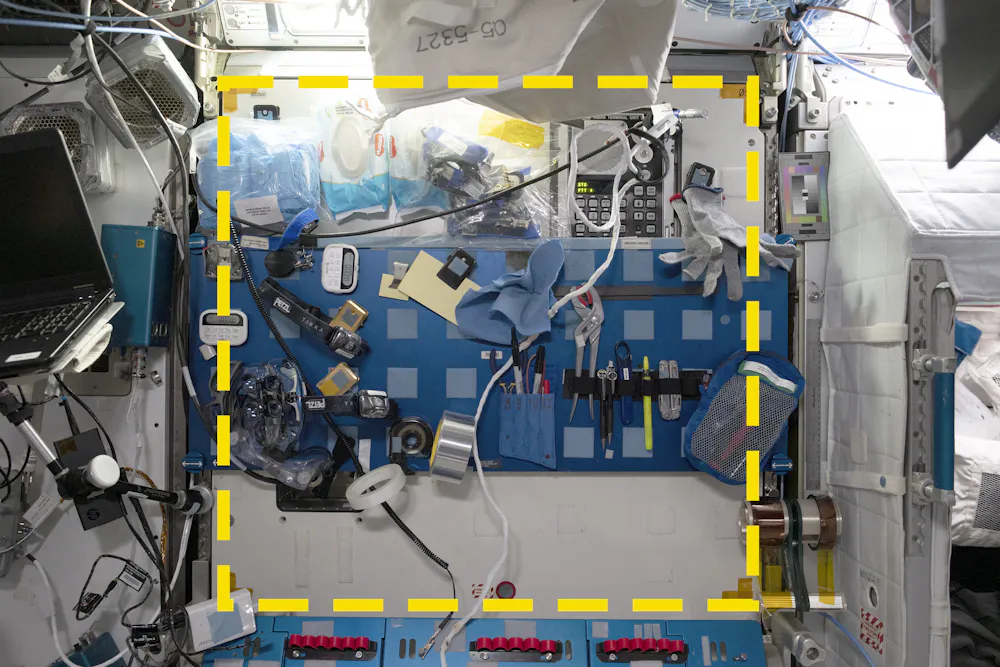
The wall of a space station module. In the center is a blue metal panel with 40 pieces of Velcro arranged in a grid. More Velcro is visible on the wall. Many different items are stuck to the wall. A yellow square is superimposed on the central part of the image.
One of the sample locations for the International Space Station Archaeological Project’s archaeological experiment on the space station was the maintenance work area in the Node 2 (Harmony) module. On the wall, many different kinds of items are stored, mostly attached to patches of Velcro. The yellow dotted line shows the boundary of the sample area. NASA/ISSAP

We discovered that despite the international nature of the station, most areas of it are highly nationalized, with each space agency controlling its own modules and, often, the activities going on in each one. This makes sense, since each agency is responsible to their own taxpayers and needs to show how their money is being spent. But it probably isn’t the most efficient way to run what is the most expensive building project in the history of humanity.

In our latest research, we tracked changes in scientific activity, which we found has become increasingly diverse, by documenting the use of specialized experimental equipment. This work was the result of questions from one of the companies competing to build a commercial successor to the International Space Station in low Earth orbit.

The company wanted to know if we could tell them what facilities their customers were likely going to need. Of course, understanding how people have used different parts of a site over time is a typical archaeological problem. They are using our results to improve the experiences of their crews.

The archaeology of the contemporary world

Similar archaeological studies of contemporary issues here on Earth can also make future lives better, whether by studying phenomena such as migration, ethnonationalism or ecological issues.

In this way, we and other contemporary archaeologists are charting a new future for studying the past, a path for our discipline that lies alongside our traditional work of investigating ancient societies and managing heritage resources. Our International Space Station work also demonstrates the relevance of social science research for solving all kinds of problems – even ones that seem to be purely technical, like living in space.The Conversation

Justin St. P. Walsh, Professor of Art History, Archaeology and Space Studies, Chapman University

This article is republished from The Conversation under a Creative Commons license. Read the original article.
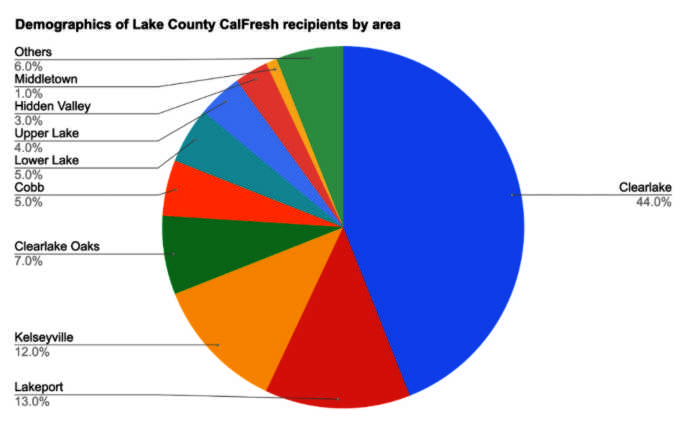

Board of Supervisors allocates $80,000 to ease food shortage in face of SNAP/CalFresh delays

LAKE COUNTY, Calif. — One in four Lake County residents rely on federal food aid that has remained suspended during the government shutdown, despite repeated court orders to release the funding.

Amid the longest government shutdown in U.S. history, 42 million, or 1 in 8 Americans nationwide who rely on the federal Supplemental Nutrition Assistance Program, or SNAP, have not received their November benefits. 

That includes 5.5 million Californians enrolled in CalFresh, the state’s version of SNAP, among them 16,320 Lake County residents — nearly a quarter of the local population — who, as the holidays approach and temperatures drop, still lack the support they need to stay fed.

Of all local benefit recipients, 46% are children, 18% are elderly, and 4% are disabled, according to Lake County Social Services Director Rachael Dillman Parsons.

While political maneuvering plays out at higher levels, shortage of food — a basic necessity for survival — can have serious local consequences, especially in Lake County, which is disproportionately affected by the fund freeze. 

Typically, Lake County issues $2.9 million in CalFresh benefits each month to 10,333 families at an average of $287.49 per family — “a huge disparity” compared with wealthier Napa County, which distributes $1.9 million monthly despite having twice the population, Dillman Parsons noted.

On Tuesday, the Board of Supervisors approved $80,000 in county funds to help address the local food crisis as uncertainties linger. 

The amount equates to about $2.50 per person every week, Supervisor Bruno Sabatier said, calling it “a drop in the bucket” compared with some county reserve accounts, asking to double it. 

Staff noted that any amount drawn from reserves would require a resolution that couldn’t be accomplished at this meeting. 

“The idea is not to replace the full benefit,” Dillman Parsons said. “It’s to potentially assist with making it not so hard.” 

“I think we need to act right now on what we've got put in front of us,” said Supervisor Jessica Pyska.

Supervisors agreed that future emergency meetings can be called to allocate more funds if the crisis worsens, then unanimously voted to issue $80,000 immediately. 

An ad hoc committee was also formed to include Supervisor Brad Rasmussen and Sabatier. A full membership list would later include various governmental agencies, local service providers and nonprofits. 

Supervisors said they also will work with agencies and service providers in their respective districts to coordinate food assistance. 

USDA stalls as federal courts order funds released

While food aid remains frozen, back-and-forth battles between the federal judiciary and the executive branch have continued to create both hope and uncertainty.

Last Friday, just before November hit, two separate lawsuits found the funding for SNAP should be released. 

In addition to the $6 billion in SNAP contingency funds appropriated by the Congress to the U.S. Department of Agriculture, or USDA, one of the court decisions also found that USDA can use $23 billion in Section 32 funds for SNAP.

However, USDA had said it can only fund up to 50% of the full benefit for November, Tom Joseph of political consulting firm Paragon Government Relations explained at Tuesday’s board meeting.

Still, the agency did not release the partial funding.

Even if it did, it would take time to reach people’s accounts, according to Dillman Parsons. Different programming methods will determine how quickly enrollees receive benefits, and it was still uncertain which method USDA will use. 

A slower method may require three weeks for system programming plus 10 days to issue benefits, she explained.

“It doesn't sound like benefits are rolling out anytime soon,” said Dillman Parsons.

“Most people are not getting their partial November benefits until after Thanksgiving,” she said. “And it's important to note, these are partial benefits.”

Joseph also added that USDA prohibits states and counties from making any new applicants eligible during this month. 

Federal judge orders Trump Administration to pay SNAP, in full

Just a few hours before the board discussion convened on Tuesday, President Donald Trump said in a social media post that “billions and billions” of SNAP dollars will be given only after the government reopens, opposing what the court ruled last week. 

Shortly after, however, White House Press Secretary Karoline Leavitt said the administration “is fully complying with the court order.”

While attributing the delay to Democrats, Leavitt offered no details on the timing or amount of funding at the time. 

On Wednesday, USDA revised its plan and said it was able to fund 65% instead of 50% of full benefit for November. 

Regardless, a federal judge in Rhode Island on Thursday ordered the Trump administration to fund full benefits, giving the administration until Friday to make the payments through SNAP.

“Without SNAP funding for the month of November, 16 million children are immediately at risk of going hungry,” said U.S. District Judge John J. McConnell Jr. “This should never happen in America. In fact, it’s likely that SNAP recipients are hungry as we sit here.”

The Trump Administration immediately appealed the decision.

Vice President JD Vance called the ruling “absurd” because “You have a federal judge effectively telling us what we have to do in the middle of a Democrat government shutdown,” Vance said during a roundtable with Central Asian leaders at the White House, according to The Hill. 

On Thursday evening, Gov. Gavin Newsom’s office issued a statement reporting that California families are beginning to see their full CalFresh benefits restored on their EBT cards. 

Supervisor Sabatier on Tuesday said he believes the distribution of food benefits has become a political tool.

“It's about leverage between Republicans and Democrats,” said Supervisor Sabatier. “If people have food, there's less leverage and pressure on Democrats to end the shutdown. If people don't, then there's potentially pressure on them to be able to end it earlier.”

As of late Thursday night, no other actions by the federal government to move forward with issuing any SNAP funds have been reported, other than the governor’s evening statement.

Community resources stepping up

Sabatier said he’s concerned that people may face eviction and homelessness when they now have to spend their rent money on food.

Dillman Parsons said that the county has some programs for preventing homelessness, such as the Family Stabilization program for families with minor children, and Home Safe program for elderly, disabled or dependent adults. 

“If they have spent their housing money on food, it's a bit of a workaround,” she said, adding that CalWORKS enrollees may get cash assistance of an extra $13 a month and pregnant individuals may be offered a one time $100 cash aid. 

Dillman Parsons said the department maintains an updated list of community resources pinned to their Facebook page.

Businesses are also affected: Joseph said that vendors that work with CalFresh are also “scrambling to get states back up and running.”

While the federal bargaining drags on, local agencies and nonprofits are stepping in, organizing resources to offer help — and calling for donations and volunteers. 

Dillman Parsons said the Freedom Riders, the Good Old Boys, Wino’s crew, Priesthood, the 20 Boys and Ghosts of Freedom are providing 2000 turkeys to The Gleaners, which is Lake County’s official food bank. Redwood Empire Food Bank, based in Sonoma County, also serves numerous food pantries in Lake County.

The department is also compiling a list of local Thanksgiving dinners free for the community, Dillman Parsons said, naming Twin Pine Casino, Solano Women in Medicine and Middletown Methodist Church among those who have confirmed. 

“I urge everyone to find out where their local food pantry is, reach out, and see what they need — whether it’s funds, food donations, or volunteers,” said Elizabeth Larson, Lake County News editor and publisher, who spoke at the meeting solely in her role as commissioned pastor at Kelseyville Presbyterian Church, which operates a food pantry.

“Mason Carter can lug a 50 pound bag of carrots like nobody's business,” Larson said of devoted volunteers at the church, lauding the son of Assistant County Administrative Officer Stephen Carter. “So we're grateful for people like that.”

“Trust me, a little will go a long way,” Larson said. “Local food pantries really stretch dollars and make the most of every donation.”

Both Larson and Shannon Kimbell-Auth of Red Cross brought up A Simple Gesture, a new countywide initiative that allows residents to donate food and volunteer as drivers to deliver it to local food pantries. 

“So that’s this coming Saturday, starting at nine o'clock,” said Kimbell-Auth. 

While the community is organizing self-help and federal judges appeal to the law to resume benefits, this nationwide delay of food aid has put forth a reminder of the critical role of safety net programs like CalFresh in Lake County — and there are broader concerns on local social services in the long run. 

The presidential “Big Beautiful Bill” approved in July, which will take effect next year, changes the county administration contribution to a higher percentage, Dillman Parsons said.

“If that does not change, and if there is not a solution from the state to augment our funding, it's going to put some counties in a position where they can't afford to operate CalFresh any longer,” she said. “We are one of those counties who will be in deficit with our realignment.”

“But that's October 2026,” Dillman Parsons continued. “The problem today is feeding people.”

Correction: United Christian Parish will not be offering a Thanksgiving dinner.

Email staff correspondent Lingzi Chen at This email address is being protected from spambots. You need JavaScript enabled to view it.. 

Register’s Office continues ballot count for Prop. 50 election

LAKE COUNTY, Calif. — The Lake County Registrar of Voters said Thursday that its staff is now in the midst of counting thousands of remaining ballots from this week’s special statewide election.

The Registrar’s Office on Tuesday night issued initial returns on the vote on Proposition 50, which will set in motion temporary redistricting.

That preliminary count tallied 10,358 votes, with 51.14%, or 5,297, in favor of Prop. 50 and 48.86% or 5,061, opposed. 

In its first update on Thursday regarding the estimated number of unprocessed ballots, the Registrar’s Office said it had a total of 10,373 still to count.
 
That estimate includes 9,827 vote-by-mail ballots, 386 provisional or conditional ballots and 160 vote-by-mail ballots that are under further review. 

In addition, ballots postmarked on or before Election Day are still coming in, and must be received by Nov. 12 to be counted.

Statewide, the Secretary of State’s Office said 8,768,221 ballots from 18,399 precincts have been processed and 2,682,623 ballots remain to be counted.

The preliminary statewide results show the measure leading so far with a 63.9% to 36.1% margin, or 5,681,795 “yes” votes to 3,214,460 “no votes,” according to the state.

The official canvass for the election on Proposition 50 will continue until December.

The Secretary of State’s Office said county elections officials must complete final official results on Dec. 4. The Secretary of State will certify results on Dec. 12.

Email Elizabeth Larson at This email address is being protected from spambots. You need JavaScript enabled to view it.. Follow her on Twitter, @ERLarson, and on Bluesky, @erlarson.bsky.social. Find Lake County News on the following platforms: Facebook, @LakeCoNews; X, @LakeCoNews; Threads, @lakeconews, and on Bluesky, @lakeconews.bsky.social. 

Alzheimer’s Disease Awareness Month observed in November

On Thursday, Gov. Gavin Newsom issued a proclamation declaring November 2025 as "Alzheimer’s Disease Awareness Month."

The text of the proclamation follows.

PROCLAMATION

California is taking on the challenge of Alzheimer's and driving rates down, even as more people live longer and face the risk of dementia. Bold initiatives to prevent, diagnose, treat, and support individuals and families are making a real impact in California, and the state is committed to continuing our leadership to support the 720,000 Californians living with the disease, and their families.

Those of us familiar with this progressive, degenerative disease with no cure know the toll it takes by erasing precious memories, reducing cognitive abilities, and draining financial resources and independence. We know from groundbreaking health disparities research happening in our state that Alzheimer's disease disproportionality impacts women, who statistically live longer than men, and Black, Indigenous, Latino, and LGBTQ communities, who are at higher risk due to persistent health and socioeconomic inequities.

California is leading the nation in Alzheimer's awareness, prevention, care, training, support, and research. The California Department of Public Health launched the state’s Neurodegenerative Disease Registry on July 1, 2025 to help California’s health care professionals determine incidence and prevalence of Alzheimer’s disease and other neurodegenerative diseases such as multiple sclerosis, Huntington's disease, and amyotrophic lateral sclerosis, also known as Lou Gehrig's disease. Additionally, this year, my Master Plan for Aging (MPA) Cabinet Workgroup and MPA partners have committed to a new set of initiatives over the next two years that focus on meeting the priority needs of individuals and families impacted by Alzheimer’s disease.

We are proud of the vital work being done by our partners – including California’s 10 university-led Alzheimer’s Disease Centers, 33 Area Agencies on Aging, 11 Caregiver Resource Centers, 21 Regional Centers, and 28 Independent Living Centers – that serve and support individuals living with Alzheimer's disease and their families. These state-funded centers play a key role in supporting California's diverse family caregivers, the backbone of our long-term care system. I also thank the members of California's Alzheimer’s Disease and Related Conditions Advisory Committee for their service and advocacy, and the Californians who generously donate each year to fund Alzheimer's disease research through the longstanding voluntary state tax check-off.

This November, I ask all Californians to join me in recognizing Alzheimer's Disease Awareness Month, an opportunity to educate ourselves and offer our support to those living with the disease, and their caregivers.
 

NOW THEREFORE I, GAVIN NEWSOM, Governor of the State of California, do hereby proclaim November 2025 as “Alzheimer’s Disease Awareness Month.”

IN WITNESS WHEREOF I have hereunto set my hand and caused the Great Seal of the State of California to be affixed this 5th day of November 2025.

 
GAVIN NEWSOM
Governor of California

ATTEST:
SHIRLEY N. WEBER, Ph.D.
Secretary of State

Why people don’t demand data privacy – even as governments and corporations collect more personal information

People feeling that their data is being collected at every turn leaves many numb to the issue of data privacy. J Studios/DigitalVision via Getty Images

When the Trump administration gave Immigration and Customs Enforcement access to a massive database of information about Medicaid recipients in June 2025, privacy and medical justice advocates sounded the alarm. They warned that the move could trigger all kinds of public health and human rights harms.

But most people likely shrugged and moved on with their day. Why is that? It’s not that people don’t care. According to a 2023 Pew Research Center survey, 81% of American adults said they were concerned about how companies use their data, and 71% said they were concerned about how the government uses their data.

At the same time, though, 61% expressed skepticism that anything they do makes much difference. This is because people have come to expect that their data will be captured, shared and misused by state and corporate entities alike. For example, many people are now accustomed to instinctively hitting “accept” on terms of service agreements, privacy policies and cookie banners regardless of what the policies actually say.

At the same time, data breaches have become a regular occurrence, and private digital conversations exposing everything from infidelity to military attacks have become the stuff of public scrutiny. The cumulative effect is that people are loath to change their behaviors to better protect their data − not because they don’t care, but because they’ve been conditioned to think that they can’t make a difference.

As scholars of data, technology and culture, we find that when people are made to feel as if data collection and abuse are inevitable, they are more likely to accept it – even if it jeopardizes their safety or basic rights.

a computer screen displaying text and a button labelled 'submit'
How often do you give your consent to have your data collected? Sean Gladwell/Moment via Getty Images

Where regulation falls short

Policy reforms could help to change this perception, but they haven’t yet. In contrast to a growing number of countries that have comprehensive data protection or privacy laws, the United States offers only a patchwork of policies covering the issue.

At the federal level, the most comprehensive data privacy laws are nearly 40 years old. The Privacy Act of 1974, passed in the wake of federal wiretapping in the Watergate and the Counterintelligence Program scandals, limited how federal agencies collected and shared data. At the time government surveillance was unexpected and unpopular.

But it also left open a number of exceptions – including for law enforcement – and did not affect private companies. These gaps mean that data collected by private companies can end up in the hands of the government, and there is no good regulation protecting people from this loophole.

The Electronic Communications Privacy Act of 1986 extended protections against telephone wire tapping to include electronic communications, which included services such as email. But the law did not account for the possibility that most digital data would one day be stored on cloud servers.

Since 2018, 19 U.S. states have passed data privacy laws that limit companies’ data collection activities and enshrine new privacy rights for individuals. However, many of these laws also include exceptions for law enforcement access.

These laws predominantly take a consent-based approach – think of the pesky banner beckoning you to “accept all cookies” – that encourages you to give up your personal information even when it’s not necessary. These laws put the onus on individuals to protect their privacy, rather than simply barring companies from collecting certain kinds of information from their customers.

The privacy paradox

For years, studies have shown that people claim to care about privacy but do not take steps to actively protect it. Researchers call this the privacy paradox. It shows up when people use products that track them in invasive ways, or when they consent to data collection, even when they could opt out. The privacy paradox often elicits appeals to transparency: If only people knew that they had a choice, or how the data would be used, or how the technology works, they would opt out.

But this logic downplays the fact that options for limiting data collection are often intentionally designed to be convoluted, confusing and inconvenient, and they can leave users feeling discouraged about making these choices, as communication scholars Nora Draper and Joseph Turow have shown. This suggests that the discrepancy between users’ opinions on data privacy and their actions is hardly a contradiction at all. When people are conditioned to feel helpless, nudging them into different decisions isn’t likely to be as effective as tackling what makes them feel helpless in the first place.

Resisting data disaffection

The experience of feeling helpless in the face of data collection is a condition we call data disaffection. Disaffection is not the same as apathy. It is not a lack of feeling but rather an unfeeling – an intentional numbness. People manifest this numbness to sustain themselves in the face of seemingly inevitable datafication, the process of turning human behavior into data by monitoring and measuring it.

It is similar to how people choose to avoid the news, disengage from politics or ignore the effects of climate change. They turn away because data collection makes them feel overwhelmed and anxious – not because they don’t care.

Taking data disaffection into consideration, digital privacy is a cultural issue – not an individual responsibility – and one that cannot be addressed with personal choice and consent. To be clear, comprehensive data privacy law and changing behavior are both important. But storytelling can also play a powerful role in shaping how people think and feel about the world around them.

We believe that a change in popular narratives about privacy could go a long way toward changing people’s behavior around their data. Talk of “the end of privacy” helps create the world the phrase describes. Philosopher of language J.L. Austin called those sorts of expressions performative utterances. This kind of language confirms that data collection, surveillance and abuse are inevitable so that people feel like they have no choice

Cultural institutions have a role to play here, too. Narratives reinforcing the idea of data collection as being inevitable come not only from tech companies’ PR machines but also mass media and entertainment, including journalists. The regular cadence of stories about the federal government accessing personal data, with no mention of recourse or justice, contributes to the sense of helplessness.

Alternatively, it’s possible to tell stories that highlight the alarming growth of digital surveillance and frame data governance practices as controversial and political rather than innocuous and technocratic. The way stories are told affects people’s capacity to act on the information that the stories convey. It shapes people’s expectations and demands of the world around them.

The ICE-Medicaid data-sharing agreement is hardly the last threat to data privacy. But the way people talk and feel about it can make it easier – or more difficult – to ignore data abuses the next time around.The Conversation

Rohan Grover, Assistant Professor of AI and Media, American University and Josh Widera, Ph.D. Candidate in Communication, USC Annenberg School for Communication and Journalism

This article is republished from The Conversation under a Creative Commons license. Read the original article.

At the polls: Precinct staff report on their work during Tuesday’s election

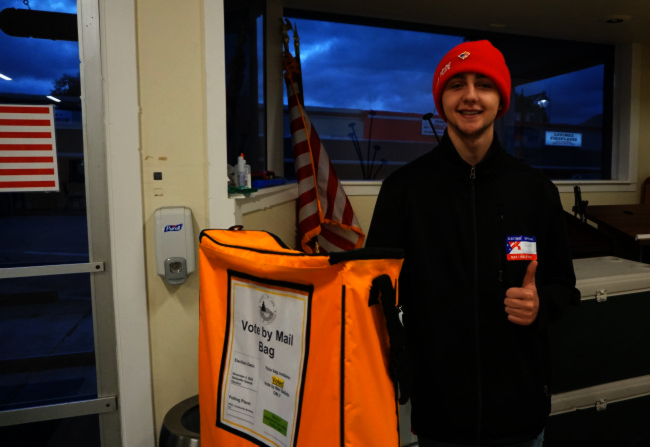
Jacob McKelvey served as vote-by-mail clerk at the Upper Lake precinct during California’s special statewide election on Tuesday, Nov. 4, 2025. Photo by Elizabeth Larson/Lake County News.


LAKE COUNTY, Calif. — Thousands of Lake County voters headed to the polls on Tuesday for the special statewide election called to decide on Proposition 50.

Lake County News staff once again participated as part of the Lake County Registrar of Voters Office’s Election Observer Panel, which visits precincts throughout the course of election day.

For this election, Lake County News sampled the four Northshore precincts, visiting them on Tuesday afternoon in the following order: Lucerne, Clearlake Oaks, Upper Lake and Nice.

At the Lucerne precinct, located once again at First Lutheran Church on Country Club Drive, election staff said the flow of voters coming in to cast their vote was busier than expected.

“I thought it was going to be a lot slower than it is,” said Marilyn Pivniska, a longtime inspector at  the Lucerne precinct for the Lake County Registrar of Voters Office.

For all of the precincts, the fact that voters receive ballots by mail has required an additional step in order to make sure ballots aren’t cast twice.

Voters can mail their ballots or drop them off at their precinct on Election Day. At the Nice precinct, located at the Community Baptist Church on Highway 20, staff said about 60 people came in to vote but there were many who came in to drop off their ballots. Staff said many people want to come in to do that ballot dropoff specifically for themselves.

When a voter comes to the precinct to cast their vote, they should bring their ballot, which they can then turn in before voting. 

If they don’t bring the ballot or simply forget, they have to essentially register to vote again and fill out a provisional ballot. Pivniska said when that happens, they need to call the Registrar of Voters Office to make sure the ballot they received in the mail wasn’t already cast.

She said all of the precincts now have explainer sheets for community members to help them understand the process.

In Clearlake Oaks, elections staff were busy helping voters navigate the process and get their ballots cast.

Election Clerk Estelle Austin welcomed people, offered help, answered questions and kept the action moving.

She said the voter traffic had been pretty steady. “So far, so good,” she said late Tuesday afternoon. 

While special elections tend to have less turnout, “It’s actually been pretty decent,” Austin said.

Down the road in Upper Lake, election staff welcomed voters at the Habematolel Pomo community room, next door to the space on Main Street where the precinct used to be located. 

Inspector Sue Dillard said Upper Lake is unique. Voters there aren’t crazy about mail-in voting and instead want to come in and cast their votes in person.

“People like to come out,” she said, noting that the precinct usually has large turnouts.

Voters turning up without their mail-in ballots was a consistent issue for the Upper Lake precinct. 

On hand to offer additional help was Jacob McKelvey, a senior at Upper Lake High School.

Following a recent presentation at his school by Registrar of Voters Office staff, McKelvey’s interest was piqued. He hadn’t thought about it before, but after the presentation, he decided to volunteer as a precinct worker — and he got the day off from school to offer that service.

Stationed near the door and overseeing the ballot boxes, McKelvey was assigned the vote-by-mail clerk position, and also helped voters with their provisional ballots. 

McKelvey didn’t just help voters, he also learned a lot about the process and the system and found people welcoming. As a result, he wants to work at the precinct again next year. 

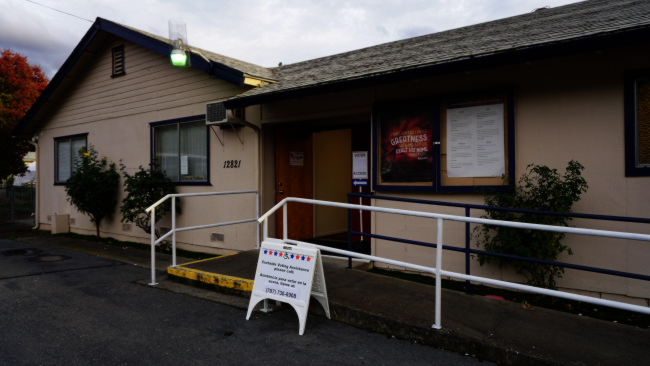
The voting precinct at the First Baptist Church in Clearlake Oaks, California, during California’s special statewide election on Tuesday, Nov. 4, 2025. Photo by Elizabeth Larson/Lake County News.


Few voters use machines

One of the common denominators across all of the precincts was the lack of interest in using the voting machines.

At the Clearlake Oaks precinct, located at the First Baptist Church on First Street, when asked about how often people use the voting machine, staff replied, “Never,” explaining that people want to use paper ballots because they don’t trust the machine.

In Nice, Inspector Ron Stewart said nobody used the voting machine Tuesday, although in the past they had a woman who regularly used it. Nevertheless, “Gotta have it,” he noted.

In Lucerne, two people used the voting machine, but there were no takers in Upper Lake.

Bob Rauch is a longtime volunteer who has also worked with voting machines in Nevada and Sonoma counties. Fellow precinct worker, Clerk Paul Rykert, called Rauch “a legend.”

“I feel like I’m past legend,” said Rauch, who has worked with the voting machines in Lake County for six years.

Did anyone use the voting machine he diligently oversaw for another year?

“Not today,” said Rauch, acknowledging that people don’t use them much.

Voting disability rights advocates say the machines are important for accessibility, and Rauch said that’s who they are primarily intended to serve.

In Nice, precinct staff said the day was “moderately busy,” as people came through either to cast their votes or drop them off. 

During the day, they had one person coming through who used the drive-thru handicap voting, which has long been an option but isn’t always used.

They said there was nothing unusual that took place.

Young people needed

As precinct staff were coming in to deliver the ballot boxes to the Registrar of Voters Office in Lakeport on Tuesday night, one of them asked a Lake County News reporter if she realized how many older people are staffing precincts.

Before leaving, she said the message needed to get out that more young people need to get involved.

For information about the Registrar of Voters Office and how to contact the agency to be involved with future elections, visit https://www.lakecountyca.gov/818/Registrar-of-Voters. 

Email Elizabeth Larson at This email address is being protected from spambots. You need JavaScript enabled to view it.. Follow her on Twitter, @ERLarson, and on Bluesky, @erlarson.bsky.social. Find Lake County News on the following platforms: Facebook, @LakeCoNews; X, @LakeCoNews; Threads, @lakeconews, and on Bluesky, @lakeconews.bsky.social. 

  • 68
  • 69
  • 70
  • 71
  • 72
  • 73
  • 74
  • 75
  • 76
  • 77

Community

  • Lake County Wine Alliance offers sponsor update; beneficiary applications open 

  • Mendocino National Forest announces seasonal hiring for upcoming field season

Public Safety

  • Lakeport Police logs: Thursday, Jan. 15

  • Lakeport Police logs: Wednesday, Jan. 14

Education

  • Woodland Community College receives maximum eight-year reaffirmation of accreditation from ACCJC

  • SNHU announces Fall 2025 President's List

Health

  • California ranks 24th in America’s Health Rankings Annual Report from United Health Foundation

  • Healthy blood donors especially vital during active flu season

Business

  • Two Lake County Mediacom employees earn company’s top service awards

  • Redwood Credit Union launches holiday gift and porch-to-pantry food drives

Obituaries

  • Rufino ‘Ray’ Pato

  • Patty Lee Smith

Opinion & Letters

  • The benefits of music for students

  • How to ease the burden of high electric bills

Veterans

  • CalVet and CSU Long Beach team up to improve data collection related to veteran suicides

  • A ‘Big Step Forward’ for Gulf War Veterans

Recreation

  • Wet weather trail closure in effect on Upper Lake Ranger District

  • Mendocino National Forest seeking public input on OHV grant applications

  • State Parks announces 2026 Anderson Marsh nature walk schedule 

  • BLM lifts seasonal fire restrictions in central California

Religion

  • Kelseyville Presbyterian to host Ash Wednesday service and Lenten dinner Feb. 18

  • Kelseyville Presbyterian Church to hold ‘Longest Night’ service Dec. 21

Arts & Life

  • Auditions announced for original musical ‘Even In Shadow’ set for March 21 and 28

  • ‘The Rip’ action heist; ‘Steal’ grounded in a crime thriller

Government & Politics

  • Lake County Democrats issue endorsements in local races for the June California Primary

  • County negotiates money-saving power purchase agreement

Legals

  • March 3 hearing on ordinance amending code for commercial cannabis uses

  • Feb. 12 public hearing on resolution to establish standards for agricultural roads

How to resolve AdBlock issue?
Refresh this page