 How to resolve AdBlock issue?
News
If so, then you probably don’t want to give the minor the money directly (either now or at your death). Instead you want the money held, and perhaps spent, for the minor and have what remains distributed when the child reaches a certain age.
What are your options? We will explore three: Trusts, custodial accounts and educational savings accounts.
Trusts are agreements between a settlor (you) and a trustee (you or someone else) to invest, manage and use trust assets for the benefit of the trust beneficiary, according to the terms of the trust document.
Typically, a trust is used when a significant inheritance is involved and also when a child with special needs receives “needs based” government assistance.
Trusts are desirable for many reasons. Trusts allow great control over the management of the assets and their distribution or use (such as an “incentive trust” that enables or rewards a beneficiary to reach certain goals).
A trust may exist for up to 90 years (so you can protect the assets) and may have multiple beneficiaries (such as a “children’s trust”). The cost of establishing and administering it – legal fees, trustee fees and other administration expenses – is a consideration.
If the money and other property to be gifted do not exceed $5,000, the gift can be given in trust to a custodial parent under a written assurance that the property will be held until the child reaches majority and that an accounting will be performed. This is a very simple type of trust with limited application.
When trusts are not used a custodial account under the California Uniform Transfer to Minors Act (‘CUTMA’) is often the next best solution. Money can be managed under custodial accounts for the benefit of one minor per account; assets must be converted to cash and split if there are two or more minors with each one having a separate account.
A custodial account is established by simply transferring an asset to a custodian to be held under a CUTMA document for the benefit of said minor. The custodian has great discretion. He may either distribute money directly to the minor or spend it for the minor’s well-being (i.e., to pay expenses), however the custodian sees fit, until the minor reaches majority, 18 years of age.
You can extend 18 to age 21 years (in the case of your lifetime gifts) and even to age 25 years (in the case of your testamentary gifts). Upon termination, all of what remains goes outright to the beneficiary.
Custodial accounts are desirable when small amounts of money are involved, and the costs of a trust are not justified. Furthermore, a custodial account allows you to avoid establishing a court supervised guardianship to control the money, which can be quite expensive and is less flexible as regards to the use of the funds.
That said, however, Trusts are more desirable when you wish to hold assets beyond the age of majority; when you wish to benefit more than one minor and do not wish to divide the trust assets in order to establish individual custodial cash accounts; and when you have specific wishes you want carried out.
Educational plans should also be considered. California has the Golden State Scholar Share Savings Trust – a so-called “Section 529 College Savings Account Program.” It can also be used for vocational schools and other post-secondary institutions that qualify for federal aid.
You can contribute cash (only) from after tax dollars into this plan. As donor you remain the owner of the funds and retain control over the account so that you can change the beneficiaries. The funds can pay for qualified educational expenses. Discuss this with your financial advisor.
Editor’s note: Dennis A. Fordham is an attorney licensed to practice law in California and New York. He earned his bachelor's degree at Columbia University, his juris doctor at the State University of New York at Buffalo, and his master's of law degree in taxation at New York University. Fordham concentrates his practice in the areas of estate planning and aspects of elder law. His office is at 55 First St., Lakeport. E-mail him at
KELSEYVILLE – After three years of planning, hard work and more than a few anxious moments, Lake County has a new domestic violence shelter facility.
On Thursday morning, the deed was recorded on the new Freedom House shelter, operated by Lake Family Resource Center. Escrow closed on Tuesday.
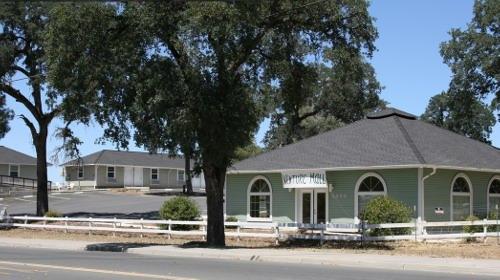
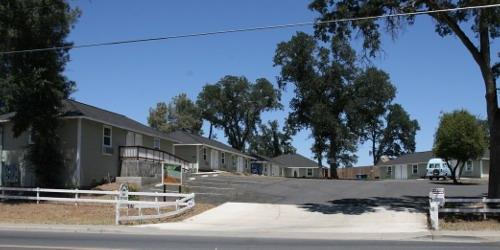
The new, nonconfidential facility will be located at 5350 Main St. in Kelseyville, said Lake Family Resource Center Executive Director Gloria Flaherty.
“The whole idea of having a nonconfidential location is really that it is owned and protected by the community,” Flaherty explained.
The property, now being run as a motel, includes 8,500 square feet of space, including a manager's unit, which will be used for Lake Family Resource Center's administrative offices, and motel units, which will be housing for families that have left violent situations, said Flaherty.
In addition, Flaherty said other program services – including counseling and parenting classes – will be located there.
The purchase price for the property was $1.1 million, said Flaherty.
Since the effort to build a new shelter began about three years ago, Flaherty said her organization has raised about $1.3 million, including $175,000 from the county of Lake and a $1 million loan from the state's Emergency Housing Assistance Program, which will be forgiven in 10 years if the property still is being used as a shelter.
Another $100,000 came from the Snite Foundation, which was facilitated by the Lake County Foundation, Flaherty said, Funds also came from the group's annual Wine and Chocolate event and from a series of fundraisers conducted by local artist Gail Salituri.
“It has been quite a journey,” said Flaherty.
Originally, the plans called for building a new facility on property at the corner of Live Oak and Highway 29. Lake Family Resource Center holds a 50-year lease on the land from Sutter Lakeside Hospital, which rents it to the center for $1 a month.
However, the difficult economy provided an opportunity to purchase buildings at a third of the price of what new construction would have cost, said Flaherty.
“We seized the day,” she said.
Flaherty said they received a call from the person who owned the property, proposing it as their new location. She said she went to look it over and realized it would work. Then the owner lost it to foreclosure. However, the person who had financed the building contacted them and the effort moved forward.
With Gary Olson of Big Valley Properties acting as Lake Family Resource Center's real estate agent, Flaherty said they made an offer in February that was accepted. The terms of the agreement called for a 90-day escrow with two 30-day extensions, so the deal had to be completed by this Saturday, July 25.
“There were a few anxious moments, let me tell you,” said Flaherty.
With the money left over after the sale, Flaherty said they will install alarms, cameras and a new phone system, increase the size of the kitchen, improve the laundry facilities and do some other remodeling.
“We will be working with all local contractors,” she said.
They'll put out an announcement seeking different kinds of services; Flaherty said they want it to be a community project.
In August or September they'll move their administrative offices from the current location on Lakeport Boulevard at the Vista Point Shopping Center. Flaherty said they spend $9,000 a month in rent there, and will cut that amount in half by moving to the new facility.
The domestic violence shelter itself isn't scheduled to relocate to the Kelseyville location until October, she said.
The center's child care services will remain on Lakeport Boulevard. Flaherty said another small office will be rented in Kelseyville. They also have applied for grants for a new and expanded child development center on the lease property at Live Oak and Highway 29.
Flaherty said the center will put together a community wish list for certain items, including sturdy furniture for the shelter facility. “We need things that are really going to stand the test of time and hard use,” she said.
At some point in the future there also will be a grand opening celebration to invite the community to come and see what it helped make possible, said Flaherty.
Most shelter campaigns such as this one take between three and five years, so Flaherty said she thinks the local effort moved quickly.
“In Lake County, when things are supposed to happen, they do,” she said.
Flaherty credited many people in the community for standing up to support the shelter – from the supervisors to the Lake County Community Development Department, the Lake County Foundation, Olson, Salituri and many others.
She noted that the thousands of dollars donated from the drawing's held by Salituri – who worked hard to raise awareness for the shelter project – will be used in the children's playroom.
The shelter will have 35 beds – not counting futons and foldouts – said Flaherty.
That's bigger than the 18 beds that Flaherty said the current shelter offers.
The increased number of beds is more needed than ever. The shelter currently has 31 residents, including 17 children, of which 12 are under age 6, said Flaherty.
Flaherty said of the shelter's residency rate, “In the last two years it has just skyrocketed,” going from an average of 10 people to now more than 20.
As the shelter's good news sinks in, Flaherty and Lake Family Resource Center are waiting to see the results of the state budget. The Legislature began voting on a reported 31 budget bills Thursday evening.
“The cuts that we're taking appear to be draconian,” said Flaherty.
The center already has had to lay off numerous staffers whose positions were funded by state money – including teen pregnancy prevention and parenting.
E-mail Elizabeth Larson at
They also argued a motion to allow the jury to visit the scene of a fatal April 2006 boating collision at night, via boat, which the judge delayed ruling on until later in the trial.
Bismarck Dinius was not present in court for the 40-minute hearing, but he was represented by his attorney, Victor Haltom of Sacramento, who appeared along with District Attorney Jon Hopkins before Judge J. Michael Byrne.
A jury was seated on Tuesday. Next Tuesday, testimony in Dinius' trial will begin.
Dinius, 41, is facing felony boating under the influence with great bodily injury and two lesser included offenses of boating with a blood alcohol level over 0.08 and boating while under the influence. The latter two offenses would only be considered if he is not found guilty of the felony charge.
Earlier this week Hopkins moved to have a manslaughter charge against Dinius dropped, as Lake County News has reported.
Dinius was steering a sailboat belonging to Willows resident Mark Weber shortly after 9:15 p.m. April 29, 2006, when the boat was hit by a speedboat driven by Russell Perdock, an off-duty sheriff's chief deputy.
Weber's girlfriend, 51-year-old Lynn Thornton, suffered blunt force trauma injuries to the head in the collision and died a few days later. Perdock was not charged; Dinius faces charges because he allegedly had a blood alcohol level of 0.12; the prosecution also alleges that the sailboat's running lights weren't on.
The hearing Thursday involved “in limine” motions. Proceedings in limine – which means literally “at the threshold” in Latin – are held before a trial starts and out of the presence of the jury.
Issues that were discussed at the hearing included time estimates on the case (Hopkins said he could present his case in two weeks, Haltom estimated he would take less time); renumbering the charges against Dinius; instructing the jury about the manslaughter charge being dropped; and not mentioning the outcome of a civil case related to the crash.
They also agreed on a stipulation that they would not introduce Thornton's autopsy photos, deciding that a pathologist's report would suffice. That will spare her family and friends, and the jurors, from seeing the graphic pictures.
“I don't think there's any dispute in this case about what caused the death,” said Haltom, adding he didn't think the photos were necessary.
The prosecution and defense also agreed with the judge that, at the end of each trial day, they'll disclose what witnesses they'll call the following day in order to be most prepared and help the trial move along more smoothly.
Haltom said that Thornton's son, John, has specifically asked to know when Perdock will appear on the witness stand, because he wants to be there for the testimony.
On Thursday, Byrne opened a sealed envelope of records subpoenaed from REACH Air Medical Services, which transported Thornton to UC Davis Medical Center, where she died three days later, on May 2, 2006. Byrne ordered that copies of the records about the company's response to the collision scene be given to both the defense and prosecution.
Haltom reported that on Tuesday and Wednesday he received a total of 116 pages of new discovery from the District Attorney's Office, including information about a new prosecution expert. “I've got a problem with that.”
He wanted the evidence of the expert – a retired engineer who worked for Baja, the company that manufactured Perdock's 24-foot power boat, and will testify on speed and engine RPMs, and how the boat's speedometer works – precluded from the trial.
Hopkins maintained he's entitled to look at issues about the boat. “I was not the one who insisted the case race into trial,” he said. “This is primarily directed at the issues that the defense is raising. I don't see any reason that it couldn't come in.”
He said he has another criminologist, Raymond Gieszl, who will look at the issue of the light bulbs in the sailboat's running lights, and whether it can be determined by looking at the bulbs whether they were on or off at the time of the crash, versus what witnesses saw.
“There's a pretty large gap between the conclusion of the defense expert and the prosecution expert,” said Hopkins.
He added that if Gieszl has an opinion that trumps the DOJ criminologist, “that's going to change the way I look at the case.”
Byrne suggested it would be an “undue consumption of time” to call two experts on one topic, and that it would further complicate things for the jury.
Hopkins replied by asking if the defense also wouldn't be able to call two people on the same topic. “Because that's what they've done.”
Gieszl, said Hopkins, is experienced at reviewing hands-on examinations such as that done by the criminologist.
Byrne said that since the lights were one of the case's core issues, he didn't want to limit evidence and would allow both sides to produce more than one witness on a topic. But he warned, “try to keep control of it” so they don't go past the time estimate given to the jury. The trial has been estimated to take a month.
Haltom said the case has been around for three years, and Hopkins needing to reinvestigate the case didn't, in Haltom's opinion, justify introducing new experts.
“I do agree with you that the case has been around for awhile and it should have been done early, or earlier than it has been done,” said Byrne.
Byrne said he thought anything the jury can find out about the speed of the boat is important, so he denied Haltom's request to stop the testimony.
Defense seeks “jury view” of the collision scene
The main motion of the day was Haltom's request for a “jury view”; in this case, he wants to take the jury on a nighttime excursion to the crash scene on Konocti Bay so they can see for themselves the lighting conditions on the lake at night.
Byrne said he was concerned about controlling the jury because of publicity, as well as whether or not they can replicate the nighttime conditions, which will be at the end of summer versus the early spring.
Hopkins was ready to argue against the proposal.
“What they are proposing is not a jury view. They're proposing what we call an experiment,” he said, arguing that the California Supreme Court also would call it an argument, a view he proceeded to back up by quoting cases going back to 1917.
Hopkins said a jury view would be if the jury was taken to a place where the court was convinced conditions were “substantially the same.”
“The defense wants to put jurors on a boat. We don't even know if that's going to scare some of those people to death,” Hopkins said.
Hopkins also questioned if they would be able to find the exact location of the crash. He said if it were a vehicle crash on a roadway, they would have skid marks and other conditions that don't change.
“In this situation,” said Hopkins, “it's all up to the wild guess and speculation” of Haltom's two experts, Dr. William Chilcott and Wes Dodd.
Byrne said he would rule on allowing the jury view after Hopkins presents his case to the jury.
“I still think there may be a good possibility that seeing some of these points at night may be of value,” said Byrne, although he agreed with Hopkins that the crash would be almost impossible to reconstruct.
Hopkins argued against the relevance of some of the witnesses Haltom wanted to introduce, including several involved in an internal affairs investigation of former sheriff's Sgt. James Beland, who has said he was ordered not to give Perdock a breathalyzer test at the scene of the crash.
He also was against allowing Annathea Danos on the stand. Haltom said Danos has said that her ex-boyfriend, sheriff's Sgt. Andy Davidson, told her on the morning after that crash that Perdock was drinking before the collision took place.
Hopkins said Danos didn't have firsthand knowledge of the situation, and that she and Davidson are in the midst of a contentious child custody issue. He added that it appears that Davidson wasn't on duty the night of the crash, and called Danos' information “silly gossip.”
Byrne suggested the witnesses with knowledge of the internal affairs investigation could be very relevant, because it could relate to Beland's motives and credibility. “I don't want to limit a relevant issue from the jury.”
Can the conditions be duplicated?
In order to understand the differences in sunset and moon phase between April 29, 2006, and the weeks in which the trial will take place, Lake County News visited the US Naval Observatory's online database.
Using exact latitude and longitude coordinates for Konocti Bay, the site said sunset occurred at 8:02 p.m. on Saturday, April 29, 2006.
That night there was a thin crescent moon – approximately 5 percent of which was visible.
When the trial starts on July 28, sunset will occur at 8:26 p.m., and the moon will be in its first quarter.
However, if the court waits until Tuesday, Aug. 18, conditions will very much resemble those on the night the crash occurred.
The US Naval Observatory's calculations for that night put sunset at 8:01 p.m., with a waning crescent moon; 4-percent of the moon will visible.
The main difference will be in the moonset. On April 29, 2006, the moon set at 10:51 p.m., while on Aug. 18 it will set at 6:59 p.m.
The US Naval Observatory's Web site can be found at http://aa.usno.navy.mil .
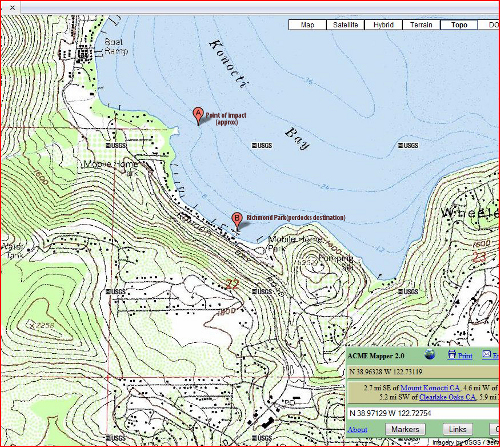
Regarding the precise location of the crash, at least one attempt has been made to find the exact location – Australian Tony Papworth has created a map, shown below.
E-mail Elizabeth Larson at
At around 3 a.m. one morning last weekend, Carolyn Hawley, who lives on Butte Avenue, was awakened by her dog and her neighbors' dogs barking profusely.
Hawley got up and looked out the window. She said she didn't have her glasses on, so at first she thought that the large, beige-colored creature she saw thirstily lapping up water from her dog's bowl was a very big dog.
However, it was a mountain lion. Hawley said she later found out from neighbors that they, too, had seen the big cat.
“It was scoping out my chicken coop,” said Hawley.
After the mountain lion emptied out the water bowl, Hawley said it sauntered out of her yard “in regal fashion.”
“He didn't cause any trouble,” she said.
Hawley said she hasn't seen a mountain lion in her neighborhood before, but she began studying up on them, and discovered that they make a sound that can sound like a peacock. She said she's heard a similar sound in the area, and so she believed the mountain lion may have been scoping out the area for a while.
Her cat wouldn't go outside after the sighting and the wild turkeys she's seen around have been gone for a while.
Hawley said she didn't think the mountain lion was out to do harm, and doubted there was danger.
Local Fish and Game Warden Loren Freeman said there are definitely mountain lions in Lake County due to its very rural nature.
“I am getting an increased activity with reports right now,” said Freeman, who believed that the growing number of sightings may be, in part, due to water drying up in area creeks and springs.
That would explain the thirsty mountain lion's fixation on the water bowl in Hawley's yard, Freeman said, since wild animals will seek other sources of water when the natural ones dry up.
He said leaving water outside for domestic animals can draw wild ones, too.
But other factors can draw mountain lions, too, Freeman explained.
Area residents who feed wildlife such as deer actually end up drawing mountain lions. Freeman said feeding deer is the No. 1 cause leading to finding mountain lions coming into neighborhoods.
Freeman said that, because mountain lions are at the top of the food chain, they eat fresh meat. “They're going to follow the deer herd.”
Even feeding pets outside can draw wildlife, said Freeman. If people stop those feeding habits, they can break the cycle and interrupt the habit of wildlife, which then will move on.
Freeman urged people who have concerns about wildlife to visit the state Fish and Game Web site at
www.dfg.ca.gov ; click on the button on the page's lefthand side for “What to do about nuisance, dangerous or injured wildlife.” That will lead to a page featuring animals from bats to bears, from coyotes to mountain lions, which then directs readers to the Fish and Game's “Keep Me Wild” Web site.
That site devotes a page to mountain lions (www.dfg.ca.gov/keepmewild/lion.html), and offers tips for living in mountain lion country, including not feeding deer – which also is illegal.
People in wild areas shouldn't hike, bike or jog alone, and should avoid outdoor activities at dawn, dusk and nighttime, when mountain lions are most active, according to the site. Those who spot a mountain lion shouldn't approach them, but should face the animal, make a noise and try to look bigger.
E-mail Elizabeth Larson at
Capt. Rob Howe of the Lake County Sheriff's Office said that sheriff's personnel, along with officers and agents from the California Bureau of Narcotic Enforcement and Bureau of Land Management (BLM), infiltrated five large marijuana cultivation operations during the Tuesday operation.
The marijuana grows were located southwest of Blue Lakes, said Howe.
One of the five grows was on private property, Howe said, while the other four were on BLM land.
Howe said law enforcement personnel seized 15,000 marijuana plants, combined, from the five grows.
He said the grows were uninhabited at the time of the operation and no arrests were made.
So far this year, law enforcement personnel in Lake County have seized 322,063 marijuana plants and 12 firearms, and have made 14 arrests in connection to these marijuana cultivation operations, according to Howe.
Last year, approximately 499,508 marijuana plants were eradicated on public and private lands in Lake County during the July through October eradication season, as Lake County News has reported.
The Mendocino County Sheriff's Office reported Wednesday that the remains, found at 19400 South Harbor Drive in Fort Bragg, on July 16, were identified as belonging to 49-year-old Michael Ray Larsen of Fort Bragg.
In December 2003 the Mendocino County Sheriff's Office was contacted by one of Larsen's family members.
The family member, who advised that Larsen was transient and last known to be living in the Fort Bragg area, was concerned because Larsen had not telephoned his family members for the holidays as was his normal routine.
Mendocino County sheriff's detectives conducted several investigations into Larsen's whereabouts and learned his ATM/debit card was last used at the Fort Bragg McDonald's on Aug. 8, 2003.
At approximately 9:15 a.m. July 16, the Mendocino County Sheriff's Office was summoned to the hillside behind the Caito Fisheries business located on South Harbor Drive in Fort Bragg.
When they arrived detectives learned the business' employees had located human remains in a skeletal condition while clearing heavy bush on the hillside. Found on the ground near the remains was a wallet containing photo identification of Larsen.
While conducting a scene examination detectives noticed the remains were located below a steep drop off in the terrain. Above this drop off was the area of a transient encampment. Detectives also noticed the location of the Fort Bragg McDonald's was above this transient encampment.
On Tuesday the teeth of the remains were compared against known dental records of Larsen. Based upon this comparison the remains were identified as Larsen's.
A further examination of the remains were conducted by the Mendocino County pathologist and the remains showed no signs of physical force or violence that would suggest Larsen's death was the result of foul play.