 How to resolve AdBlock issue?
News
The Mendocino County Public Health Department is reporting a total of 12 cases in that county, with one new hospitalized patient in stable condition. Six other patients who previously were hospitalized have been released.
Lake County has so far reported one case, as Lake County News has reported.
The Centers for Disease Control is reporting a total of 43,771 cases in the United States and its territories, and 302 deaths. In California, there have been 3,161 cases and 52 deaths.
The H1N1 influenza virus will continue to cause mild to severe illness throughout the summer and into the annual flu season, officials reported.
A vaccine for the virus currently is under development.
On Wednesday the Centers for Disease Control and Prevention’s Advisory Committee on Immunization Practices met to make recommendations for the vaccine's use when it becomes available, and to determine which groups of the population should be prioritized if the vaccine is initially available in extremely limited quantities.
The committee recommended the vaccination efforts focus on five key populations: pregnant women; people who live with or care for children younger than 6 months of age; health care and emergency services personnel; persons between the ages of 6 months through 24 years of age; and people from ages 25 through 64 years who are at higher risk for novel H1N1 because of chronic health disorders or compromised immune systems.
Those groups total approximately 159 million people in the United States.
The novel H1N1 vaccine is not intended to replace the seasonal flu vaccine. It is intended to be used alongside seasonal flu vaccine to protect people.
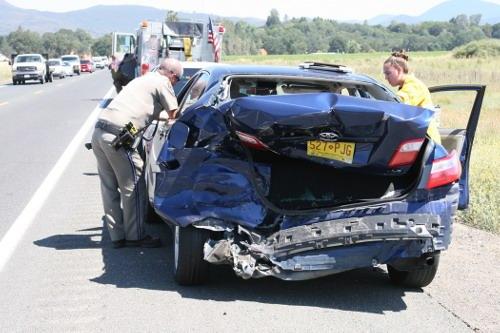
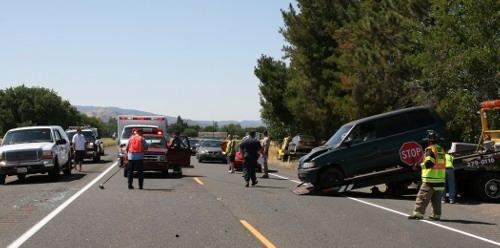
LAKEPORT – Traffic on Highway 29 was snarled for nearly an hour Wednesday afternoon after a traffic collision sent at least one person to Sutter Lakeside Hospital.
First reported at 2:45 p.m. the collision, located just south of Thomas Drive on Highway 29, involved a 1995 Mazda van and a 2008 Toyota sedan.
First responders indicated via radio that four persons had suffered mild to moderate injuries.
Medics and fire personnel from Lakeport and Kelseyville were on scene as well as California Highway Patrol officers.
CHP Officer Mark Crutcher told Lake County News that a couple from Kansas was preparing to make a left turn from Highway 29 when the Mazda van struck it from behind.
The Toyota suffered serious rear-end damage, while the Mazda was damaged enough to require a flatbed truck to transport it from the scene.
Three persons involved were still on scene at 3:30 p.m. while CHP investigated the accident and medical personnel evaluated their injuries.
Both vehicles appeared to be registered in states other than California. The van carried plates from Washington state and the Toyota from New Mexico.
The roadway was opened to two-lane traffic by 3:30 p.m. although cleanup crews continued to remove debris that had been pushed to the side of the road.
E-mail Harold LaBonte at
The second day of Bismarck Dinius' trial took place on Wednesday.
The 41-year-old Carmichael man is charged with felony boating under the influence causing great bodily injury and two lesser included offenses of boating with a blood alcohol level over 0.08 and boating while under the influence.
Dinius is alleged to have had a blood alcohol level of 0.12 while sitting at the tiller of Willows resident Mark Weber's sailboat, Beats Workin' II, on the night of April 29, 2006. The prosecution alleges that Dinius, by steering the boat, was responsible for operating it, and that he failed to have the boat's running lights turned on.
The sailboat was hit by a powerboat driven by an off-duty sheriff's chief deputy, Russell Perdock. Witnesses on Tuesday gave estimates that Perdock was driving his boat between 40 and 50 miles per hour that night, which was extremely dark and moonless.
Weber's girlfriend, 51-year-old Lynn Thornton, was mortally injured in the crash and died a few days later.
Establishing the custodial chain and testing of key pieces of evidence in the case – including blood samples from Dinius, Weber and Perdock – was a focus of much of the day's testimony.
Sheriff's Det. Jerry Pfann, who manages the agency's evidence storage, explained how he was contacted shortly before 2 p.m. the day after the crash and traveled to the Lower Lake substation to pick up Perdock's blood sample, taken the previous night at Redbud Community Hospital. The hospital has since changed its name to St. Helena Hospital-Clearlake.
Pfann said all sworn personnel and some designated civilian personnel have access to the substation, which serves as patrol office and holding area for inmates for court, and has a room for evidence storage.
He found Perdock's sample in a small refrigerator and transported it to the sheriff's main office on Martin Street in Lakeport.
Pfann told the court that he placed Perdock's sample – along with those from Weber and Dinius – in an evidence refrigerator, at the back of a shelf behind other materials in evidence. “Because of the nature of the case and who was involved, I wanted to be the only person who knew where they were,” he said.
The next day – Monday, May 1, 2006 – Pfann found all the samples the way he had left them before taking all of the items to the California Department of Justice (DOJ) Lab in Santa Rosa for testing.
Pfann brought the samples – picked up from the DOJ earlier this month – to court on Wednesday, where District Attorney Jon Hopkins had him open the sealed plastic and paper envelopes containing the vials of blood and reseal them in new plastic bags before submitting them into evidence. Court had a brief recess while Pfann went to retrieve his portable heat sealing machine.
Beland testifies about night of crash
A former sheriff's sergeant who stated that he was ordered not to give a preliminary alcohol screening – or PAS, also known as a breathalyzer – test to Perdock at the crash scene also took the stand.
James Beland related how he got the call and volunteered to notify Sheriff Rod Mitchell before responding to the Konocti Bay area, where the crash took place.
Beland said Sgt. Dennis Ostini, the primary supervisor for the sheriff's Boat Patrol, led the investigation.
When Beland met up with Ostini and then-Sgt. Mike Morshed at the scene, he recalled, “I said, 'I have a PAS on board.' Do you want to use it?'
“Sgt. Ostini's response was, 'No, no no, Perdock has already volunteered to do blood,'” Beland said.
Beland said his patrol vehicle was one of the few at that time that had a mobile audio visual unit (MAV) which could be used for videotaping witness statements. Another deputy used the unit to take statements and Beland had to wait before being able to transport Perdock to the hospital, getting there, he believed, around 11:30 p.m.
After the blood draw, Beland said he and Perdock parted ways. He said he didn't see Perdock with any signs of intoxication.
During questioning, Beland also admitted that he had written the wrong date – April 30 rather than April 29 – on one of the pieces of evidence, which was brought to his attention several months later.
Haltom asked Beland if he was still with the sheriff's office. Beland replied that he was terminated last December.
“Was your termination related to this case?” Haltom asked.
“Yes,” Beland responded.
Hopkins objected to the question, and Judge J. Michael Byrne sustained the objection.
Under Haltom's cross-examination, Beland described seeing Mitchell arrive at the crash scene, where he walked up to Perdock and hugged him.
Beland explained that Ostini was the second-most senior sergeant in the sheriff's office at the time of the crash. Rather than press the PAS, Beland said, “I pretty much followed what those two had to say.”
“Were you ordered not to give a breath test to Russell Perdock?” asked Haltom.
“If I had done that I would have been written up,” said Beland, who was a new sergeant in April of 2006.
He added, “It was a discussion on how to handle the situation, but it was also an order.”
Beland said he had no reason to question Ostini. “He's a very fine upstanding person,” and also was a mentor.
It wasn't until a few months later that Beland said he became upset about the decision not to do the PAS. When Haltom asked why, Hopkins objected and Byrne sustained the objection.
Haltom asked Beland if he administered breath tests in other driving under the influence-type arrests. Beland said yes.
“Is it desirable to get as early a possible test result as you can?” Haltom asked, to which Beland again responded in the affirmative.
Beland explained that having the PAS results helps verify field sobriety test results. It also gives a timespan during which blood alcohol levels may be going up or coming down.
After Dinius' preliminary hearing, which took place in May and June of last year, Beland said he wasn't happy with his performance, so he researched his activities that night. Originally he couldn't remember exactly what he did after leaving the hospital – he'd stated in court last year that he and Perdock had driven around afterward, but he couldn't remember where he had taken him.
About the time that he gave testimony in the preliminary hearing in late May of 2008, Beland said he generated a report that stated he was ordered not to give the PAS at the scene.
Beland said the blood test was a good call, but he “couldn't say either way” about whether not giving the PAS was a bad call, since he didn't know how boating collisions were handled.
Hopkins asked if there was a difference between breath and blood tests. “So, blood's the best?”
Yes, Beland replied. Haltom objected and Byrne sustained.
Hopkins asked the question another way, questioning Beland about whether blood was better than breath and urine tests. Beland said yes.
Beland mentioned in his testimony that some of his reports where changed, including the original report that documented how he handled Perdock the day of the crash.
His original report stated that he notified Mitchell of the crash. He said Capt. James Bauman ordered him to take that part out.
Under continued cross-examination, Haltom asked, “Is it optimal to have both blood and breath?”
“If it was a vehicle accident, yes,” Beland said.
Hopkins, taking another turn at questioning Beland, challenged his assertion that his report was altered by the sheriff's office, but that he had changed it himself at the order of a commanding officer. That wasn't unlike Beland ordering his own patrol deputies to correct reports, Hopkins suggested.
Hopkins asked if it was standard procedure to have higher-ranking officers approve reports. It isn't standard for supervisors, Beland responded.
But Beland said he was an exception. “They wanted my reports approved.”
Criminalists explain testing procedures
Gregory Priebe, a senior criminalist with the DOJ's Santa Rosa lab, spent time on the stand Wednesday afternoon explaining the science behind blood alcohol testing, testing procedures, handling evidence and levels of impairment.
Priebe tested all three blood samples in the case. His analysis found no alcohol in Perdock's blood which, by agency protocol, was then sent to the DOJ toxicology lab in Sacramento because anything under 0.08 percent blood alcohol undergoes additional testing.
Weber's sample showed 0.18 percent blood alcohol and Dinius' 0.12, according to the testing done by Priebe, who said he has tested between 7,500 and 10,000 samples in his career.
Hopkins asked Priebe about the impacts of alcohol on human function and judgment. Priebe said effects range from impairment of a person's ability to process information and its impact on inhibitions and vision.
“You're just not processing information at same rate as you're processing it when you're sober,” Priebe said.
“Would that affect your ability to remember to turn your lights on, for instance?” asked Hopkins.
It could, said Priebe.
Priebe went on to explain, “Everyone is impaired at a 0.08 percent,” and most people are impaired at 0.05 percent.
At Hopkins' request, Priebe explained intoxication levels and how quickly they would change for a hypothetical 200-pound man, whose body composition would cause him to eliminate 0.018 percent alcohol per hour. That's about the rate that same man's blood alcohol level would go up for one 12-ounce beer, a 4-ounce glass of wine or one and a quarter ounce glass of hard liquor.
Priebe also stated that the DOJ blood draw kits have gray-stoppered tubes to hold blood that contain sodium fluoride, a strong enzyme inhibitor, which doesn't require they be refrigerated. The samples can safely be stored at room temperature, but handling samples is an issue determined by agencies. DOJ refrigerates samples to slow the enzymatic process, he added.
Under Haltom's cross-examination, Priebe explained that drinking large amounts of alcohol in a short time period would cause a person with an otherwise empty stomach to reach a peak intoxication rate within 15 to 30 minutes, while a person with a full stomach's peak intoxication would come between 30 and 90 minutes.
Priebe said this was the first time he's testified in a case involving a sailboat. His only experience on a sailboat led to the craft sinking in the bay.
He didn't know much about sailboats, but said he understood what it took to steer such a vessel. “I know how difficult it is because I sank one of these things,” Priebe said.
Haltom asked Priebe about a time limit for taking blood samples. Priebe said there is a three hour time period in which samples should be collected in order to accurately reflect intoxication levels.
Priebe, in response to another question by Haltom, said there was no rush in testing the samples in this case. “We have a bureau policy we turn around blood alcohol results, try to, within five days of receiving the sample,” he said, adding that toxicology labs take longer.
Being able to respond to conditions in a sailboat, said Priebe, takes longer than in an automobile.
Hopkins asked how many drinks a 200-pound man would have to drink to have a blood alcohol level of 0.12. Priebe calculated 6.6 drinks.
If that person's blood alcohol level actually was declining from a peak three hours earlier, Priebe calculated the peak would be 0.15.
Senior criminalist Gary Davis, who works at DOJ's Sacramento toxicology lab, discussed the drug testing conducted on Perdock's blood sample, which included screening for six groups of drugs, among them opiates and barbiturates.
An initial screening will indicate if a general type of drug is present, said Davis. A confirmation test identifies the specific drugs present.
“Can the screening test be misleading,” asked Hopkins.
“It can be wrong at times,” said Davis.
Haltom asked about the screening's results.
“The initial one was positive for opiates and nothing else,” said Davis, explaining opiates include Codeine, Vicodin, Hydrocodone, opium and Oxycontin.
“Are you testifying that that was a false positive?” Haltom asked.
“Yes,” Davis said.
False positives happen less than 5 percent of the time, Davis explained, and can be triggered by small bubbles that appear in the samples.
“I don't know what exactly happened in this case,” said Davis.
Hopkins asked if he asked for a second screening on the blood sample. Davis said yes, and the result was a negative test.
Phlebotomists, retired sergeant testify
During the day's testimony, the jury also heard from the two phlebotomists who drew the blood samples.
Andrea Estep, who works at St. Helena Hospital-Clearlake, took Perdock's sample at 11:30 p.m. the night of the crash. She acknowledged she wrote the wrong date – April 30 – on the sample.
Estep, who works late-night graveyards shifts, explained that she often dates materials for the next day and didn't double-check herself that night before turning over the sample to Beland.
LaDonna Hartman took Weber's sample at 11:15 p.m. and Dinius' at 12:05 a.m. at Sutter Lakeside Hospital and gave them to Sgt. Mark Hoffman.
Both Hartman and Estep explained how they took the samples and sealed DOJ blood draw kits before turning them over to the deputies.
Beland took Perdock's blood sample to the Lower Lake substation, where Pfann retrieved it the next day, while Hoffman took Weber's and Dinius' samples to the main sheriff's facility before logging them into the evidence facility.
Hoffman, now retired, was a sheriff's patrol sergeant in April of 2006. On the stand Wednesday he described being one of the first responders to the crash scene, where he was instructed to take Weber to the hospital for the blood draw.
Testimony continues on Thursday.
E-mail Elizabeth Larson at
THIS STORY HAS BEEN UPDATED
MIDDLETOWN – A local man won more than $1.5 million at Twin Pine Casino this week.
On Tuesday the man, who requested anonymity, hit a MegaJackpot of $1,501,686.39 by playing a “Marilyn Monroe” dollar slot machine.
The machine, which is known as a “Wide-Area Progressive,” is electronically connected to other similar machines throughout the country, and these types of machines can pay off very large jackpots through a group play network rather than through standard individual play.
Twin Pine has several wide-area progressive machines on its new gaming floor to accommodate customers who are hoping to hit the supersized jackpots.
Twin Pine Casino is owned by the Middletown Rancheria of Pomo Indians of California.
Referring to the major jackpot, Carl Rivera, the Rancheria’s tribal council chairman, said, “The tribe has been pointing to this moment for a long time. We knew it would happen, but you just never know when. With the recent grand opening of Twin Pine as California’s newest casino, it couldn’t come at a more exciting time for all of us.”
The $1.5 million jackpot is the largest single payout in Twin Pine’s 15-year history. It also represents the largest payout of its type in Lake County history, and exceeds the jackpots of all other casinos in the Bay Area.
“It’s a real thrill to see one of our many loyal guests combine with one of our most popular gaming machines to produce such a life-changing event,” said Richard Howard, General Manager of Twin Pine Casino.
Twin Pine Casino has operated a Las Vegas-style gaming facility of the latest slot machines and table games since 1994.
This year the Middletown Rancheria recently opened its 107,000-square-foot new casino/ hotel/ restaurant complex at its current Middletown location.
Visit www.TwinPine.com .
The recently released grand jury report noted in its overview of the county's administrative office that an internal audit found “significant cash management improprieties including undeposited receipts totaling more than $45,000 and several months of unpaid invoices, and veterinary costs in excess of $10,000 to treat a single animal.”
“The department was lax in its procedures,” said Deputy County Administrative Officer Jeff Rein. “As a result of audit, we have tightened procedures up.”
Rein said nothing appeared to have been missing, nor does it appear to be a criminal issue, more one of negligence. Deposits are supposed to be done on a daily basis, not once a month.
County Auditor-Controller Pam Cochrane said the discrepancies were discovered during an annual, unannounced department audit conducted earlier this year.
“When we were out doing our routine audit in March we discovered there were some irregularities with regards to a lot of money laying around,” Cochrane said.
Specifically, they discovered $4,900 in cash and $46,000 in undeposited checks amassed during a two-week period, from donations to licenses. There also were a few large checks from the cities of Lakeport and Clearlake, which have animal control services contracts with the county. Cochrane said her office encourages large departments to regularly make deposits.
Cochrane's office brought the discrepancies to the grand jury's attention, and also to that of the County Administrative Office.
However, when her auditors went back to audit Animal Care and Control again in June, the issue had been resolved, regular deposits were being made and the audit yielded no findings, Cochrane said.
Cochrane attributed the failure to make the deposits to a “transition in staff.”
Deputy Animal Control Director Bill Davidson said the department's procedures have improved by “leaps and bounds,” and they've been making regular deposits for several months. During the June audit he said the auditors said it was the quickest one they had ever done.
“Right now things are running smooth,” Davidson said.
He said Animal Care and Control Director Denise Johnson was privy to most of the specifics about the situation, but she's out on medical leave. Johnson suffered serious injuries in a fall from a horse earlier this month and currently is in a wheelchair.
Regarding the grand jury's statement about $10,000 spent on a single animal, Davidson said he didn't have a record of that much being spent, although it did cost the department $7,000 to care for a dog, dubbed Dixie.
Dixie was impounded last summer as part of an animal cruelty investigation, as Lake County News has reported. She had been hit by a semi truck and her owner didn't take her to the vet, letting her lie in the yard in pain for two weeks before Animal Care and Control was notified.
Davidson said the costs for Dixie's care – resulting from her severe injuries and a rare bacterial infection – snuck up on them.
Rein said Johnson looked to the administrative office to implement new polices and procedures to make sure the problems with cash management and deposits wouldn't reoccur.
“We will be watching them closely to make sure that this doesn't happen again,” Rein said.
E-mail Elizabeth Larson at
LAKEPORT – The trial of a Carmichael man facing a felony boating under the influence charge for a fatal 2006 sailboat crash on Clear Lake got under way on Tuesday morning.
Bismarck Dinius, 41, was in court with his family, supporters and interested community members as opening arguments were presented in Lake County Superior Court's Department One before visiting Judge J. Michael Byrne.
By the end of the first day of testimony, the trial lost two jurors. The two young women were replaced by two males, changing the jury's composition from seven males and five females to nine males and three females.
Those developments also leave the proceedings with only two alternates – one male and one female – to get through the trial, estimated to take at least a month to complete.
District Attorney Jon Hopkins told jurors that he would present evidence that showed Dinius had responsibility for steering a sailboat owned by Willows resident Mark Weber during a nighttime cruised on April 29, 2006.
While the boat was under way – without lights, Hopkins alleges – it was hit by a power boat driven by Russell Perdock, an off-duty sheriff's deputy. Weber's girlfriend, Lynn Thornton, was fatally injured. As a result, Dinius is facing felony boating under the influence causing great bodily injury. Perdock was not charged.
Hopkins and Dinius' attorney, Victor Haltom, spent a total of an hour and 20 minutes presenting summaries of their versions of what happened that night.
Weber and Thornton were in Lake County on the day of the crash for the annual Konocti Cup sailing race, in which Weber's sailboat, the Beats Workin' II, took part, they said.
Later that night, after spending time with fellow sailors at Richmond Park Bar and Grill, Weber, Thornton and some new friends took a cruise across Konocti Bay.
Hopkins, in his opening, argued that the sailboat's lights weren't on, and that two fishermen that night saw a boat under way without lights.
Coming from the other side of the lake was Perdock, bringing with him a friend and the friend's daughter. People also saw Perdock's 24-foot power boat, said Hopkins, and there are a “wide range of estimates” about his speed that night.
After the crash, which occurred at about 9:10 p.m., sheriff's deputies and paramedics responded to the shore, while good Samaritans already had towed in the boat, so the exact location was hard to determine, said Hopkins.
“This is not like a car collision. You don't have skid marks. You don't have landmarks to tell you where it is,” he said.
Weber, said Hopkins, had a 0.18 blood alcohol level based on a blood draw, while Dinius' blood alcohol tested 0.12, according to test results. Perdock's blood draw showed no presence of alcohol or drugs.
When Hopkins asserted that, by law, Dinius was the sailboat's operator, Haltom objected. Byrne allowed it for the purposes of Hopkins' general introduction.
Hopkins alleged that the sailboat's light toggle switches showed the running lights weren't on, which he said is a crucial factor in the case.
He told the jurors that one of their biggest challenges will be having to listen to experts. “You're going to have to stay awake, pay attention and be patient.”
One of those experts, a Department of Justice criminologist, will testify that the filament in the sailboat's broken stern light has characteristics that indicate it was a “cold break,” meaning, the light was not on when it was broken, Hopkins said.
Hopkins stated that with Dinius at the helm, he was responsible for ensuring the running lights were on.
“Failure to have running lights on is a substantial factor in the cause of the collision,” said Hopkins.
During his statements, Haltom – accompanied by two attorneys from The Innocence Project – argued that Weber was “running the show” on the boat, not Dinius, who he said wasn't the operator.
“The evidence that you will hear in this case will show that that is not the case,” he said, noting that “any 6-year-old” can sit at a sailboat's tiller when there's no wind.
While the Beats Workin' II was on its cruise across Konocti Bay, “Things go horribly wrong,” with Haltom alleging that Perdock was going “very, very, very fast.”
A retired police officer saw Perdock's boat and noted to friends that the driver was “going to kill himself or someone else” said Haltom.
“The power boat is going so fast it literally devours the sailboat,” Haltom said.
Haltom told the jury that the key issue for them to decide is causation – and who, ultimately, is responsible for the crash.
He said the evidence actually show is that it is Perdock's “speed and recklessness” that is the crash's cause.
Haltom alleged that in the day after the crash, the sheriff's office left the sailboat unattended at the sheriff's boat yard, and that Perdock was treated “a little differently than you or I would have been.” That included getting a hug from Sheriff Rod Mitchell at the scene and not having a breathalyzer test administered to him on shore after the crash.
Also introduced to the jury was information about witnesses who Haltom said will testify that Perdock was at Konocti Harbor Resort & Spa in the hours before the crash, with one witness allegedly spotting him at the bar.
“The evidence in this case will show that Russell Perdock and Russell Perdock alone is the cause of this accident,” said Haltom.
Witnesses questioned closely on sailboat lights
During the morning session, Hopkins began calling witnesses to testify.
Jim Ziebell, who helped skipper Weber's boat during the Konocti Cup on April 29, 2006, was the first to testify. He discussed the hours before the crash and his experience sailing on Clear Lake.
Ziebell said he saw the sailboat's stern light when it left on the cruise, but couldn't see the bow lights. “There's a position where even people on the boat can't see them,” he said. Having sat at the tiller of Weber's vessel, he could say that neither the stern or bow lights are visible from that position.
Haltom asked Ziebell if he knew of a reason why someone would turn off the boat's lights while under way. “I would never turn off the light,” he said. “I can't imagine any reason why I would.”
The lights aren't bright enough that turning them off would help with stargazing, he said.
While traveling home on his own power boat from Richmond Park at around 9:30 p.m. the night of the crash, Ziebell said he saw the silhouette of the sailboat being towed, but thought it was because someone ran out of gas.
Haltom asked Ziebell how long it would take to execute a turn in a sailboat if a boat was bearing down on it.
“I don't think it would be possible,” said Ziebell. “The boat behind me has the burden of missing me. I don't have the burden of missing him.”
The morning after the crash, Ziebell and some friends saw the unsecured sailboat sitting at Braito's Marina on the lakeshore at Buckingham Point.
Also called to the stand was Doug Jones, the past commodore of a local sailing club who knew Weber and had worked on his boats. Jones was at Richmond Park after the Konocti Cup and saw Weber, who he said was “loud” and intoxicated.
Jones said he “grabbed a burger and a couple of beers and came home” at around 6:30 p.m. After being driven home by a friend, he sat at his tenant's home on the lakeshore and spotted Weber's boat sailing by, about 300 to 400 yards out, at “deep dusk.”
“I did not notice any bow light,” said Jones, which caused him to pay attention because he was concerned about not seeing the light. “The light should be on by that time.”
Jone said he saw a bright stern light and a red glow that he realized were cabin lights. The sailboat also was running under full sail.
The night of the crash, Jones said close to 10 sheriff's patrol cars came down his driveway and said there was a boating crash. Jones went out to his dock and saw the boat being towed into view.
The next day he said he spoke to Lloyd Wells, a deputy sheriff with the Lake County Sheriff's office, who came to pick up Weber's boat trailer in Jones' boat yard.
Jones asked about the crash and said Wells didn't identify who drove the power boat. Wells also reportedly said the sailboat didn't have any lights one. Jones said he saw the lights on, and Wells replied that he couldn't have.
Fishermen describe night on the water
Most of the afternoon was devoted to hearing the testimony of Anthony Esposti and Colin Johnson, who were prefishing for a catfish tournament on the night of the crash.
The men, in a 14-foot aluminum fishing boat, noted in their separate testimony that the night was extremely dark. They both said they saw a sailboat without lights before witnessing the boat crash later in the night.
Esposti, who was more familiar with Clear Lake, said they put into the water at about 4 p.m. and fished until after dark.
He said he saw no lights on the sailboat, only seeing it after Johnson flashed it with a spotlight. However, he did see the stern light on Perdock's boat, which he said was very loud. Esposti estimated it was traveling about 40 miles per hour.
“We watched it on its course until it collided with something,” he said.
It was so dark, with no moon, that they didn't know what it hit, but he could hear the engine when it came out of the water as the powerboat flew over the sailboat, said Esposti. They could hear yelling for help, so he and Johnson approached the boat and found it with a broken mast.
Esposti said they heard screaming from the boat. Asked what he saw on the sailboat, he replied, “God ... blood.”
He and Johnson helped tow Perdock's boat to shore while two other boats which had come out to render assistance towed the sailboat.
In cross-examining Esposti, Haltom asked him about statements he'd made previously to investigators, including comments about going out later in the evening, at 7 p.m. Esposti insisted there were several hours of daylight when they started.
He believed he had seen the sailboat on its cruise between 7 p.m. and 7:30 pm. but couldn't remember it being under sail. Esposti believed the crash happened about two hours later, with the power boat traveling on a straight line before the crash.
When Johnson took the stand, his testimony contained several notable differences from Esposti's beginning with his assertion that they headed out for their fishing trip close to the time it began getting dark.
He said he heard people laughing and talking on the sailboat, but saw no lights of any kind – not even cabin lights. Johnson also didn't see a sail. Without his spotlight, they couldn't see the boat at all.
Johnson said they heard and saw the power boat as it moved across the bay. “Then all of a sudden it just jumped up in the air,” he said, describing how he saw the boat's navigation lights spin 360 degrees and they heard the crunching of the crash.
“I was clueless about what it ran into,” he said.
He and Esposti made their way over the sailboat; when they got there, Johnson stood and pulled himself up to look into the sailboat, where he saw a man doing cardiopulmonary resuscitation on Thornton. The side of the boat had blood on it, he noted. He then started yelling to the shore for help. Boats arrived to help shortly afterward.
When Haltom asked him about the speed of Perdock's boat, Johnson replied, “I think that it was somewhere between 40 and 50 miles per hour.”
During his testimony, Johnson said he flashed Perdock's boat with his spotlight when the boat was coming straight toward him. It then “tailed off” toward the sailboat.
With no speed limits on the lake, boats can travel at any speed, Johnson said. “You've got to watch out for yourself,” he said. “He was just coming too close to me for my comfort.”
Haltom wanted both Esposti and Johnson subject to recall for possible further testimony at some point during the remainder of the trial.
At the end of the day, Byrne admonished jurors not to read about the case or talk to anyone about it.
He said the evidence will come in phases. “It's important to keep an open mind,” he said.
The trial resumes at 9 a.m. Wednesday.
E-mail Elizabeth Larson at