How to resolve AdBlock issue?
News

I’ll admit upfront that I have all of the “Resident Evil” movies on DVD and my daughter and I play the zombie based video game “Left 4 Dead” regularly. So I’ll also say up front that while the facts in this column about food safety are true, the conclusions I make are just for fun and only because I have a lot of zombie references in the forefront of my mind.
Food safety is very important, and we here in the U.S. have some of the safest, healthiest food on the planet thanks to the regulations set by the Food & Drug Administration.
In recent years though, we have seen some odd illnesses crop up that are foodborne. I don’t want to scare people about their food, I just want them to understand more about it.
To make it topical, the H1N1 virus, or “Swine flu,” is an adaptation of a known swine flu virus and a bird flu virus that mutated together to affect humans. While H1N1 is an airborne illness, these types of mutations and adaptations happen all of the time to food-borne viruses too, so I think we have to start worrying about ... that’s right, the Zombie Apocalypse!
Bovine Spongiform Encephalitis (BSE), more commonly known as Mad Cow Disease, could be the thing that brings the Zombiepocalypse down upon us all (hey, if "unfriend" can be a real word in the dictionary so can "Zombiepocalypse").
Most people aren’t aware of this, but the most common way that cows contract BSE is by eating the brains of a cow that is already infected. I can hear you now, “Whoa, Whoa, WHOA! Cows eating cow brains? How does that happen? Are they zombie cows?” No, not zombie cows … not yet at least.
In an attempt to boost the protein in the cows’ feed to bulk up the cow and get more meat and also to stretch the expensive feed further, the waste parts of slaughtered cows (brains, spinal cord and any non-marketable bones) are cooked, ground and mixed in with regular cow feed and fed to the remaining herd. Since the incubation period for BSE is typically four years it’s very difficult to tell if you are accidentally feeding a diseased animal to a healthy herd.
Luckily in North American cattle ranches this isn’t a common practice and the extra protein in the cows’ diet is usually provided through the use of soy meal. However in Europe where soybeans don’t grow as well these cooked cow floor sweepings are the usual supplement, which is why BSE is more common in Europe. Soy meal is expensive there and dead cow parts are not.
Another reason the BSE outbreaks happened so often there is that the U.K. lowered the required sterilization temperature of the cow meal, possibly making it easier for the infectious agent (technically a prion) to survive the sanitation process. By lowering the safety standards they put the public at risk.
Vegetarianism is looking better, isn’t it?
Food safety regulations are constantly being changed. One president and Congress lowers standards in order to influence trade, while the next president and Congress will raise the standards for public safety. President Obama has stated that, as a father, our nation’s food safety is a primary concern to him. Right at this moment, Senate bill S510, the Food Safety Modernization Act is being discussed. This bill, while being a good step towards some much needed revisions, is unfortunately being written by people who don’t work in the field.
While it does give the FDA more authority to inspect food processing facilities and order recalls, one big problem in the FSMA is that it applies a single package of regulations to the food safety problem that could put small and midsize sustainable farmers, not the huge food manufacturers that are responsible for most food recalls, out of business.
Smaller producers usually have smaller risk of contamination of their produce or infection of their stock, and therefore should not be treated the same as large production facilities. They also generally don’t have the large financial base to make what are expensive and unnecessary food tracking modifications to their operations that may be required of them should this bill pass and be signed into law.
Currently the FDA can only recommend a producer enact a recall when a food safety problem arises, while this law will allow the FDA to enact one on their own authority. Food producers will pay for this increase in FDA enforcement with a special annual fee.
Somebody better at reading government bills could probably explain this all better than I can. There is much more to this bill, but I just want to give you enough information to get you involved.
In general, it is safer to purchase food from local growers and producers. Great resources are farmer’s markets and locally owned grocery stores that purchase from local suppliers. Ask questions about the origins of your food. Be sure to wash all your produce thoroughly. These are some positive steps you can personally take to ensure the safety of your food.
In another science fiction-like twist to the story, a biotechnology company in South Dakota claims to have genetically engineered cattle that are immune to BSE, so they can still be fed the cow-brain feed. Better living through science!
Here’s my pitch to George Romero – well maybe not Mr. Romero, more likely the SyFy Channel:
We open in the British countryside ...
“Genetically engineered cows that are now immune to BSE contract it, and due to their unique genetics actually develop an addiction to brains. Since it takes so long for the symptoms to develop nobody suspects anything until it’s too late and some of the cows have already gone to slaughter!
Now, not only does our hero have to retrieve the tainted meat from the consumer before it’s too late, but due to lower food tracking safety rules he won’t make it in time. Meanwhile, on page 34 of your script, the cattle that didn’t go to slaughter are now in a craze for more brains. They have eaten the rancher, his family, and all the ranch hands, and are now wandering the countryside looking for more. We can add some dark humor to the situation by having the cows come across a group of vegetarians who are quickly consumed by the manic beasts.
Then, at the White House (go to page 67 of your script), the government will claim that plenty of the anti-virus is in production, they will be inoculating everyone soon and there will be nothing to worry about” Panting, excuse me while I catch my breath for a moment. “Of course we know that this is completely untrue, and that because of the lax food safety tracking they haven’t even figured out how this happened yet. People are infected, animals are infected, and both are out searching for more brains. Eventually infected people fly out of the UK, animals make their way through the Chunnel, and the world is doomed to the Zombie Apocalypse.”
What do you think? I can have some storyboards drawn up in a couple of days ...
Okay, maybe that scenario is pretty far-fetched, but the truth is we have outbreaks of E. coli and BSE and salmonella and H1N1, all because we keep raising and lowering our food safety standards to meet the needs of some large food processors that donate to a political campaign, then we encourage countries with lower food safety standards to send their food here.
I encourage you to be aware of the changes in food safety regulations, and to contact your government representatives with your opinions. Only you can stop the zombie apocalypse!
Barbara Boxer
112 Hart Senate Office Building
Washington, DC 20510
202-224-3553
Dianne Feinstein
331 Hart Senate Office Building
Washington, DC 20510
202-224-3841
http://feinstein.senate.gov/public/index.cfm?FuseAction=ContactUs.EmailMe
You can also contact you local House member. For Lake County residents:
Congressman Mike Thompson
231 Cannon Office Building
Washington, DC 20515
202-225-3311
http://mikethompson.house.gov/contact/email.shtml
My pantry is currently full, so all I need is a source for concertina wire and I’ll be ready for the hoards of zombies. OK, maybe my daughter and I have been playing too much “Left 4 Dead.” and now we have “Left 4 Dead 2.”
Ross A. Christensen is an award-winning gardener and gourmet cook. He is the author of "Sushi A to Z, The Ultimate Guide" and is currently working on a new book. He has been a public speaker for many years and enjoys being involved in the community. Follow him on Twitter, http://twitter.com/Foodiefreak .
Late Friday, Santa Rosa Memorial Hospital and Golden State Donor Services issued a joint statement on behalf of the family of 19-year-old Steven Culbertson of Lakeport, who died Nov. 29.
“Nineteen-year-old Steven Culbertson’s organ donation provided the gift of life to others waiting for a life-saving transplant,” the statement read.
Culbertson died the morning after he allegedly ran a red light in his Mini Cooper on Lakeville Highway in Sonoma County, triggering a four-car collision.
During that fatal crash, Culbertson is alleged to have broadsided a Nissan Quest in which John and Susan Maloney and their young children, Aiden and Grace, were riding. The family died at the scene, as Lake County News has reported.
The story has gained nationwide attention, as the deaths of so many people was compounded by a burglary of the Maloney family's home and speculation about speed and possible other contributing factors to the crash – including a report that Culbertson was spotted drinking at a bar before the crash.
However, news of the organ donations brings to the fore another story – the need for organ donors around California and across the nation.
There are 105,000 people who are waiting nationwide to receive organ transplants, according to Tracy Bryan, spokesperson for Golden State Donor Services. Of those, 21,000 are in California, the state with the most overall need.
The Donate Life California Organ and Tissue Donor Registry's Web site, www.donatelifecalifornia.org , reportedly on Friday that there are more than 5.8 million people statewide who are signed up to become donors.
However, less than 1 percent of of all hospital deaths qualify for organ donation, said Bryan. Usually, the situations that qualify involve a traumatic head injury leading to brain death.
“We really need people to think about it and sign up,” Bryan said, noting they can sign up directly at www.donatelifecalifornia.org .
She said that only about 8,000 organ donations take place nationwide each year. Of those, between 50 and 70 take place within Golden State Donors Services' service area.
Information about the specifics of Culbertson's donation are private, but Bryan explained the donation process in a late Friday interview.
Bryan said that when a potential donor is identified, the hospital is mandated by federal law to call a donor procurement organization. Golden State Donor Services is the donor procurement organization that serves Santa Rosa Memorial Hospital, as well as the Sacramento area and 10 surrounding counties.
Once the donor is identified, the process must move rapidly. Bryan said organs only can be preserved a short time – four to six hours for a heart or up to 72 hours for kidneys, which can be flown cross-country to be given to a person with a perfect tissue match.
Golden State Donor Services sends out a family care coordinator to work with the family, and they being working through the approval process, including accessing a large donor database to see if the person has given consent.
If they haven't signed up, “then we seek consent from the next of kin,” said Bryan.
Next come blood and tissue samples and a search for matching recipients through the United Network for Organ Sharing, Bryan said.
The United Network for Organ Sharing reported that it is under contract with the U.S. Department of Health and Human Services' Health Services & Resources Administration, and maintains a centralized computer network – available around the clock – linking all organ procurement organizations and transplant centers.
Bryan said recipients are prioritized by need – the sickest patients are taken first – tissue and blood matches with the donor as well as geographic proximity, which is crucial because of the short time organs can be kept. For the most part, organs generally stay within a general region.
Up to eight organs that can be recovered, said Bryan – the two kidneys, both lungs, the heart, liver, the pancreas and intestines. Donate Life California reported that they also take tissue donations for eyes, heart valves, bones and skin grafts.
The donors' families receive general information afterward about who received the organs, Bryan said.
She said they believe that people who become donors “become heroes in every sense of the word.”
Bryan urged people to sign up to give “the gift of life.”
“In many cases,” said Bryan, “families are comforted by something good coming out of something tragic.”
E-mail Elizabeth Larson at
Rain showers are forecast to move in to Lake County on Sunday afternoon with low daytime temperatures only reaching in to the 40s with gusty winds increasing throughout the day, according to the National Weather Service.
After 10 p.m. on Sunday, winds will decrease and chances for snow showers will increase throughout the night, with snow expected down to lake level, based on the National Weather Service forecast.
On Monday daytime highs will be in the low 40s with a 70 percent chance of snow that will continue until late afternoon, when the National Weather Services forecasts snow showers will change to rain mixed with snow, tapering off before 10 p.m.
Tuesday is on tap to be cold and sunny, with highs in 40s, before a warmer system moves through Tuesday night, bringing with it heavier amounts of precipitation and lows overnight will drop in to the upper 20s, the National Weather Service reported.
Wednesday through Friday will continue the wet weather pattern, the National Weather Service predicted, with daytime highs only reaching into the mid-40s all week and overnight lows near freezing.
There remains a fair amount of uncertainty for the exact track and timing of these storms, so the National Weather Service suggested monitoring the weather closely.
Please visit the home page of Lake County News (www.lakeconews.com) for up-to-date weather information.
E-mail Terre Logsdon at
The quake, originally measured at 3.2 but later downgraded by the US Geological Survey, occurred at 9:05 a.m.
The epicenter was six miles west of the Alder Springs area, 17 miles north northeast of Lake Pillsbury, 17 miles west northwest of Stony Gorge Reservoir and 39 miles north northeast of Ukiah, the US Geological Survey reported. The quake was recorded at a depth of 3.4 miles.
The US Geological Survey received one shake report – from Redwood City, 242 miles away, according to records.
Over the course of the day, three more quakes near Alder Springs were reported – one measuring 2.0 in magnitude and two measuring 1.3, and all centered either to the west or to the west southwest of Alder Springs, the US Geological Survey reported. Depths for the quakes ranged between 1.7 and 5.3 miles.
E-mail Elizabeth Larson at
The US Bureau of Labor Statistics reported that the US unemployment rate was 10 percent, down from 10.2 percent in October. In November 15.4 million Americans were out of work.
The California Employment Development Department's most recent report – issued late last month – reported the state's unemployment at 12.5 percent in October. Lake County's unemployment for that month was 16.2 percent, as Lake County News has reported.
While a minor improvement, the 10 percent national unemployment rate still accounts for the second-highest unemployment rate of the year, according to US Bureau of Labor Statistics records.
At the start of the recession in December 2007, the number of unemployed persons was 7.5 million, and the jobless rate was 4.9 percent. In December 2008, the rate was 7.2.
The rate has grown steadily throughout 2009, beginning at 7.6 percent in January and edging upward on a monthly basis.
There was a brief exception to that trend, in May, June and July, when unemployment rates were 9.4, 9.5 and 9.4 percent, respectively, showing a minor rollback before the rate climbed to 9.7 in in August.
Perhaps the most encouraging part of the report came in job loss numbers.
Federal officials reported that nonfarm payroll employment was essentially unchanged since October, with a loss of 11,000 jobs.
The agency noted that, in the prior three months, payroll job losses had averaged 135,000 a month. In November, employment fell in construction, manufacturing, and information, while temporary help services and health care added jobs.
Among the major worker groups, unemployment rates for adult men (10.5 percent), adult women (7.9 percent), teenagers (26.7 percent), whites (9.3 percent), blacks (15.6 percent) and Hispanics (12.7 percent) showed little change in November. The unemployment rate for Asians was 7.3 percent, not
seasonally adjusted.
Among the unemployed, the number of job losers and persons who completed temporary jobs fell by 463,000 in November. The number of long-term unemployed (those jobless for 27 weeks and over) rose by 293,000 to 5.9 million. The percentage of unemployed persons jobless for 27 weeks or more increased by 2.7 percentage points to 38.3 percent.
The civilian labor force participation rate was little changed in November at 65.0 percent. The employment-population ratio was unchanged at 58.5 percent.
The number of people working part time for economic reasons (sometimes referred to as involuntary part-time workers) was little changed in November at 9.2 million. These individuals were working part time because their hours had been cut back or because they were unable to find a full-time job.
About 2.3 million persons were marginally attached to the labor force in November, an increase of 376,000 from a year earlier. (The data are not seasonally adjusted.) These individuals were not in the labor force, wanted and were available for work, and had looked for a job sometime in the prior 12
months. They were not counted as unemployed because they had not searched for work in the 4 weeks preceding the survey.
Among the marginally attached, there were 861,000 discouraged workers in November, up from 608,000 a year earlier. (The data are not seasonally adjusted.) Discouraged workers are persons not currently looking for work because they believe no jobs are available for them. The remaining 1.5 mil-
lion persons marginally attached to the labor force had not searched for work in the 4 weeks preceding the survey for reasons such as school attendance or family responsibilities.
Total nonfarm payroll employment was essentially unchanged in November (-11,000). Job losses in the construction, manufacturing, and information industries were offset by job gains in temporary help services and health care. Since the recession began, payroll employment has decreased by 7.2
million.
Construction employment declined by 27,000 over the month. Job losses had averaged 117,000 per month during the 6 months ending in April and 63,000 per month from May through October. In November, construction job losses were concentrated among nonresidential specialty trade contractors
(-29,000).
Manufacturing employment fell by 41,000 in November. The average monthly decline for the past 5 months (-46,000) was much lower than the average monthly job loss for the first half of this year (-171,000). About 2.1 million manufacturing jobs have been lost since December 2007; the majority of
this decline has occurred in durable goods manufacturing (-1.6 million).
Employment in the information industry fell by 17,000 in November. About half of the job loss occurred in its telecommunications component (-9,000).
There was little change in wholesale and retail trade employment in November. Within retail trade, department stores added 8,000 jobs over the month.
The number of jobs in transportation and warehousing, financial activities, and leisure and hospitality showed little change over the month.
Employment in professional and business services rose by 86,000 in November. Temporary help services accounted for the majority of the increase, adding 52,000 jobs. Since July, temporary help services employment has risen by 117,000.
Health care employment continued to rise in November (21,000), with notable gains in home health care services (7,000) and hospitals (7,000). The health care industry has added 613,000 jobs since the recession began in December 2007.
In November, the average workweek for production and nonsupervisory workers on private nonfarm payrolls rose by 0.2 hour to 33.2 hours. The manufacturing workweek increased by 0.3 hour to 40.4 hours. Factory overtime rose by 0.1 hour to 3.4 hours. Since May, the manufacturing workweek has increased by 1.0 hour.
In November, average hourly earnings of production and nonsupervisory workers on private nonfarm payrolls edged up by 1 cent, or 0.1 percent, to $18.74. Over the past 12 months, average hourly earnings have risen by 2.2 percent, while average weekly earnings have risen by 1.6 percent.
The change in total nonfarm payroll employment for September was revised from a loss of 219,000 to a loss of 139,000, and the change for October was revised from 190,000 jobs lost to 111,000 jobs lost.
Follow Lake County News on Twitter at http://twitter.com/LakeCoNews and on Facebook at http://www.facebook.com/pages/Lake-County-News/143156775604?ref=mf .
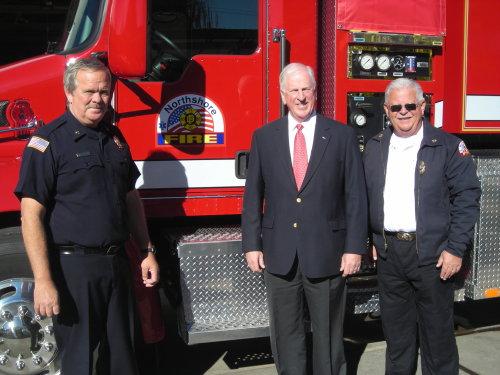
CLEARLAKE OAKS – This week Northshore Fire Protection District marked the addition of a new water tender made possible through a federal grant.
Congressman Mike Thompson visited the district's Clearlake Oaks Fire Station on Monday to celebrate the new equipment, which Fire Chief Jim Robbins said is the district's second water tender.
Robbins said the water tender – built by Fouts Brothers Fire Equipment of Smyrna, Georgia – will be based at the Clearlake Oaks station. The other one the district has is in Upper Lake.
Accompanying Thompson were representatives from the US Department of Agriculture Rural Development Santa Rosa office.
A grant through USDA Rural Development's Economic Impact Initiative Grant Program helped make the water tender purchase possible, as Lake County News has reported.
The agency gave the district a $100,000 grant in June, and the district provided another $57,000 to pay for the equipment, Robbins said.
In September the district also received 20 new air packs and 20 new lightweight air tanks paid for through a $78,000 grant of American Recovery and Reinvestment Act funds, also through USDA Rural Development. The district supplemented that grant with $25,000 to purchase the new equipment.
The district, with a $2.3 million annual budget, has 17 paid staff and 72 volunteers to cover 228,300 acres or 350 square miles, making it the largest fire district by area in the state, as Lake County News has reported.
Robbins said they're working on some new grant applications to USDA Rural Development now, hoping to receive funds for a new ambulance for the Clearlake Oaks station.
The district also wants a new machine that fills air bottles for firefighters' breathing apparatus. The machine would be built right into a truck, Robbins said. The district currently is looking for a company to build the equipment.
E-mail Elizabeth Larson at